The conservation programs span 600 acres along the St. Mary's River in northeast Florida ... Founded in 1982, White Oak leads professional efforts to improve veterinary care, develop holistic ...
The conservation programs span 600 acres along the St. Mary's River in northeast Florida ... Founded in 1982, White Oak leads professional efforts to improve veterinary care, develop holistic ...
The conservation programs span 600 acres along the St. Mary's River in northeast Florida ... Founded in 1982, White Oak leads professional efforts to improve veterinary care, develop holistic ...
The conservation programs span 600 acres along the St. Mary's River in northeast Florida ... Founded in 1982, White Oak leads professional efforts to improve veterinary care, develop holistic ...
The conservation programs span 600 acres along the St. Mary's River in northeast Florida ... Founded in 1982, White Oak leads professional efforts to improve veterinary care, develop holistic ...
The conservation programs span 600 acres along the St. Mary's River in northeast Florida ... Founded in 1982, White Oak leads professional efforts to improve veterinary care, develop holistic ...
The conservation programs span 600 acres along the St. Mary's River in northeast Florida ... Founded in 1982, White Oak leads professional efforts to improve veterinary care, develop holistic ...
The conservation programs span 600 acres along the St. Mary's River in northeast Florida ... Founded in 1982, White Oak leads professional efforts to improve veterinary care, develop holistic ...
Veterinary Technician Department: Animal Health Reports To: Hospital Manager FLSA Status: Non ... The conservation programs span 600 acres along the St. Mary's River in northeast Florida ...
Veterinary Technician Department: Animal Health Reports To: Hospital Manager FLSA Status: Non ... The conservation programs span 600 acres along the St. Mary's River in northeast Florida ...
Veterinary Technician
Yulee, FL · On-site
Veterinary Technician Department: Animal Health Reports To: Hospital Manager FLSA Status: Non ... The conservation programs span 600 acres along the St. Mary's River in northeast Florida ...
Veterinary Technician
Yulee, FL · On-site
Veterinary Technician Department: Animal Health Reports To: Hospital Manager FLSA Status: Non ... The conservation programs span 600 acres along the St. Mary's River in northeast Florida ...
Veterinary Technician Department: Animal Health Reports To: Hospital Manager FLSA Status: Non ... The conservation programs span 600 acres along the St. Mary's River in northeast Florida ...
Veterinary Technician Department: Animal Health Reports To: Hospital Manager FLSA Status: Non ... The conservation programs span 600 acres along the St. Mary's River in northeast Florida ...
Veterinary Technician Department: Animal Health Reports To: Hospital Manager FLSA Status: Non ... The conservation programs span 600 acres along the St. Mary's River in northeast Florida ...
Veterinary Technician Department: Animal Health Reports To: Hospital Manager FLSA Status: Non ... The conservation programs span 600 acres along the St. Mary's River in northeast Florida ...

Participate in capturing, incapacitating, and moving animals. * Assist Veterinarian staff in the treatment of collection animals. * Act as primary keeper for some collection animals and conservation ...
Participate in capturing, incapacitating, and moving animals. * Assist Veterinarian staff in the treatment of collection animals. * Act as primary keeper for some collection animals and conservation ...

Part Time Veterinary Technician
New York, NY · On-site
$26 - $28/hr
Veterinary Technician Students and Volunteers Department: Zoological Health Program Location ... As the world's premier wildlife conservation organization, WCS has a long track record of achieving ...
Part Time Veterinary Technician
New York, NY · On-site
$26 - $28/hr
Veterinary Technician Students and Volunteers Department: Zoological Health Program Location ... As the world's premier wildlife conservation organization, WCS has a long track record of achieving ...
Veterinarian
$110K - $130K/yr
... Conservation Society (WCS) zoos. * Coordinate the veterinary student externship program and supervise externs, including providing input for final reviews (students). * Contribute to mentoring WCS ...
Veterinarian
$110K - $130K/yr
... Conservation Society (WCS) zoos. * Coordinate the veterinary student externship program and supervise externs, including providing input for final reviews (students). * Contribute to mentoring WCS ...
Participate in capturing, incapacitating, and moving animals. * Assist Veterinarian staff in the treatment of collection animals. * Act as primary keeper for some collection animals and conservation ...
Participate in capturing, incapacitating, and moving animals. * Assist Veterinarian staff in the treatment of collection animals. * Act as primary keeper for some collection animals and conservation ...
Participate in capturing, incapacitating, and moving animals. * Assist Veterinarian staff in the treatment of collection animals. * Act as primary keeper for some collection animals and conservation ...
Quick apply
Participate in capturing, incapacitating, and moving animals. * Assist Veterinarian staff in the treatment of collection animals. * Act as primary keeper for some collection animals and conservation ...
Veterinary Extern
Denver, CO · On-site
Denver Zoo Conservation Alliance (DZCA) Denver Zoo Conservation Alliance (DZCA) honors our animals ... DZCA offers a 4-week zoological medicine externship for 4th-year veterinary students for the 2027 ...
Veterinary Extern
Denver, CO · On-site
Denver Zoo Conservation Alliance (DZCA) Denver Zoo Conservation Alliance (DZCA) honors our animals ... DZCA offers a 4-week zoological medicine externship for 4th-year veterinary students for the 2027 ...
Veterinarian
New York, NY · On-site
$110K - $130K/yr
... Conservation Society (WCS) zoos. * Coordinate the veterinary student externship program and supervise externs, including providing input for final reviews (students). * Contribute to mentoring WCS ...
Veterinarian
New York, NY · On-site
$110K - $130K/yr
... Conservation Society (WCS) zoos. * Coordinate the veterinary student externship program and supervise externs, including providing input for final reviews (students). * Contribute to mentoring WCS ...
Veterinarian
Manhattan, NY · On-site
... Conservation Society zoos. * Coordinate the veterinary student externship program and supervise externs, including providing input for final reviews (students). * Contribute to mentoring WCS ...
Veterinarian
Manhattan, NY · On-site
... Conservation Society zoos. * Coordinate the veterinary student externship program and supervise externs, including providing input for final reviews (students). * Contribute to mentoring WCS ...

Veterinary Assistant Externship
Goddard, KS · On-site
$15.75 - $19.50/hr
Drive Conservation. At Tanganyika Wildlife Park, we go beyond caring for animals. We create once-in ... This opportunity provides exposure to veterinary care in a zoological setting and allows ...
Veterinary Assistant Externship
Goddard, KS · On-site
$15.75 - $19.50/hr
Drive Conservation. At Tanganyika Wildlife Park, we go beyond caring for animals. We create once-in ... This opportunity provides exposure to veterinary care in a zoological setting and allows ...
This role integrates veterinary medicine, population health, and conservation science to support The Wilds' mission and global conservation initiatives. Serves as a key member of the senior ...
This role integrates veterinary medicine, population health, and conservation science to support The Wilds' mission and global conservation initiatives. Serves as a key member of the senior ...
Postdoctoral Research Fellow - Wildlife Health and Conservation *St Kitts*
Hialeah, FL · On-site
$44K - $60K/yr
Ross University School of Veterinary Medicine (RUSVM) is the number one provider of Doctors of ... We offer research programs focused on emerging infectious and zoonotic diseases, conservation ...
Postdoctoral Research Fellow - Wildlife Health and Conservation *St Kitts*
Hialeah, FL · On-site
$44K - $60K/yr
Ross University School of Veterinary Medicine (RUSVM) is the number one provider of Doctors of ... We offer research programs focused on emerging infectious and zoonotic diseases, conservation ...
This role integrates veterinary medicine, population health, and conservation science to support The Wilds' mission and global conservation initiatives. Serves as a key member of the senior ...
This role integrates veterinary medicine, population health, and conservation science to support The Wilds' mission and global conservation initiatives. Serves as a key member of the senior ...
Veterinary Conservation information
See salary details
$12.02 - $13.81
2% of jobs
$13.81 - $15.60
8% of jobs
$15.60 - $17.40
11% of jobs
$17.94 is the 25th percentile. Wages below this are outliers.
$17.40 - $19.19
15% of jobs
The median wage is $20.61 / hr.
$19.19 - $20.98
18% of jobs
$20.98 - $22.77
13% of jobs
$23.93 is the 75th percentile. Wages above this are outliers.
$22.77 - $24.56
13% of jobs
$24.56 - $26.35
9% of jobs
$26.35 - $28.15
5% of jobs
$28.15 - $29.94
4% of jobs
$29.94 - $31.73
2% of jobs
$12
$21
$31
How much do veterinary conservation jobs pay per hour?
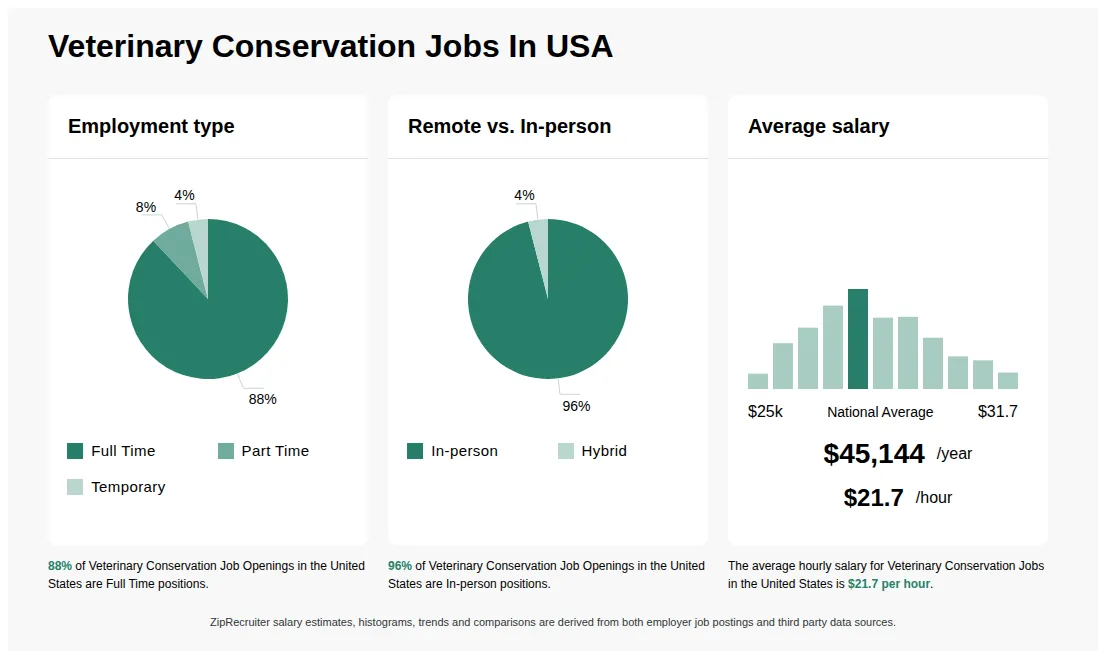
As of Sep 2, 2026, the average hourly pay for veterinary conservation in the United States is $21.70, according to ZipRecruiter salary data. Most workers in this role earn between $17.79 and $24.76 per hour, depending on experience, location, and employer.
What is veterinary conservation?
Veterinary conservation is a specialized field that combines veterinary medicine with wildlife conservation efforts. Professionals in this area work to protect and improve the health of wild animal populations, often focusing on endangered species and their habitats. They may be involved in disease monitoring, wildlife rehabilitation, research, and advising conservation strategies. Veterinary conservationists collaborate with ecologists, government agencies, and non-profit organizations to promote biodiversity and ecosystem health. This field is crucial for maintaining the delicate balance of natural environments and ensuring the survival of various species.
How does a veterinary conservationist typically collaborate with other professionals in wildlife conservation projects?
Veterinary conservationists frequently work as part of interdisciplinary teams that include ecologists, biologists, park rangers, and government officials. Collaboration often involves coordinating fieldwork, sharing health data on wildlife populations, and developing strategies for disease prevention and habitat management. These professionals may also provide training to local staff and assist with community outreach to promote conservation goals. Effective communication and teamwork are essential, as the success of conservation initiatives depends on integrating veterinary expertise with broader environmental and policy efforts.
What are the key skills and qualifications needed to thrive as a veterinary conservationist, and why are they important?
To thrive as a Veterinary Conservationist, you need a veterinary degree (DVM or equivalent), expertise in wildlife health, and knowledge of conservation biology. Familiarity with field research tools, GPS tracking systems, and wildlife disease surveillance platforms is commonly required. Strong problem-solving abilities, communication skills, and cultural sensitivity help you collaborate with multidisciplinary teams and local communities. These skills ensure effective wildlife conservation interventions, promote ecosystem health, and support sustainable biodiversity management.
What is the difference between Veterinary Conservation vs Veterinary Technician?
| Aspect | Veterinary Conservation | Veterinary Technician |
|---|---|---|
| Required Credentials | Veterinary degree, specialized training in wildlife or conservation | Associate degree in veterinary technology, certification |
| Work Environment | Wildlife reserves, conservation projects, zoos | Veterinary clinics, animal hospitals, labs |
| Employer & Industry Usage | Environmental agencies, conservation organizations | Veterinary clinics, animal care facilities |
Veterinary Conservation professionals focus on wildlife health and conservation efforts, often working in outdoor or specialized settings. Veterinary Technicians assist in clinical settings with animal care and medical procedures. While both roles require animal health knowledge, Veterinary Conservation emphasizes wildlife and habitat preservation, whereas Veterinary Technicians support clinical veterinary practices.
How do you get a job in veterinary conservation?
To pursue a career in veterinary conservation, individuals typically need a veterinary degree or related biological sciences background, along with experience in wildlife or conservation projects. Gaining skills in fieldwork, animal handling, and conservation strategies, as well as obtaining relevant certifications, can improve job prospects in this specialized field.
What can you do with a veterinary conservation degree?
A veterinary conservation degree prepares individuals for roles focused on wildlife and habitat preservation, often involving fieldwork, research, and collaboration with conservation organizations. Graduates can work as wildlife veterinarians, conservation biologists, or in environmental policy, utilizing skills in animal health, ecology, and veterinary medicine. Certification and hands-on experience are valuable for advancing in this field.
More about Veterinary Conservation jobs
What states have the most Veterinary Conservation jobs?
States with the most job openings for Veterinary Conservation jobs include:
What job categories do people searching Veterinary Conservation jobs look for?
The top searched job categories for Veterinary Conservation jobs are:

Full-time
Re-posted 3 days ago
Job description
Job Title: Conservation and Recovery Specialist
Department: Conservation and Recovery
Reports To: Conservation and Recovery Program Manager
FLSA Status: Non-exempt
Effective Date: September 2025
White Oak conserves and sustains some of the earth's rarest wild animals through innovative training, research, education, and conservation breeding programs that contribute to the survival of wildlife in nature. The conservation programs span 600 acres along the St. Mary's River in northeast Florida, surrounded by 22,000 acres of mixed forest and wetlands that make up the beautiful White Oak property. Founded in 1982, White Oak leads professional efforts to improve veterinary care, develop holistic animal management techniques, and better understand the biology of critically endangered species by providing excellent care and managing conservation programs for over 30 species of imperiled wildlife in large, naturalistic habitats.
White Oak Mission:
Saving endangered wildlife and habitats through sustainable populations, expanding education initiatives, and responsible land stewardship.
Job Summary:
The Conservation and Recovery Specialist will perform as a member of the White Oak team to achieve exceptional animal care and facility care standards in their area of focus to sustain and grow White Oak's species recovery programs and achieve its conservation goals. This position is focused on avian and canid recovery programs, with possible engagement with other taxa, such as amphibians.
Essential Duties:
o Participates in the daily care of the animals to promote a naturally enriching environment; including diet preparation, feeding, cleaning, medicating, observing, and training.
o Participates in animal restraint, incubation/hatching, animal transfers, introductions, operant conditioning, assisted-reproduction in cranes, and passerine mist-netting.
o Participates in and assists with area research projects.
o Maintains and cares for surrounding areas to ensure a natural environment and ecological health.
o Fosters department delivery of guest engagement programs featuring wildlife populations.
o Assists veterinarian staff with animal care procedures, treatments and sample collection, as directed by area supervisor.
o Keeps Florida grasshopper sparrow breeding documents up to date throughout breeding season.
o Creates hatch, nest fail and other breeding related calendar alerts to help monitor diet changes and consumption, as well as to monitor breeding behavior.
o Notifies supervisor of facility maintenance, equipment, supplies, and animal feed needs.
o Assists with minor animal care facilities maintenance including: mowing, weed eating, netting, pressure washing, dirt and substrate work, limb pick up, and minor repairs.
o Organizes, preps, and conducts controlled burns on property.
o Prepares burn plans for controlled burns conducted on property; documents action reports.
o Maintains records and reports related to wildlife.
o Collects, maintains, organizes, and assembles data and spreadsheets for accurate analysis.
o Assists Leads with program data and statistical analysis for scientific publications.
o Maintains, cleans and organizes work and break areas, food storage, food prep, vehicles and equipment.
o Conducts camera trapping operation, maintenance, and review.
o Conducts the daily care of several invertebrate prey species and collection of wild invertebrate prey species.
o Observes and ensures area safety protocol, safe vehicle and equipment operation.
o Applies herbicide application and performs other needed pest management activities.
o Assists with intern training and mentoring.
o Participates in trainings including animal husbandry and management, ZIMS record keeping, research, conservation and recovery projects, chainsaw operation, venomous snake handling, and other education projects.
The above cited duties and responsibilities describe the general nature and level of work performed by people assigned to the job. They are not intended to be an exhaustive list of all the duties and responsibilities that an incumbent may be expected or asked to perform.
Education and Work Experience Requirements:
• High School Diploma or equivalent required; Bachelor's degree in Biology, Animal Science, Wildlife Management or related field, preferred.
• Minimum of one year of animal/wildlife experience.
• Species conservation or recovery program experience, preferred.
• Experience with animal husbandry practices such as feeding, cleaning, medicating, and enrichment.
• Canid experience, preferred.
Knowledge/Skills/Abilities:
• Strong oral and written communication skills.
• Basic computer skills, including data entry and record keeping.
• Ability to operate small machinery and farm equipment safely.
• Strong organizational skills and attention to detail.
• Team-oriented with the ability to collaborate effectively across departments.
• Flexibility and adaptability to work outdoors, in variable conditions.
• Occasional work on holidays or weekends.
• Highly collaborative and team oriented.
• Passion for White Oak's mission and genuine appreciation for wildlife and conservation
Physical Requirements, Hazards, and Special Working Conditions:
• Must have valid Florida or Georgia drivers' license.
• Must be able to exert up to 50 pounds of force to lift, push, pull, carry, or otherwise move objects, climb a 5-foot ladder and work outdoors in all conditions
• Must be able to work holidays, nights and weekends when required.
White Oak Conservation is committed to creating an environment where diverse perspectives are welcome, and to nurturing a culture where everyone feels valued and appreciated. We are proud to be an equal opportunity employer. All qualified applicants will receive consideration for employment without regard to gender, race, color, age, national origin, religion, disability, marital status, sexual orientation, gender identity/expression, citizenship, pregnancy or maternity, veteran status, or any other status protected by applicable national, federal, state, or local law.
Department: Conservation and Recovery
Reports To: Conservation and Recovery Program Manager
FLSA Status: Non-exempt
Effective Date: September 2025
White Oak conserves and sustains some of the earth's rarest wild animals through innovative training, research, education, and conservation breeding programs that contribute to the survival of wildlife in nature. The conservation programs span 600 acres along the St. Mary's River in northeast Florida, surrounded by 22,000 acres of mixed forest and wetlands that make up the beautiful White Oak property. Founded in 1982, White Oak leads professional efforts to improve veterinary care, develop holistic animal management techniques, and better understand the biology of critically endangered species by providing excellent care and managing conservation programs for over 30 species of imperiled wildlife in large, naturalistic habitats.
White Oak Mission:
Saving endangered wildlife and habitats through sustainable populations, expanding education initiatives, and responsible land stewardship.
Job Summary:
The Conservation and Recovery Specialist will perform as a member of the White Oak team to achieve exceptional animal care and facility care standards in their area of focus to sustain and grow White Oak's species recovery programs and achieve its conservation goals. This position is focused on avian and canid recovery programs, with possible engagement with other taxa, such as amphibians.
Essential Duties:
o Participates in the daily care of the animals to promote a naturally enriching environment; including diet preparation, feeding, cleaning, medicating, observing, and training.
o Participates in animal restraint, incubation/hatching, animal transfers, introductions, operant conditioning, assisted-reproduction in cranes, and passerine mist-netting.
o Participates in and assists with area research projects.
o Maintains and cares for surrounding areas to ensure a natural environment and ecological health.
o Fosters department delivery of guest engagement programs featuring wildlife populations.
o Assists veterinarian staff with animal care procedures, treatments and sample collection, as directed by area supervisor.
o Keeps Florida grasshopper sparrow breeding documents up to date throughout breeding season.
o Creates hatch, nest fail and other breeding related calendar alerts to help monitor diet changes and consumption, as well as to monitor breeding behavior.
o Notifies supervisor of facility maintenance, equipment, supplies, and animal feed needs.
o Assists with minor animal care facilities maintenance including: mowing, weed eating, netting, pressure washing, dirt and substrate work, limb pick up, and minor repairs.
o Organizes, preps, and conducts controlled burns on property.
o Prepares burn plans for controlled burns conducted on property; documents action reports.
o Maintains records and reports related to wildlife.
o Collects, maintains, organizes, and assembles data and spreadsheets for accurate analysis.
o Assists Leads with program data and statistical analysis for scientific publications.
o Maintains, cleans and organizes work and break areas, food storage, food prep, vehicles and equipment.
o Conducts camera trapping operation, maintenance, and review.
o Conducts the daily care of several invertebrate prey species and collection of wild invertebrate prey species.
o Observes and ensures area safety protocol, safe vehicle and equipment operation.
o Applies herbicide application and performs other needed pest management activities.
o Assists with intern training and mentoring.
o Participates in trainings including animal husbandry and management, ZIMS record keeping, research, conservation and recovery projects, chainsaw operation, venomous snake handling, and other education projects.
The above cited duties and responsibilities describe the general nature and level of work performed by people assigned to the job. They are not intended to be an exhaustive list of all the duties and responsibilities that an incumbent may be expected or asked to perform.
Education and Work Experience Requirements:
• High School Diploma or equivalent required; Bachelor's degree in Biology, Animal Science, Wildlife Management or related field, preferred.
• Minimum of one year of animal/wildlife experience.
• Species conservation or recovery program experience, preferred.
• Experience with animal husbandry practices such as feeding, cleaning, medicating, and enrichment.
• Canid experience, preferred.
Knowledge/Skills/Abilities:
• Strong oral and written communication skills.
• Basic computer skills, including data entry and record keeping.
• Ability to operate small machinery and farm equipment safely.
• Strong organizational skills and attention to detail.
• Team-oriented with the ability to collaborate effectively across departments.
• Flexibility and adaptability to work outdoors, in variable conditions.
• Occasional work on holidays or weekends.
• Highly collaborative and team oriented.
• Passion for White Oak's mission and genuine appreciation for wildlife and conservation
Physical Requirements, Hazards, and Special Working Conditions:
• Must have valid Florida or Georgia drivers' license.
• Must be able to exert up to 50 pounds of force to lift, push, pull, carry, or otherwise move objects, climb a 5-foot ladder and work outdoors in all conditions
• Must be able to work holidays, nights and weekends when required.
White Oak Conservation is committed to creating an environment where diverse perspectives are welcome, and to nurturing a culture where everyone feels valued and appreciated. We are proud to be an equal opportunity employer. All qualified applicants will receive consideration for employment without regard to gender, race, color, age, national origin, religion, disability, marital status, sexual orientation, gender identity/expression, citizenship, pregnancy or maternity, veteran status, or any other status protected by applicable national, federal, state, or local law.

About White Oak Conservation
Sourced by ZipRecruiter
Industry
Clean energy semiconductors manufacturing
Company size
51 - 200 Employees
Headquarters location
Yulee, FL, US
Year founded
1982