1

Tissue Engineering Jobs in Wisconsin (NOW HIRING)

Deep knowledge of biomechanics, biomaterials, bioinstrumentation, medical imaging, tissue engineering, physiological systems modeling, biostatistics, and regulatory affairs. Ability to explain signal ...

... in Classic Tissue Converting to support process improvement, equipment optimization, and production troubleshooting at the Green Bay Plant. This role requires a strong mechanical engineering ...

Controls Engineer

Green Bay, WI · On-site

$81K - $105K/yr

Join Our Team as an Electrical / Automation Engineer for the Tissue Converting Industry. As a global company, we offer many career paths to suit individual needs and aspirations. Apply your expertise ...

next page

Showing results 1-20

People also search for

Tissue Engineering information

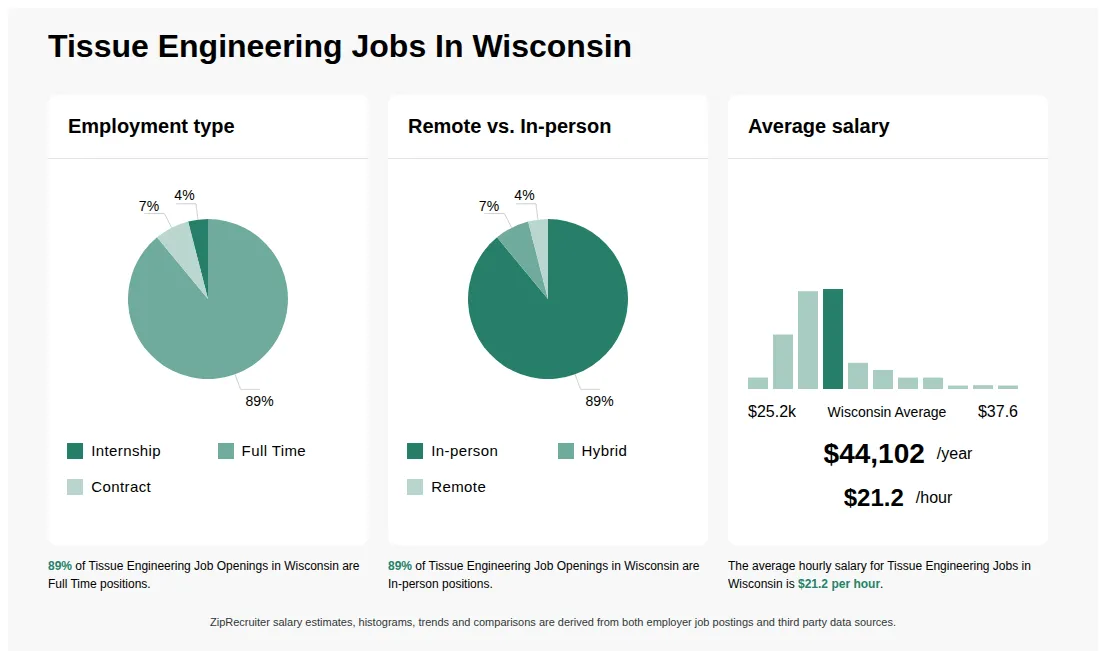
See Wisconsin salary details

$12

$21

$37

How much do tissue engineering jobs pay per hour?

As of Jun 11, 2026, the average hourly pay for tissue engineering in Wisconsin is $21.20, according to ZipRecruiter salary data. Most workers in this role earn between $17.21 and $21.59 per hour, depending on experience, location, and employer.

What are the key skills and qualifications needed to thrive as a Tissue Engineer, and why are they important?

To thrive as a Tissue Engineer, you need a solid background in biology, biomaterials, and biomedical engineering, typically supported by a relevant degree (such as biomedical engineering or a related field) and laboratory experience. Proficiency in cell culture techniques, bioreactor systems, and analytical tools like microscopy and spectroscopy is essential, and certifications in laboratory safety or Good Laboratory Practice (GLP) can be beneficial. Strong problem-solving abilities, teamwork, and attention to detail set candidates apart in this multidisciplinary field. These skills ensure the successful development of engineered tissues and effective collaboration in advancing regenerative medicine solutions.

What is the difference between Tissue Engineering vs Biomedical Engineer?

AspectTissue EngineeringBiomedical Engineer
Required CredentialsBachelor's or Master's in Bioengineering, Biomedical Engineering, or related fields; often includes specialized tissue engineering courseworkBachelor's or Master's in Biomedical Engineering, Bioengineering, or related fields; broader focus on medical device design and systems
Work EnvironmentResearch labs, tissue manufacturing facilities, biotech companiesHospitals, medical device companies, research institutions
Industry UsageDeveloping artificial tissues, regenerative medicine, organ scaffoldsDesigning medical devices, prosthetics, imaging systems, and healthcare technology

While both roles require a background in bioengineering, Tissue Engineering focuses specifically on creating biological tissues and regenerative solutions, often within research and biotech settings. Biomedical Engineers have a broader scope, working on medical devices, systems, and technology across healthcare environments. Understanding these differences helps professionals choose the right career path or specialization.

What does a Tissue Engineer do?

A Tissue Engineer designs and develops biological tissues and organs by combining principles from biology, engineering, and materials science. They often work with cell cultures, biomaterials, and bioreactors to create functional tissue constructs for medical research, regenerative medicine, or transplantation. Skills in cell biology, materials science, and laboratory techniques are essential for this role.

What engineers make $500,000?

In the field of tissue engineering, senior-level professionals such as biomedical engineers with extensive experience, advanced degrees, and leadership roles can reach salaries around $500,000, especially in biotech or pharmaceutical industries. These roles often require specialized skills, research expertise, and sometimes management responsibilities, with compensation influenced by location and company size.

What engineers make $300,000 a year?

Engineers in specialized fields such as petroleum engineering, aerospace engineering, and certain senior roles in software engineering can earn $300,000 or more annually, often due to high demand, advanced skills, and experience. These roles typically require advanced degrees, certifications, and extensive industry experience, and may involve leadership responsibilities or working in high-cost-of-living areas.

How much do tissue engineers make in the US?

Tissue engineers in the US typically earn a median annual salary of around $70,000 to $90,000, with experienced professionals and those working in research or biotech companies earning higher. Salaries can vary based on education, experience, location, and industry sector, and many tissue engineers hold advanced degrees and specialized skills in biomaterials and cell culture techniques.

What are some common challenges tissue engineers face when transitioning from academic research to industry roles?

Tissue engineers moving from academia to industry often encounter challenges such as adapting to faster project timelines, working within multidisciplinary teams, and aligning research goals with commercial objectives. In industry, there is a strong emphasis on regulatory compliance, scalability, and product development—areas that may receive less focus in academic settings. Successful candidates typically benefit from strong communication skills, flexibility, and a willingness to learn about manufacturing standards and quality assurance processes.

What is tissue engineering?

Tissue engineering is a multidisciplinary field that combines principles of biology, engineering, and materials science to develop artificial organs, tissues, or biological substitutes that can restore, maintain, or improve tissue function. The goal is to create functional tissues in the lab that can be used to repair or replace damaged or diseased tissues in the body. This often involves using a combination of cells, scaffolds, and biologically active molecules to construct living tissues. Tissue engineering has applications in regenerative medicine, transplantation, and drug testing. The field is rapidly evolving, with ongoing research aimed at creating more complex and functional tissues.

What Are Jobs in Tissue Engineering?

Tissue engineering is a scientific discipline of regenerative medicine in which experts combine structural frameworks known as scaffolds with cells and biological agents to create functional replacement tissues. Jobs in this field include lab technician, research technician, and research bioengineer. As a technician or assistant, your duties involve managing the lab inventory, assisting with quality control and regulatory compliance, maintaining lab equipment, and working hands-on with laboratory test animals like rodents and pigs. As a bioengineer, you develop, lead, and oversee biomedical procedures. Additionally, your responsibilities involve collaborating with peers and writing reports, publications, and patent applications.

What are popular job titles related to Tissue Engineering jobs in Wisconsin? For Tissue Engineering jobs in Wisconsin, the most frequently searched job titles are:
What job categories do people searching Tissue Engineering jobs in Wisconsin look for? The top searched job categories for Tissue Engineering jobs in Wisconsin are:
Biomedical Engineering Tutor

Biomedical Engineering Tutor

Varsity Tutors

Madison, WI • Remote

$40/hr

Part-time

Posted 6 days ago


Varsity Tutors rating

5.7

Company rating: 5.7 out of 10

Based on 16 frontline employees who took The Breakroom Quiz

13th of 21 rated private schools and tutoring


Job description

About the Job
The Varsity Tutors Live Learning Platform has thousands of students looking for online Biomedical Engineering tutors nationally. As a tutor on the Varsity Tutors Platform, you'll have the flexibility to set your own schedule, earn competitive rates, and make a real impact on students' academic success and understanding. All from the comfort of your home.
Why Join Our Platform?
  • Earn incrementally higher pay for each session with the same student, reaching up to $40/hour.
  • Get paid up to twice per week, ensuring fast and reliable compensation for the tutoring sessions you conduct and invoice.
  • Set your own hours and tutor as much as you'd like.
  • Tutor remotely using our purpose-built Live Learning Platform. No commuting required.
  • Get matched with students best-suited to your teaching style and expertise.
  • Our AI-powered Tutor Copilot enhances your sessions with real-time instructional support, lesson generation, and engagement features, helping you save prep time and focus on impactful teaching.
  • We handle the logistics—you just invoice for your tutoring sessions, and we take care of payments.

What We Look For In a Biomedical Engineering Tutor
  • Advanced Subject Mastery: Deep knowledge of biomechanics, biomaterials, bioinstrumentation, medical imaging, tissue engineering, physiological systems modeling, biostatistics, and regulatory affairs. Ability to explain signal processing for biosignals, finite element analysis, drug delivery systems, and medical device design principles while preparing students for biomedical engineering coursework, research, and industry careers.
  • Conceptual Teaching & Problem-Solving: Skilled at breaking down physiological system modeling, biomechanical analysis, and medical device design challenges. Guides students through analyzing biosignals, applying engineering principles to biological systems, designing and evaluating medical devices, and conducting biostatistical analysis. Emphasizes interdisciplinary integration of engineering, biology, and medicine, connecting biomedical engineering to prosthetics, diagnostic imaging, and pharmaceutical development.
  • Curriculum Awareness & Adaptive Instruction: Familiar with biomedical engineering curricula and common challenges such as integrating biology with engineering mathematics, understanding physiological systems, and navigating FDA regulatory requirements. Adapts instruction using case studies of medical devices, MATLAB simulation exercises, and design project guidance to support undergraduate biomedical engineering students bridging life sciences and engineering disciplines.
  • Effective Teaching Methods: Ability to identify concepts students commonly struggle with, explain material using multiple approaches, and adapt instruction to meet individual learning needs and styles.
  • Strong communication skills and a friendly, engaging teaching style.
  • Ability to adapt to different learning styles and student needs.

Ways To Connect With Students
  • 1-on-1 Online Tutoring - Provide personalized instruction to individual students.
  • Instant Tutoring - Accept on-demand tutoring requests whenever you're available.

About Varsity Tutors And 1-on-1 Online Tutoring
Our mission is to transform the way people learn by leveraging advanced technology, AI, and the latest in learning science to create personalized learning experiences. Through 1-on-1 Online Tutoring, students receive customized instruction that helps them achieve their learning goals. Our platform is designed to match students with the right tutors, fostering better outcomes and a passion for learning.
Please note: Varsity Tutors does not contract in: Alaska, California, Colorado, Delaware, Hawaii, Maine, New Hampshire, North Dakota, Vermont, West Virginia or Puerto Rico.

What Varsity Tutors employees say

Pay

Hours and flexibility

Workplace

Get the full story on Breakroom