... for the tissue, nonwovens, hygiene, bag-converting, mailing, and printing industries. Barry ... Lead the Sustaining Engineering team in maintaining and improving existing product lines with a ...
... for the tissue, nonwovens, hygiene, bag-converting, mailing, and printing industries. Barry ... Lead the Sustaining Engineering team in maintaining and improving existing product lines with a ...

... for the tissue, nonwovens, hygiene, bag-converting, mailing, and printing industries. Barry ... Lead the Sustaining Engineering team in maintaining and improving existing product lines with a ...
... for the tissue, nonwovens, hygiene, bag-converting, mailing, and printing industries. Barry ... Lead the Sustaining Engineering team in maintaining and improving existing product lines with a ...

2027 Engineering Co-ops & Internships
Neenah, WI · On-site
$24.50/hr
... tissue machine and/or converting. Within a development or design team, mechanical co-ops can be part of a new product/process development team or work to develop prototype assets and/or overall ...
2027 Engineering Co-ops & Internships
Neenah, WI · On-site
$24.50/hr
... tissue machine and/or converting. Within a development or design team, mechanical co-ops can be part of a new product/process development team or work to develop prototype assets and/or overall ...
2027 Engineering Co-ops & Internships
Neenah, WI · On-site
$24.50/hr
... tissue machine and/or converting. Within a development or design team, mechanical co-ops can be part of a new product/process development team or work to develop prototype assets and/or overall ...
2027 Engineering Co-ops & Internships
Neenah, WI · On-site
$24.50/hr
... tissue machine and/or converting. Within a development or design team, mechanical co-ops can be part of a new product/process development team or work to develop prototype assets and/or overall ...
2027 Engineering Co-ops & Internships
Neenah, WI · On-site
$24.50/hr
... tissue machine and/or converting. Within a development or design team, mechanical co-ops can be part of a new product/process development team or work to develop prototype assets and/or overall ...
2027 Engineering Co-ops & Internships
Neenah, WI · On-site
$24.50/hr
... tissue machine and/or converting. Within a development or design team, mechanical co-ops can be part of a new product/process development team or work to develop prototype assets and/or overall ...
Lead Process Engineer
$104K - $135K/yr
Bachelor's degree in Engineering or Sciencerelated field * Prefer5 years or more of relevant experience * Experience in product development, tissue processes, design of experiments, data analysis and ...
Lead Process Engineer
$104K - $135K/yr
Bachelor's degree in Engineering or Sciencerelated field * Prefer5 years or more of relevant experience * Experience in product development, tissue processes, design of experiments, data analysis and ...
Lead Process Engineer
Neenah, WI · On-site
$104K - $135K/yr
Bachelor's degree in Engineering or Sciencerelated field * Prefer5 years or more of relevant experience * Experience in product development, tissue processes, design of experiments, data analysis and ...
Lead Process Engineer
Neenah, WI · On-site
$104K - $135K/yr
Bachelor's degree in Engineering or Sciencerelated field * Prefer5 years or more of relevant experience * Experience in product development, tissue processes, design of experiments, data analysis and ...
Lead Process Engineer
Neenah, WI · On-site
$104K - $135K/yr
Bachelor's degree in Engineering or Sciencerelated field * Prefer5 years or more of relevant experience * Experience in product development, tissue processes, design of experiments, data analysis and ...
Lead Process Engineer
Neenah, WI · On-site
$104K - $135K/yr
Bachelor's degree in Engineering or Sciencerelated field * Prefer5 years or more of relevant experience * Experience in product development, tissue processes, design of experiments, data analysis and ...
Lead Process Engineer
Neenah, WI · On-site
$104K - $135K/yr
Bachelor's degree in Engineering or Sciencerelated field * Prefer5 years or more of relevant experience * Experience in product development, tissue processes, design of experiments, data analysis and ...
Lead Process Engineer
Neenah, WI · On-site
$104K - $135K/yr
Bachelor's degree in Engineering or Sciencerelated field * Prefer5 years or more of relevant experience * Experience in product development, tissue processes, design of experiments, data analysis and ...
Lead Scientist Product
Neenah, WI · On-site
Bachelor's degree in Engineering or Science related field * 5 years or more of relevant experience * Experience in product development, tissue processes, design of experiments, data analysis and safe ...
Lead Scientist Product
Neenah, WI · On-site
Bachelor's degree in Engineering or Science related field * 5 years or more of relevant experience * Experience in product development, tissue processes, design of experiments, data analysis and safe ...

Bachelor's degree in Engineering or a related technical discipline. * Proven leadership experience within the paper, board, tissue, industrial equipment, manufacturing, or related industries.
Bachelor's degree in Engineering or a related technical discipline. * Proven leadership experience within the paper, board, tissue, industrial equipment, manufacturing, or related industries.

Process Engineer
Hayward, WI · On-site
$80K - $130K/yr
Collaborates on the preparation of engineering analysis of projects that includes preliminary ... Paper, Tissue, Non-Woven, Coating, Engineered Wood/Panels, Printing, or Chemical processes a plus.
Process Engineer
Hayward, WI · On-site
$80K - $130K/yr
Collaborates on the preparation of engineering analysis of projects that includes preliminary ... Paper, Tissue, Non-Woven, Coating, Engineered Wood/Panels, Printing, or Chemical processes a plus.
Process Engineer
Hayward, WI · On-site
$80K - $130K/yr
Collaborates on the preparation of engineering analysis of projects that includes preliminary ... Paper, Tissue, Non-Woven, Coating, Engineered Wood/Panels, Printing, or Chemical processes a plus.
Process Engineer
Hayward, WI · On-site
$80K - $130K/yr
Collaborates on the preparation of engineering analysis of projects that includes preliminary ... Paper, Tissue, Non-Woven, Coating, Engineered Wood/Panels, Printing, or Chemical processes a plus.
Process Engineer
Hayward, WI · On-site
$80K - $130K/yr
Collaborates on the preparation of engineering analysis of projects that includes preliminary ... Paper, Tissue, Non-Woven, Coating, Engineered Wood/Panels, Printing, or Chemical processes a plus.
Quick apply
Process Engineer
Hayward, WI · On-site
$80K - $130K/yr
Collaborates on the preparation of engineering analysis of projects that includes preliminary ... Paper, Tissue, Non-Woven, Coating, Engineered Wood/Panels, Printing, or Chemical processes a plus.
Quality Engineer
Green Bay, WI · On-site
$70K - $90K/yr
... the tissue, nonwovens, hygiene, bag-converting, mailing, and printing industries. Barry-Wehmiller is a diversified global supplier of engineering consulting and manufacturing technology for the ...
Quality Engineer
Green Bay, WI · On-site
$70K - $90K/yr
... the tissue, nonwovens, hygiene, bag-converting, mailing, and printing industries. Barry-Wehmiller is a diversified global supplier of engineering consulting and manufacturing technology for the ...

Quality Engineer
Green Bay, WI · On-site
$70K - $90K/yr
... the tissue, nonwovens, hygiene, bag-converting, mailing, and printing industries. Barry-Wehmiller is a diversified global supplier of engineering consulting and manufacturing technology for the ...
Quality Engineer
Green Bay, WI · On-site
$70K - $90K/yr
... the tissue, nonwovens, hygiene, bag-converting, mailing, and printing industries. Barry-Wehmiller is a diversified global supplier of engineering consulting and manufacturing technology for the ...
Quality Engineer
$70K - $90K/yr
... the tissue, nonwovens, hygiene, bag-converting, mailing, and printing industries. Barry-Wehmiller is a diversified global supplier of engineering consulting and manufacturing technology for the ...
Quality Engineer
$70K - $90K/yr
... the tissue, nonwovens, hygiene, bag-converting, mailing, and printing industries. Barry-Wehmiller is a diversified global supplier of engineering consulting and manufacturing technology for the ...
Senior Mechanical Engineer
Green Bay, WI · On-site
$101K - $134K/yr
... the tissue, nonwovens, hygiene, bag-converting, mailing, and printing industries. Barry-Wehmiller is a diversified global supplier of engineering consulting and manufacturing technology for the ...
Senior Mechanical Engineer
Green Bay, WI · On-site
$101K - $134K/yr
... the tissue, nonwovens, hygiene, bag-converting, mailing, and printing industries. Barry-Wehmiller is a diversified global supplier of engineering consulting and manufacturing technology for the ...
Senior Mechanical Engineer
$101K - $134K/yr
... the tissue, nonwovens, hygiene, bag-converting, mailing, and printing industries. Barry-Wehmiller is a diversified global supplier of engineering consulting and manufacturing technology for the ...
Senior Mechanical Engineer
$101K - $134K/yr
... the tissue, nonwovens, hygiene, bag-converting, mailing, and printing industries. Barry-Wehmiller is a diversified global supplier of engineering consulting and manufacturing technology for the ...
Senior Mechanical Engineer
$101K - $134K/yr
... the tissue, nonwovens, hygiene, bag-converting, mailing, and printing industries. Barry-Wehmiller is a diversified global supplier of engineering consulting and manufacturing technology for the ...
Senior Mechanical Engineer
$101K - $134K/yr
... the tissue, nonwovens, hygiene, bag-converting, mailing, and printing industries. Barry-Wehmiller is a diversified global supplier of engineering consulting and manufacturing technology for the ...
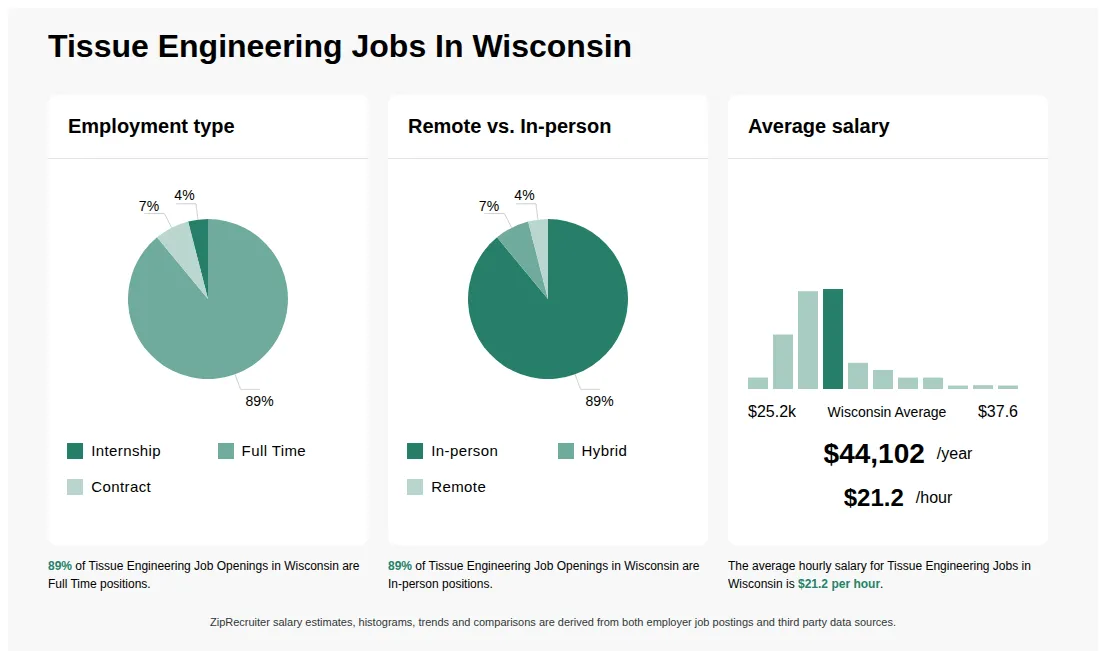
Tissue Engineering information
See Wisconsin salary details
$12.13 - $14.45
3% of jobs
$14.45 - $16.76
16% of jobs
$17.24 is the 25th percentile. Wages below this are outliers.
$16.76 - $19.08
29% of jobs
The median wage is $19.20 / hr.
$19.08 - $21.40
31% of jobs
$21.40 - $23.71
7% of jobs
$23.71 - $26.03
5% of jobs
$26.03 - $28.34
3% of jobs
$28.34 - $30.66
3% of jobs
$30.66 - $32.98
0% of jobs
$32.98 - $35.29
1% of jobs
$35.29 - $37.61
1% of jobs
$12
$21
$37
How much do tissue engineering jobs pay per hour?
As of Sep 3, 2026, the average hourly pay for tissue engineering in Wisconsin is $21.20, according to ZipRecruiter salary data. Most workers in this role earn between $17.21 and $21.59 per hour, depending on experience, location, and employer.
What is tissue engineering?
Tissue engineering is a multidisciplinary field that combines principles of biology, engineering, and materials science to develop artificial organs, tissues, or biological substitutes that can restore, maintain, or improve tissue function. The goal is to create functional tissues in the lab that can be used to repair or replace damaged or diseased tissues in the body. This often involves using a combination of cells, scaffolds, and biologically active molecules to construct living tissues. Tissue engineering has applications in regenerative medicine, transplantation, and drug testing. The field is rapidly evolving, with ongoing research aimed at creating more complex and functional tissues.
What are jobs in tissue engineering?
Tissue engineering is a scientific discipline of regenerative medicine in which experts combine structural frameworks known as scaffolds with cells and biological agents to create functional replacement tissues. Jobs in this field include lab technician, research technician, and research bioengineer. As a technician or assistant, your duties involve managing the lab inventory, assisting with quality control and regulatory compliance, maintaining lab equipment, and working hands-on with laboratory test animals like rodents and pigs. As a bioengineer, you develop, lead, and oversee biomedical procedures. Additionally, your responsibilities involve collaborating with peers and writing reports, publications, and patent applications.
What are the key skills and qualifications needed to thrive as a tissue engineer, and why are they important?
To thrive as a Tissue Engineer, you need a solid background in biology, biomaterials, and biomedical engineering, typically supported by a relevant degree (such as biomedical engineering or a related field) and laboratory experience. Proficiency in cell culture techniques, bioreactor systems, and analytical tools like microscopy and spectroscopy is essential, and certifications in laboratory safety or Good Laboratory Practice (GLP) can be beneficial. Strong problem-solving abilities, teamwork, and attention to detail set candidates apart in this multidisciplinary field. These skills ensure the successful development of engineered tissues and effective collaboration in advancing regenerative medicine solutions.
What are some common challenges tissue engineers face when transitioning from academic research to industry roles?
Tissue engineers moving from academia to industry often encounter challenges such as adapting to faster project timelines, working within multidisciplinary teams, and aligning research goals with commercial objectives. In industry, there is a strong emphasis on regulatory compliance, scalability, and product development—areas that may receive less focus in academic settings. Successful candidates typically benefit from strong communication skills, flexibility, and a willingness to learn about manufacturing standards and quality assurance processes.
What is the difference between Tissue Engineering vs Biomedical Engineer?
| Aspect | Tissue Engineering | Biomedical Engineer |
|---|---|---|
| Required Credentials | Bachelor's or Master's in Bioengineering, Biomedical Engineering, or related fields; often includes specialized tissue engineering coursework | Bachelor's or Master's in Biomedical Engineering, Bioengineering, or related fields; broader focus on medical device design and systems |
| Work Environment | Research labs, tissue manufacturing facilities, biotech companies | Hospitals, medical device companies, research institutions |
| Industry Usage | Developing artificial tissues, regenerative medicine, organ scaffolds | Designing medical devices, prosthetics, imaging systems, and healthcare technology |
While both roles require a background in bioengineering, Tissue Engineering focuses specifically on creating biological tissues and regenerative solutions, often within research and biotech settings. Biomedical Engineers have a broader scope, working on medical devices, systems, and technology across healthcare environments. Understanding these differences helps professionals choose the right career path or specialization.
How do you become a tissue engineer?
To become a tissue engineer, you typically need a bachelor's degree in biomedical engineering, bioengineering, or a related field, followed by a master's or Ph.D. for advanced roles. Gaining experience with laboratory techniques, tissue culture, and biomaterials is important, and certifications in relevant skills can enhance job prospects.
What does a tissue engineer do?
A tissue engineer designs and develops biological tissues and organs by combining cells, biomaterials, and engineering principles. They often work in laboratories, using techniques like cell culture and 3D bioprinting, and may require knowledge of biology, materials science, and sterile procedures.
What skills do you need to be a tissue engineer?
Tissue engineers need strong knowledge of biology, materials science, and engineering principles. Skills in laboratory techniques, cell culture, and familiarity with biomedical devices are essential. Additionally, problem-solving abilities, attention to detail, and proficiency with software like CAD or data analysis tools are important for success in this field.
More about Tissue Engineering jobs
What are popular job titles related to Tissue Engineering jobs in Wisconsin?
For Tissue Engineering jobs in Wisconsin, the most frequently searched job titles are:
What job categories do people searching Tissue Engineering jobs in Wisconsin look for?
The top searched job categories for Tissue Engineering jobs in Wisconsin are:

Full-time
Re-posted 29 days ago
Job description
About Us:
BW Converting Solutions is a strategic alliance of resources and services that bring together several Barry-Wehmiller companies - Paper Converting Machine Company (PCMC), Winkler + Dunnebier (W+D), STAX Technologies, Hudson-Sharp, Baldwin Technologies and Northern Engraving and Machine. These industry leaders offer trusted brands and innovative technologies in the design, manufacture, and service of high-performance converting and packaging machinery for the tissue, nonwovens, hygiene, bag-converting, mailing, and printing industries.
Job Description:
We are seeking an experienced and results-driven Global Director of Sustaining Engineering & US Sold Work to lead a critical segment of our Engineering organization. This high-impact leadership role is responsible for both Sustaining Engineering and the engineering execution of sold customer orders in the United States. The ideal candidate will thrive in a fast-paced, dynamic environment and possess strong technical and operational expertise across product design, lifecycle management, manufacturing support, and custom order engineering.
This role plays a dual function: ensuring long-term product integrity and continuous improvement across our global product lines, while also managing the execution of engineering for sold customer orders-from review and customization through release to production
Key Responsibilities
Global Sustaining Engineering
- Lead the Sustaining Engineering team in maintaining and improving existing product lines with a focus on design robustness and manufacturing efficiency.
- Drive implementation of Design Failure Mode and Effects Analysis (DFMEA) to proactively identify and mitigate design risks.
- Apply Design for Manufacturability (DFM) principles to improve ease of production, reduce variability, and enhance cost-effectiveness.
- Ensure use of Geometric Dimensioning & Tolerancing (GD&T) best practices to support clear, consistent, and functionally appropriate part specifications.
- Lead engineering change control and lifecycle management to ensure product quality, reliability, and compliance.
- Lead continuous improvement initiatives including VaVe, design simplification, and standardization across platforms.
- Develop and execute strategies for product modularization, commonization, and reuse to improve flexibility and lead time reduction.
- Proactively manage obsolescence risks and implement redesign strategies as needed.
- Partner closely with Manufacturing, Quality, and Supply Chain teams to resolve design-related production issues, driving root cause analysis and permanent corrective actions.
- Oversee the administration and advancement of CAD/PDM tools and ensure strong engineering documentation and traceability.
Order Fulfillment Engineering (US)
- Direct engineering execution for sold work orders, ensuring technical accuracy, manufacturability, and on-time delivery of custom product configurations.
- Lead the Engineering team responsible for reviewing and configuring designs, generating build packages, and supporting the transition to production.
- Implement efficient workflows for engineering review of sales orders, distinguishing between standard and custom configurations, and facilitating rapid and accurate design modifications.
- Ensure thorough application of DFM and GD&T principles in custom engineering work to support efficient and repeatable production.
- Collaborate with Sales, Project Management, and Operations to align scope, technical requirements, and resource planning.
- Ensure engineering deliverables meet customer specifications, functional performance requirements, and internal quality standards.
- Continuously improve order fulfillment engineering processes and toolsets to reduce cycle time, improve first-pass yield, and enhance customer satisfaction.
People & Culture
- Lead and develop a global team of sustaining engineers with an emphasis on technical excellence, responsiveness, and collaboration.
- Model Barry-Wehmiller's people-centric leadership philosophy-prioritizing care, trust, and respect while driving results.
- Mentor and coach engineers to strengthen technical depth and problem-solving capability.
- Foster a culture of proactive support, innovation, and continuous improvement.
Education & Experience
- 10+ years of engineering experience in product development, sustaining, or order fulfillment engineering within an industrial or capital equipment environment.
- 5+ years of experience leading multidisciplinary engineering teams, including both sustaining product support and order-specific execution.
- Proficiency in DFMEA, DFM, and GD&T methodologies and their application in a production equipment context.
- Proven success in leading engineering change processes, VaVe initiatives, cost reduction efforts, and obsolescence planning.
- Strong familiarity with CAD and PDM systems (e.g., SolidWorks, Windchill, or equivalent).
- Experience managing configurable products in complex build-to-order environments.
- Excellent leadership, cross-functional collaboration, and communication skills.
- Strong organizational and problem-solving abilities, with a track record of delivering engineering outcomes aligned with business objectives.
- Experience working in high-mix, low-to-medium volume manufacturing environments preferred.
What You'll Love About Working Here
At Barry-Wehmiller, we measure success by the way we touch the lives of people. You'll join a global team dedicated to improving both products and lives-where technical excellence and human connection come together to build a better business and a better world.
#LI-TH2
At Barry-Wehmiller we recognize that people come with a wealth of experience and talent beyond just the technical requirements of a job. If your experience is close to what you see listed here, please still consider applying. We know that our differences often can bring about innovation, excellence and meaningful work-therefore, people from all backgrounds are encouraged to apply to our positions. Please let us know if you require reasonable accommodations during the interview process.
Barry-Wehmiller is an equal opportunity employer. M/F/D/V This organization uses E-Verify.
Company:
BW Converting
About PAPER
Sourced by ZipRecruiter
Industry
Machinery manufacturing
Company size
1,001 - 5,000 Employees
Headquarters location
Green Bay, WI, US
Year founded
1919