1

Telesitter Jobs (NOW HIRING)

Patient Care Tech

Ames, IA · On-site

$15.75 - $20.50/hr

Demonstrates understanding and proficiency of the use of Avasys Telesitter Solution Software. * Communicates effectively in all areas of practice * Seeks help or advice as soon as possible when a ...

Patient Care Tech

Ames, IA · On-site

$15.75 - $20.50/hr

Demonstrates understanding and proficiency of the use of Avasys Telesitter Solution Software. * Communicates effectively in all areas of practice * Seeks help or advice as soon as possible when a ...

$17.25 - $23.75/hr

Responds to remote telesitter escalation for face-to-face intervention* Notifies Nurse and/or charge Nurse when face to face redirection is requireda.Transport, using good body mechanics as ...

New

$15.50 - $19.25/hr

Responds to remote telesitter escalation for face-to-face intervention* Notifies Nurse and/or charge Nurse when face to face redirection is requireda.Transport, using good body mechanics as ...

next page

Showing results 1-20

Telesitter information

See salary details

$8

$26

$61

How much do telesitter jobs pay per hour?

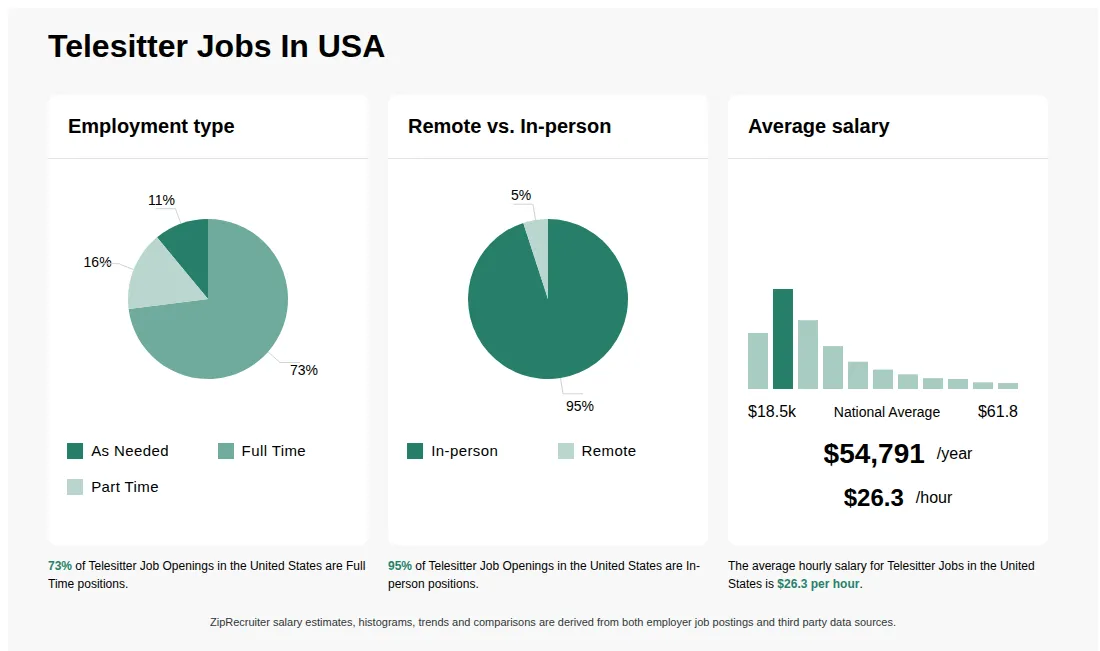
As of Jun 21, 2026, the average hourly pay for telesitter in the United States is $26.34, according to ZipRecruiter salary data. Most workers in this role earn between $15.14 and $30.77 per hour, depending on experience, location, and employer.

What are the key skills and qualifications needed to thrive in the Telesitter position, and why are they important?

To thrive as a Telesitter, you need strong observational skills, attention to detail, and familiarity with basic healthcare protocols, typically supported by a high school diploma or equivalent. Knowledge of video monitoring systems, electronic patient safety platforms, and hospital communication tools is highly beneficial. Excellent verbal communication, calmness under pressure, and a compassionate approach are crucial soft skills in this role. These abilities ensure patient safety, enable effective teamwork, and support swift response to potential risks in healthcare settings.


What jobs pay 2000 a day?

Telesitter roles typically do not pay $2000 a day; such high daily earnings are more common in specialized fields like high-level consulting, investment banking, or certain entrepreneurial ventures. Most jobs with high daily pay require advanced skills, certifications, or significant experience, and earnings can vary widely based on workload, location, and industry.

What does a Telesitter do?

A Telesitter monitors patients remotely using video and audio technology to ensure their safety and well-being, often in healthcare or mental health settings. They observe patient behavior, alert staff to any issues, and may document incidents, requiring good communication skills and familiarity with monitoring equipment.

What jobs pay 10,000 a month without a degree?

A Telesitter role typically does not pay $10,000 a month without specialized skills or experience. High-paying jobs that can reach this level often include sales, real estate, or certain freelance roles that rely on commissions, along with skilled trades or entrepreneurship, which may require certifications or self-employment. Most jobs paying this amount without a degree involve sales, business ownership, or highly skilled freelance work rather than entry-level positions.

What is a Telesitter job?

A Telesitter is a healthcare professional who remotely observes patients through video monitoring to ensure their safety and prevent falls or other incidents. They typically work in hospitals or healthcare facilities, monitoring multiple patients at once and alerting on-site staff if intervention is needed. Telesitters do not provide direct patient care but play a crucial role in patient safety. Strong communication and attention to detail are essential skills for this role.

How do you become a patient sitter?

To become a Telesitter, candidates typically need a high school diploma or equivalent, and some roles require CPR certification or training in patient monitoring. Relevant skills include good communication, attention to detail, and the ability to observe and report patient behavior accurately. Training is often provided by the employer, and a background check may be required.

What does a typical shift look like for a Telesitter, and how do they interact with clinical staff?

During a typical shift, a Telesitter closely monitors multiple patients remotely via video feeds, watching for signs of distress or unsafe behaviors and promptly alerting nursing staff when intervention is needed. The telesitter sits in a centralized monitoring room and frequently communicates with clinical teams using phones or intercom systems to convey important observations. While they do not provide direct patient care, Telesitters play a vital role in patient safety by ensuring swift communication and supporting fall prevention initiatives. This role requires sustained focus, adaptability to varying patient behaviors, and the ability to collaborate effectively within a healthcare team.

What cities are hiring for Telesitter jobs? Cities with the most Telesitter job openings:
What are the most commonly searched types of Telesitter jobs? The most popular types of Telesitter jobs are:
What states have the most Telesitter jobs? States with the most job openings for Telesitter jobs include:
Infographic showing various Telesitter job openings in the United States as of June 2026, with employment types broken down into 100% Part Time. Highlights an 100% In-person job distribution, with an average salary of $54,791 per year, or $26.3 per hour.
Patient Care Tech

$15.75 - $20.50/hr

Full-time

Posted 25 days ago


Mary Greeley Medical Center rating

7.1

Company rating: 7.1 out of 10

Based on 18 frontline employees who took The Breakroom Quiz

436th of 1,001 rated hospitals


Job description

  • Position Summary
    • Under general direction, protects, promotes, and optimizes health and abilities. Under general supervision, supports the professional clinical staff by providing direct patient care and performing duties as assigned by the RN. Prevents illness and injury. Advocates for patients and their families. Ensures all actions taken in carrying out responsibilities support patient centered care.
  • Position Responsibilities

    • Unit Specific Position Responsibilities
      • Attend and participate in 50 % of department unit meetings.
      • Practices ethically
      • Demonstrates understanding and proficiency of the use of Avasys Telesitter Solution Software.
      • Communicates effectively in all areas of practice
      • Seeks help or advice as soon as possible when a patient appears to pose a threat to themselves or others. Participates in a collaborative identification and reporting of patient safety issues. Assures patient environment safety. Seeks assistance with removal of any potential safety hazard from room and reports findings to the RN.
      • Performs patient care and treatments under the supervision of a nurse
      • When using Avasys Telesitter Solution Software maintains visual observation at all times. Verbally redirects patient over digital 2-way audio device that is in patient room. Immediately summons the nursing staff if the patient requires assistance.
      • Provides and documents nursing care, including but not limited to activities of daily living, exercise and ambulation, specimen collection, and respiratory support activities
      • Lifts, moves, positions, and transports patients
      • Performs procedures as defined by departmental competencies
      • Considers age, growth, and developmental needs when providing care
      • Assists with duties as requested to support the day-to-day operations of the unit
  • Qualifications, Knowledge & Experience
    • Required Qualifications (Including any licensure, certification, education):
      • Basic Life Support (BLS) training, or within 90 days of hire and must maintain throughout employment.
      • Mandatory Reporter training or within 90 days of hire and must maintain throughout employment.
    • Organizational Requirements:
      • Maintain stroke education per regulatory requirements.

    • Preferred Qualifications:
      • Completion of Advanced Nurse Aide program.
      • None Specified
      • High school diploma or GED
      • Completion of 75-hour basic Certified Nursing Assistant Program or completion of at least one clinical rotation of a nursing program or comparable education, training and experience OR ER and ICCU Department only- NREMT Certification.

    • Required Knowledge, Skills & Experience:
      • Proficient in communication skills.
      • Ability to pursue and foster a sense of team and partnership across all disciplines.
      • Ability to communicate effectively, in English, with diverse population groups.
      • Ability to be self-directed, flexible, and able to adapt to change.
      • Ability to communicate effectively in a professional and tactful manner with physicians, staff, patients and/or their representatives.
      • Ability to read and understand chart documentation.
      • Ability to demonstrate basic computer skills.
      • Ability to read, write and understand the English language.
      • Ability to demonstrate clinical competence and maintain current knowledge in providing care for infant through geriatric patients as required.
      • Ability to assist nursing personnel with patients; explain procedures and give information; skill in the use of specialized equipment and/or techniques; ability to detect abnormal conditions and report appropriately; able to function promptly and appropriately under stressful conditions.

    • Preferred Knowledge, Skills & Experience:
      • None Specified

What Mary Greeley Medical Center employees say

Pay

Benefits

Hours and flexibility

Workplace

Get the full story on Breakroom