1

Sql Database Administrator Jobs (NOW HIRING)

$47.75 - $59.75/hr

We are seeking an experienced Azure SQL Database Administrator (Azure SQL DBA) to manage, optimize, and support enterprise database environments. The role requires strong expertise in Azure SQL ...

No SQL DBA

San Jose, CA · On-site

$58.50 - $73.25/hr

They are seeking a No SQL DBA to manage database performance and handle AWS migration and data recovery for their SaaS product. Responsibilities : • Required No SQL DBA Postgres, Redis, Past ...

SQL DBA

Stamford, CT · On-site

$53.25 - $66.75/hr

Syntricate Technologies is seeking a SQL DBA to manage and support various database environments. The role involves installation, configuration, and performance monitoring of SQL database servers, as ...

SQL Database Administrator (Compliance)

Concord, NC · On-site

$46.50 - $58.25/hr

HOW A COMPLIANCE SQL Database Administrator WILL MAKE AN IMPACT Duties & Responsibilities We are seeking a highly skilled SQL Database Administrator with deep expertise in DISA STIGs and hand-on ...

Showing results 41-60

Sql Database Administrator information

See salary details

$12

$53

$72

How much do sql database administrator jobs pay per hour?

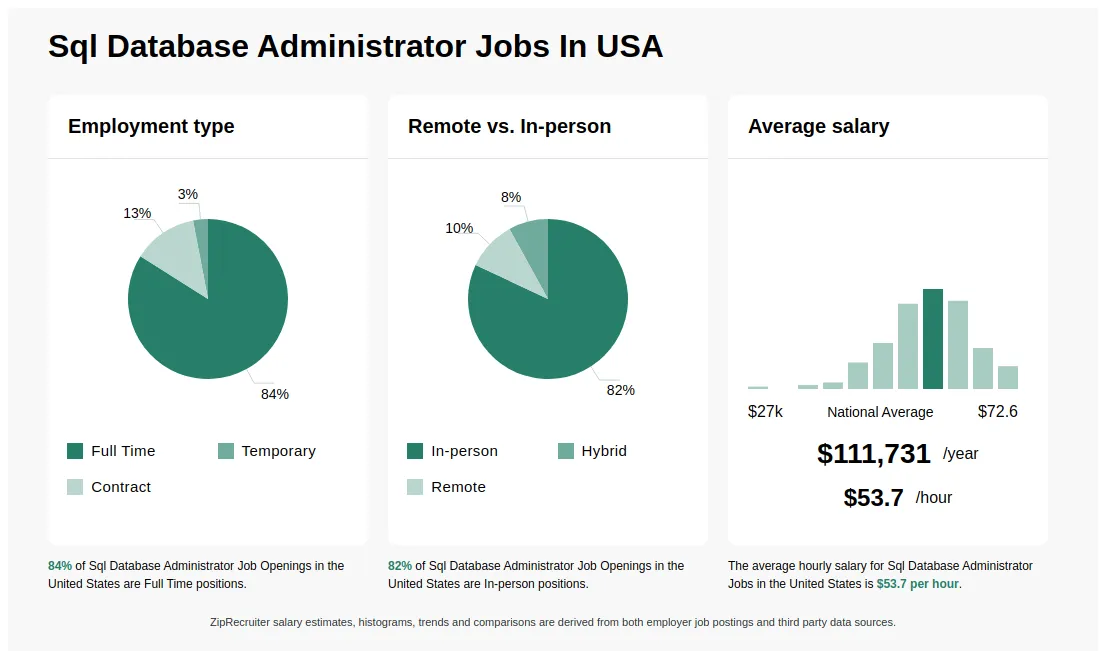
As of Sep 13, 2026, the average hourly pay for sql database administrator in the United States is $53.72, according to ZipRecruiter salary data. Most workers in this role earn between $48.08 and $60.10 per hour, depending on experience, location, and employer.

What is an SQL database administrator?

A SQL database administrator is an IT professional who installs, monitors, maintains, and improves SQL databases; these databases house the data required for various systems within the company and are vital to business’ success. Responsibilities include supporting the organization’s application teams, as well as identifying and troubleshooting any database issues. SQL database administrators work closely with support administrators to keep the business’s infrastructure up, running smoothly, and protected from unapproved access.

What are some of the common challenges SQL database administrators face when managing large-scale databases?

SQL Database Administrators often encounter challenges such as maintaining database performance during high-traffic periods, ensuring data security, and planning for effective backups and disaster recovery. Managing schema changes without impacting application uptime and troubleshooting complex performance issues are also frequent hurdles. Collaboration with development and infrastructure teams is essential to optimize queries, manage deployments, and implement best practices for scalability and reliability.

What are the key skills and qualifications needed to thrive as a SQL database administrator, and why are they important?

To thrive as a SQL Database Administrator, you need expertise in database design, SQL querying, performance tuning, and a strong understanding of data security and backup strategies, typically supported by a relevant degree or certifications like Microsoft Certified: Azure Database Administrator Associate. Familiarity with database management systems such as Microsoft SQL Server, MySQL, and tools like SSMS (SQL Server Management Studio) is essential. Problem-solving, attention to detail, and effective communication are crucial soft skills for troubleshooting and collaborating with development and IT teams. These competencies are vital to ensure data integrity, system reliability, and efficient database operations within an organization.

What is the difference between Sql Database Administrator vs Database Developer?

AspectSql Database AdministratorDatabase Developer
Primary RoleMaintains, secures, and optimizes SQL databasesDesigns, develops, and implements database solutions
Skills & CertificationsSQL Server certifications, database management skillsSQL, programming languages, database design expertise
Work EnvironmentDatabase management teams, IT departmentsDevelopment teams, software projects
Common TasksBackup, recovery, performance tuningQuery development, schema design, data modeling

While both roles work with SQL databases, the Sql Database Administrator focuses on maintaining and securing existing databases, whereas the Database Developer designs and builds new database solutions. Understanding these differences helps organizations assign the right responsibilities and professionals for their database needs.

Are SQL database administrators still in demand?

SQL database administrators remain in demand due to ongoing reliance on relational databases for data management across industries. They are valued for their skills in database design, performance tuning, and security, often requiring knowledge of SQL, backup strategies, and certifications like Microsoft Certified: Azure Database Administrator Associate.

What cities are hiring for Sql Database Administrator jobs?

Cities with the most Sql Database Administrator job openings:

What are the most commonly searched types of Sql Database Administrator jobs?

The most popular types of Sql Database Administrator jobs are:

Who are the top companies hiring for Sql Database Administrator jobs?

The top employers for Sql Database Administrator jobs are:

What states have the most Sql Database Administrator jobs?

States with the most job openings for Sql Database Administrator jobs include:

What are popular job titles related to Sql Database Administrator jobs?

For Sql Database Administrator jobs, the most frequently searched job titles are:

Infographic showing various Sql Database Administrator job openings in the United States as of September 2026, with employment types broken down into 89% Full Time, 8% Part Time, and 3% Contract. Highlights an 85% Physical, 4% Hybrid, and 11% Remote job distribution, with an average salary of $111,731 per year, or $53.7 per hour.

Azure SQL Database Administrator

Miami Springs, FL • On-site

Neshent Technologies
11 - 50 employees

$45.25 - $56.50/hr

Full-time

Posted 10 days ago


Job description

We are seeking an experienced Azure SQL Database Administrator (Azure SQL DBA) to manage, optimize, and support enterprise database environments. The role requires strong expertise in Azure SQL Database, Microsoft SQL Server, database performance tuning, high availability/disaster recovery, Terraform, and cloud infrastructure automation.

Roles and Responsibilities
  • Administer, configure, monitor, and maintain Azure SQL Database and Microsoft SQL Server environments.

  • Design, implement, and test High Availability (HA) and Disaster Recovery (DR) solutions for production databases.

  • Perform database performance tuning, query optimization, indexing, and troubleshooting.

  • Provision and manage cloud database infrastructure using Terraform Infrastructure as Code (IaC).

  • Automate database deployment, configuration, and infrastructure management across Azure environments.

  • Monitor database health, availability, capacity, performance, and resource utilization.

  • Apply AI/ML tools and techniques for database performance optimization, anomaly detection, query analysis, and proactive issue identification.

  • Support database backup, recovery, security, access management, and operational maintenance.

  • Troubleshoot complex database and Windows infrastructure issues and collaborate with application, cloud, and infrastructure teams.

  • Maintain technical documentation, operational procedures, and database standards.

Required Qualifications
  • Bachelor’s degree in Technology, Computer Science, Information Systems, or a related field.

  • 8+ years of experience in Windows system administration.

  • 5+ years of enterprise database administration experience.

  • 3+ years of experience with Microsoft SQL Server.

  • 3+ years of experience designing and testing HA/DR configurations for production database systems.

  • Strong hands-on experience with Azure SQL Database.

  • 3+ years of experience with Terraform for provisioning and managing cloud database services.

  • Strong knowledge of database performance tuning, query optimization, and index design.

  • Required experience applying AI/ML tools to database performance optimization, anomaly detection, or query analysis.

  • Strong troubleshooting, analytical, and problem-solving skills.

  • Experience working with enterprise-scale Azure cloud and database environments.