1

Spatial Intelligence Jobs (NOW HIRING)

A core part of what makes Molg's systems work is spatial intelligence: the ability to understand, model, and reason about complex physical environments--down to the geometry, tolerances, and dynamics ...

Apply Early

Vantor is forging the new frontier of spatial intelligence, helping decision makers and operators navigate what's happening now and shape what's coming next. The Software Engineer will support the ...

Vantor is forging the new frontier of spatial intelligence, helping decision makers and operators navigate what's happening now and shape what's coming next. They are seeking a Platform Engineer with ...

GIS DevOps Engineer

Westminster, CO ยท On-site

$53.50 - $73.50/hr

Vantor is forging the new frontier of spatial intelligence, helping decision makers and operators navigate what's happening now and shape what's coming next. They are seeking a GIS DevOps Engineer to ...

Vantor is forging the new frontier of spatial intelligence, helping decision makers and operators navigate what's happening now and shape what's coming next. They are seeking a Lab Manager to own and ...

Vantor is forging the new frontier of spatial intelligence, helping decision makers and operators navigate what's happening now and shape what's coming next. They are seeking a Platform Engineer with ...

Vantor is forging the new frontier of spatial intelligence, helping decision makers and operators navigate what's happening now and shape what's coming next. The Applied AI Scientist will design ...

GIS Engineer (Senior) - TS/SCI with Poly

Arlington, VA ยท On-site

$120K - $165K/yr

Our client is forging the new frontier of spatial intelligence, helping decision makers and operators navigate what's happening now and shape what's coming next. They are a place for problem solvers ...

Apply Early

Finance Manager

San Francisco, CA ยท On-site

$157K - $210K/yr

Powered by a proprietary database of over 30 billion posed images, our groundbreaking mapping technology unlocks a new dimension of interaction and spatial intelligence that helps both humans and ...

Vantor is forging the new frontier of spatial intelligence, helping decision makers and operators navigate what's happening now and shape what's coming next. The Data Scientist role focuses on ...

next page

Showing results 1-20

Spatial Intelligence information

See salary details

$11K

$100.6K

$133K

How much do spatial intelligence jobs pay per year?

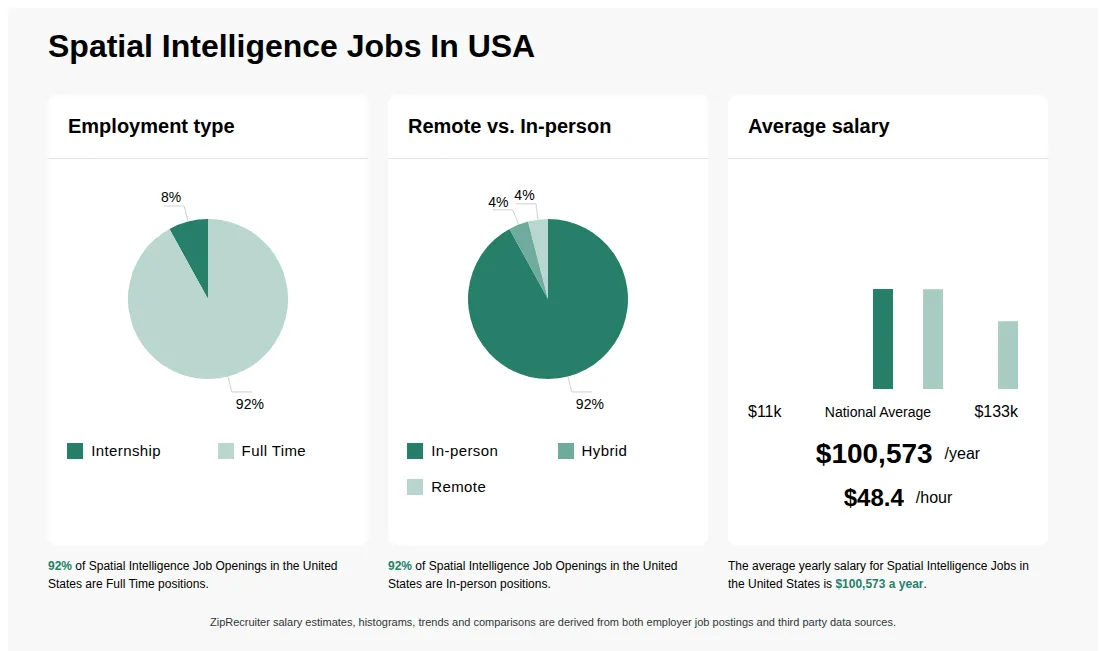
As of Jul 3, 2026, the average yearly pay for spatial intelligence in the United States is $100,573.00, according to ZipRecruiter salary data. Most workers in this role earn between $73,500.00 and $132,500.00 per year, depending on experience, location, and employer.

What are some of the typical projects or responsibilities for someone working in Spatial Intelligence?

Professionals in Spatial Intelligence often work on projects involving spatial data analysis, mapping, and the creation of geospatial models to support organizational decision-making. Their responsibilities may include collecting and processing geographic data, conducting site suitability analyses, performing spatial risk assessments, and generating detailed maps or visual reports for stakeholders. They typically collaborate with urban planners, engineers, data scientists, and decision-makers to integrate spatial perspectives into broader business strategies. day can vary between intensive data analysis, meeting with project teams, and presenting findings to clients or leadership. This dynamic role offers the opportunity to make significant impacts on projects such as urban development, environmental conservation, and transportation planning.

What jobs are good for spatial skills?

Jobs that require strong spatial skills include roles such as architects, urban planners, surveyors, and GIS specialists. These positions involve visualizing and manipulating objects or data in space, often using tools like CAD software or geographic information systems, and may require relevant certifications or technical training.

What can you do with spatial intelligence?

Spatial intelligence in a job context involves analyzing and interpreting spatial data to solve problems related to geography, architecture, urban planning, or navigation. Professionals use tools like GIS software, CAD programs, and mapping technologies to create models, optimize layouts, and support decision-making. Developing this skill can lead to roles in fields such as cartography, surveying, or spatial data analysis.

What careers use spatial intelligence?

Careers that utilize spatial intelligence include architects, urban planners, surveyors, graphic designers, and engineers. These roles often require strong visualization skills, proficiency with design or mapping software, and the ability to interpret and manipulate spatial data.

What are the key skills and qualifications needed to thrive in the Spatial Intelligence position, and why are they important?

To excel in a Spatial Intelligence role, individuals typically need a strong background in geospatial analysis, GIS (Geographic Information Systems), and spatial data interpretation, often supported by a degree in geography, urban planning, data science, or a related field. Familiarity with specialized software such as ArcGIS, QGIS, remote sensing tools, and spatial databases is essential, and certifications in GIS or remote sensing are highly valued. Strong analytical thinking, attention to detail, and effective communication are important soft skills for translating complex spatial data into actionable insights. These skills ensure the professional can deliver accurate spatial analyses that inform decision-making across industries such as urban planning, environmental management, and logistics.


What is a Spatial Intelligence job?

A Spatial Intelligence job involves analyzing and interpreting spatial data to identify patterns, trends, and relationships in geographic or built environments. Professionals in this field use GIS (Geographic Information Systems), remote sensing, and data visualization tools to support decision-making in industries like urban planning, logistics, environmental management, and defense. They help organizations optimize resources, improve efficiency, and solve complex spatial problems. Strong analytical skills, proficiency in mapping software, and an understanding of spatial relationships are essential for success in this role.

What are the signs of a person with a high spatial intelligence?

A person with high spatial intelligence, relevant to roles like spatial intelligence analysts or designers, often demonstrates strong visualization skills, the ability to mentally manipulate objects, and good spatial reasoning. They excel at tasks involving maps, diagrams, or 3D models and may have a talent for architecture, engineering, or graphic design. These skills are valuable in environments that require precise spatial awareness and problem-solving involving physical space.
What cities are hiring for Spatial Intelligence jobs? Cities with the most Spatial Intelligence job openings:
What are the most commonly searched types of Spatial Intelligence jobs? The most popular types of Spatial Intelligence jobs are:
What states have the most Spatial Intelligence jobs? States with the most job openings for Spatial Intelligence jobs include:
Infographic showing various Spatial Intelligence job openings in the United States as of June 2026, with employment types broken down into 92% Full Time, and 8% Part Time. Highlights an 73% Physical, 1% Hybrid, and 26% Remote job distribution, with an average salary of $100,573 per year, or $48.4 per hour.

Synthesis/Computational Design Engineer

Molg

Sterling, VA โ€ข On-site

Full-time

Posted 4 days ago

Be an early applicant


Job description

ABOUT US

Hey! Weโ€™re Molg ๐Ÿ‘‹ Weโ€™re building robotic systems that make electronics manufacturing circular. We work with hyperscalers and leading electronics manufacturers to automate how hardware is designed, manufactured, disassembled, repaired, reused, and recovered. Using robotics, computational design, and AI, our systems turn todayโ€™s e-waste into resilient, data-driven supply chainsโ€”and change how electronics are made in the first place.

A core part of what makes Molg's systems work is spatial intelligence: the ability to understand, model, and reason about complex physical environmentsโ€”down to the geometry, tolerances, and dynamics of individual components. Our synthesis and computational design platform sits at the intersection of geometry, algorithms, and physical reasoning, and is central to how we automate the design and execution of manufacturing and disassembly processes at scale.

IN THIS ROLE YOU WILL:

Join a talented cross-functional team of robotics, software, mechanical, and electrical engineers to develop Molg's computational design and spatial intelligence platform. As a Synthesis / Computational Design Engineer, you will:

  • Design and implement algorithms for geometric reasoning, spatial analysis, and computational synthesisโ€”enabling Molg's systems to automatically understand and operate on complex physical assemblies.

  • Build the computational backbone for automated process planning: translating 3D representations of electronics into actionable, robot-executable sequences for assembly, disassembly, repair, and recovery.

  • Develop tools and pipelines for working with 3D geometryโ€”including mesh processing, point cloud analysis, CAD interoperability, and physics-informed simulationโ€”to support perception, planning, and verification workflows.

  • Collaborate with robotics and controls engineers to close the loop between spatial models and physical executionโ€”ensuring that synthesized plans are feasible, robust, and safe.

  • Contribute to the design and evolution of Molg's internal data models for representing products, components, processes, and spatial relationships across the manufacturing lifecycle.

  • Prototype and evaluate new approaches to geometric search, constraint solving, and design space explorationโ€”drawing from fields like computational geometry, CAD/CAM, and generative design.

  • Build scalable, production-grade software that integrates computational design capabilities into Molg's broader robotics and microfactory platform.

  • Participate in design reviews and technical discussions, bringing rigorous geometric and algorithmic thinking to cross-functional problems.

  • Stay current with advances in computational design, geometry processing, and spatial AIโ€”identifying and applying relevant techniques to Molg's challenges.

You'll have the opportunity to build alongside an incredible team, develop innovative solutions, and grow in a fast-paced environment that values autonomy and impact.

WHO YOU ARE:

We're looking for someone who combines strong algorithmic and geometric instincts with the engineering rigor to build reliable, production-quality systems. The ideal candidate has:

  • 5+ years of experience in computational geometry, geometric computing, computational design, CAD/CAM software development, or a closely related field.

  • Proficiency in Python and/or C++, with experience writing performance-sensitive geometric or numerical code.

  • Deep familiarity with 3D geometry representationsโ€”meshes, point clouds, solid models (B-rep), voxel grids, or implicit surfacesโ€”and the algorithms that operate on them.

  • Experience with one or more geometry processing or computational design tools or libraries (e.g., Open3D, CGAL, libigl, OpenCASCADE, Rhino/Grasshopper, or similar).

  • Strong understanding of linear algebra, computational geometry fundamentals, and numerical methods as applied to 3D problems.

  • Comfort working in a research-to-production context: able to prototype rapidly, then harden and scale solutions for real-world deployment.

  • Experience integrating geometric pipelines with downstream systemsโ€”robotics, simulation, databases, or web services.

  • A track record of shipping complex technical work end-to-end, not just prototyping.

  • Excellent communication skills; able to explain geometric and algorithmic concepts clearly to engineers from different disciplines.

Nice to have:

  • Experience with robotic motion planning, task planning, or manipulationโ€”particularly in the context of geometric reasoning.

  • Familiarity with machine learning approaches to geometry (e.g., 3D neural representations, learned shape descriptors, or spatial transformers).

  • Background in electronics manufacturing, PCB design, or physical product development.

  • Experience with physics simulation (e.g., PyBullet, MuJoCo, Isaac Sim) or tolerance analysis.

  • Contributions to open-source geometry or robotics software.

WHO WE ARE:

We spend our days building robotic systems, developing complex assembly intelligence software, and designing the next generation of circular products for our customers. Given the importance of working hands-on with physical systems, the majority of our team is in-person collaboratively working in our industrial space in Sterling, VA, down the road from the largest data center market in the world. Our facility includes a variety of robots, CNC milling machines, 3D printers, and all the tools needed to build and test our products. It is important to us that anyone on our team that is interested in learning how to use our various pieces of equipment and machinery is taught and can gain the skills and appreciation for making physical things.

THINGS TO KNOW:

  • Weโ€™re a hands on collaborative team with big ambitions, and thereโ€™s a good amount of context-switching. We expect people to be autonomous and drive their own work to completion.

  • We are scrappy and looking to build a great sustainable company for years to come.

  • As a growing company and startup, priorities may shift as customer or business requirements change. We strive to empower individuals with context and decision-making power to meet this need.