Summary The Senior Manager, Spatial Intelligence & Facility Data is responsible for establishing and advancing Freeman's strategy for facility data, digital venue assets, BIM, and emerging spatial ...
Summary The Senior Manager, Spatial Intelligence & Facility Data is responsible for establishing and advancing Freeman's strategy for facility data, digital venue assets, BIM, and emerging spatial ...

Senior Software Engineer, Spatial Intelligence and Foundation Models
Santa Clara, CA · On-site
$143K - $189K/yr
NVIDIA is seeking a Software Engineer to join our Isaac Spatial Intelligence team within the Isaac Engineering org. You will join a group of world-class robotics software and applied research ...
Senior Software Engineer, Spatial Intelligence and Foundation Models
Santa Clara, CA · On-site
$143K - $189K/yr
NVIDIA is seeking a Software Engineer to join our Isaac Spatial Intelligence team within the Isaac Engineering org. You will join a group of world-class robotics software and applied research ...
Senior Software Engineer, Spatial Intelligence and Foundation Models
Santa Clara, CA · On-site
$143K - $189K/yr
NVIDIA is seeking a Software Engineer to join our Isaac Spatial Intelligence team within the Isaac Engineering org! You will join a group of world-class robotics software and applied research ...
Senior Software Engineer, Spatial Intelligence and Foundation Models
Santa Clara, CA · On-site
$143K - $189K/yr
NVIDIA is seeking a Software Engineer to join our Isaac Spatial Intelligence team within the Isaac Engineering org! You will join a group of world-class robotics software and applied research ...
NVIDIA is seeking a Software Engineer to join our Isaac Spatial Intelligence team within the Isaac Engineering org! You will join a group of world-class robotics software and applied research ...
NVIDIA is seeking a Software Engineer to join our Isaac Spatial Intelligence team within the Isaac Engineering org! You will join a group of world-class robotics software and applied research ...

GIS Engineer (Mid)
Reston, VA · On-site
Vantor is forging the new frontier of spatial intelligence, helping decision makers and operators navigate what's happening now and shape what's coming next. The GIS Engineer role involves designing ...
GIS Engineer (Mid)
Reston, VA · On-site
Vantor is forging the new frontier of spatial intelligence, helping decision makers and operators navigate what's happening now and shape what's coming next. The GIS Engineer role involves designing ...
Business Development Leader (Public Sector)
San Francisco, CA · On-site +1
$183K - $230K/yr
About the Role As Business Development Lead, Public Sector, you'll build and scale Niantic Spatial's partner ecosystem across the Department of Defense, Intelligence Community, and Federal Civilian ...
Business Development Leader (Public Sector)
San Francisco, CA · On-site +1
$183K - $230K/yr
About the Role As Business Development Lead, Public Sector, you'll build and scale Niantic Spatial's partner ecosystem across the Department of Defense, Intelligence Community, and Federal Civilian ...
Robotics Engineering Intern - Fall 2026
San Francisco, CA · On-site
$19.75 - $25.50/hr
Powered by a proprietary database of over 30 billion posed images, our groundbreaking mapping technology unlocks a new dimension of interaction and spatial intelligence that helps both humans and ...
Robotics Engineering Intern - Fall 2026
San Francisco, CA · On-site
$19.75 - $25.50/hr
Powered by a proprietary database of over 30 billion posed images, our groundbreaking mapping technology unlocks a new dimension of interaction and spatial intelligence that helps both humans and ...
Solutions Architect (Public Sector)
$74.25 - $97.75/hr
About the Role As a Solutions Architect for Niantic Spatial's Public Sector team (DoW, Intelligence Community, and Federal Civilian), you'll own technical solutioning from early customer discovery ...
Solutions Architect (Public Sector)
$74.25 - $97.75/hr
About the Role As a Solutions Architect for Niantic Spatial's Public Sector team (DoW, Intelligence Community, and Federal Civilian), you'll own technical solutioning from early customer discovery ...
Head of Legal
San Francisco, CA · On-site
$270K - $340K/yr
Powered by a proprietary database of over 30 billion posed images, our groundbreaking mapping technology unlocks a new dimension of interaction and spatial intelligence that helps both humans and ...
Head of Legal
San Francisco, CA · On-site
$270K - $340K/yr
Powered by a proprietary database of over 30 billion posed images, our groundbreaking mapping technology unlocks a new dimension of interaction and spatial intelligence that helps both humans and ...
Solutions Architect (Public Sector)
San Francisco, CA · On-site +1
$171K - $215K/yr
About the Role As a Solutions Architect for Niantic Spatial's Public Sector team (DoW, Intelligence Community, and Federal Civilian), you'll own technical solutioning from early customer discovery ...
Solutions Architect (Public Sector)
San Francisco, CA · On-site +1
$171K - $215K/yr
About the Role As a Solutions Architect for Niantic Spatial's Public Sector team (DoW, Intelligence Community, and Federal Civilian), you'll own technical solutioning from early customer discovery ...
Senior Computer Vision Engineer (Localization)
San Francisco, CA · On-site
$189K - $255K/yr
Powered by a proprietary database of over 30 billion posed images, our groundbreaking mapping technology unlocks a new dimension of interaction and spatial intelligence that helps both humans and ...
Senior Computer Vision Engineer (Localization)
San Francisco, CA · On-site
$189K - $255K/yr
Powered by a proprietary database of over 30 billion posed images, our groundbreaking mapping technology unlocks a new dimension of interaction and spatial intelligence that helps both humans and ...
Senior Technical Program Manager
San Francisco, CA · On-site
$193K - $250K/yr
Powered by a proprietary database of over 30 billion posed images and a groundbreaking third-generation digital map, our mission is to develop spatial intelligence that helps both humans and machines ...
Senior Technical Program Manager
San Francisco, CA · On-site
$193K - $250K/yr
Powered by a proprietary database of over 30 billion posed images and a groundbreaking third-generation digital map, our mission is to develop spatial intelligence that helps both humans and machines ...

UI/UX Designer
San Francisco, CA · On-site
Translate complex spatial intelligence concepts into clear, intuitive interfaces that enterprise engineers love to use. Website & Marketing : Design website landing pages, product demos, and ...
UI/UX Designer
San Francisco, CA · On-site
Translate complex spatial intelligence concepts into clear, intuitive interfaces that enterprise engineers love to use. Website & Marketing : Design website landing pages, product demos, and ...
Technical Lead, Computer Vision
San Francisco, CA · On-site
$256K - $315K/yr
Powered by a proprietary database of over 30 billion posed images and a groundbreaking third-generation digital map, our mission is to develop spatial intelligence that helps both humans and machines ...
Technical Lead, Computer Vision
San Francisco, CA · On-site
$256K - $315K/yr
Powered by a proprietary database of over 30 billion posed images and a groundbreaking third-generation digital map, our mission is to develop spatial intelligence that helps both humans and machines ...

We are seeking an Applied Scientist to focus on Robotics Spatial Intelligence and Semantic Understanding. In this role, you'll research and build advanced semantic and world understanding algorithms ...
We are seeking an Applied Scientist to focus on Robotics Spatial Intelligence and Semantic Understanding. In this role, you'll research and build advanced semantic and world understanding algorithms ...
Sr Product Manager-Tech, cRME - Controls Engineering
Bellevue, WA · On-site
$188K - $195K/yr
... Spatial Intelligence Platform. SpectraLink automates the generation of multi-perspective 2D/3D site layouts and unifies telemetry, safety, maintenance, and operational data into a spatially aware ...
Sr Product Manager-Tech, cRME - Controls Engineering
Bellevue, WA · On-site
$188K - $195K/yr
... Spatial Intelligence Platform. SpectraLink automates the generation of multi-perspective 2D/3D site layouts and unifies telemetry, safety, maintenance, and operational data into a spatially aware ...
Sr Product Manager-Tech, cRME - Controls Engineering
Bellevue, WA · On-site
$188K - $195K/yr
... Spatial Intelligence Platform. SpectraLink automates the generation of multi-perspective 2D/3D site layouts and unifies telemetry, safety, maintenance, and operational data into a spatially aware ...
Sr Product Manager-Tech, cRME - Controls Engineering
Bellevue, WA · On-site
$188K - $195K/yr
... Spatial Intelligence Platform. SpectraLink automates the generation of multi-perspective 2D/3D site layouts and unifies telemetry, safety, maintenance, and operational data into a spatially aware ...
Applied Scientist, Fauna
Sunnyvale, CA · On-site
We are seeking an Applied Scientist to focus on Robotics Spatial Intelligence and Semantic Understanding. In this role, you'll research and build advanced semantic and world understanding algorithms ...
Applied Scientist, Fauna
Sunnyvale, CA · On-site
We are seeking an Applied Scientist to focus on Robotics Spatial Intelligence and Semantic Understanding. In this role, you'll research and build advanced semantic and world understanding algorithms ...
Solutions Architect (Enterprise)
San Francisco, CA · On-site +1
$171K - $215K/yr
Powered by a proprietary database of over 30 billion posed images, our groundbreaking mapping technology unlocks a new dimension of interaction and spatial intelligence that helps both humans and ...
Solutions Architect (Enterprise)
San Francisco, CA · On-site +1
$171K - $215K/yr
Powered by a proprietary database of over 30 billion posed images, our groundbreaking mapping technology unlocks a new dimension of interaction and spatial intelligence that helps both humans and ...
Vantor is forging the new frontier of spatial intelligence, helping decision makers and operators navigate what's happening now and shape what's coming next. They are seeking an experienced Backend ...
Vantor is forging the new frontier of spatial intelligence, helping decision makers and operators navigate what's happening now and shape what's coming next. They are seeking an experienced Backend ...
Spatial Intelligence information
See salary details
$11K - $22.1K
0% of jobs
$22.1K - $33.2K
0% of jobs
$33.2K - $44.3K
0% of jobs
$44.3K - $55.4K
0% of jobs
$55.4K - $66.5K
0% of jobs
$73.9K is the 25th percentile. Wages below this are outliers.
$66.5K - $77.5K
37% of jobs
$77.5K - $88.6K
0% of jobs
The median wage is $92.4K / yr.
$88.6K - $99.7K
37% of jobs
$99.7K - $110.8K
0% of jobs
$110.8K - $121.9K
0% of jobs
$122K is the 75th percentile. Wages above this are outliers.
$121.9K - $133K
25% of jobs
$11K
$100.6K
$133K
How much do spatial intelligence jobs pay per year?
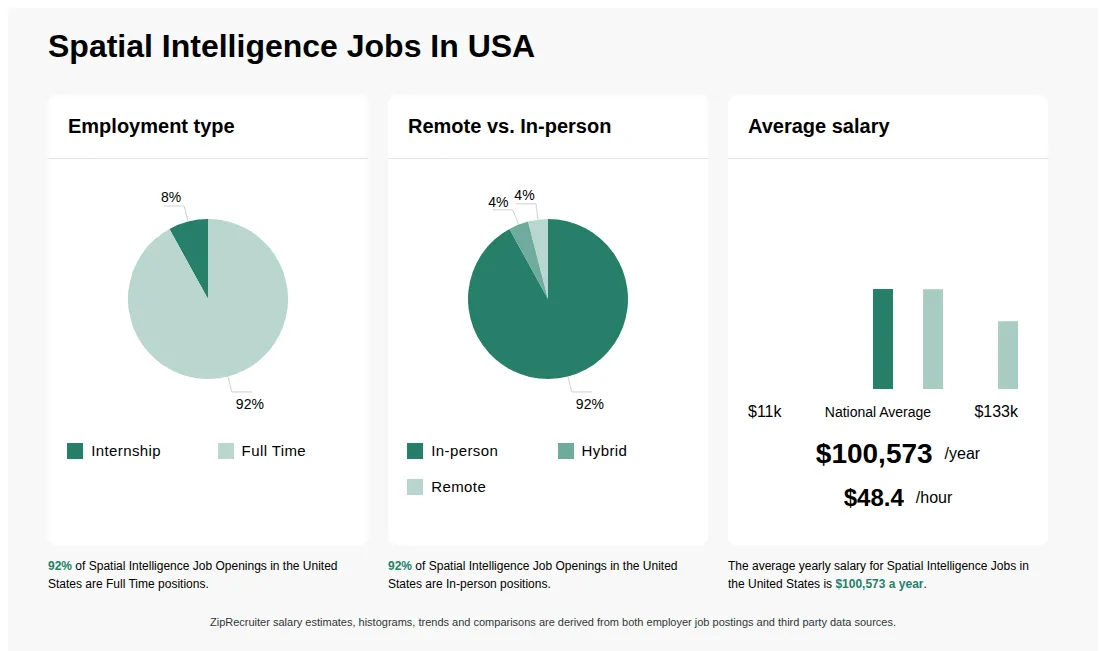
As of Sep 4, 2026, the average yearly pay for spatial intelligence in the United States is $100,573.00, according to ZipRecruiter salary data. Most workers in this role earn between $73,500.00 and $132,500.00 per year, depending on experience, location, and employer.
What is spatial intelligence?
A Spatial Intelligence job involves analyzing and interpreting spatial data to identify patterns, trends, and relationships in geographic or built environments. Professionals in this field use GIS (Geographic Information Systems), remote sensing, and data visualization tools to support decision-making in industries like urban planning, logistics, environmental management, and defense. They help organizations optimize resources, improve efficiency, and solve complex spatial problems. Strong analytical skills, proficiency in mapping software, and an understanding of spatial relationships are essential for success in this role.
What does someone in spatial intelligence do?
Professionals in Spatial Intelligence often work on projects involving spatial data analysis, mapping, and the creation of geospatial models to support organizational decision-making. Their responsibilities may include collecting and processing geographic data, conducting site suitability analyses, performing spatial risk assessments, and generating detailed maps or visual reports for stakeholders. They typically collaborate with urban planners, engineers, data scientists, and decision-makers to integrate spatial perspectives into broader business strategies. day can vary between intensive data analysis, meeting with project teams, and presenting findings to clients or leadership. This dynamic role offers the opportunity to make significant impacts on projects such as urban development, environmental conservation, and transportation planning.
What are the key skills and qualifications needed for spatial intelligence?
To excel in a Spatial Intelligence role, individuals typically need a strong background in geospatial analysis, GIS (Geographic Information Systems), and spatial data interpretation, often supported by a degree in geography, urban planning, data science, or a related field. Familiarity with specialized software such as ArcGIS, QGIS, remote sensing tools, and spatial databases is essential, and certifications in GIS or remote sensing are highly valued. Strong analytical thinking, attention to detail, and effective communication are important soft skills for translating complex spatial data into actionable insights. These skills ensure the professional can deliver accurate spatial analyses that inform decision-making across industries such as urban planning, environmental management, and logistics.
Is geospatial intelligence a good career?
Geospatial intelligence is a growing field that involves analyzing geographic data using tools like GIS and remote sensing. It offers opportunities in government, defense, and private sectors, often requiring technical skills and security clearances. The career can be stable and rewarding for those interested in spatial analysis and technology.
What careers use spatial intelligence?
Careers that utilize spatial intelligence include architecture, engineering, urban planning, surveying, and graphic design. These roles often require strong visualization skills, proficiency with design software, and the ability to interpret spatial data and diagrams.
More about Spatial Intelligence jobs
What cities are hiring for Spatial Intelligence jobs?
Cities with the most Spatial Intelligence job openings:
What are the most commonly searched types of Spatial Intelligence jobs?
The most popular types of Spatial Intelligence jobs are:
What states have the most Spatial Intelligence jobs?
States with the most job openings for Spatial Intelligence jobs include:
What job categories do people searching Spatial Intelligence jobs look for?
The top searched job categories for Spatial Intelligence jobs are:

Full-time
Medical, Dental, Vision, Life, Retirement, PTO
Re-posted 22 hours ago
Job description
About Us
The Freeman Company is a global leader in events, on a mission to redefine live for a new era. With a data-driven approach and the industry's largest network of experts, The Freeman Company's insights shape exhibitions, exhibits, and events that drive audiences to action. The integrated full-service solutions leverage a 99-year legacy in event management as well as new technologies to deliver moments that matter.
Summary
The Senior Manager, Spatial Intelligence & Facility Data is responsible for establishing and advancing Freeman's strategy for facility data, digital venue assets, BIM, and emerging spatial technologies. This role will lead the development of capabilities that transform physical environments into reusable digital assets that improve planning, design, visualization, decision-making, and operational effectiveness.
Working across Creative, Technology Services, Growth, and Operations, this role will define the vision, roadmap, governance, and operating model for Freeman's facility intelligence capabilities. This includes venue capture, BIM workflows, digital twins, facility data management, and related capabilities such as Freeman Blue Echo.
The role requires strategic thinking, business acumen, technical fluency, and strong cross-functional leadership to translate emerging technologies into scalable capabilities that create measurable business value.
This position will support our Creative team. It is eligible to work a hybrid schedule, generally requiring work in-office and/or show site 2-3 days per week. The ideal candidate will be based out of any of the following locations:
Essential Duties & Responsibilities
Strategy & Capability Leadership
• Define and maintain the roadmap for facility data, BIM, venue intelligence, digital twins, and related technologies.
• Establish the vision, operating model, governance framework, and growth strategy for Freeman's facility intelligence capabilities.
• Evaluate emerging technologies, industry trends, and business opportunities to identify areas for innovation and investment.
• Develop business cases, capability plans, and recommendations to support strategic decision-making.
• Serve as the primary subject matter expert and advisor on facility intelligence and spatial technology initiatives.
Capability Development & Growth
• Lead the development and evolution of Freeman Blue Echo and related facility intelligence capabilities.
• Define priorities, success measures, adoption goals, and business outcomes.
• Identify opportunities to connect venue capture, facility data, BIM workflows, visualization platforms, and future digital capabilities.
• Partner with Technology Services, external providers, and business stakeholders to align development efforts with business needs.
• Ensure capabilities deliver measurable value for Creative, Growth, Operations, and clients.
Governance & Operating Model
• Establish standards, policies, and governance processes for facility data acquisition, management, and use.
• Define scalable workflows that transform captured environments into reusable business assets.
• Create operating procedures, accountability structures, and performance metrics that support enterprise adoption.
• Partner with Creative Enablement leadership to integrate facility intelligence capabilities into systems, workflows, and training programs.
• Monitor capability performance and identify opportunities for continuous improvement.
Adoption & Business Value
• Partner with Growth, Creative, and Delivery teams to identify and prioritize high-value use cases.
• Develop adoption strategies that drive utilization, engagement, and business impact.
• Support commercialization planning and market readiness efforts as capabilities mature.
• Communicate capability value across stakeholders, teams, and business units.
• Act as the bridge between technology innovation and operational execution.
Leadership & Cross-Functional Collaboration
• Build alignment among Creative, Technology Services, Growth, Operations, and executive leadership.
• Lead initiatives that require coordination across multiple teams and disciplines.
• Provide leadership and direction to technical specialists and supporting resources responsible for research, development, implementation, and execution.
• Foster a culture of innovation, continuous learning, and operational excellence.
• Execute other strategic initiatives that advance the Creative organization's goals.
Education & Experience
• Demonstrated expertise in capability development, digital transformation, enterprise technology strategy, or related disciplines.
• Experience developing and scaling new platforms, services, processes, or business capabilities.
• Strong understanding of BIM, CAD, reality capture, digital twins, facility data, or related technologies.
• Proven ability to influence stakeholders and drive alignment across multiple functions.
• Experience developing roadmaps, business cases, investment plans, and adoption strategies.
• Strong communication, presentation, and relationship-building skills.
• Ability to translate technical capabilities into business value and operational outcomes.
• Strong leadership presence with a balance of strategic thinking and practical execution.
• A continuous learning mindset with a passion for innovation and emerging technologies.
• Capacity for self-awareness, adaptability, and growth.
Travel Requirements
Travel up to 25%
What We Offer
The Freeman Company provides benefits that aim to empower our people and their families to thrive mentally, physically, and financially. These are a handful of the types of programs and benefits our full-time people may be eligible for. There may be some variances in specific benefits across regions.
Diversity Commitment
At The Freeman Company, our commitment to diversity and inclusion is helping us to create not only a great place to work, but also an environment where our employees, our customers and our communities around the world can reach their goals and connect with each other. All qualified applicants will receive consideration for employment without regard to race, color, religion, gender, gender identity or expression, sexual orientation, national origin, genetics, disability, age, veteran status and other characteristic protected by federal, state or local laws.
#LI-Hybrid
#TFCBrand
The Freeman Company is a global leader in events, on a mission to redefine live for a new era. With a data-driven approach and the industry's largest network of experts, The Freeman Company's insights shape exhibitions, exhibits, and events that drive audiences to action. The integrated full-service solutions leverage a 99-year legacy in event management as well as new technologies to deliver moments that matter.
Summary
The Senior Manager, Spatial Intelligence & Facility Data is responsible for establishing and advancing Freeman's strategy for facility data, digital venue assets, BIM, and emerging spatial technologies. This role will lead the development of capabilities that transform physical environments into reusable digital assets that improve planning, design, visualization, decision-making, and operational effectiveness.
Working across Creative, Technology Services, Growth, and Operations, this role will define the vision, roadmap, governance, and operating model for Freeman's facility intelligence capabilities. This includes venue capture, BIM workflows, digital twins, facility data management, and related capabilities such as Freeman Blue Echo.
The role requires strategic thinking, business acumen, technical fluency, and strong cross-functional leadership to translate emerging technologies into scalable capabilities that create measurable business value.
This position will support our Creative team. It is eligible to work a hybrid schedule, generally requiring work in-office and/or show site 2-3 days per week. The ideal candidate will be based out of any of the following locations:
- Las Vegas, NV
- Dallas, TX
Essential Duties & Responsibilities
Strategy & Capability Leadership
• Define and maintain the roadmap for facility data, BIM, venue intelligence, digital twins, and related technologies.
• Establish the vision, operating model, governance framework, and growth strategy for Freeman's facility intelligence capabilities.
• Evaluate emerging technologies, industry trends, and business opportunities to identify areas for innovation and investment.
• Develop business cases, capability plans, and recommendations to support strategic decision-making.
• Serve as the primary subject matter expert and advisor on facility intelligence and spatial technology initiatives.
Capability Development & Growth
• Lead the development and evolution of Freeman Blue Echo and related facility intelligence capabilities.
• Define priorities, success measures, adoption goals, and business outcomes.
• Identify opportunities to connect venue capture, facility data, BIM workflows, visualization platforms, and future digital capabilities.
• Partner with Technology Services, external providers, and business stakeholders to align development efforts with business needs.
• Ensure capabilities deliver measurable value for Creative, Growth, Operations, and clients.
Governance & Operating Model
• Establish standards, policies, and governance processes for facility data acquisition, management, and use.
• Define scalable workflows that transform captured environments into reusable business assets.
• Create operating procedures, accountability structures, and performance metrics that support enterprise adoption.
• Partner with Creative Enablement leadership to integrate facility intelligence capabilities into systems, workflows, and training programs.
• Monitor capability performance and identify opportunities for continuous improvement.
Adoption & Business Value
• Partner with Growth, Creative, and Delivery teams to identify and prioritize high-value use cases.
• Develop adoption strategies that drive utilization, engagement, and business impact.
• Support commercialization planning and market readiness efforts as capabilities mature.
• Communicate capability value across stakeholders, teams, and business units.
• Act as the bridge between technology innovation and operational execution.
Leadership & Cross-Functional Collaboration
• Build alignment among Creative, Technology Services, Growth, Operations, and executive leadership.
• Lead initiatives that require coordination across multiple teams and disciplines.
• Provide leadership and direction to technical specialists and supporting resources responsible for research, development, implementation, and execution.
• Foster a culture of innovation, continuous learning, and operational excellence.
• Execute other strategic initiatives that advance the Creative organization's goals.
Education & Experience
• Demonstrated expertise in capability development, digital transformation, enterprise technology strategy, or related disciplines.
• Experience developing and scaling new platforms, services, processes, or business capabilities.
• Strong understanding of BIM, CAD, reality capture, digital twins, facility data, or related technologies.
• Proven ability to influence stakeholders and drive alignment across multiple functions.
• Experience developing roadmaps, business cases, investment plans, and adoption strategies.
• Strong communication, presentation, and relationship-building skills.
• Ability to translate technical capabilities into business value and operational outcomes.
• Strong leadership presence with a balance of strategic thinking and practical execution.
• A continuous learning mindset with a passion for innovation and emerging technologies.
• Capacity for self-awareness, adaptability, and growth.
Travel Requirements
Travel up to 25%
What We Offer
The Freeman Company provides benefits that aim to empower our people and their families to thrive mentally, physically, and financially. These are a handful of the types of programs and benefits our full-time people may be eligible for. There may be some variances in specific benefits across regions.
- Medical, Dental, Vision Insurance
- Tuition Reimbursement
- Paid Parental Leave
- Life, Accident and Disability
- Retirement with Company Match
- Paid Time Off
Diversity Commitment
At The Freeman Company, our commitment to diversity and inclusion is helping us to create not only a great place to work, but also an environment where our employees, our customers and our communities around the world can reach their goals and connect with each other. All qualified applicants will receive consideration for employment without regard to race, color, religion, gender, gender identity or expression, sexual orientation, national origin, genetics, disability, age, veteran status and other characteristic protected by federal, state or local laws.
#LI-Hybrid
#TFCBrand