1

Search Rescue Jobs (NOW HIRING)

Provides protection of life and property; suppresses, controls and extinguishes fires; performs search, rescue, extrication of victims, and forcible entries; assists individuals from burning ...

Paid On-Call Firefighter

Anoka, MN ยท On-site

$14.90/hr

Perform fire suppression tasks in line with National Fire Protection Association (NFPA) standards, including operating fire apparatus, pumps, hoses, and performing search, rescue, ventilation, and ...

Firefighter, Recruit

Decatur, GA ยท On-site

$55K/yr

Provides protection of life and property; suppresses, controls and extinguishes fires; performs search, rescue, extrication of victims, and forcible entries; assists individuals from burning ...

Provides protection of life and property; suppresses, controls and extinguishes fires; performs search, rescue, extrication of victims, and forcible entries; assists individuals from burning ...

Showing results 41-60

Search Rescue information

See salary details

$16.5K

$56.7K

$115.5K

How much do search rescue jobs pay per year?

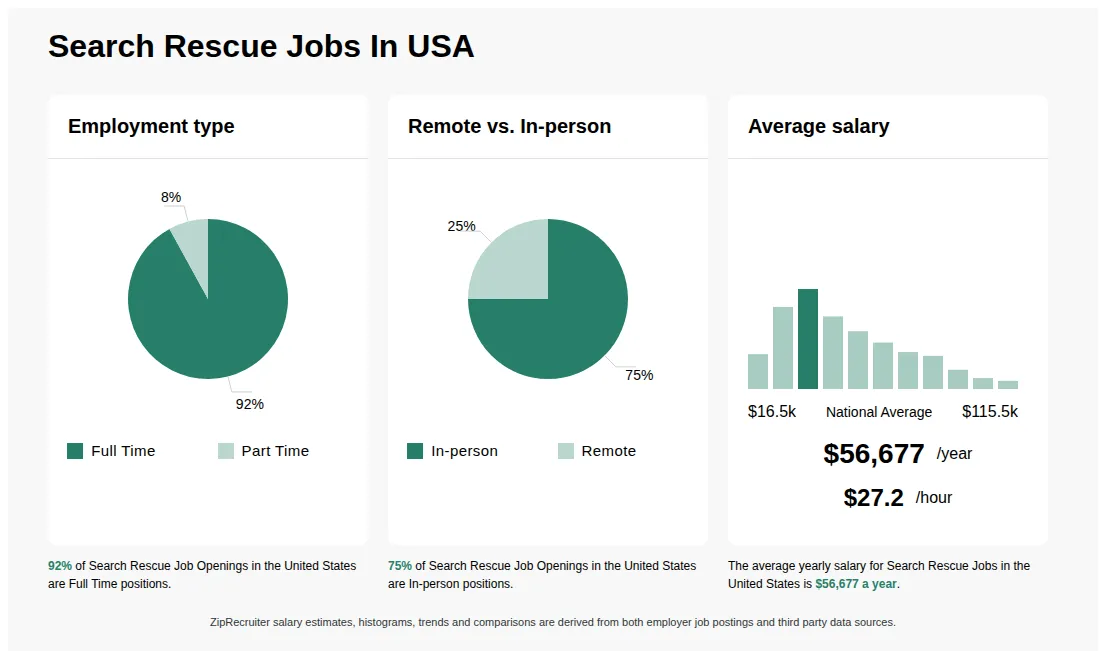
As of Sep 3, 2026, the average yearly pay for search rescue in the United States is $56,677.00, according to ZipRecruiter salary data. Most workers in this role earn between $35,000.00 and $70,500.00 per year, depending on experience, location, and employer.

What is a search and rescue professional?

Search and Rescue (SAR) professionals are trained individuals who locate and assist people who are lost, injured, or in danger, often in remote or hazardous environments. Their work may involve searching for missing hikers, rescuing disaster victims, or providing emergency medical assistance. SAR teams can include volunteers and professionals from various backgrounds such as law enforcement, firefighting, emergency medical services, and the military. Their operations often require specialized skills like navigation, first aid, and survival techniques. These professionals play a crucial role in responding to emergencies and saving lives.

What are jobs in search and rescue?

Jobs in search & rescue, often abbreviated to SAR, involve supervising, training, planning, and coordinating SAR missions and crews that provide on-call support for emergencies and disasters. The duties and responsibilities of these jobs focus on directing staff during rescue efforts as well as volunteers who are helping search for missing people. These positions are found in law enforcement, national parks, the military, and even some non-profit organizations. SAR missions involve using planes, boats, or other exploration devices to traverse terrain, track signals, and otherwise locate people who need rescuing. Job qualifications include strong leadership and communication skills.

What are the key skills and qualifications needed to thrive as a search and rescue professional?

To thrive as a Search and Rescue professional, you need strong physical fitness, situational awareness, and knowledge of emergency response procedures, often backed by certifications such as EMT or wilderness first responder. Familiarity with GPS navigation, radio communication equipment, and rescue tools like ropes and stretchers is essential. Excellent teamwork, problem-solving abilities, and the capacity to remain calm under pressure are crucial soft skills in this field. These skills ensure effective coordination, quick decision-making, and successful outcomes in high-stress, life-saving situations.

What are some common challenges faced by professionals in search and rescue roles, and how can new team members prepare for them?

Search and Rescue professionals often encounter physically demanding environments, unpredictable weather, and high-stress situations requiring quick decision-making. New team members should be prepared for irregular hours, including nights and weekends, and the need to work collaboratively with multidisciplinary teams such as emergency medical personnel and local law enforcement. Building strong physical fitness, staying current on technical rescue skills, and developing effective communication abilities are key to overcoming these challenges and contributing successfully to the team.

What is the difference between Search Rescue vs Search and Rescue Technician?

AspectSearch RescueSearch and Rescue Technician
CertificationsFirst aid, CPR, basic rescue trainingAdvanced rescue certifications, technical rescue training
Work EnvironmentOutdoor, varied terrains, emergency situationsOutdoor, technical rescue scenarios, often specialized
Employer & IndustryGovernment agencies, NGOs, militaryEmergency services, specialized rescue teams
Search & Comparison IntentGeneral search and rescue rolesTechnical rescue operations, specialized skills

Search Rescue involves basic to intermediate rescue efforts in outdoor environments, often performed by volunteers or general emergency personnel. Search and Rescue Technicians typically have advanced training and perform technical rescues in complex scenarios. While both roles focus on saving lives, Search and Rescue Technicians require specialized skills and certifications for technical rescue operations.

Can I get paid for search and rescue?

Search and rescue personnel are often paid employees, especially when working for government agencies, emergency services, or contracted organizations. Compensation varies based on the agency, location, experience, and whether the role is full-time or volunteer; paid positions typically include benefits and require training and certifications such as first aid or technical rescue skills.

What qualifications do you need to be a search and rescue?

To become a search and rescue professional, candidates typically need a high school diploma or equivalent, relevant certifications such as CPR and first aid, and specialized training in rescue techniques, navigation, and survival skills. Physical fitness, the ability to work in challenging environments, and often certification in areas like wilderness or urban rescue are also important.

What cities are hiring for Search Rescue jobs?

Cities with the most Search Rescue job openings:

What are the most commonly searched types of Search Rescue jobs?

The most popular types of Search Rescue jobs are:

What states have the most Search Rescue jobs?

States with the most job openings for Search Rescue jobs include:

What job categories do people searching Search Rescue jobs look for?

The top searched job categories for Search Rescue jobs are:

Infographic showing various Search Rescue job openings in the United States as of August 2026, with employment types broken down into 100% Full Time. Highlights an 100% In-person job distribution, with an average salary of $56,677 per year, or $27.2 per hour.

Fire Rescue Firefighter-Paramedic

Polk County Board of County Commissioners

Bartow, FL โ€ข On-site

$52K - $63K/yr

Other

Medical, Dental, Vision, Life, Retirement, PTO

This job post hasย expired 2 days ago.ย Applications are no longer accepted.


Job description


FIREFIGHTER-PARAMEDIC
(Fire Rescue Division)
******$15,000 SIGN ON BONUS******
*****Submit/upload all credentials at time of application. See minimum qualifications.*****
****KELLY DAY October 2026****
Pay grade: F22
Salary info: $52,071.04 - $63,670.40 /year (includes normal overtime & holiday pay)
+ $2.82/ hr Functioning paramedic incentive
+ $1.75/ hr "Seat pay" when assigned to a Transport Unit
Additional salary steps based on years of experience - 1 additional Step for each year up to Step 5.
(Polk County Fire Rescue salary steps range from 0-12)
Health Benefits Package, Paid Holidays, FRS Pension Plan for Special Risk
24-hour shifts
1 shift on, 2 shifts off rotation
Employee Benefits
Direct Deposit, Bi-Weekly Pay Checks
Medical, Dental, Vision
Life Insurance
FRS Retirement (Special Risk)
10 Paid Holidays
Paid Time Off
Tuition Reimbursement
Education Incentives
Deferred Compensation Plan
Wellness Incentives
Employee Assistance Program (EAP)
Free Employee Gym
Free Employee Health Clinic
Please take a moment to enjoy this short video about Polk County Fire Rescue.
*** This position is covered by a collective bargaining agreement ***
**This position may require a physical ability/agility test**
No CPAT required for firefighter/paramedics from a Career Department (Lateral Transfers) with two (2) years of experience
Must have the physical, developmental and mental ability to perform job tasks, work efforts, responsibilities and duties of the job illustrated. The job description herein provides for the range of duties to be performed for this position. It is not intended to reflect all duties that are required within this position.
MAJOR FUNCTION
This is responsible technical and skilled work in firefighting and paramedicine work in rendering out of hospital life support functions, other emergency care and rescue services including the preservation of life and protection of property against fire and related hazards. Duties include the operation and maintenance of Fire Rescue Division vehicles and equipment.
ILLUSTRATIVE DUTIES
Administers out of hospital emergency, fire rescue, medical care services, and advanced life support. Under supervision of Fire Rescue Medical Director or a physician, performs the following by protocol and standing orders: defibrillate a pulse less non-breathing patient, administers intravenous electrolyte or glucose solutions, surgical cricothyrotomy on adult complete airway obstruction, needle cricothyrotomy on pediatric complete airway obstruction, intra osseous infusion on the pediatric arrest/trauma alert patient, performs gastric/tracheal suction by intubation, endotracheal intubation, administers injections, documents controlled substance use, and performs other procedures as allowed by emergency medical service rules and regulations and/or by the Fire Rescue Medical Director. Must comply with the Polk County Fire Rescue Blood Borne Pathogen Exposure Control Plan. Work involves responsibility for the protection of life and property through firefighting and rescue operations, usually under close supervision. Employees of this class are also required to learn and participate in the operation of firefighting equipment and apparatus. Although firefighting and emergency rescue work, including the administration of emergency medical treatment, are the most difficult and responsible areas of activity, a major portion of time is spent on pre-fire surveys; training, studying methods, techniques and organization of firefighting and on routine duties in the care and maintenance of Fire Department property and equipment. Work involves an element of personal danger and requires working on extended shifts. Work is usually performed in accordance with explicit instructions and well-defined procedures; however, satisfactory performance of the work requires initiative and a thorough individual understanding of the methods, equipment and principles of firefighting, fire prevention, rescue and emergency medical techniques in meeting a wide variety of emergencies.
Firefighters with appropriate specialized training may work in the assignment of Hazardous Materials Technician, Technical Rescue Member, Apparatus Operator/Driver or assigned to an Emergency Medical Unit.
Responds to alarms of fire or other emergencies; dons personal protective equipment; works in enclosed areas; lays and connects hoses; holds nozzles which direct water streams; raises and climbs ladders; uses chemical extinguishers, bars, hooks, lines and other equipment.
Responds to alarms of fire or other emergencies in commercial, residential and multiple story structures; climbs stairs carrying a myriad of firefighting tools or emergency medical equipment; performs search and rescue techniques for locating building occupants; operates and controls building fire suppression systems; operates building elevators under fire service control.
Responds to alarms of fire or other emergencies often performing duties for an extended period of time while wearing self-contained breathing apparatus in high temperatures and with limited vision.
Ventilates structures in accordance with applied knowledge; removes victims from serious auto accidents, structures on fire, or other dangerous situations; administers emergency medical care to injured persons; performs property conservation (salvage) operations; assists in cleanup operation after the fire is suppressed.
May be assigned as a driver of a vehicle or apparatus; checks radio operability; responsible for maintaining apparatus, equipment, inventory and other logs; may communicate by radio from fire, rescue and other emergency scenes. May be assigned as the operator of a heavy- duty diesel-powered pumper truck or aerial truck; directs hose connections at pump; operates pumps, making sure proper pressure and water flow is maintained; operates aerial ladder or snorkel power lift.
Operates fire apparatus to and from the fire or rescue scene over the optimal route at high speeds in the safest and most efficient manner in accordance with departmental policy. Participates in the on-duty company physical fitness program.
Participates in fire drills and attends training classes in firefighting, emergency medical techniques and related subjects; participates in pre-fire surveys of industrial and other business buildings, hospitals, nursing homes, schools and multi-family dwellings; prepares floor plans, records and locates key items on floor plans of facilities for departmental use in the event of fires, disasters or other emergencies.
Performs general maintenance and cleaning work in the upkeep of apparatus, equipment, furnishings and structures.
Aids in the evacuation of portions of the County during natural or other disasters. Assists law enforcement agencies in the investigation of arson cases. Performs related work as assigned.
KNOWLEDGE, ABILITIES AND SKILLS
Knowledge of emergency care procedures, cardio-pulmonary resuscitation and the use of life sustaining equipment and practices. Knowledge of safety, comfort matters/methods in the handling and treatment of patients. Knowledge of Florida safety requirements and privileges when responding to non-emergency and emergency calls. Knowledge of Florida traffic and driving regulations. Knowledge of and skill in defensive driving methods. Ability to become familiar with the roadway/highway systems within Polk County. Ability to communicate effectively both orally and in writing. Must be able to read, write clearly using rules of punctuation, grammar, diction, and style. Must be able to read, write, and speak the English language in an understandable manner. Must be able to compute portions, ratios, percentages, calculate surfaces, volumes, weights, and measures. Ability to work as a team player. Ability to make sound judgments.
Using proper body mechanics, ability to lift and carry one end of a stretcher holding patients weighing an average of 150 pounds frequently, with an upward range of 300 pounds infrequently not including the weight of the stretcher. Ability to exert an excess of 100 pounds of force occasionally, and/or in excess of 50 pounds frequently, and/or in excess of 20 pounds of force constantly to move objects. Physical demand requirements are in excess of those for heavy work. Ability to adhere to physician instructions, protocol, and standing orders.
Ability to physically and mentally perform a variety of various emergency duties under extreme conditions. Ability to distinguish colors. Ability and skill to perform minor maintenance and/or repairs on various fire rescue vehicles and equipment. Knowledge of all pieces of patient care equipment and ambulance vehicle operation. Ability to relate use and care of such equipment. Ability to learn and follow the current Fire Rescue Critical Care Guidelines for patient care, as well as all Fire Rescue policies, procedures and Standard Operating Procedures (SOP).
Ability to analyze situations quickly and objectively and to determine the proper course of action. Ability to react quickly and calmly under emergency conditions.
Ability to become familiar with the roadway/highway systems within Polk County. Skill and dexterity in the use and manipulation of tools and apparatus used in fighting fires and performing emergency medical care. Ability to learn and efficiently perform a wide variety of firefighting and rescue duties, methods and techniques. Ability to climb stairs in multiple story buildings carrying heavy tools and equipment.
Ability to perform physically demanding duties such as carrying victims; hoisting equipment using ropes; using heavy equipment to force entry into or ventilation of structures; use of hand and mechanical tools to extricate patients of automobile accidents.
Ability to establish and maintain effective working relationships as necessitated by the work. Ability to climb ladders and work at considerable heights.
Ability to understand and execute complex oral and written instructions quickly. Ability to perform limited mechanical work involved in maintaining firefighting and rescue apparatus, equipment and tools.
Ability to work as a part of a team and to exercise independent judgment as required. Ability to cope with stressful situations firmly, courteously and tactfully, and with respect for the rights of others. Ability to drive or operate large fire rescue vehicles in a safe and efficient manner.
*****Submit/upload all professional credentials at time of application*****
MINIMUM QUALIFICATIONS
Graduate of an accredited high school or possess an acceptable equivalency diploma and have a valid Certificate of Compliance as outlined in the Florida Division of State Fire Marshal Uniform Fire Safety Rules and Standards Chapter 69A-37, or a verification letter indicating that the individual meets the above requirements and will be issued a Certificate of Compliance from the Florida Division of State Fire Marshal, Bureau of Fire Standards and Training Office. Must possess and maintain a valid certification card as a Paramedic issued by the State of Florida Department of Health and:
A. Is at least 18 years of age.
B. Certifies under oath that he/she is not addicted to alcohol or any controlled substance.
C. Certifies under oath that he/she is free from any physical or mental defect or disease that might impair his/her ability to drive an ambulance and perform his/her duties.
D. Meets the requirements in Florida Statute 401.281 as this position may be required to drive an advanced life support vehicle in the event of an emergency.
E. Meet the following driving history requirements:
  1. Have not accrued 12 points within 24 months or 18 points within 36 months.
  2. Have not been convicted on alcohol/drug related offenses within 36 mounts.
  3. Have not been convicted of two (2) alcohol/drug related offenses within 10 years.
  4. Have not had a suspension, revocation, or restriction due to moving violations or alcohol/ drug related problem, including failure to take a breath test within the 36 months prior.
  5. Must provide proof of insurance when required to use their personal vehicle as part of their daily job duties.
F. Possess a valid American Heart Association CPR "BLS for Health Care Providers" card or the American Red Cross Professional CPR card or American Heart Association (AHA) or American Safety and Health Institute (ASHI)
G. Possess a valid American Heart Association Advanced Cardiac Life Support provider or instructor card.
H. Must have a valid driver's license and be able to secure a valid Florida driver's license at the time of employment.
I. Possess the following National Incident Management System (NIMS) certifications:
  1. ICS-100: Introduction to the Incident Command System
  2. ICS-200: ICS for Single Resources and Initial Action Incidents
  3. IS-700: National Incident Management System, An Introduction
  4. IS-800: National Response Framework, an Introduction

J. Certification by the Polk County Office of Medical Direction to function as a paramedic under the license of the Polk County Fire Rescue Medical Director
SPECIAL REQUIREMENTS
Must obtain and maintain Federal Bureau of Investigations (FBI) Criminal Justice Information Services (CJIS) Security Awareness certification through the Florida Department of Law Enforcement (FDLE). Employees hired into this position after January 1, 2013, must obtain and maintain this certification as a condition of employment.
Applicant/employee shall be fingerprinted and subject to personal background investigation procedures to ascertain an evaluation and determination of moral character according to Chapter 69A-37 Firefighters Standards and Training.
Must be able to add, subtract, multiply, and divide all units of measure. Work requires lifting very heavy weight occasionally, heavy weight frequently and moderate weight constantly. Ability to cope