1

Risk Adjustment Coder Jobs in Texas (NOW HIRING)

Risk Adjustment Coding Auditor

Prosper, TX · On-site

$25 - $28.50/hr

This role will be occupied by a certified risk adjustment coder to support first and second pass auditing for CMS RADV's. Required skillset: MS Suite CPC certified CRC certified 5+ years of risk ...

Auditor, Risk Adjustment

Dallas, TX · Remote

$82K - $108K/yr

The Associate, Risk Adjustment Auditor conducts internal and external quality audits ... Quality audits are specific to ICD-10 code abstraction relative to accuracy, completeness, and ...

Certified Medical Coder

Houston, TX · On-site

$21.50 - $29.25/hr

Follows CMS Risk Adjustment guidelines and has a complete understanding of their real-world ... Codes all diagnoses and services accurately and completely, from the medical record in accordance ...

Certified Medical Coder

Houston, TX

$21.50 - $29.25/hr

Follows CMS Risk Adjustment guidelines and has a complete understanding of their real-world ... Codes all diagnoses and services accurately and completely, from the medical record in accordance ...

Value Based Coder II

Houston, TX · On-site

$25.30 - $35.74/hr

Job Requirements 2+ years of experience in outpatient coding 2+ years focused on risk adjustment ... and HCC principles. Advanced knowledge of CPT and ICD-10 coding, with significant expertise in HCC ...

next page

Showing results 1-20

Risk Adjustment Coder information

See Texas salary details

$14

$25

$40

How much do risk adjustment coder jobs pay per hour?

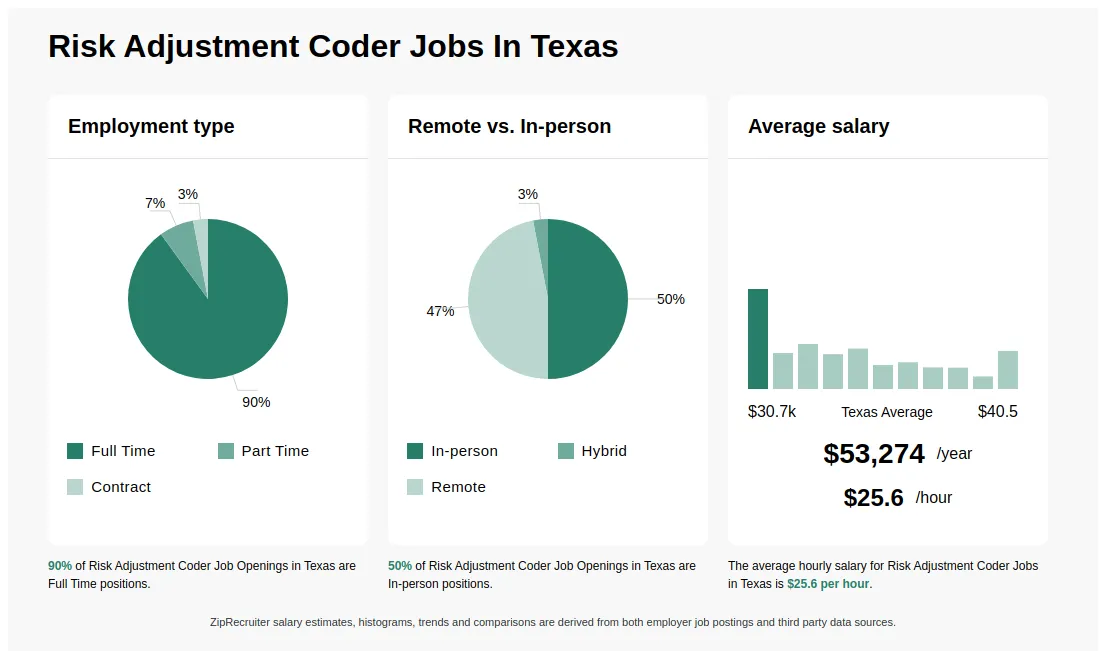
As of Aug 20, 2026, the average hourly pay for risk adjustment coder in Texas is $25.61, according to ZipRecruiter salary data. Most workers in this role earn between $17.69 and $32.26 per hour, depending on experience, location, and employer.

What is a risk adjustment coder?

Risk Adjustment Coders are healthcare professionals who review and analyze patient medical records to ensure accurate coding of diagnoses and procedures for risk adjustment purposes. Their work is crucial for health plans and providers, as it affects reimbursement rates and compliance with government programs like Medicare Advantage and the Affordable Care Act. These coders use specialized knowledge of coding systems, such as ICD-10, to assign appropriate codes that reflect patients’ health status and help organizations receive proper funding for patient care.

What are the key skills and qualifications needed to thrive as a risk adjustment coder, and why are they important?

To thrive as a Risk Adjustment Coder, you need a solid understanding of medical coding (especially ICD-10-CM), healthcare regulations, and risk adjustment methodologies, typically supported by certifications like CRC or CPC. Proficiency with coding software, electronic health records (EHR) systems, and auditing tools is essential. Attention to detail, analytical thinking, and strong organizational skills set top performers apart in this role. These competencies ensure accurate coding, compliance, and optimal reimbursement for healthcare organizations.

What are some common challenges faced by risk adjustment coders, and how can they be overcome?

Risk Adjustment Coders often encounter challenges such as interpreting complex medical documentation and ensuring accurate code assignment to reflect patient risk profiles. Keeping up with frequent updates to coding guidelines and payer requirements can also be demanding. To overcome these challenges, coders should engage in continuous education, actively participate in team discussions to clarify ambiguities, and utilize available coding resources or auditing tools. Strong communication with providers and attention to detail are key to maintaining compliance and high-quality coding standards.

What is the difference between Risk Adjustment Coder vs Medical Coder?

AspectRisk Adjustment CoderMedical Coder
CertificationsCPR, RHIT, CCS, or CPC often preferredCCS, CPC, or CPC-H
Work EnvironmentHealthcare facilities, insurance companies, remoteHospitals, clinics, physician offices
Industry UsageHealth plans, risk adjustment programsGeneral medical billing and coding

Both Risk Adjustment Coders and Medical Coders require similar certifications and work in healthcare settings. However, Risk Adjustment Coders focus on coding for risk adjustment models used by insurance companies, while Medical Coders handle broader medical billing and coding tasks. Understanding these differences helps professionals choose the right career path and employers.

How much do risk adjustment coders make in the US?

Risk adjustment coders in the US typically earn between $50,000 and $75,000 annually, depending on experience, certification, and location. Experienced coders with certifications like CPC or CCS may earn higher salaries, especially in healthcare hubs or with specialized skills in coding software and compliance.

How to become a risk adjustment coder?

To become a risk adjustment coder, individuals typically need a high school diploma or equivalent, followed by specialized training in medical coding and risk adjustment principles. Certification through organizations like the American Academy of Professional Coders (AAPC) or the American Health Information Management Association (AHIMA) is often required or preferred, and proficiency with coding tools and medical record review is essential.

Is risk adjustment coding a good career?

Risk adjustment coding is a growing field within healthcare that involves reviewing medical records and assigning codes to accurately reflect patient health status for insurance purposes. It requires knowledge of medical terminology, coding systems like ICD-10, and often certification such as CPC, making it a stable career with opportunities for advancement and specialization.

What are the most commonly searched types of Risk Adjustment Coder jobs in Texas?

The most popular types of Risk Adjustment Coder jobs in Texas are:

What cities in Texas are hiring for Risk Adjustment Coder jobs?

Cities in Texas with the most Risk Adjustment Coder job openings:

Infographic showing various Risk Adjustment Coder job openings in Texas as of August 2026, with employment types broken down into 96% Full Time, 2% Part Time, and 2% Temporary. Highlights an 63% In-person, 2% Hybrid, and 35% Remote job distribution, with an average salary of $53,274 per year, or $25.6 per hour.

Risk Adjustment Coding Auditor

Vytwo

Prosper, TX • On-site

$25 - $28.50/hr

Full-time

Re-posted 10 days ago


Job description

Role type: Risk Adjustment Coding Auditor
Quantity of resources: 2
Duration: 6 months
JD: This role will be occupied by a certified risk adjustment coder to support first and second pass auditing for CMS RADV's.
Required skillset:
MS Suite
CPC certified
CRC certified
5+ years of risk adjustment experience