1

Revit Api Jobs (NOW HIRING)

The Revit API Developer builds the Revit add-ins and Revit-integrated desktop applications that connect our customers' design environment to the Stratus platform. Reporting to the Director of ...

... API's (Application Programing Interface) with the appropriate IDE (Integrated Development Environment) for TP Mechanical Plugins. d. Resolve and correct any Revit issues/bugs identified by ...

... Revit API ( C#, Dynamo scripting or Python) 3. Experience with 3D Model handling, BIM data workflow, and file formats ( RVT, IFC, etc) 4. Understanding of ACC / Cloud computing platform. 5. Good ...

Responsibilities : • Develop custom plugins, add-ins, and scripts across the Autodesk suite (AutoCAD, Revit, Inventor, or Fusion). • Architect and maintain custom API layers to seamlessly sync CA ...

Experience in model automations using Revit API * Experience leading a small team for rapid technical solution rollout * Experience interfacing with construction and cost control on quantity takeoffs ...

Working knowledge of Autodesk Revit API, Dynamo, and/or Grasshopper is a plus * Proficiency in Microsoft Office Suite; experience with Adobe Creative Cloud is preferred

Be Seen First

BIM Specialist

Bellevue, WA · On-site

$35 - $50/hr

Revit API familiarity * Advanced parametric family creation and optimization * Experience with BIM standards, shared parameters, templates, coordinate systems, and model QA/QC processes Company ...

BIM Specialist

$70K - $90K/yr

Revit, AutoCAD, BIM 360, Autodesk Construction Cloud, and Navisworks, Dynamo, Python or Grasshopper, and an understanding of the Revit API Salary: * $70,000-$90,000 depending on education, skill ...

next page

Showing results 1-20

Revit Api information

See salary details

$39K

$72.8K

$113K

How much do revit api jobs pay per year?

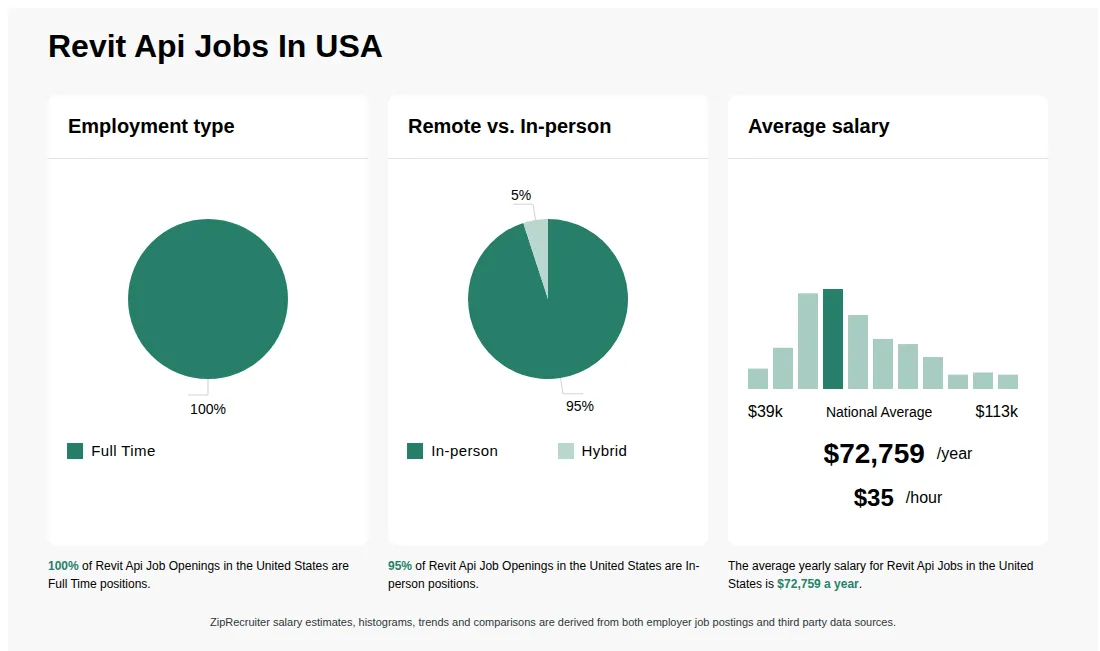
As of Jul 11, 2026, the average yearly pay for revit api in the United States is $72,759.00, according to ZipRecruiter salary data. Most workers in this role earn between $57,500.00 and $81,000.00 per year, depending on experience, location, and employer.

What are the key skills and qualifications needed to thrive in the Revit Api position, and why are they important?

To excel working with the Revit API, you generally need a strong background in software development, experience with programming languages such as C# or Python, and a solid understanding of Autodesk Revit and Building Information Modeling (BIM) concepts. Proficiency in using development environments like Visual Studio and familiarity with Autodesk’s Revit API documentation are essential, and certifications in Autodesk products or software development may be advantageous. Effective problem-solving skills, attention to detail, and the ability to collaborate with architects, engineers, and other stakeholders are valuable soft skills. These qualifications are crucial for successfully automating Revit workflows, developing custom tools, and enhancing productivity within AEC (Architecture, Engineering, Construction) project teams.


What types of projects and daily tasks does a Revit API specialist typically work on?

A Revit API specialist commonly develops custom add-ins, automates repetitive modeling tasks, and integrates Revit with other project management or analysis tools to streamline BIM workflows. Daily responsibilities may include writing and debugging code, collaborating with architects and engineers to understand project requirements, and providing technical support for improving design processes. Projects could range from creating parametric family generators to linking Revit with databases or visualization platforms. This role offers the opportunity to work on cutting-edge solutions that can significantly impact the productivity and efficiency of design teams within architecture, engineering, and construction environments.

What is a Revit API job?

A Revit API job involves using Autodesk Revit's Application Programming Interface (API) to develop custom plugins, automate tasks, and extend Revit’s functionality. Professionals in this role typically write code in C# or Python to manipulate Revit models, create parametric workflows, or integrate with other software. These jobs are common in architecture, engineering, and construction industries, where efficiency and customization are crucial.

More about Revit Api jobs
What cities are hiring for Revit Api jobs? Cities with the most Revit Api job openings:
What are the most commonly searched types of Revit Api jobs? The most popular types of Revit Api jobs are:
What states have the most Revit Api jobs? States with the most job openings for Revit Api jobs include:
Infographic showing various Revit Api job openings in the United States as of July 2026, with employment types broken down into 91% Full Time, 3% Part Time, and 6% Contract. Highlights an 77% Physical, 4% Hybrid, and 19% Remote job distribution, with an average salary of $72,759 per year, or $35 per hour.

Full-time

Medical, Retirement, PTO

Posted 24 days ago


Job description

Stratus, deriving from the Latin term meaning 'layer', offers an advanced set of MEP specific solutions that seamlessly layer across a contractor's entire workflow from design to fabrication to installation. Our team of seasoned industry experts, skilled technology leaders, innovators, and entrepreneurs understands that fabrication does not occur in isolation, and increasingly, it may not happen within your own fabrication shop. Through close relationships with our customers-who include some of the most innovative and largest MEP contractors-we have developed a suite of Stratus tools to digitize, automate, and optimize piping, plumbing, sheet metal, and electrical contracting. Stratus provides the software layer an MEP Contractor needs to optimize profits with true "Data Driven Contracting."
GENERAL DESCRIPTION:
The Revit API Developer builds the Revit add-ins and Revit-integrated desktop applications that connect our customers' design environment to the Stratus platform. Reporting to the Director of Engineering, this role spans our desktop application portfolio - all of which runs through, or integrates tightly with, Autodesk Revit. You'll write production C#/.NET code against the Revit API and work across the full set of Revit-integrated applications we build and continue to ship.
We are an AI-forward engineering team. We expect every engineer to use AI-assisted development tooling (Claude Code, Cursor, Copilot, and the like) as a first-class part of the dev loop - and to exercise sharp judgment about when AI output is shippable, when it needs rework, and when it should be thrown away.
These are C#/.NET desktop applications built on the Revit API. The right candidate is pragmatic, customer-focused, and takes pride in building reliable desktop tools that our customers depend on.
KEY RESPONSIBILITIES:
  • Design, build, and ship features across our Revit add-ins and Revit-integrated desktop applications that connect our customers' Autodesk design environment to the Stratus platform.
  • Use AI-assisted development tooling (Claude Code, Cursor, Copilot, etc.) as a first-class part of the dev loop - writing tests for AI-generated changes and exercising clear judgment about when AI output is ready to ship.
  • Write production C#/.NET code against the Revit API: custom commands, panels, external events, document and transaction management, and integration with Autodesk model data.
  • Own and improve the publishing add-in that exports data from Revit into the Stratus Core application - including data mapping, fidelity, validation, and the error handling that keeps exports trustworthy.
  • Interface with the Stratus open API and understand our data export pipeline - including how data flows through our Azure ServiceBus and other backend services - to build and troubleshoot the integrations that move data out of Revit.
  • Solve the hard problems of desktop add-in development - Revit version compatibility, performance inside large models, the API threading model, and graceful degradation when the host environment misbehaves.
  • Build and manage the deployment of these desktop applications - installers (MSIs), versioning, and update mechanisms across customer environments.
  • Investigate and fix customer-reported bugs across the desktop applications, including the failure modes specific to Revit add-ins.
  • Collaborate with product leadership, engineering teams, and customer-facing teams to scope, design, and ship - grounding technical decisions in real design and fabrication workflows.
  • Implement and maintain automated testing for the desktop applications, and advocate for incremental, reliable delivery.
  • Stay current on the Autodesk Revit API and the broader Autodesk Platform Services ecosystem, and bring that judgment to how we build.

QUALIFICATIONS:
Required:
  • 5+ years of software engineering experience - with 3+ years of that experience building production applications with the Autodesk Revit API
  • Hands-on use of AI-assisted development tooling (Claude Code, Cursor, Copilot, or equivalent) as a first-class part of your daily workflow, with clear judgment about when AI output ships, needs rework, or should be thrown away.
  • Strong proficiency in C#/.NET, with demonstrated production ownership of real features - not prototypes.
  • Direct, hands-on experience building Revit add-ins and the realities of the Revit API: the document and transaction lifecycle, external events, the threading model, version compatibility, and performance inside large models.
  • Desktop application development experience - including building installers (MSIs) and managing the packaging, deployment, and updating of desktop software across customer environments.
  • Working familiarity with the broader Autodesk application family (e.g., AutoCAD, Fabrication, BIM 360 / ACC, Navisworks) and how Stratus-style tools integrate with them.
  • Solid software engineering fundamentals - debugging through complex systems, reproducing edge cases, and finding root causes in code you didn't write.
  • Comfortable integrating a desktop application with backend services and APIs; working understanding of how the client and the platform talk to each other.
  • Excellent communication; able to work directly with product managers, designers, and customers to triage and scope work.
  • Able to walk into an existing codebase and become productive quickly, asking sharp questions where the gaps are.

Nice to Have:
  • Experience with Autodesk Platform Services (formerly Forge) - Data Management, Model Derivative, Design Automation, or related APIs.
  • Full-stack development experience - comfortable contributing to web frontends and backend services beyond the desktop application.
  • Domain knowledge of MEP, BIM, or construction fabrication workflows, or an architectural/AEC engineering background.
  • Experience with automated testing strategies for desktop and add-in software.

BENEFITS:
  • Comprehensive and competitive health benefits plan
  • Matching 401k contributions
  • 20 days annual PTO
  • Primarily remote work with occasional annual team onsites.

This is a remote role, but candidates must be based in the U.S.
E-VERIFY STATEMENT
Stratus participates in E-Verify. After you join the team, we'll verify your eligibility to work in the U.S. by submitting information from your Form I-9 to the Social Security Administration and, if needed, the Department of Homeland Security. This process happens post-hire only - we never use E-Verify to pre-screen applicants.
E-Verify Notice
Right to Work Notice