1

Research Software Engineer Jobs (NOW HIRING)

RTX BBN Networking and Cyber Technologies group is looking for a Research Software Engineer, Formal Methods with strong software development skills and an interest in security and resilience of large ...

Sr. Engineer, Research Software Location: San Jose, CA (on-site) Ayar Labs is shattering AI data bottlenecks by moving data at the speed of light. As pioneers of co-packaged optics (CPO), we are ...

Sr. Engineer, Research Software Location: San Jose, CA (on-site) Ayar Labs is shattering AI data bottlenecks by moving data at the speed of light. As pioneers of co-packaged optics (CPO), we are ...

Sr. Engineer, Research Software Location: San Jose, CA (on-site) Ayar Labs is shattering AI data bottlenecks by moving data at the speed of light. As pioneers of co-packaged optics (CPO), we are ...

RTX BBN Technologies is looking for a Cyber Research Software Engineer to develop systems and software to deter and defeat our Nation's adversaries. At RTX BBN Technologies, we develop creative cyber ...

next page

Showing results 1-20

Research Software Engineer information

See salary details

$111.5K

$206K

How much do research software engineer jobs pay per year?

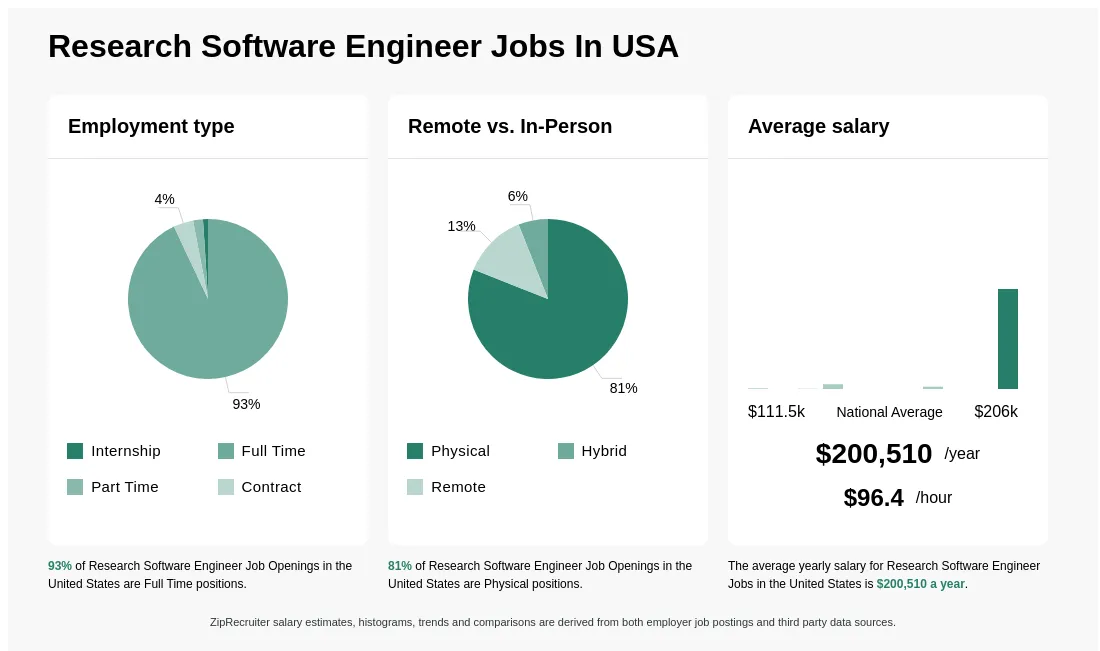
As of Jun 4, 2026, the average yearly pay for research software engineer in the United States is $200,510.00, according to ZipRecruiter salary data. Most workers in this role earn between $205,000.00 and $205,000.00 per year, depending on experience, location, and employer.

What is a Research Software Engineer job?

A Research Software Engineer (RSE) combines expertise in software development and research to create, maintain, and optimize software used in scientific or academic projects. They work closely with researchers to develop efficient, reliable, and reproducible software solutions for data analysis, simulations, or machine learning. RSEs bridge the gap between research and software engineering, ensuring that computational tools meet the needs of scientific investigations. Their role may involve coding, performance optimization, software sustainability, and deploying applications on high-performance computing or cloud platforms.

What are the key skills and qualifications needed to thrive in the Research Software Engineer position, and why are they important?

To thrive as a Research Software Engineer, you need strong programming skills (often in Python, C++, or Java), a solid understanding of algorithms, and an academic or industry background in computer science or a related field. Familiarity with version control systems like Git, cloud platforms, and experience using scientific computing libraries and frameworks are valuable, while a master's or Ph.D. can be advantageous for specialized roles. Excellent problem-solving, communication, and collaborative skills help in working closely with researchers and multidisciplinary teams. These capabilities are crucial for successfully translating complex research problems into robust, reproducible software solutions that advance scientific inquiry.

What are some typical daily responsibilities for a Research Software Engineer?

As a Research Software Engineer, your daily work often involves designing and implementing software to support cutting-edge research projects, collaborating with scientists to understand their computational needs, and ensuring code reliability and reproducibility. You may spend time optimizing algorithms, writing unit tests, documenting software, and participating in code reviews within a collaborative team environment. Additionally, you might help deploy research applications on high-performance or cloud computing platforms and contribute to research publications. Balancing independent programming tasks with ongoing communication is key to making meaningful contributions to both the research and software development processes.
What cities are hiring for Research Software Engineer jobs? Cities with the most Research Software Engineer job openings:
What are the most commonly searched types of Research Software Engineer jobs? The most popular types of Research Software Engineer jobs are:
Who are the top companies hiring for Research Software Engineer jobs? The top employers for Research Software Engineer jobs are:
What states have the most Research Software Engineer jobs? States with the most job openings for Research Software Engineer jobs include:
Infographic showing various Research Software Engineer job openings in the United States as of May 2026, with employment types broken down into 92% Full Time, 7% Part Time, and 1% Contract. Highlights an 88% Physical, 3% Hybrid, and 9% Remote job distribution, with an average salary of $200,510 per year, or $96.4 per hour.
Principal Research Software Engineer

Principal Research Software Engineer

Microsoft Corporation

Redmond, WA • On-site

$151K - $202K/yr

Other

This job post has expired today. Applications are no longer accepted.


Microsoft rating

8.6

Company rating: 8.6 out of 10

Based on 125 frontline employees who took The Breakroom Quiz

47th of 185 rated software companies


Job description

Overview

Microsoft Research (MSR) is a multidisciplinary global organization creating scientific knowledge and delivering innovation for positive human impact at scale. We work with scientific, engineering, academic, and business partners to apply machine learning and Artificial Intelligence (AI) to advance economics, health, and society.

The Microsoft Research Americas Engineering team is hiring a Principal Research Software Engineer to provide technical leadership and direct technical contribution as an individual contributor on the AI Agentic Core Team. Our mission is to accelerate the path from research to product by building AI-driven systems, workflows, and platforms that help researchers and product teams move faster from exploration to real-world impact. In this role, you will collaborate with engineers, researchers, and product teams to build high-impact systems spanning early-stage prototypes through production-ready tools, services, and experiences, while modernizing how we design, build, evaluate, and ship software across Microsoft Research Americas and beyond.

This role is well suited for engineers who enjoy moving across layers-from product experiences and services to data, cloud infrastructure, and AI-enabled workflows-and who are energized by applying AI to real engineering and product problems. Deep expertise in how models work is valuable but not required to be effective in this role.

At Microsoft, our mission-to empower every person and every organization on the planet to achieve more-guides how we partner with customers to deliver trusted, impactful solutions. With a growth mindset culture, we innovate responsibly and measure success by shared progress-people, teams, and customers. Join us to do meaningful work that changes the world and helps shape what's next for everyone.

Responsibilities

Research-to-Product Engineering & Technical Leadership

  • Design, develop, and ship systems that transition Microsoft Research (MSR) concepts into production-quality tools, services, and product capabilities, owning the end-to-end engineering lifecycle from prototype to scalable, maintainable software.

  • Build robust solutions spanning product experiences, Application Programming Interfaces (APIs), data pipelines, model integration layers, and cloud infrastructure that connect research prototypes to real product environments.

  • Partner with MSR researchers and Microsoft product teams to align engineering efforts with research priorities, identifying reusable components and shared architectures that amplify impact across projects and labs.

  • Provide technical direction, mentor engineers, and guide architecture and design decisions, upholding best practices for code quality, security, privacy, testing, observability, and reproducibility.

  • Help shape the team's engineering culture, long-term strategy, and adoption of modern AI-driven engineering practices.

AI Agentic Systems & Accelerated Research Pipeline

  • Define and implement AI-driven processes that accelerate how research moves into products, applying Large Language Models (LLMs), agentic workflows, and modern developer tooling to improve experimentation, implementation, testing, evaluation, documentation, and iterative refinement.

  • Design and integrate agentic AI frameworks and LLM-based pipelines into research tools and engineering workflows, building systems that coordinate AI agents for complex tasks such as code generation, evaluation, debugging, and refinement.

  • Develop tool-use and function-calling architectures that enable AI systems to interact with codebases, APIs, and data sources.

  • Apply modern AI engineering practices-including prompt design, retrieval-augmented generation, and evaluation frameworks.

  • Contribute to model experimentation and adaptation, such as fine-tuning, where appropriate to the project.

Qualifications

Required Qualifications

  • Bachelor's Degree in Computer Science or related technical field AND 6+ years technical engineering experience with coding in languages including, but not limited to, Python, Rust, C++, C#, C, Java, JavaScript

  • OR equivalent experience.

Preferred Qualifications

  • Master's Degree or Ph.D. in Computer Science, Operations Research, Applied Mathematics, or a related field AND 10+ years of technical engineering experience

  • OR Bachelor's Degree AND 12+ years of equivalent experience

  • OR equivalent experience.

  • Experience applying Artificial Intelligence (AI) or Machine Learning (ML) to real systems, products, or engineering workflows, with working knowledge of how modern models are trained, adapted, evaluated, optimized, or deployed, and the curiosity and ability to learn quickly across unfamiliar domains.

  • Familiarity with several of the following: agentic AI frameworks, tool use and function calling, prompt engineering, retrieval-augmented generation, evaluation frameworks, model fine-tuning or post-training, observability, and AI-assisted code generation.

  • Demonstrated engineering fundamentals and broad technical range, with experience designing, building, and shipping software systems, taking ambiguous, early-stage ideas from prototypes through production across layers such as user-facing experiences, Application Programming Interfaces (APIs) and services, data workflows, cloud systems, and model integration.

  • Experience providing technical leadership across cross-functional efforts-defining direction, mentoring engineers, and driving execution on complex projects-and building systems that balance speed of experimentation with production requirements such as reliability, security, privacy, and maintainability.

  • Proficiency with a major cloud and AI platform stack; experience with Azure, Azure AI services, and Copilot-based tools.

  • Contributions to research papers, patents, or open-source projects at the intersection of engineering and research.

#Research #MSRR

Software Engineering IC5 - The typical base pay range for this role across the U.S. is USD $139,900 - $274,800 per year. There is a different range applicable to specific work locations, within the San Francisco Bay area and New York City metropolitan area, and the base pay range for this role in those locations is USD $188,000 - $304,200 per year.

Certain roles may be eligible for benefits and other compensation. Find additional benefits and pay information here:

https://careers.microsoft.com/us/en/us-corporate-pay

This position will be open for a minimum of 5 days, with applications accepted on an ongoing basis until the position is filled.

Microsoft is an equal opportunity employer. All qualified applicants will receive consideration for employment without regard to age, ancestry, citizenship, color, family or medical care leave, gender identity or expression, genetic information, immigration status, marital status, medical condition, national origin, physical or mental disability, political affiliation, protected veteran or military status, race, ethnicity, religion, sex (including pregnancy), sexual orientation, or any other characteristic protected by applicable local laws, regulations and ordinances. If you need assistance with religious accommodations and/or a reasonable accommodation due to a disability during the application process, read more about requesting accommodations. (https://careers.microsoft.com/v2/global/en/accessibility.html)


What Microsoft employees say

Pay

Benefits

Hours and flexibility

Workplace

Get the full story on Breakroom


Microsoft logo

About Microsoft

Sourced by ZipRecruiter

Our infrastructure is comprised of a large global portfolio of more than 100 datacenters and 1 million servers. Our foundation is built upon and managed by a team of subject matter experts working to support services for more than 1 billion customers and 20 million businesses in over 90 countries worldwide. With environmental sustainability and optimization at the forefront of our datacenter design and operations, we continue to grow and evolve as we meet the ever-changing business demands that hold Microsoft as a world-class cloud provider.

Industry

Computer and computer peripheral equipment and software wholesalers

Company size

10,000+ Employees

Headquarters location

Redmond, WA, US

Year founded

1975

Social media