2

Remote Systems Engineer Jobs in New York (NOW HIRING)

Provides advice and consultation to engineering teams regarding system engineering principles and system level requirements ofproducts. Actively participates in decision making processes that involve ...

Senior Systems Engineer

Manhattan, NY ยท On-site +1

$114K - $156K/yr

A minimum of 3 years UNIX/Linux, Mac OS X and Windows system administration experience. * Engineering level knowledge of standard CG, compositing and color grading applications (Maya, Houdini, Flame ...

If you don't know us yet, we are an engineering company working on different projects in telecommunications, space, defence and security. You will be part of our team, full of talent and desire to ...

The Show Systems Engineer III is a specialist within the Control Engineering department, focused on show control systems. They will expand the show control capabilities of the general control team ...

Security Systems Design Engineer

Monroe, NJ ยท On-site +1

$105K - $130K/yr

Security Systems Design Engineer At Salas O'Brien we tell our clients that we're engineered for ... New Jersey or New York (HYBRID) Or REMOTE Travel : Some travel to US sites. Compensation & Benefits:

Showing results 21-40

Remote Systems Engineer information

See New York salary details

$58.5K

$139.2K

$182.7K

How much do remote systems engineer jobs pay per year?

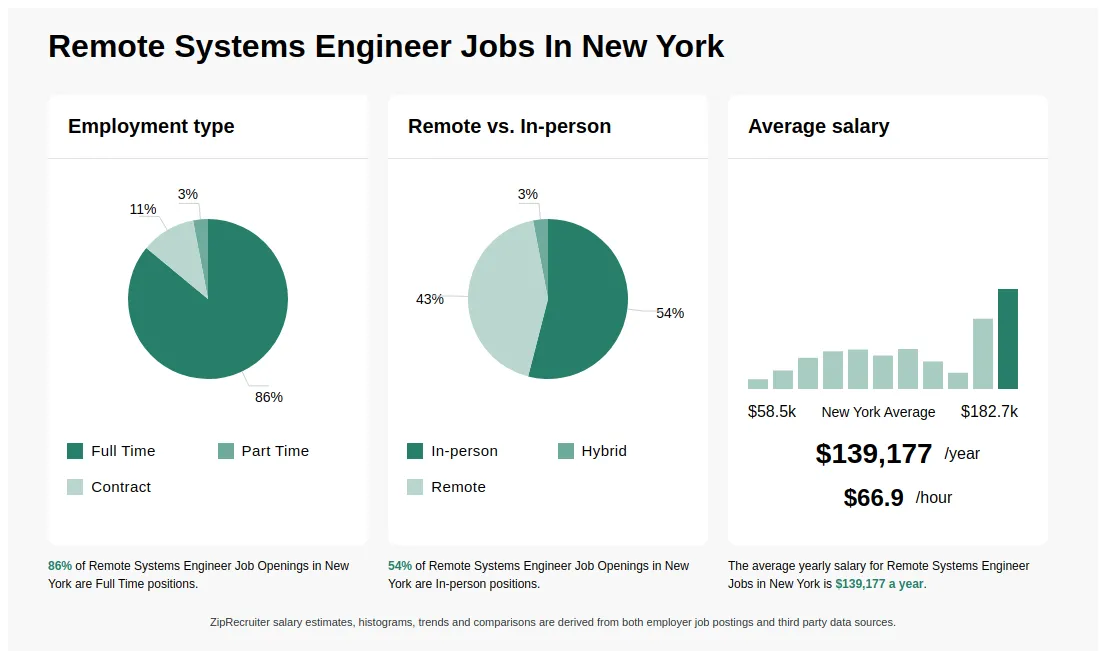
As of Jul 29, 2026, the average yearly pay for remote systems engineer in New York is $139,177.00, according to ZipRecruiter salary data. Most workers in this role earn between $107,200.00 and $171,800.00 per year, depending on experience, location, and employer.

What is a Remote Systems Engineer?

A Remote Systems Engineer is an IT professional who designs, implements, manages, and maintains computer systems and networks for organizations while working from a remote location. They ensure that systems are reliable, secure, and perform optimally, often troubleshooting issues and deploying updates without being physically present onsite. Remote Systems Engineers typically use remote access tools to monitor systems, collaborate with teams, and provide technical support. Their work is essential for companies with distributed workforces or cloud-based infrastructure.

What Does a Remote Systems Engineer Do?

The job of a remote systems engineer is to develop, test, and maintain a computer network system for a company. Your duties include implementing updates, handling technical issues (including connectivity issues and VPN setup), performing system administration tasks, documenting changes, preparing reports, and developing new infrastructure as needed. Your responsibilities as a remote systems engineer are to ensure the software system and network connectivity meet the needs of the business environment and provide user support. This is a work from home position that involves coordinating with IT and management.

How does a Remote Systems Engineer typically collaborate with on-site IT teams and other departments?

As a Remote Systems Engineer, you will frequently coordinate with on-site IT staff and cross-functional teams through virtual meetings, project management tools, and shared documentation. Effective communication and clear documentation are crucial, as you may not be physically present to troubleshoot or implement solutions. You can expect to rely heavily on remote access tools and cloud-based platforms to monitor, maintain, and update systems. Building strong relationships with team members and setting clear expectations helps ensure seamless collaboration and project success, even from a distance.

What are the key skills and qualifications needed to thrive as a Remote Systems Engineer, and why are they important?

To thrive as a Remote Systems Engineer, you need a strong background in computer science, systems administration, and network management, often supported by a relevant degree or certifications such as CompTIA Network+ or Microsoft Certified: Azure Administrator. Proficiency with cloud platforms (e.g., AWS, Azure), automation tools (like Ansible or Puppet), and monitoring systems is typically required. Excellent problem-solving, communication, and time-management skills help in collaborating with distributed teams and resolving issues independently. These skills and qualities are crucial for maintaining reliable system operations and ensuring seamless remote support in a distributed work environment.
What are the most commonly searched types of Systems Engineer jobs in New York? The most popular types of Systems Engineer jobs in New York are:
What job categories do people searching Remote Systems Engineer jobs in New York look for? The top searched job categories for Remote Systems Engineer jobs in New York are:
What cities in New York are hiring for Remote Systems Engineer jobs? Cities in New York with the most Remote Systems Engineer job openings:
Infographic showing various Remote Systems Engineer job openings in New York as of July 2026, with employment types broken down into 88% Full Time, and 12% Contract. Highlights an 100% Remote job distribution, with an average salary of $139,177 per year, or $66.9 per hour.

Medical Device Systems Engineer

AVTC Group

Parsippany, NJ โ€ข On-site, Remote

Full-time

Posted 5 days ago


Job description

ob Summary:
Highly experienced, cross-functionally skilled technical leader (electrical/software/mechanical) responsible for the system level architecture/design, implementation and verification of complex systems (e.g. defibrillators, patient monitors, ventilators) in a matrix setting.
Essential Functions:
  • Works with Project/Program management to establish and refine system level requirements for assigned new and enhanced products.
  • Leads development team in translating system level requirements into product architecture and system level design including partitioning functionality into sub-systems, creating specifications for each sub-system and documenting the interface requirements among the sub-system.
  • Ensures that new product architecture meets system level requirements, is appropriately featured, robust and adaptable enough to support product lifecycle plans and objectives.
  • Establishes performance, interface, safety, and cost specifications for each sub- system within the selected architecture in consultation with the functional design leaders. Contributes significantly to the system level risk management activities associated with assigned programs.
  • Under auspices of the Program Manager, leads efforts to allocate system functionality among electronic/software/mechanical subsystems, make hardware/software/mechanical trade-off decisions, cost/time/performance trade-off and safety decisions necessary to meet the product's clinical performance, reliability, manufacturability/serviceability, regulatory and business objectives.
  • Leads efforts during the product implementation phase to develop and refine the system level design, identify and resolve sub-system performance and interface issues, and resolve crossโ€ขfunctional design issues that have system level impacts.
  • Leads/oversees team efforts during the subsystem integration and verification testing phases to ensure that critical sub-systems meet their individual performance, interface and system integration goals and to ensure that the fully integrated system robustly meets its performance, safety and cost requirements.
  • Responsible for documenting the system level design, operating principles and sub-system interface specifications for his/her assigned new and existing products.
  • Researches and documents the relationships between clinical requirements, architectural decisions, performance requirements and product evolution plans.
  • Provides advice and consultation to engineering teams regarding system engineering principles and system level requirements ofproducts. Actively participates in decision making processes that involve changes to the system level design of existing products.

Skills Requirements:
  • Extensive knowledge and experience in the system level design and development of multiโ€ขprocessor based medical instruments containing biomedical signal acquisition and processing electronics and embedded software systems.
  • Demonstrated ability to translate high level product requirements into system and sub- system level specifications and designs.
  • Demonstrated success leading engineering teams in the architecture, system level design, integration and verification of portable, battery operated, multi-processor based measuring and/or patient treatment systems.
  • Working knowledge and experience with low level analog signal acquisition, digital/microprocessor systems design, power supplies, embedded real time software development, digital signal processing, real time operating systems, Analog/digital control systems, displays, batteries, data storage and wireless communications systems.
  • Working knowledge of mechanical engineering issues and processes associated with electronics packaging, small moving mechanisms, molding, and machining processes.
  • Ability to independently analyze and evaluate electronic circuitry, software and mechanical designs using drawings, schematics, source code, technical education, and experience.
  • Thorough understanding of the product development and engineering project management processes.
  • Experience with and sensitivity to human factors issues associated with the use of medical devices.
  • Knowledge and experience developing products under FDA and European Community medical device regulations and standards.
  • Excellent verbal and written communications skills. Demonstrated success in technical decision making and people management/leadership in a matrix environment.
  • Ability to handle confidential information with discretion and skill.
  • Business acumen.

Required/Preferred Education and Experience:
  • Advanced degree in Engineering including training and experience in systems, electronics, software and mechanical engineering.
  • 10+ years' experience developing electronic hardware and embedded software systems/subsystems for complex, real time measuring instruments.
  • 7+ years' experience as a Systems Engineer, leading the architectural design and systems engineering of complex, real time medical measuring instruments.
  • Knowledge of fluid mechanics and/or past experience with ventilators/aspirators is required.
  • Project management experience and training.