This is a remote position based in Oregon and travel is required. Why Comagine Health? Comagine ... Clinical documentation review expertise, including use of the Oregon Health Plan Prioritized List ...
This is a remote position based in Oregon and travel is required. Why Comagine Health? Comagine ... Clinical documentation review expertise, including use of the Oregon Health Plan Prioritized List ...
Senior Hospitalist Clinical Reviewer Job Type: Contractor Location: Remote Job Overview We are seeking experienced Senior Hospitalist Clinical Reviewers to support a high-impact project focused on ...
Quick apply
Senior Hospitalist Clinical Reviewer Job Type: Contractor Location: Remote Job Overview We are seeking experienced Senior Hospitalist Clinical Reviewers to support a high-impact project focused on ...

This position is REMOTE within US Only - Equipment provided Required Schedule: Monday - Friday, 8:00 AM - 5:00 PM PST (Pacific West Coast) The Clinical Reviewer supports the WISeR Prior Authorization ...
This position is REMOTE within US Only - Equipment provided Required Schedule: Monday - Friday, 8:00 AM - 5:00 PM PST (Pacific West Coast) The Clinical Reviewer supports the WISeR Prior Authorization ...

As well as, aids and acts as a resource to Initial Clinical Reviewers. What You Will Be Doing ... Active Board Certification in Cardiology, Vascular Surgery or Adult Congenital Heart Disease
As well as, aids and acts as a resource to Initial Clinical Reviewers. What You Will Be Doing ... Active Board Certification in Cardiology, Vascular Surgery or Adult Congenital Heart Disease
This position is REMOTE within US Only - Equipment provided Required Schedule: Monday - Friday, 8:00 AM - 5:00 PM PST (Pacific West Coast) The Clinical Reviewer supports the WISeR Prior Authorization ...
This position is REMOTE within US Only - Equipment provided Required Schedule: Monday - Friday, 8:00 AM - 5:00 PM PST (Pacific West Coast) The Clinical Reviewer supports the WISeR Prior Authorization ...
As well as, aids and acts as a resource to Initial Clinical Reviewers. What You Will Be Doing ... Active Board Certification in Cardiology, Vascular Surgery or Adult Congenital Heart Disease
As well as, aids and acts as a resource to Initial Clinical Reviewers. What You Will Be Doing ... Active Board Certification in Cardiology, Vascular Surgery or Adult Congenital Heart Disease
Sr Hospitalist Clinical Reviewer - Remote
Houston, TX · Remote
$70 - $100/hr
Senior Hospitalist Clinical Reviewer Job Type: Contractor Location: Remote Job Overview We are seeking experienced Senior Hospitalist Clinical Reviewers to support a high-impact project focused on ...
Quick apply
Sr Hospitalist Clinical Reviewer - Remote
Houston, TX · Remote
$70 - $100/hr
Senior Hospitalist Clinical Reviewer Job Type: Contractor Location: Remote Job Overview We are seeking experienced Senior Hospitalist Clinical Reviewers to support a high-impact project focused on ...
Sr Hospitalist Clinical Reviewer - Remote
Palo Alto, CA · Remote
$70 - $100/hr
Senior Hospitalist Clinical Reviewer Job Type: Contractor Location: Remote Job Overview We are seeking experienced Senior Hospitalist Clinical Reviewers to support a high-impact project focused on ...
Quick apply
Sr Hospitalist Clinical Reviewer - Remote
Palo Alto, CA · Remote
$70 - $100/hr
Senior Hospitalist Clinical Reviewer Job Type: Contractor Location: Remote Job Overview We are seeking experienced Senior Hospitalist Clinical Reviewers to support a high-impact project focused on ...
Remote Job Overview We are seeking experienced Senior Hospitalist Clinical Reviewers to support a high-impact project focused on inpatient clinical quality, documentation accuracy, and medical review
Quick apply
Remote Job Overview We are seeking experienced Senior Hospitalist Clinical Reviewers to support a high-impact project focused on inpatient clinical quality, documentation accuracy, and medical review
Sr Hospitalist Clinical Reviewer - Remote
Boston, MA · Remote
$70 - $100/hr
Senior Hospitalist Clinical Reviewer Job Type: Contractor Location: Remote Job Overview We are seeking experienced Senior Hospitalist Clinical Reviewers to support a high-impact project focused on ...
Quick apply
Sr Hospitalist Clinical Reviewer - Remote
Boston, MA · Remote
$70 - $100/hr
Senior Hospitalist Clinical Reviewer Job Type: Contractor Location: Remote Job Overview We are seeking experienced Senior Hospitalist Clinical Reviewers to support a high-impact project focused on ...
Sr Hospitalist Clinical Reviewer - Remote
San Jose, CA · Remote
$146.50 - $193.50/hr
Senior Hospitalist Clinical Reviewer Job Type: Contractor Location: Remote Job Overview We are seeking experienced Senior Hospitalist Clinical Reviewers to support a high-impact project focused on ...
Quick apply
Sr Hospitalist Clinical Reviewer - Remote
San Jose, CA · Remote
$146.50 - $193.50/hr
Senior Hospitalist Clinical Reviewer Job Type: Contractor Location: Remote Job Overview We are seeking experienced Senior Hospitalist Clinical Reviewers to support a high-impact project focused on ...
Sr Hospitalist Clinical Reviewer - Remote
Philadelphia, PA · Remote
$70 - $100/hr
Senior Hospitalist Clinical Reviewer Job Type: Contractor Location: Remote Job Overview We are seeking experienced Senior Hospitalist Clinical Reviewers to support a high-impact project focused on ...
Quick apply
Sr Hospitalist Clinical Reviewer - Remote
Philadelphia, PA · Remote
$70 - $100/hr
Senior Hospitalist Clinical Reviewer Job Type: Contractor Location: Remote Job Overview We are seeking experienced Senior Hospitalist Clinical Reviewers to support a high-impact project focused on ...
Sr Hospitalist Clinical Reviewer - Remote
Miami, FL · Remote
$70 - $100/hr
Senior Hospitalist Clinical Reviewer Job Type: Contractor Location: Remote Job Overview We are seeking experienced Senior Hospitalist Clinical Reviewers to support a high-impact project focused on ...
Quick apply
Sr Hospitalist Clinical Reviewer - Remote
Miami, FL · Remote
$70 - $100/hr
Senior Hospitalist Clinical Reviewer Job Type: Contractor Location: Remote Job Overview We are seeking experienced Senior Hospitalist Clinical Reviewers to support a high-impact project focused on ...
Sr Hospitalist Clinical Reviewer - Remote
Dallas, TX · Remote
$70 - $100/hr
Senior Hospitalist Clinical Reviewer Job Type: Contractor Location: Remote Job Overview We are seeking experienced Senior Hospitalist Clinical Reviewers to support a high-impact project focused on ...
Quick apply
Sr Hospitalist Clinical Reviewer - Remote
Dallas, TX · Remote
$70 - $100/hr
Senior Hospitalist Clinical Reviewer Job Type: Contractor Location: Remote Job Overview We are seeking experienced Senior Hospitalist Clinical Reviewers to support a high-impact project focused on ...
Clinical Reviewer, OT
$95K - $105K/yr
Clinical Reviewer, OT We are looking for a licensed Occupational Therapist (OT) who has expertise ... Fully remote opportunity with about x% travel Medical, dental, vision, life, disability insurance ...
Clinical Reviewer, OT
$95K - $105K/yr
Clinical Reviewer, OT We are looking for a licensed Occupational Therapist (OT) who has expertise ... Fully remote opportunity with about x% travel Medical, dental, vision, life, disability insurance ...
Sr Hospitalist Clinical Reviewer - Remote
Atlanta, GA · Remote
$70 - $100/hr
Senior Hospitalist Clinical Reviewer Job Type: Contractor Location: Remote Job Overview We are seeking experienced Senior Hospitalist Clinical Reviewers to support a high-impact project focused on ...
Quick apply
Sr Hospitalist Clinical Reviewer - Remote
Atlanta, GA · Remote
$70 - $100/hr
Senior Hospitalist Clinical Reviewer Job Type: Contractor Location: Remote Job Overview We are seeking experienced Senior Hospitalist Clinical Reviewers to support a high-impact project focused on ...
Sr Hospitalist Clinical Reviewer - Remote
Chicago, IL · Remote
$70 - $100/hr
Senior Hospitalist Clinical Reviewer Job Type: Contractor Location: Remote Job Overview We are seeking experienced Senior Hospitalist Clinical Reviewers to support a high-impact project focused on ...
Quick apply
Sr Hospitalist Clinical Reviewer - Remote
Chicago, IL · Remote
$70 - $100/hr
Senior Hospitalist Clinical Reviewer Job Type: Contractor Location: Remote Job Overview We are seeking experienced Senior Hospitalist Clinical Reviewers to support a high-impact project focused on ...
Sr Hospitalist Clinical Reviewer - Remote
New York, NY · Remote
$70 - $100/hr
Senior Hospitalist Clinical Reviewer Job Type: Contractor Location: Remote Job Overview We are seeking experienced Senior Hospitalist Clinical Reviewers to support a high-impact project focused on ...
Quick apply
Sr Hospitalist Clinical Reviewer - Remote
New York, NY · Remote
$70 - $100/hr
Senior Hospitalist Clinical Reviewer Job Type: Contractor Location: Remote Job Overview We are seeking experienced Senior Hospitalist Clinical Reviewers to support a high-impact project focused on ...
Sr Hospitalist Clinical Reviewer - Remote
Los Angeles, CA · Remote
$70 - $100/hr
Senior Hospitalist Clinical Reviewer Job Type: Contractor Location: Remote Job Overview We are seeking experienced Senior Hospitalist Clinical Reviewers to support a high-impact project focused on ...
Quick apply
Sr Hospitalist Clinical Reviewer - Remote
Los Angeles, CA · Remote
$70 - $100/hr
Senior Hospitalist Clinical Reviewer Job Type: Contractor Location: Remote Job Overview We are seeking experienced Senior Hospitalist Clinical Reviewers to support a high-impact project focused on ...
Sr Hospitalist Clinical Reviewer - Remote
San Francisco, CA · Remote
$70 - $100/hr
Senior Hospitalist Clinical Reviewer Job Type: Contractor Location: Remote Job Overview We are seeking experienced Senior Hospitalist Clinical Reviewers to support a high-impact project focused on ...
Quick apply
Sr Hospitalist Clinical Reviewer - Remote
San Francisco, CA · Remote
$70 - $100/hr
Senior Hospitalist Clinical Reviewer Job Type: Contractor Location: Remote Job Overview We are seeking experienced Senior Hospitalist Clinical Reviewers to support a high-impact project focused on ...
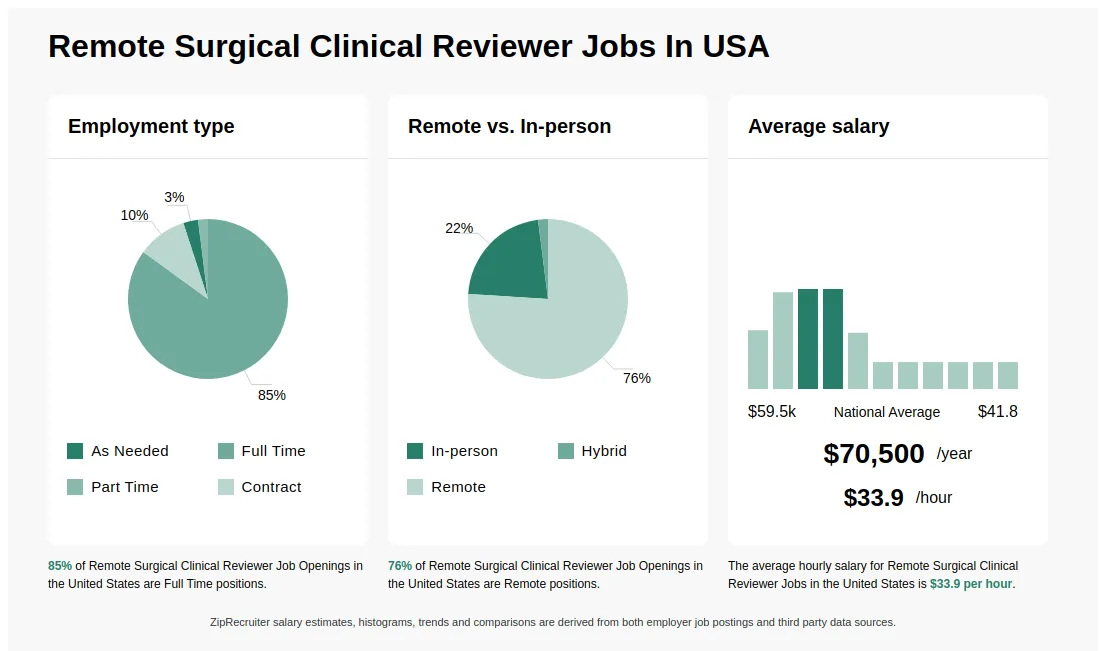
Remote Surgical Clinical Reviewer information
See salary details
$28.61 - $29.81
11% of jobs
$30.80 is the 25th percentile. Wages below this are outliers.
$29.81 - $31.01
17% of jobs
$31.01 - $32.21
18% of jobs
The median wage is $32.46 / hr.
$32.21 - $33.41
18% of jobs
$33.41 - $34.62
10% of jobs
$34.84 is the 75th percentile. Wages above this are outliers.
$34.62 - $35.82
4% of jobs
$35.82 - $37.02
4% of jobs
$37.02 - $38.22
4% of jobs
$38.22 - $39.42
4% of jobs
$39.42 - $40.63
4% of jobs
$40.63 - $41.83
4% of jobs
$28
$33
$41
How much do remote surgical clinical reviewer jobs pay per hour?
As of Sep 14, 2026, the average hourly pay for remote surgical clinical reviewer in the United States is $33.89, according to ZipRecruiter salary data. Most workers in this role earn between $30.77 and $36.54 per hour, depending on experience, location, and employer.
What is a remote surgical clinical reviewer?
A Remote Surgical Clinical Reviewer is a healthcare professional, often a registered nurse, who reviews and analyzes surgical patient records from a remote location. Their main responsibility is to collect, assess, and report data on surgical outcomes, complications, and processes as part of quality improvement or research initiatives. They ensure accurate data entry into databases such as the National Surgical Quality Improvement Program (NSQIP) and help hospitals improve patient care by identifying trends and areas for improvement. This role typically requires strong clinical knowledge, attention to detail, and the ability to work independently using electronic medical records and data systems.
What are the key skills and qualifications needed to thrive as a remote surgical clinical reviewer?
To thrive as a Remote Surgical Clinical Reviewer, you need a strong background in nursing or a clinical field, detailed knowledge of surgical procedures, and often an RN license or equivalent healthcare credential. Familiarity with clinical data abstraction tools, electronic medical records (EMRs), and quality improvement platforms is typically required. Exceptional analytical skills, attention to detail, and clear written communication help reviewers accurately interpret medical records and collaborate with medical teams remotely. These competencies are vital to ensure the integrity of surgical data, support patient safety initiatives, and maintain high standards in surgical outcome reporting.
What are some common challenges faced by remote surgical clinical reviewers, and how can they be managed?
Remote Surgical Clinical Reviewers often encounter challenges such as maintaining accurate data abstraction from diverse electronic health record systems and ensuring HIPAA-compliant data handling. Working remotely, it can also be difficult to coordinate with surgical teams and access complete case information. To manage these challenges, strong organizational skills, effective use of secure communication tools, and proactive collaboration with hospital staff are essential. Regular training on data standards and cybersecurity best practices further supports accuracy and compliance.
What is the difference between Remote Surgical Clinical Reviewer vs Remote Medical Reviewer?
| Aspect | Remote Surgical Clinical Reviewer | Remote Medical Reviewer |
|---|---|---|
| Required Credentials | Medical degree, surgical or clinical experience, licensure | Medical degree, clinical experience, licensure |
| Work Environment | Remote, healthcare or insurance companies | Remote, insurance or healthcare organizations |
| Employer & Industry | Hospitals, insurance companies, healthcare providers | Insurance companies, healthcare organizations |
| Common Search & Comparison | Yes | Yes |
The main difference is that Remote Surgical Clinical Reviewers focus on evaluating surgical cases and procedures, requiring surgical experience, while Remote Medical Reviewers assess general medical claims and cases. Both roles involve remote work, require medical credentials, and are used in healthcare and insurance industries.
More about Remote Surgical Clinical Reviewer jobs
What cities are hiring for Remote Surgical Clinical Reviewer jobs?
Cities with the most Remote Surgical Clinical Reviewer job openings:
What are the most commonly searched types of Surgical Clinical Reviewer jobs?
The most popular types of Surgical Clinical Reviewer jobs are:
What states have the most Remote Surgical Clinical Reviewer jobs?
States with the most job openings for Remote Surgical Clinical Reviewer jobs include:
What are popular job titles related to Remote Surgical Clinical Reviewer jobs?
For Remote Surgical Clinical Reviewer jobs, the most frequently searched job titles are:
Clinical Reviewer
Remote
Comagine
Other
Medical, Dental, Vision, Retirement, PTO
Re-posted 23 days ago
Job description
Behavioral Health Services Reviewer
Are you passionate about improving access to behavioral health services in the community? Do you enjoy using your clinical expertise to evaluate needs, support care decisions, and help individuals receive the right services at the right time?
In this role, you will review clinical documentation to determine medical necessity and appropriateness of services, complete functional needs assessments that evaluate how mental health symptoms impact daily living, and support service coordination that connects children, youth, and adults to in-home and community-based care. You will manage referrals, follow-ups, reviews, and assessments within an electronic medical record system; apply evidence-based criteria to utilization management reviews; document clinical determinations; provide subject matter expertise to stakeholders; support quality activities and audits; and travel for in-person assessments as needed across your assigned region.
If you are someone who demonstrates strong clinical judgment, builds trusting relationships with members and partners, and effectively manages a high-volume workload while meeting timelines, we encourage you to apply. If you bring a collaborative mindset, accountability in your work, curiosity to ask questions and learn, and comfort using technology to navigate systems and documentation, you will be well-positioned for success on this team. This is a remote position based in Oregon and travel is required.
Why Comagine Health?
Comagine Health is a national, mission-driven, nonprofit organization that has engaged in health care quality consulting and quality improvement services for more than 50 years.
We are leaders in assisting front-line providers and engaging health care partners to improve care delivery and patient outcomes.
Our talented remote workforce spans the country and plays a vital role in our success. We go beyond merely providing a remote work option; we support and embrace it. We offer opportunities to make a difference from anywhere in the U.S. and enjoy better work-life balance. An annual stipend gives you the freedom to enhance your workspace with options that suit your needs.
We believe in an environment that allows you to thrive both personally and professionally. That's why we offer benefits that include:
- Medical, dental and vision insurance
- Paid time off for vacation, illness, and volunteering
- Retirement savings plan with employer contribution
- Adoption financial assistance
- Paid parental leave.
- And much more!
You Have (Required Qualifications)
- Current, active, unrestricted clinical licensure as required by the Oregon contract (e.g., RN or behavioral health licensure such as LCSW, LPC, LCPC, LPA, PsyD, PhD)
- Master's in physical or occupational therapy OR Master's in psychology, counseling, or social work OR Bachelor's degree in nursing and licensed by the State of Oregon
- 3 years of clinical (direct patient care) experience; behavioral health preferred
Candidates must reside in Oregon, have personal transportation, and ability to travel. Valid Driver License and Proof of Auto Insurance are required.
You May Have (Desired Qualifications)
- Experience with Medicaid
- Knowledge of the Oregon behavioral health system of care
- 2 years of utilization review or other medical management experience
- 2 years of full-time substance use disorder and/or behavioral health disorder experience
You Bring (Competencies)
- Clinical documentation review expertise, including use of the Oregon Health Plan Prioritized List of Health Services and InterQual
- Strong organizational skills and ability to manage multiple tasks in a team environment
- Excellent oral and written communication skills
- Strong interpersonal and problem-solving skills
- Proficiency with MS Office Suite and familiarity with database software
- Ability to apply clinical review criteria, policies, and guidelines to determine medical necessity
- Ability to document utilization review determinations accurately and timely in designated systems
- Capability to provide clinical and utilization review subject matter expertise and respond to stakeholder questions or concerns
In this Role, You Will
- Review clinical documentation to substantiate medical necessity and appropriateness for requested services
- Perform initial and continued stay reviews using standardized, evidence-based criteria to ensure services align with individualized behavioral health needs
- Apply clinical review criteria, organizational policies, guidelines, and screening tools to determine medical necessity of healthcare services
- Document utilization review determinations accurately and timely in designated systems
- Consult with physician or practitioner reviewers when cases do not meet clinical review criteria
- Refer cases to other clinicians when appropriate
- Provide clinical and utilization review subject matter expertise and respond to stakeholder questions or concerns
- Support quality assurance activities, audits, and other program support as assigned
- Provide guidance or oversight to non-clinical staff performing support activities, as appropriate
- Perform other duties as assigned
- Full-Time
- 100% Remote (Oregon)
- Travel required
- Reliable, secure internet connection required
- Must maintain licensure eligibility for assigned state contract
Equal Opportunity Employer Comagine Health is an equal opportunity employer and is committed to creating a diverse, equitable, and inclusive workplace.
Physical Requirements & Work Environment
This position is primarily remote and performed in a home-based setting, requiring reliable internet access and a workspace free from significant distractions. The role involves frequent use of computers, phones, and virtual communication tools. Employees must be able to sit for extended periods, communicate effectively.
Some positions may require operating a motor vehicle for business purposes; in such cases, employees must maintain a valid driver's license and meet the organization's driving eligibility requirements. Occasional travel may be required for meetings, training, or other work-related events.
Reasonable accommodations will be provided to enable individuals with disabilities to perform essential functions.