2

Remote Sensing Scientist Jobs (NOW HIRING)

Remote Sensing Scientist

Dayton, OH · Remote

$91K - $140K/yr

Position Overview Riverside Research is seeking a full-time Remote Sensing Scientist in support of the National Air and Space Intelligence Center (NASIC) at Wright Patterson AFB, OH. You will be ...

The Senior Hyperspectral Image Scientist will provide subject matter expertise in spectral data ... Integrate hyperspectral analytics with other GEOINT, remote sensing, and intelligence data sources.

Remote Commitment: 40 hours/week Role Responsibilities * Guide research teams to close knowledge ... Develop evaluation frameworks and rubrics for assessing scientific reasoning quality across STEM ...

next page

Showing results 1-20

People also search for

Remote Sensing Scientist information

See salary details

$83.5K

$127K

$171K

How much do remote sensing scientist jobs pay per year?

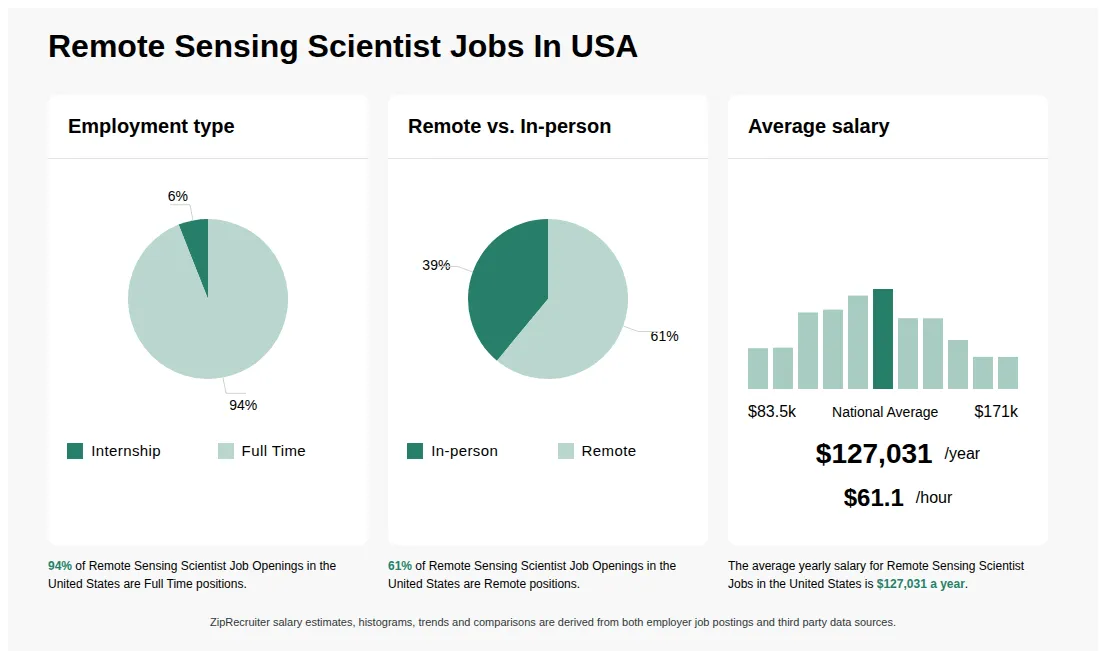
As of Jun 10, 2026, the average yearly pay for remote sensing scientist in the United States is $127,031.00, according to ZipRecruiter salary data. Most workers in this role earn between $109,000.00 and $143,500.00 per year, depending on experience, location, and employer.

How much does remote sensing pay?

Remote sensing scientists typically earn between $60,000 and $110,000 annually, depending on experience, education, and location. Entry-level positions may start lower, while experienced professionals with specialized skills in GIS, satellite imagery analysis, or programming can earn higher salaries.

What is the difference between Remote Sensing Scientist vs GIS Analyst?

AspectRemote Sensing ScientistGIS Analyst
Required CredentialsBachelor's/Master's in Remote Sensing, Geospatial Science, or related fieldsBachelor's/Master's in Geography, GIS, or related fields
Work EnvironmentResearch labs, government agencies, environmental firmsUrban planning, environmental consulting, government agencies
Industry UsageSatellite data analysis, environmental monitoringMapping, spatial data analysis, infrastructure planning
Common Search IntentRemote sensing data interpretation, satellite imagery analysisGIS mapping, spatial data management

While both roles involve geospatial data, Remote Sensing Scientists focus on analyzing satellite and aerial imagery to monitor environmental changes, whereas GIS Analysts primarily work with geographic information systems to create maps and analyze spatial data for planning and decision-making.

What Does a Remote Sensing Scientist Do?

Remote sensing scientists analyze data using sensors to solve problems related to local issues like urban planning to global complications like natural resource management. As a remote sensing scientist, your responsibilities include using statistical analysis or image analysis software to analyze data acquired by aircraft, satellites, and other platforms. You monitor atmospheric changes, better understand geospatial information, and even help influence decision making regarding fair and equitable land use. Remote sensing scientists are closely involved in innumerable fields.

What are the key skills and qualifications needed to thrive as a Remote Sensing Scientist, and why are they important?

To thrive as a Remote Sensing Scientist, you need a strong background in geospatial analysis, image processing, and a relevant degree in fields such as geography, environmental science, or engineering. Familiarity with GIS software (like ArcGIS or QGIS), remote sensing tools (such as ENVI or ERDAS Imagine), and programming languages (Python, R) is typically required. Analytical thinking, attention to detail, and effective communication are crucial soft skills for interpreting data and presenting findings. These competencies are vital for accurately analyzing earth observation data, supporting decision-making, and ensuring the reliability of scientific conclusions.

What are Remote Sensing Scientists?

Remote Sensing Scientists are professionals who use satellite or airborne sensor data to analyze and interpret information about the Earth's surface and atmosphere. They apply techniques from physics, geography, and computer science to process and analyze remotely sensed images for applications such as environmental monitoring, agriculture, urban planning, and disaster management. Their work often involves using software to manipulate geospatial data and create maps or models that inform decision-making. Remote Sensing Scientists may work in government agencies, research institutions, or private industry, and often collaborate with other scientists and engineers.

What are some typical challenges Remote Sensing Scientists face when working with large datasets?

Remote Sensing Scientists often work with massive amounts of satellite or aerial imagery, which can present challenges related to data storage, processing speed, and data quality management. Ensuring the accuracy of image analysis and integrating data from multiple sensor types or platforms can also be complex. To address these issues, scientists frequently rely on high-performance computing, cloud-based platforms, and advanced algorithms for data preprocessing and analysis. Collaborating closely with data engineers and software developers is common to streamline workflow and maintain data integrity.
What cities are hiring for Remote Sensing Scientist jobs? Cities with the most Remote Sensing Scientist job openings:
What states have the most Remote Sensing Scientist jobs? States with the most job openings for Remote Sensing Scientist jobs include:
What job categories do people searching Remote Sensing Scientist jobs look for? The top searched job categories for Remote Sensing Scientist jobs are:
Infographic showing various Remote Sensing Scientist job openings in the United States as of June 2026, with employment types broken down into 100% Full Time. Highlights an 100% Remote job distribution, with an average salary of $127,031 per year, or $61.1 per hour.
Remote Sensing Scientist

Remote Sensing Scientist

Riverside Research

Dayton, OH • Remote

$91K - $140K/yr

Full-time

Posted 19 days ago


Job description

Riverside Overview

Riverside Research is an independent National Security Nonprofit dedicated to research and development in the national interest. We provide high-end technical services, research and development, and prototype solutions to some of the country’s most challenging technical problems. All Riverside Research opportunities require U.S. Citizenship.

Position Overview

Riverside Research is seeking a full-time Remote Sensing Scientist in support of the National Air and Space Intelligence Center (NASIC) at Wright Patterson AFB, OH. You will be working with a team of Riverside Research, government, military, and contractor personnel to apply experience with intelligence analysis and remote sensing technologies to answer specific science, technology, and innovation problems. This work is in support of US Air Force and Intelligence Community programs.

Responsibilities

  • Identify candidate technologies that show promise to disrupt the evolutionary advance of military technologies
  • Assess viability of novel technologies identified and prioritize and/or recommend areas that require more detailed evaluation
  • Prioritize topics of interest; identify both open and classified sources of information on foreign research in relevant topic areas
  • Identify conferences or symposia addressing critical technology
  • Document state of research and leading research actors in relevant candidate technologies
  • Other duties as assigned

Qualifications

Required Qualifications:

  • Active TS/SCI security clearance
  • Bachelor’s degree in Electrical Engineering, Physics, or comparable technical degree; non-technical degree with experience will be considered
  • 4-5 years of experience working with overhead EO-IR data
  • Experience with intelligence community overhead EO-IR data sources
  • Experience with common remote sensing EO-IR data formats

Desired Qualifications:

  • Master's degree in Electrical Engineering, Physics, or comparable technical degree
  • Experience working with spectral and thermal signatures and libraries
  • Knowledge of standard spectral and thermal imaging data formats

Global Comp

$91,000 - $140,000 This represents the typical compensation range for this position based on experience, location and other factors.

Closing Statement

Riverside Research Institute is a not-for-profit, technology-oriented defense company, where service to our customers and support of our staff is our overall mission. Riverside is an affirmative action-equal opportunity employer and complies with all applicable federal, state, and local laws regarding recruitment and hiring. Riverside offers comprehensive compensation and benefit packages to our employees. Riverside bases its employment decisions solely on technical experience, qualifications and other job-related criteria related to our organizational purpose as a not-for-profit company, and without regard to race, color, religion, age, sex marital status, sexual orientation, national origin, physical or mental disability, veteran’s status or any other status legally protected by applicable federal, state, and local law.