2

Remote Rn Case Manager Jobs in Los Angeles, CA (NOW HIRING)

Be Seen First

... Nursing Facility, Assisted Living Facility, · Prior Social Worker, Case Manager, or Care ... Remote Social Worker position is a good fit for you, please reach out to me - feel free to call ...

New

Showing results 41-60

Remote Rn Case Manager information

See Los Angeles, CA salary details

$20

$51

$86

How much do remote rn case manager jobs pay per hour?

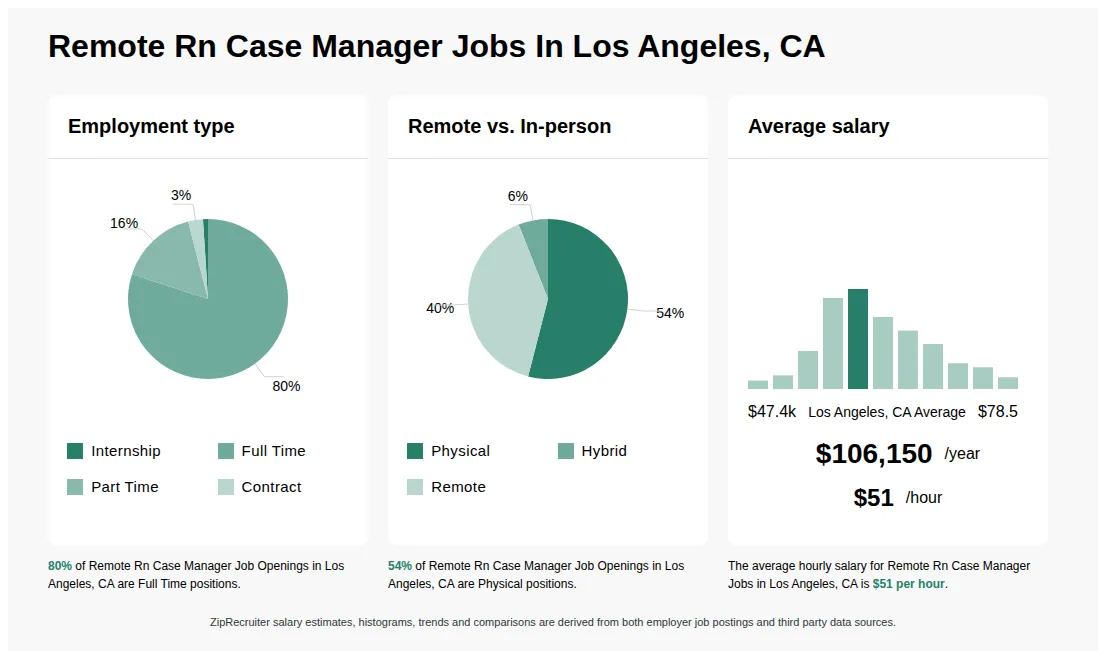
As of Aug 23, 2026, the average hourly pay for remote rn case manager in Los Angeles, CA is $51.22, according to ZipRecruiter salary data. Most workers in this role earn between $38.08 and $61.92 per hour, depending on experience, location, and employer.

What is a remote RN case manager?

A Remote RN Case Manager is a registered nurse who coordinates patient care, manages treatment plans, and advocates for patients—working primarily from a remote location rather than in a traditional healthcare facility. They assess patient needs, communicate with healthcare providers, and help ensure that patients receive timely and appropriate care. Remote RN Case Managers often use technology to monitor patient progress, provide education, and facilitate communication between patients and the healthcare team. This role is crucial in improving patient outcomes, reducing hospital readmissions, and supporting overall healthcare efficiency.

What are the key skills and qualifications needed to thrive as a remote RN case manager?

To thrive as a Remote RN Case Manager, you need a current RN license, strong clinical assessment skills, and experience in case management or care coordination. Familiarity with case management software, telehealth platforms, and electronic health records (EHRs) is typically required. Excellent communication, critical thinking, and self-motivation are standout soft skills for this remote role. These skills ensure effective patient support, accurate care planning, and seamless collaboration with healthcare teams from a distance.

What are some common challenges faced by remote RN case managers, and how can they be addressed?

Remote RN Case Managers often encounter challenges such as maintaining effective communication with patients and interdisciplinary teams, managing caseloads across different time zones, and ensuring patient privacy during virtual interactions. To address these, it is important to leverage secure telehealth platforms, establish regular check-ins with team members, and stay organized with digital case management tools. Continuous professional development in remote communication and time management can also help RN Case Managers thrive in a virtual work environment.

What is the difference between Remote Rn Case Manager vs Remote Lpn Case Manager?

FeatureRemote Rn Case ManagerRemote Lpn Case Manager
CredentialsRegistered Nurse (RN) licenseLicensed Practical Nurse (LPN) license
Work EnvironmentHealthcare facilities, insurance companies, telehealthLong-term care, home health, insurance
Industry UsageWidely used in case management, patient advocacyCommon in basic patient care coordination
Job ResponsibilitiesCare planning, patient advocacy, complex case coordinationBasic patient monitoring, routine care coordination

The main difference between a Remote Rn Case Manager and a Remote Lpn Case Manager lies in their credentials and scope of practice. RNs typically handle more complex cases and have broader responsibilities, while LPNs focus on routine patient care and basic case coordination. Both roles are essential in healthcare, but RNs generally require more advanced training and licensing.

Can remote RN case managers work from home?

Remote RN case managers typically work from home, utilizing electronic health records and communication tools to coordinate patient care. They often need a reliable internet connection, relevant licensure, and sometimes specific certifications, but their role allows for a flexible, home-based work environment.

What job categories do people searching Remote Rn Case Manager jobs in Los Angeles, CA look for?

The top searched job categories for Remote Rn Case Manager jobs in Los Angeles, CA are:

What cities near Los Angeles, CA are hiring for Remote Rn Case Manager jobs?

Cities near Los Angeles, CA with the most Remote Rn Case Manager job openings:

Infographic showing various Remote Rn Case Manager job openings in Los Angeles, CA as of August 2026, with employment types broken down into 74% Full Time, 9% Part Time, and 17% Contract. Highlights an 100% Remote job distribution, with an average salary of $106,532 per year, or $51.2 per hour.

Case Management Assistant - Referrals

Tristar Insurance

Long Beach, CA • On-site, Remote

$18 - $22/hr

Full-time

Re-posted 29 days ago


Job description

This is a remote position.
The preferred hours for this position is 9 am - 5:30 pm Pacific time or 12 pm - 8:30 pm Eastern time.
POSITION SUMMARY:
Work directly with the Supervisor and Manager to provide additional resources for the case management staff. This position does not provide any clinical review or decisions.
This individual is responsible for monitoring incoming correspondence received. The coordinator will ensure the referrals are set up in the case management system and promptly assigned to the case manager. The Referral Coordinator will answer incoming calls, screen, respond and route the calls. This position requires the ability to work independently to meet deadlines, as well as an excellent phone demeanor and a desire to provide exceptional customer service. The position requires knowledge of medical terminology, the understanding of referral criteria by client and/or jurisdictions. The referrals may be for WC Utilization Review and or Case Management services.
Responsibilities of the position include, but are not limited to:
  • Set up of member within the case management system
  • Assist incoming calls to the case management referral department
  • Monitor dedicated referral emails to review for new referrals and correspondence
  • Monitor workflow of referrals and identify areas where daily assistance is needed
  • Work with the branch locations and staff to complete and provide necessary information for referrals
  • Process all referrals and correspondence within 24 hours of receipt
  • Maintain daily/monthly referral logs
  • Identify trends and/or issues in referral patterns and communicate them with management.

***Other duties as assigned
Additional Functions and Responsibilities
  • Demonstrates ability to meet administrative requirements, including productivity, time management and Quality Assurance standards
  • Maintain documentation standards adhering to URAC standards and company policy and procedures
  • Maintain confidentiality- Knowledge of laws and regulations pertaining to HIPPA and PHI
  • Other job duties as assigned

Equipment Operated/Used:
Essential Equipment: Desk, Telephone/Fax, Computer Keyboard, Mouse, System Applications
Essential Tools: Pens, pencil, computer, Keyboard
Essential Vehicles: N/A
Special Equipment or Clothing:
Professional attire adhering to the Company Dress Code
Education: High school diploma required. Medical or Managed Care background preferred and/ or Certified Medical Assistant
Experience: Experience in healthcare and or managed care related fields, Minimum of one year of working in a medical or managed care environment preferred. Medical Terminology preferred.
Knowledge, Skills and Abilities:
  • Experience in healthcare related fields
  • Strong communication skills; customer service mindset; team player.
  • Adheres to professional standards, codes of ethics, system and department policies and procedures.
  • Incorporates the philosophies of continuous quality improvement, customer service and teamwork into daily routine
  • Excellent typing and keyboard skills (35-40wpm)
  • Ability to work in a variety of computer systems proficiently
  • Ability to navigate a Windows environment, utilize Outlook, and the ability to create, edit, save and send documents utilizing Microsoft Word and Microsoft Excel
  • Ability to work within a paperless environment

MENTAL AND PHYSICAL REQUIREMENTS
1. MENTAL EFFORT
a. Reasoning development:
Follow one- or two-step instructions; routine, repetitive task.
Carry out detail but uninvolved written or verbal instructions; deal with a few concrete variables.
Follow written, verbal, or diagrammatic instructions; several concrete variables.
X Solve practical problems; variety of variables with limited standardization; interpret instructions.
Logical or scientific thinking to solve problems; several abstract and concrete variables.
Wide range of intellectual and practical problems; comprehend most obscure concepts.
b. Mathematical development:
Simple additional and subtraction; copying figures, counting, and recording.
Add, subtract, multiply, and divide whole numbers.
X Arithmetic calculations involving fractions, decimals, and percentages.
Arithmetic, algebraic, and geometric calculations.
Advanced mathematical and statistical techniques such as calculus, factor analysis, and probability determination.
Highly complex mathematical and statistical techniques such as calculus, factor analysis, and probability determination; require theoretical application.
c. Language development:
Ability to understand and follow verbal or demonstrated instructions; write identifying information; request supplies verbally or in writing.
Ability to file, post, and mail materials; copy data from one record to another; interview to obtain basic information such as age, occupation, and number of children; guide people and provide basic direction.
Ability to transcribe dictation; make appointments and process mail; write form letters or routine correspondence; interpret written work instructions; interview job applicants.
X Ability to compose original correspondence, follow technical manuals, and have increased contact with people.
Ability to report, write, or edit articles for publication; prepare deeds, contracts or leases, prepare and deliver lectures; interview, counsel, or advise people; evaluate technical data.
2. PHYSICAL EFFORT
a. Physical activity required to perform the job:
Sedentary work: Exerting up to 10 pounds of force occasionally and/or a negligible amount of force frequently or constantly to lift, carry, push, pull, or otherwise move objects. Sedentary work involves sitting most of the time. Jobs are sedentary if walking and standing are required only occasionally and all other sedentary criteria are met.
X Light work:
a. Exerting up to 20 pounds of force occasionally
b. Exerting up to 10 pounds frequently
c. Exerting a negligible amount of force constantly to move objects
(If the use of arm and/or leg controls requires exertion of forces greater than that for Sedentary Work and the worker sits most of the time, the job is rated for Light Work).
Medium work:
a. Exerting up to 50 pounds of force occasionally
b. Exerting up to 20 pounds of force frequently
c. Exerting up to 10 pounds of force constantly to move objects
Heavy work:
a. Exerting up to 100 pounds of force occasionally
b. Exerting up to 50 pounds of force frequently
c. Exerting up to 20 pounds of force constantly to move objects
Very heavy work:
a. Exerting in excess of 100 pounds of force occasionally
b. Exerting in excess of 50 pounds of force constantly to move objects
c. Exerting in excess of 20 pounds of force constantly to move objects
  1. Visual requirements necessary to perform the job:

Far vision: clarity of vision at 20 feet or more
X Near vision: clarity of vision at 20 inches or less
X Mid-range vision: clarity of vision at distances of more than 20 inches and less than 20 feet
Depth perception: the ability to judge distance and space relationships, so as to see objects where and as they actually are
Color vision: ability to identify and distinguish colors
Field of vision: ability to observe an area up or down or to the right or left while eyes are fixed on a given point
2. PHYSICAL EFFORT (cont.)
FREQUENCY
c. Physical activity necessary to perform the job and frequency (e.g., continually, frequently, or occasionally):
Climbing: Ascending or descending ladders, stairs, scaffolding, ramps, poles, and the like, using feet and legs and/or hands and arms. Body agility is emphasized. This factor is important if the amount and kind of climbing required exceeds that required for ordinary locomotion.
Balancing: Maintaining body equilibrium to prevent falling when walking, standing, or crouching on narrow, slippery, or erratically moving surfaces. This factor is important if the amount and kind of balancing exceeds that needed for ordinary locomotion and maintenance of body equilibrium.
Stooping: Bending body downward and forward by bending spine at the waist. This factor is important if it occurs to a considerable degree and requires full use of the lower extremities and back muscles.
Kneeling: Bending legs at knee to come to a rest on knee or knees.
Crouching: Bending the body downward and forward by bending legs and spine.
Crawling: Moving about on hands and knees or hands and feet.
Reaching: Extending hand(s) and arm(s) in any direction.
Standing: Particularly for sustained periods of time.
Walking: Moving about on foot to accomplish tasks, particularly for long distances.
Pushing: Using upper extremities top press against something with steady force in order to thrust forward, downward, or outward.
Pulling: Using upper extremities to extent force in order to drag, haul, or tug objects in a sustained motion.
Foot
Motion: Using feet to push pedals.
Lifting: Raising objects from a lower to a higher position or moving objects horizontally from position to position. This factor is important if it occurs to a considerable degree and requires substantial use of the upper extremities and back muscles.
X Fingering: Picking, pinching, typing, or otherwise working with fingers rather than with the whole hand or arm as in handling.
X Grasping: Applying pressure to an object with the fingers and palm.
Frequently
Occasionally
2. PHYSICAL EFFORT (cont.)
FREQUENCY
X Talking: Expressing or exchanging ideas by means of the spoken word. Those activities in which workers must convey detailed or important spoken instructions to other workers accurately, loudly, or quickly.
X Hearing: Perceiving the nature of sounds with or without correction. Ability to receive detailed information through verbal communication and to make fine discriminations in sound, such as when making find adjustments on machined parts.
Feeling: Perceiving attributes of objects, such as size, shape, temperature, or texture by touching with skin, particularly that of fingertips.
X Repetitive Substantial movements (motions) of the wrists, hands,
Motion: and/or fingers.
Regularly
Regularly
Frequently