We are looking for a Research Scientist to join the Health Science team. This is a deeply collaborative, R&D-oriented role that sits at the intersection of rigorous science and real-world product ...
We are looking for a Research Scientist to join the Health Science team. This is a deeply collaborative, R&D-oriented role that sits at the intersection of rigorous science and real-world product ...
AI Research Scientist
$130K - $200K/yr
We are hiring an AI Research Scientist to advance the frontier of reliable agentic AI. You will be ... • Fully remote within the United States or Canada • Work on East Coast hours • Full-time ...
AI Research Scientist
$130K - $200K/yr
We are hiring an AI Research Scientist to advance the frontier of reliable agentic AI. You will be ... • Fully remote within the United States or Canada • Work on East Coast hours • Full-time ...
Research Scientist
$250K - $285K/yr
About the Role As a Research Scientist, you will conduct deep, original research that advances how the world understands, evaluates, and routes large language models. You'll work with one of the ...
Research Scientist
$250K - $285K/yr
About the Role As a Research Scientist, you will conduct deep, original research that advances how the world understands, evaluates, and routes large language models. You'll work with one of the ...

We're looking for a Research Scientist to lead the analysis and reporting of multilingual safety evaluation results. The role involves identifying patterns in data, creating reports and dashboards ...
We're looking for a Research Scientist to lead the analysis and reporting of multilingual safety evaluation results. The role involves identifying patterns in data, creating reports and dashboards ...
Research Scientist
San Francisco, CA · On-site
$158K - $269K/yr
As a research scientist, you will invent new AI technologies that enable our launch of fully driverless autonomous trucks. You will contribute towards Waabi's vision of a single AI system that learns ...
Research Scientist
San Francisco, CA · On-site
$158K - $269K/yr
As a research scientist, you will invent new AI technologies that enable our launch of fully driverless autonomous trucks. You will contribute towards Waabi's vision of a single AI system that learns ...
Research Scientist
$158K - $269K/yr
As a research scientist, you will invent new AI technologies that enable our launch of fully driverless autonomous trucks. You will contribute towards Waabi's vision of a single AI system that learns ...
Research Scientist
$158K - $269K/yr
As a research scientist, you will invent new AI technologies that enable our launch of fully driverless autonomous trucks. You will contribute towards Waabi's vision of a single AI system that learns ...

Senior Microwave Research Scientist
$126K - $166K/yr
This role will work remote Travel: 25% travel Job ID: 1601 The Role: We are looking for a Senior Microwave Research Scientist. As a Senior Microwave Research Scientist, you'll be part of a cross ...
Senior Microwave Research Scientist
$126K - $166K/yr
This role will work remote Travel: 25% travel Job ID: 1601 The Role: We are looking for a Senior Microwave Research Scientist. As a Senior Microwave Research Scientist, you'll be part of a cross ...

Research Scientist - Theoretical Physics
Raleigh, NC · On-site +1
Engineering & Science Job Schedule: Full time Remote: No Research Scientist - Theoretical Physics The Opportunity As a Research Scientist focused on theoretical physics applications for power system ...
Research Scientist - Theoretical Physics
Raleigh, NC · On-site +1
Engineering & Science Job Schedule: Full time Remote: No Research Scientist - Theoretical Physics The Opportunity As a Research Scientist focused on theoretical physics applications for power system ...

ML Research Scientist - PhD
New York, NY · Remote
$110 - $145/hr
ML Research PhD Experts (ICML / NeurIPS / ICLR Publications) Type: Contract Compensation: $110-$145 ... Remote Role Responsibilities * Evaluate the accuracy and depth of AI-generated content to ...
Quick apply
ML Research Scientist - PhD
New York, NY · Remote
$110 - $145/hr
ML Research PhD Experts (ICML / NeurIPS / ICLR Publications) Type: Contract Compensation: $110-$145 ... Remote Role Responsibilities * Evaluate the accuracy and depth of AI-generated content to ...

Research Scientist Program Manager
New York, NY · On-site +1
$45K - $50K/yr
No We invite applications for a Research Scientist Program Manager (Part-Time, Postdoctoral Level ... Remote or hybrid work arrangements will be considered. Research Analytical Support (~ 55 60% of ...
Research Scientist Program Manager
New York, NY · On-site +1
$45K - $50K/yr
No We invite applications for a Research Scientist Program Manager (Part-Time, Postdoctoral Level ... Remote or hybrid work arrangements will be considered. Research Analytical Support (~ 55 60% of ...

This is a remote-based opportunity. The Research Scientist III works with data, develops preliminary findings, and prepares written reports and data visualizations that supports the research of the ...
This is a remote-based opportunity. The Research Scientist III works with data, develops preliminary findings, and prepares written reports and data visualizations that supports the research of the ...
ML Research Scientist - PhD
San Francisco, CA · Remote
$60 - $100/hr
ML Research PhD Experts (ICML / NeurIPS / ICLR Publications) Type: Contract Compensation: $60-$100 ... Remote Role Responsibilities * Evaluate the accuracy and depth of AI-generated content to ...
Quick apply
ML Research Scientist - PhD
San Francisco, CA · Remote
$60 - $100/hr
ML Research PhD Experts (ICML / NeurIPS / ICLR Publications) Type: Contract Compensation: $60-$100 ... Remote Role Responsibilities * Evaluate the accuracy and depth of AI-generated content to ...

Research Scientist Senior
Chicago, IL · On-site +1
$101K - $129K/yr
Research Scientist Senior Research Scientist Senior This role requires associates to be in-office 1 - 2 days per week, fostering collaboration and connectivity, while providing flexibility to support ...
Research Scientist Senior
Chicago, IL · On-site +1
$101K - $129K/yr
Research Scientist Senior Research Scientist Senior This role requires associates to be in-office 1 - 2 days per week, fostering collaboration and connectivity, while providing flexibility to support ...
This is a remote-based opportunity. The Research Scientist III works with data, develops preliminary findings, and prepares written reports and data visualizations that supports the research of the ...
This is a remote-based opportunity. The Research Scientist III works with data, develops preliminary findings, and prepares written reports and data visualizations that supports the research of the ...
Research Scientist Senior
Atlanta, GA · On-site +1
$94K - $120K/yr
Research Scientist Senior Research Scientist Senior This role requires associates to be in-office 1 - 2 days per week, fostering collaboration and connectivity, while providing flexibility to support ...
Research Scientist Senior
Atlanta, GA · On-site +1
$94K - $120K/yr
Research Scientist Senior Research Scientist Senior This role requires associates to be in-office 1 - 2 days per week, fostering collaboration and connectivity, while providing flexibility to support ...
Research Scientist Senior
Indianapolis, IN · On-site +1
$94K - $120K/yr
Research Scientist Senior Research Scientist Senior This role requires associates to be in-office 1 - 2 days per week, fostering collaboration and connectivity, while providing flexibility to support ...
Research Scientist Senior
Indianapolis, IN · On-site +1
$94K - $120K/yr
Research Scientist Senior Research Scientist Senior This role requires associates to be in-office 1 - 2 days per week, fostering collaboration and connectivity, while providing flexibility to support ...
ML Research Scientist - PhD
New York, NY · Remote
$60 - $100/hr
ML Research PhD Experts (ICML / NeurIPS / ICLR Publications) Type: Contract Compensation: $60-$100 ... Remote Role Responsibilities * Evaluate the accuracy and depth of AI-generated content to ...
Quick apply
ML Research Scientist - PhD
New York, NY · Remote
$60 - $100/hr
ML Research PhD Experts (ICML / NeurIPS / ICLR Publications) Type: Contract Compensation: $60-$100 ... Remote Role Responsibilities * Evaluate the accuracy and depth of AI-generated content to ...

Clinical Research Scientist
$106K - $118K/yr
We are seeking a Clinical Research Scientist to join the Clinical Research Team at InStride Health. This role is ideal for an early-career doctoral level researcher who is passionate about advancing ...
Clinical Research Scientist
$106K - $118K/yr
We are seeking a Clinical Research Scientist to join the Clinical Research Team at InStride Health. This role is ideal for an early-career doctoral level researcher who is passionate about advancing ...

Research Scientist
San Antonio, TX · On-site +1
... scientific content for clinical and regulatory documents. Manages and reviews medical writing of study protocols, statistical analysis and study reports. This is a Cancer Research Position. The ...
Research Scientist
San Antonio, TX · On-site +1
... scientific content for clinical and regulatory documents. Manages and reviews medical writing of study protocols, statistical analysis and study reports. This is a Cancer Research Position. The ...
Research Scientist - Health Economic Modeling Remote, Canada or United States Join Our Dynamic HEOR Team as a Research Scientist! Are you a self-starter with a passion for projects involving ...
Research Scientist - Health Economic Modeling Remote, Canada or United States Join Our Dynamic HEOR Team as a Research Scientist! Are you a self-starter with a passion for projects involving ...
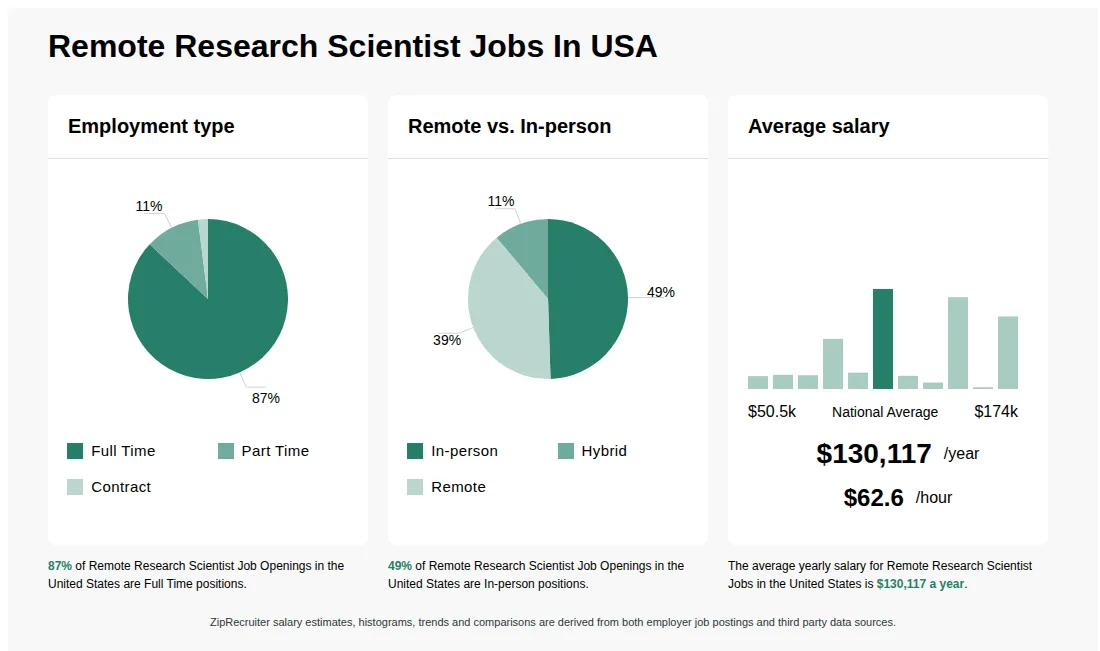
Remote Research Scientist information
See salary details
$50.5K - $61.7K
3% of jobs
$61.7K - $73K
3% of jobs
$73K - $84.2K
3% of jobs
$84.2K - $95.4K
13% of jobs
$103.1K is the 25th percentile. Wages below this are outliers.
$95.4K - $106.6K
4% of jobs
The median wage is $116.7K / yr.
$106.6K - $117.9K
26% of jobs
$117.9K - $129.1K
3% of jobs
$129.1K - $140.3K
1% of jobs
$148.7K is the 75th percentile. Wages above this are outliers.
$140.3K - $151.5K
24% of jobs
$151.5K - $162.8K
0% of jobs
$162.8K - $174K
19% of jobs
$50.5K
$130.1K
$174K
How much do remote research scientist jobs pay per year?
As of Sep 2, 2026, the average yearly pay for remote research scientist in the United States is $130,117.00, according to ZipRecruiter salary data. Most workers in this role earn between $107,500.00 and $173,000.00 per year, depending on experience, location, and employer.
What is a remote research scientist?
A Remote Research Scientist conducts scientific research and analysis from a remote location, often for academic institutions, private companies, or government agencies. They design experiments, analyze data, and publish findings while collaborating with teams virtually. Depending on the field, they may work in areas like artificial intelligence, biology, or social sciences. Strong communication, data analysis, and self-management skills are crucial for success in this role.
What are the key skills and qualifications needed to thrive as a remote research scientist?
A Remote Research Scientist typically needs an advanced degree (Master's or Ph.D.) in a relevant scientific field, strong analytical abilities, and experience designing and conducting research studies. Familiarity with statistical software, data analysis tools, and research databases, as well as experience with tools like R, Python, or MATLAB, is often required. Excellent written and verbal communication, self-motivation, and strong organizational skills are key soft skills for this role. These competencies are crucial for managing independent research projects, collaborating virtually with team members, and producing high-quality, publishable work.
How does collaboration work for remote research scientists who are not physically present with their teams?
Remote Research Scientists often collaborate through digital platforms such as video conferencing, shared cloud-based documents, and project management tools to ensure seamless communication and teamwork. Regular virtual meetings, clear documentation, and prompt updates are essential to keep everyone aligned on project goals and timelines. Many organizations have established protocols for remote workflow that foster close cooperation with colleagues across disciplines and time zones. This structure enables Remote Research Scientists to effectively contribute to joint publications, share findings, and access support from mentors or team leads regardless of their physical location.
Are remote research scientists in high demand?
Remote research scientists are in high demand across industries such as healthcare, technology, and academia due to the increasing reliance on data analysis, scientific innovation, and remote collaboration tools. Employers seek candidates with strong analytical skills, relevant technical expertise, and the ability to work independently in a virtual environment.
Can a remote research scientist work from home?
Yes, many remote research scientists work from home, utilizing digital collaboration tools and data analysis software. Their work often involves independent research, data collection, and reporting, which can be performed remotely with a reliable internet connection and relevant technical skills.
Can you work remotely as a research scientist?
Remote research scientist positions are common in many fields, allowing professionals to conduct experiments, analyze data, and collaborate virtually. These roles often require strong communication skills, familiarity with collaboration tools, and sometimes specific certifications or software proficiency. Remote work arrangements depend on the employer and the nature of the research.
More about Remote Research Scientist jobs
What cities are hiring for Remote Research Scientist jobs?
Cities with the most Remote Research Scientist job openings:
What are the most commonly searched types of Research Scientist jobs?
The most popular types of Research Scientist jobs are:
What states have the most Remote Research Scientist jobs?
States with the most job openings for Remote Research Scientist jobs include:
What job categories do people searching Remote Research Scientist jobs look for?
The top searched job categories for Remote Research Scientist jobs are:
Full-time
Medical, Dental, Vision, PTO
This job post has expired today. Applications are no longer accepted.
Job description
At Oura, our mission is to help people better understand their bodies so they can make healthier, more informed choices every day. With the Oura Ring and app, we translate complex signals about sleep, activity, and readiness into intuitive insights that support long-term health.
We are looking for a Research Scientist to join the Health Science team. This is a deeply collaborative, R&D-oriented role that sits at the intersection of rigorous science and real-world product impact. You will work with large-scale, real-world biobehavioral data - grounded in a mechanistic understanding of human physiology - to drive our end-to-end innovation pipeline, from scientific insight to AI/ML-powered models and cutting-edge analytics that translate complex biology into impactful, scalable product experiences.
You will lead and contribute to research that shapes how Oura understands and serves its members - across sleep, women's reproductive health, cardiometabolic health, and movement - while building the product relationships and scientific foundations that let those insights reach people at scale. You'll work closely with Data Science, Product, Engineering, and Clinical research partners to move ideas from proof of concept to member-facing impact, and to advance the scientific questions that push the field of digital health forward.
What you will do- Lead and contribute to end-to-end research projects using multimodal physiological and behavioral data - including wearable time-series signals, continuous biomarkers (e.g. CGM), and biological samples (e.g. blood biomarkers) - from hypothesis through analysis to dissemination.
- Design rigorous studies and analyses to answer challenging scientific questions that can move the field forward, across sleep and circadian biology, women's health, cardiometabolic function, and physical activity.
- Develop and apply advanced statistical and computational models (e.g., mixed-effects models, time-series methods, ML/AI approaches) to answer meaningful health questions with real-world, noisy data.
- Translate evidence and research insights into actionable product solutions, helping partners understand what findings mean for members and future features.
- Build and maintain strong working relationships across Health Science, Data Science, and Product squads
- Contribute to external scientific dissemination through abstracts, posters, and peer-reviewed manuscripts, strengthening Oura's scientific credibility and visibility.
- Support literature synthesis and help contextualize findings within current evidence to sharpen research narratives and identify new directions.
- A PhD in a relevant field (e.g., bioengineering, data science, biostatistics, neuroscience, biomedical engineering, computer science, exercise science, women's health, or digital health), combined with a degree in a quantitative or computational field - such as computer science, data science, engineering, or biostatistics - at the BS level or above.
- A strong track record of first-authored publications in peer-reviewed journals - particularly work introducing novel concepts, methods, or algorithms - or patent applications, demonstrating the ability to independently drive innovation from conception through to completion.
- Deep hands-on experience with statistical modeling and applied ML in Python or R, particularly with time-series or physiological data, and predictive analytics - for example, forecasting models, classification pipelines, or risk stratification applied to health outcomes.
- Fluency in advanced statistical methods - mixed-effects models, survival analysis, Bayesian inference, or equivalent - and comfort building models that hold up under real-world messiness.
- Demonstrated interest and domain knowledge in at least one of our focus areas: sleep & circadian biology, women's reproductive health, cardiometabolic health, movement and physical activity, longevity, neuroendocrinology, or immune function.
- Experience working with wearable or sensor-based data, digital health platforms, or similar applied data environments.
- Strong product intuition - you understand that rigorous science and practical impact are complementary, not competing, and you enjoy building the relationships that make both possible.
- Creative, hypothesis-driven thinking: the ability to frame new questions, design novel analyses, and operate in ambiguous, exploratory R&D contexts.
- Strong scientific communication skills-able to synthesize results and clearly explain methods, assumptions, and limitations to both technical and non-technical audiences.
Benefits
At Oura, we care about you and your well-being. Everyone here at Oura has a ring of their own and we are continually looking to improve employee health.
What we offer:
- Competitive salary and equity packages
- Health, dental, vision insurance, and mental health resources
- An Oura Ring of your own plus employee discounts for friends & family
- 20 days of paid time off plus 13 paid holidays plus 8 days of flexible wellness time off
- Paid sick leave and parental leave
Oura takes a market-based approach to pay, which may vary depending on your location. US locations are categorized into tiers based on a cost of labor index for that geographic area. While most offers will be closer to the starting range, successful candidates' pay will be determined based on job-related skills, experience, qualifications, work location, internal peer equity, and market conditions. These ranges may be modified in the future.
- Region 1: $151,300 - $178,000
- Region 2: $138,550 - $163,000
- Region 3: $127,500 - $150,000
A recruiter can determine your zones/tiers based on your US location.
We are not considering candidates residing in the following states: Alaska (AK), Delaware (DE), Iowa (IA), Mississippi (MS), Nebraska (NE), South Dakota (SD), Vermont (VT), West Virginia (WV), and Wisconsin (WI)