NetSPI ® pioneered Penetration Testing as a Service (PTaaS) and leads the industry in modern pentesting. Combining world-class security professionals with AI and automation, NetSPI delivers clarity ...
NetSPI ® pioneered Penetration Testing as a Service (PTaaS) and leads the industry in modern pentesting. Combining world-class security professionals with AI and automation, NetSPI delivers clarity ...
... remote access, single sign on, firewalls, vulnerability assessments, and penetration testing. Experience with security metrics, development of incident response procedures, and risk management.
... remote access, single sign on, firewalls, vulnerability assessments, and penetration testing. Experience with security metrics, development of incident response procedures, and risk management.
NetSPI ® is an award-winning pioneer of Penetration Testing as a Service (PTaaS) with its AI-powered platform supported by more than 350 in-house cybersecurity experts. Specializing in 50+ pentest ...
NetSPI ® is an award-winning pioneer of Penetration Testing as a Service (PTaaS) with its AI-powered platform supported by more than 350 in-house cybersecurity experts. Specializing in 50+ pentest ...

We are seeking an experienced and results-driven Penetration Tester to perform comprehensive web application security assessments. The role involves conducting penetration tests, evaluating security ...
We are seeking an experienced and results-driven Penetration Tester to perform comprehensive web application security assessments. The role involves conducting penetration tests, evaluating security ...

Senior AI/LLM Penetration Tester
OR · On-site +1
... penetration testing and AI/LLM security assessments that reflect real-world attacker behavior. Renowned for its innovation and contributions to the open-source community through flagship tools ...
Senior AI/LLM Penetration Tester
OR · On-site +1
... penetration testing and AI/LLM security assessments that reflect real-world attacker behavior. Renowned for its innovation and contributions to the open-source community through flagship tools ...

Associate, Compliance Security Penetration Tester
$64K - $117K/yr
Internal and External Network Penetration Testing, Application Penetration Testing (Browser-based ... Remote Why You'll Want to Join Us At Coalfire, you'll find the support you need to thrive ...
Associate, Compliance Security Penetration Tester
$64K - $117K/yr
Internal and External Network Penetration Testing, Application Penetration Testing (Browser-based ... Remote Why You'll Want to Join Us At Coalfire, you'll find the support you need to thrive ...

Jr Cyber Penetration Tester
Arlington, VA · On-site +1
$66K - $106K/yr
Support the Penetration Testing (Red Cell) Team. * Assess the current state of the customer's system security by identifying all vulnerabilities and security measures. * Help customer perform ...
Jr Cyber Penetration Tester
Arlington, VA · On-site +1
$66K - $106K/yr
Support the Penetration Testing (Red Cell) Team. * Assess the current state of the customer's system security by identifying all vulnerabilities and security measures. * Help customer perform ...
Jr Cyber Penetration Tester / Secret
Arlington, VA · On-site +1
$66K - $106K/yr
Support the Penetration Testing (Red Cell) Team. * Assess the current state of the customer's system security by identifying all vulnerabilities and security measures. * Help customer perform ...
Jr Cyber Penetration Tester / Secret
Arlington, VA · On-site +1
$66K - $106K/yr
Support the Penetration Testing (Red Cell) Team. * Assess the current state of the customer's system security by identifying all vulnerabilities and security measures. * Help customer perform ...

Security Architect - Penetration Tester (REMOTE Position)
Columbia, SC · Remote
$115 - $123/hr
Title: Security Architect - Penetration Tester (REMOTE Position) Location: Columbia SC 29201 Duration: 12+ months Pay rate on $115 to $123 an hour Required Education/Certifications: Any one or ...
Security Architect - Penetration Tester (REMOTE Position)
Columbia, SC · Remote
$115 - $123/hr
Title: Security Architect - Penetration Tester (REMOTE Position) Location: Columbia SC 29201 Duration: 12+ months Pay rate on $115 to $123 an hour Required Education/Certifications: Any one or ...

Network Security Penetration Tester, AppSTAR Network Security
$107K - $146K/yr
This role is primarily remote, with up to approximately 15% travel required for on-site network penetration testing at Amazon facilities across North America You will conduct assessments both ...
Network Security Penetration Tester, AppSTAR Network Security
$107K - $146K/yr
This role is primarily remote, with up to approximately 15% travel required for on-site network penetration testing at Amazon facilities across North America You will conduct assessments both ...
Network Security Penetration Tester, AppSTAR Network Security
$107K - $146K/yr
This role is primarily remote, with up to approximately 15% travel required for on-site network penetration testing at Amazon facilities across North America You will conduct assessments both ...
Network Security Penetration Tester, AppSTAR Network Security
$107K - $146K/yr
This role is primarily remote, with up to approximately 15% travel required for on-site network penetration testing at Amazon facilities across North America You will conduct assessments both ...

Sr. Security Engineer (Penetration Testing)
$100K - $180K/yr
We are looking to hire someone with a passion for application security and penetration testing ... LI-Remote #blockchain #startups #hiring CertiK is proud to offer medical, vision, and dental ...
Sr. Security Engineer (Penetration Testing)
$100K - $180K/yr
We are looking to hire someone with a passion for application security and penetration testing ... LI-Remote #blockchain #startups #hiring CertiK is proud to offer medical, vision, and dental ...

Solutions Engineer, Penetration Testing
Chicago, IL · Remote
$130K/yr
Solutions Engineer Remote, US At Prescient Security, we are on a mission to simplify security and ... Strong understanding of cybersecurity concepts, security assessments, penetration testing, and ...
Quick apply
Solutions Engineer, Penetration Testing
Chicago, IL · Remote
$130K/yr
Solutions Engineer Remote, US At Prescient Security, we are on a mission to simplify security and ... Strong understanding of cybersecurity concepts, security assessments, penetration testing, and ...

Senior Cybersecurity Auditor
$100K - $170K/yr
Proven proficiency performing CCRI/ vulnerability assessment/ penetration testing on networks ... HBSS (remote console, AV, ABM, PA HIPS, ePO) * Traditional Security (Common, Basic, NCV, SCV)
Senior Cybersecurity Auditor
$100K - $170K/yr
Proven proficiency performing CCRI/ vulnerability assessment/ penetration testing on networks ... HBSS (remote console, AV, ABM, PA HIPS, ePO) * Traditional Security (Common, Basic, NCV, SCV)
Solutions Engineer, Penetration Testing
Chicago, IL · Remote
$130K/yr
Solutions Engineer Remote, US At Prescient Security, we are on a mission to simplify security and ... Strong understanding of cybersecurity concepts, security assessments, penetration testing, and ...
Solutions Engineer, Penetration Testing
Chicago, IL · Remote
$130K/yr
Solutions Engineer Remote, US At Prescient Security, we are on a mission to simplify security and ... Strong understanding of cybersecurity concepts, security assessments, penetration testing, and ...
Senior Cybersecurity Auditor
$100K - $170K/yr
Proven proficiency performing CCRI/ vulnerability assessment/ penetration testing on networks ... HBSS (remote console, AV, ABM, PA HIPS, ePO) * Traditional Security (Common, Basic, NCV, SCV)
Senior Cybersecurity Auditor
$100K - $170K/yr
Proven proficiency performing CCRI/ vulnerability assessment/ penetration testing on networks ... HBSS (remote console, AV, ABM, PA HIPS, ePO) * Traditional Security (Common, Basic, NCV, SCV)
Senior Cybersecurity Auditor
$100K - $170K/yr
Proven proficiency performing CCRI/ vulnerability assessment/ penetration testing on networks ... HBSS (remote console, AV, ABM, PA HIPS, ePO) * Traditional Security (Common, Basic, NCV, SCV)
Senior Cybersecurity Auditor
$100K - $170K/yr
Proven proficiency performing CCRI/ vulnerability assessment/ penetration testing on networks ... HBSS (remote console, AV, ABM, PA HIPS, ePO) * Traditional Security (Common, Basic, NCV, SCV)

Senior Offensive Security Consultant (Red Team / Penetration Tester) Location: Remote (United States) Travel: Minimal (occasional company or client meetings, or onsite requirements, Citizenship ...
Senior Offensive Security Consultant (Red Team / Penetration Tester) Location: Remote (United States) Travel: Minimal (occasional company or client meetings, or onsite requirements, Citizenship ...

Penetration Testing Team Lead
Washington, DC · On-site +1
$130K - $160K/yr
This is a remote position. Responsibilities: * Plans, coordinates and leads red team and penetration testing engagements across FSA systems. * Oversees test planning, execution, and reporting.
Quick apply
Penetration Testing Team Lead
Washington, DC · On-site +1
$130K - $160K/yr
This is a remote position. Responsibilities: * Plans, coordinates and leads red team and penetration testing engagements across FSA systems. * Oversees test planning, execution, and reporting.

Application Security Engineer
Post Falls, ID · On-site +1
$175K/yr
This is a remote position, but if you're near one of our local offices, you're welcome to come ... As the right candidate, you will have experience working in-house as a full-time penetration tester ...
Application Security Engineer
Post Falls, ID · On-site +1
$175K/yr
This is a remote position, but if you're near one of our local offices, you're welcome to come ... As the right candidate, you will have experience working in-house as a full-time penetration tester ...
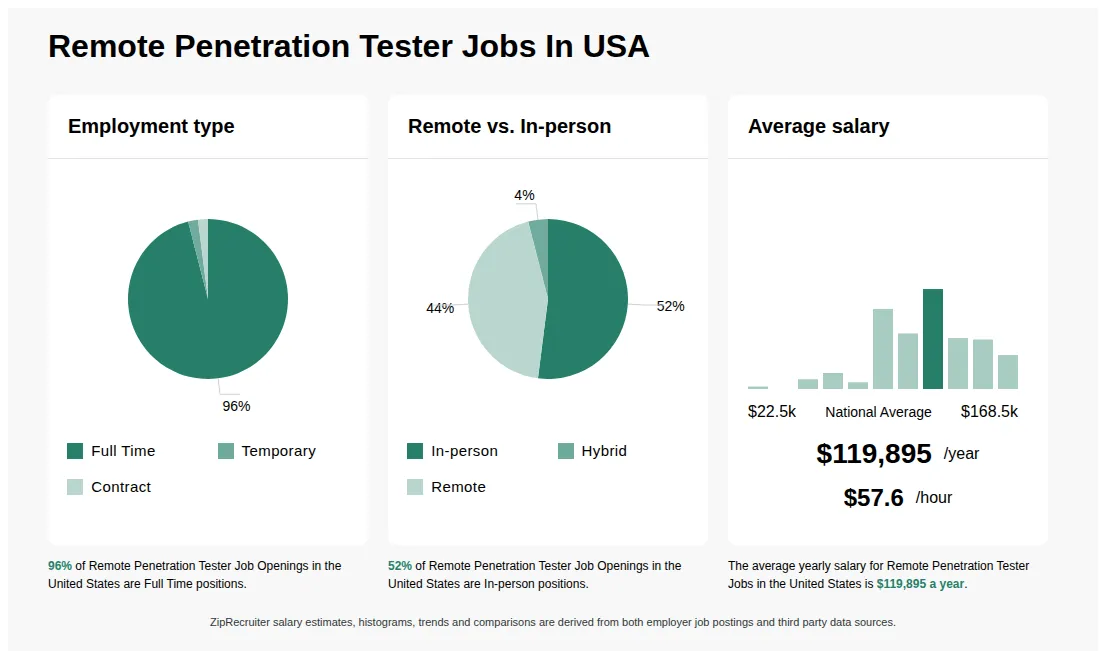
Remote Penetration Tester information
See salary details
$22.5K - $35.8K
0% of jobs
$35.8K - $49K
0% of jobs
$49K - $62.3K
2% of jobs
$62.3K - $75.6K
3% of jobs
$75.6K - $88.9K
1% of jobs
$101.1K is the 25th percentile. Wages below this are outliers.
$88.9K - $102.1K
20% of jobs
$102.1K - $115.4K
14% of jobs
The median wage is $120.4K / yr.
$115.4K - $128.7K
26% of jobs
$138.1K is the 75th percentile. Wages above this are outliers.
$128.7K - $142K
13% of jobs
$142K - $155.2K
13% of jobs
$155.2K - $168.5K
9% of jobs
$22.5K
$119.9K
$168.5K
How much do remote penetration tester jobs pay per year?
As of Sep 5, 2026, the average yearly pay for remote penetration tester in the United States is $119,895.00, according to ZipRecruiter salary data. Most workers in this role earn between $96,000.00 and $141,000.00 per year, depending on experience, location, and employer.
What is a remote penetration tester?
A Remote Penetration Tester is a cybersecurity professional who evaluates the security of computer systems, networks, and applications by simulating cyberattacks from a remote location. Their goal is to identify vulnerabilities that malicious hackers could exploit and to provide recommendations for strengthening security. Working remotely, they use specialized tools and techniques to conduct assessments without being physically present at the client’s site. This role often involves preparing detailed reports and collaborating with IT teams to remediate identified risks.
What does a remote penetration tester do?
Remote penetration testers attempt to hack into an application, network, or computer to assess its security. Instead of working in the office, remote penetration testers complete their tasks from home or another location outside of the office with internet connectivity. As a remote penetration tester, you discuss the security concerns your client may have about their current computer system and develop ways to infiltrate the security of a network or computer hardware using the internet as a pathway. Other job duties may include documenting how you broke through a company's network security and providing recommendations for augmenting the protection of company files. Because of their hacking expertise, some remote penetration testers may be called in to help investigate cyber crimes in criminal cases.
What are the key skills and qualifications needed to thrive as a remote penetration tester, and why are they important?
To thrive as a Remote Penetration Tester, you need strong knowledge of cybersecurity principles, network protocols, and operating systems, often supported by certifications like OSCP, CEH, or CISSP. Familiarity with penetration testing tools such as Metasploit, Burp Suite, and Nmap, as well as secure remote collaboration platforms, is essential. Analytical thinking, attention to detail, and clear written communication skills help you document findings and collaborate with clients and teams remotely. These competencies ensure you can effectively identify vulnerabilities, communicate risks, and help organizations strengthen their security posture from any location.
How does a remote penetration tester typically collaborate with in-house IT and security teams during an engagement?
Remote penetration testers often work closely with in-house IT and security teams through virtual meetings, secure communication platforms, and shared documentation. They coordinate to define testing scopes, clarify network boundaries, and discuss any findings in real time. Regular check-ins and status updates ensure transparency and alignment throughout the engagement. This collaborative approach helps address vulnerabilities promptly and fosters knowledge sharing between the remote tester and the organization’s internal teams.
What is the difference between Remote Penetration Tester vs Remote Security Analyst?
| Aspect | Remote Penetration Tester | Remote Security Analyst |
|---|---|---|
| Certifications | OSCP, CEH, GPEN | CISSP, Security+ |
| Work Environment | Conducts simulated attacks, often independently or in teams | Monitors security systems, analyzes threats, and implements defenses |
| Employer & Industry Usage | Cybersecurity firms, consulting companies, large enterprises | Corporate IT departments, government agencies, financial institutions |
Remote Penetration Testers focus on identifying vulnerabilities through simulated attacks, requiring offensive skills and certifications like OSCP or CEH. Remote Security Analysts monitor and defend networks, emphasizing defensive skills and certifications like CISSP. While both roles work remotely in cybersecurity, their core responsibilities and skill sets differ significantly.
More about Remote Penetration Tester jobs
What cities are hiring for Remote Penetration Tester jobs?
Cities with the most Remote Penetration Tester job openings:
What are the most commonly searched types of Penetration Tester jobs?
The most popular types of Penetration Tester jobs are:
What states have the most Remote Penetration Tester jobs?
States with the most job openings for Remote Penetration Tester jobs include:
What job categories do people searching Remote Penetration Tester jobs look for?
The top searched job categories for Remote Penetration Tester jobs are:

Full-time
Re-posted 2 days ago
Job description
NetSPI® pioneered Penetration Testing as a Service (PTaaS) and leads the industry in modern pentesting. Combining world-class security professionals with AI and automation, NetSPI delivers clarity, speed, and scale across 50+ pentest types, attack surface management, and vulnerability prioritization. The NetSPI platform streamlines workflows and accelerates remediation, enabling our experts to focus on deep dive testing that uncovers vulnerabilities others miss. Trusted by the top 10 U.S. banks and Fortune 500 companies worldwide, NetSPI has been driving security innovation since 2001.
NetSPI is on an exciting growth journey as we disrupt and improve the proactive security market. We are looking for individuals with a collaborative, innovative, and customer-first mindset to join our team. Learn more about our award-winning workplace culture and get to know our A-Team at www.netspi.com/careers.
Join the mission as a Security Consultant II. We are seeking a skilled and detail-oriented Penetration Tester to conduct thorough security assessments, identify vulnerabilities, and provide expert recommendations to strengthen our clients' security posture. As a Penetration Tester supporting web applications, you will work closely with clients to deliver clear, actionable reports and contribute to the development of security best practices.
Responsibilities:
Minimum Qualifications:
Preferred Qualifications:
We are an equal employment opportunity employer. All qualified applicants will receive consideration for employment without regard to race, color, religion, sex, national origin, disability status, protected veteran status or any other characteristic protected by law.
Equal Opportunity Employer
This employer is required to notify all applicants of their rights pursuant to federal employment laws. For further information, please review the Know Your Rights notice from the Department of Labor.
NetSPI is on an exciting growth journey as we disrupt and improve the proactive security market. We are looking for individuals with a collaborative, innovative, and customer-first mindset to join our team. Learn more about our award-winning workplace culture and get to know our A-Team at www.netspi.com/careers.
Join the mission as a Security Consultant II. We are seeking a skilled and detail-oriented Penetration Tester to conduct thorough security assessments, identify vulnerabilities, and provide expert recommendations to strengthen our clients' security posture. As a Penetration Tester supporting web applications, you will work closely with clients to deliver clear, actionable reports and contribute to the development of security best practices.
Responsibilities:
- Conduct penetration testing engagements on web applications and underlying APIs.
- Create, deliver, and collaborate on penetration testing reports in diverse client environments, maintaining client-specific processes, reporting standards, and access protocols to help improve their security posture.
- Research and develop innovative techniques, tools, and methodologies for penetration testing services, alongside commitment to improvement and execution on NetSPI specific products and processes
- Perform administrative tasks related to day-to-day consulting activities to ensure smooth business and engagement operations.
Minimum Qualifications:
- Bachelor's degree or higher required, with a concentration in Computer Science, Engineering, Math, or IT preferred, or equivalent experience
- Minimum of 2-3 years of work experience in application penetration testing
- Familiarity with offensive tools, based on applicable skillset (e.g., Kali Linux, Burp Suite, Metasploit, Nessus)
- Familiarity with offensive and defensive IT concepts and protocols
- Extensive understanding of the OWASP Top 10 and various security frameworks.
- Working knowledge of Windows, Linux and MacOS operating systems internals
- Ability to work independently and as part of a team
- Proficient communication skills, both written and verbal
- Willingness to travel up to 5-10%
- This position requires an 8-hour workday, with occasional evenings or weekends necessary to meet project deadlines or critical needs
Preferred Qualifications:
- Experience mentoring or coaching to growing team members, while sharing knowledge externally through blogs, hosting webinars, or presenting at conferences
- Experience in one or more of the following programming or scripting languages (e.g., Ruby, Python, Perl, C, C++, Java, and C#)
- Offensive cybersecurity certifications (e.g., GXPN, GPEN, OSCP, CISSP, GWAPT)
We are an equal employment opportunity employer. All qualified applicants will receive consideration for employment without regard to race, color, religion, sex, national origin, disability status, protected veteran status or any other characteristic protected by law.
Equal Opportunity Employer
This employer is required to notify all applicants of their rights pursuant to federal employment laws. For further information, please review the Know Your Rights notice from the Department of Labor.

About NetSPI
Sourced by ZipRecruiter
Industry
Network security
Company size
11 - 50 Employees
Headquarters location
Minneapolis, MN, US
Year founded
2001