2

Remote Machine Learning Jobs (NOW HIRING)

Machine Learning Engineer (AI Data Trainer) About the Role What if your expertise in machine ... This is a fully remote, flexible contract role built for experienced ML and engineering ...

Join us to gain hands‐on experience in the exciting field of machine learning while working in a dynamic and collaborative remote environment. Responsibilities Assist in collecting, cleaning, and ...

Remote About the job At Alignerr, we partner with the world's leading AI research teams and labs to ... Machine Learning Engineer - AI Data Trainer Type : Hourly Contract Compensation : $50-$70 /hour ...

Machine Learning Engineer

$128.80K - $214.50K/yr

General information Requisition # R67616 Locations USA-Remote Work Posting Date 05/19/2026 Security ... The Machine Learning Engineer will leverage their strong technical background and knowledge to ...

Fully Remote Position Preferred Locations: Midwest based: Indianapolis, IN or IL, Chicagoland Area ... As a Machine Learning Engineer, you will play a critical role in developing and implementing ...

Freeport Maine Remote Must haves: * 4+ years ML experience * Python / Spark * Tensorflow / PyTorch (or similar) * Databricks * MLflow * Docker * SQL * Design and implement machine learning models and ...

next page

Showing results 1-20

Remote Machine Learning information

See salary details

$25.5K

$42.6K

$88K

How much do remote machine learning jobs pay per year?

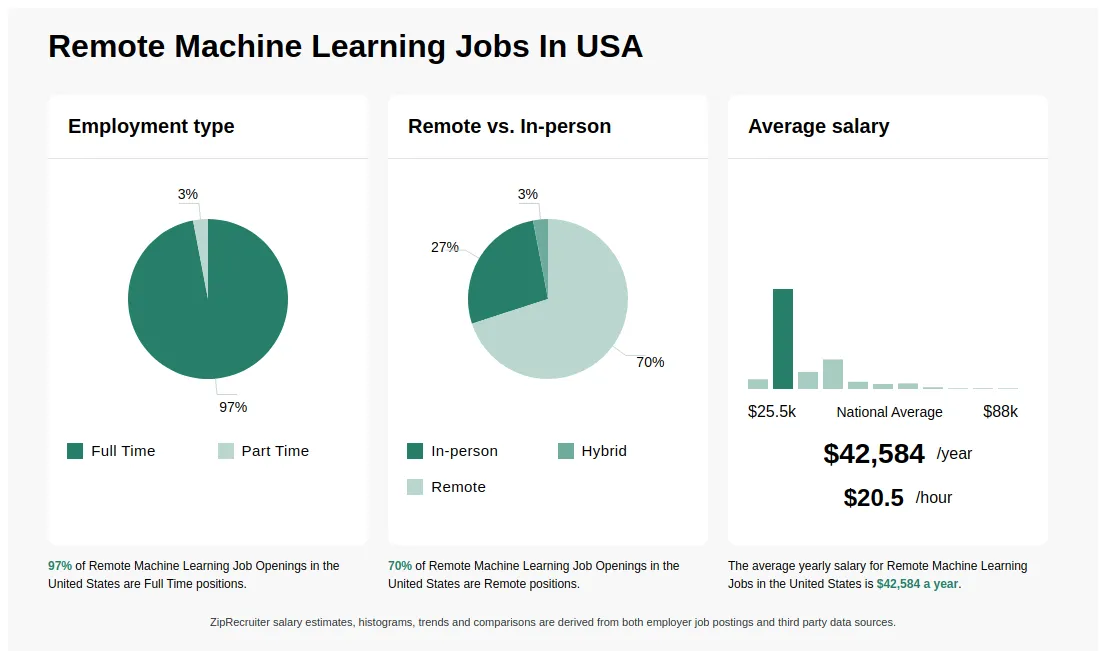
As of Jun 3, 2026, the average yearly pay for remote machine learning in the United States is $42,584.00, according to ZipRecruiter salary data. Most workers in this role earn between $32,500.00 and $46,000.00 per year, depending on experience, location, and employer.

What Are Remote Machine Learning Jobs?

Machine learning is a method of analyzing data via automating analytical model building. The premise is that systems can learn from data. Machine learning positions include machine learning engineer, computer vision engineer, and senior deep learning engineer. In a remote machine learning job, you work from home in a branch of artificial intelligence performing duties related to computational processing and data. Your goal is to design models that solve business problems, such as helping organizations avoid unknown risks or find profitable opportunities. Your responsibilities include maintaining data pipelines, performing model research and implementation, building machine learning systems, and onboarding new utilities.

What are the key skills and qualifications needed to thrive as a Remote Machine Learning Engineer, and why are they important?

To thrive as a Remote Machine Learning Engineer, you need a strong background in mathematics, statistics, programming (often Python), and experience with machine learning frameworks, typically supported by a relevant degree. Familiarity with tools such as TensorFlow, PyTorch, cloud platforms (like AWS or GCP), and version control systems is crucial. Strong problem-solving abilities, self-management, and effective virtual communication distinguish top performers in remote settings. These competencies ensure the engineer can build effective models, collaborate across distributed teams, and deliver impactful solutions independently.

What are some effective strategies for collaborating with team members while working remotely as a Machine Learning Engineer?

Collaboration in a remote Machine Learning role often relies on clear communication through digital tools such as Slack, Zoom, and project management platforms like Jira or Asana. Regular check-ins and stand-up meetings help keep everyone aligned on project goals and timelines. Sharing code and models via version control systems (like Git) and using collaborative notebooks (such as JupyterHub or Google Colab) are also common practices. Building strong documentation habits and proactively seeking feedback can help ensure smooth teamwork and project success, even across different time zones.

What is a remote machine learning job?

A remote machine learning job involves working with algorithms, data, and models to develop predictive systems or automate tasks, all while working from a location outside of a traditional office setting. Professionals in this role use techniques from statistics and computer science to analyze data, train machine learning models, and deploy solutions for real-world applications. Remote machine learning jobs can span various industries, including technology, healthcare, finance, and e-commerce. These roles typically require strong programming skills, knowledge of machine learning frameworks, and the ability to communicate findings effectively with team members or stakeholders. Working remotely offers flexibility, but also requires discipline and self-motivation to succeed.

Is ML full of coding?

Machine Learning (ML) roles often involve significant coding, especially in programming languages like Python or R, to develop algorithms and models. However, some positions focus more on data analysis, feature engineering, or model evaluation, which may require less coding but still involve technical skills and understanding of ML concepts.

What is the difference between Remote Machine Learning vs Data Scientist?

AspectRemote Machine LearningData Scientist
Required CredentialsBachelor's/Master's in CS, ML certificationsBachelor's/Master's in CS, Statistics, or related field
Work EnvironmentRemote, collaborative teams, tech companiesRemote or on-site, diverse industries, analytics focus
Industry UsageTech, AI startups, researchFinance, healthcare, e-commerce, tech
Search & Comparison IntentOften compared for technical roles in AI/MLBroader data analysis roles, but overlapping skills

Remote Machine Learning specialists focus on developing algorithms and models primarily in tech environments, often requiring advanced programming and ML knowledge. Data Scientists analyze data to extract insights, sometimes utilizing ML techniques. While both roles share skills and credentials, Remote Machine Learning emphasizes model development, whereas Data Scientists focus on data analysis and interpretation.


What cities are hiring for Remote Machine Learning jobs? Cities with the most Remote Machine Learning job openings:
What are the most commonly searched types of Machine Learning jobs? The most popular types of Machine Learning jobs are:
What states have the most Remote Machine Learning jobs? States with the most job openings for Remote Machine Learning jobs include:
Infographic showing various Remote Machine Learning job openings in the United States as of May 2026, with employment types broken down into 8% Internship, 62% Full Time, 15% Part Time, and 15% Contract. Highlights an 100% Remote job distribution, with an average salary of $42,584 per year, or $20.5 per hour.

Remote Machine Learning Engineer

Angenex

Jersey City, NJ • Remote

Other

This job post has expired today. Applications are no longer accepted.


Job description

Remote Machine Learning Engineer

Jersey City, NJ, United States

About the Job

We're seeking an outstanding ML Engineer to join our data team and help build out best-in-class machine learning solutions on our platform, powering innovative solutions in marketing & sales and commercial analytics.

Responsibilities

- Build and deploy the ML pipelines that power the company machine learning platform.

- Manage MLOps infrastructure to monitor and optimize models.

Qualifications

Experience:

1+ years of professional experience as a Machine Learning Engineer or production-focused Data Scientist.

Proficiency across topics in machine learning and statistics.

Fluency in Python coding as well as data manipulation (SQL, Spark, Pandas)

Broad familiarity with the Python ecosystem and common libraries including Scikit-Learn, XGBoost, PyTorch, Keras, Tensorflow, Pandas, and common ML cloud services.

Familiarity with CNNs, RNN, LSTMs, and the latest research trends.

Experience implementing, deploying, and maintaining production machine learning systems.

Experience monitoring and optimizing model performance.

Experience with Linux, Docker and AWS, and basic development operations.

Advanced degree in computer science, mathematics, statistics or related area of study strongly preferred.