Perform Linux engineering and administration for thousands of bare metal and virtual machines ... LI-Remote This role will require the candidate to periodically undergo and pass additional ...
Perform Linux engineering and administration for thousands of bare metal and virtual machines ... LI-Remote This role will require the candidate to periodically undergo and pass additional ...
Perform Linux engineering and administration for thousands of bare metal and virtual machines ... LI-Remote This role will require the candidate to periodically undergo and pass additional ...
Perform Linux engineering and administration for thousands of bare metal and virtual machines ... LI-Remote This role will require the candidate to periodically undergo and pass additional ...

Linux Systems & DevOps Engineer
Fairfax, VA · On-site +1
This is a remote opportunity; however, the person must reside in the United States. This is a broad ... We are looking for a well-rounded engineer with strong Linux and Ansible skills who can work across ...
Linux Systems & DevOps Engineer
Fairfax, VA · On-site +1
This is a remote opportunity; however, the person must reside in the United States. This is a broad ... We are looking for a well-rounded engineer with strong Linux and Ansible skills who can work across ...
This is a remote opportunity; however, the person must reside in the United States. This is a broad ... We are looking for a well-rounded engineer with strong Linux and Ansible skills who can work across ...
New
Quick apply
This is a remote opportunity; however, the person must reside in the United States. This is a broad ... We are looking for a well-rounded engineer with strong Linux and Ansible skills who can work across ...
New

Senior Linux Device Programmer
Boston, MA · On-site +1
$170K - $185K/yr
We are seeking an experienced Linux Developer to join our Engineering team. The ideal candidate ... This role can be remote or hybrid. Salary Range $170,000--$185,000 USD Owl Labs is an Equal ...
Quick apply
Senior Linux Device Programmer
Boston, MA · On-site +1
$170K - $185K/yr
We are seeking an experienced Linux Developer to join our Engineering team. The ideal candidate ... This role can be remote or hybrid. Salary Range $170,000--$185,000 USD Owl Labs is an Equal ...

Linux Systems Engineer
Santa Clara, CA · Remote
$65 - $80/hr
Linux Infrastructure Engineering: Maintain, tune, and secure mission-critical Linux operating ... remote position. Application Deadline This position is anticipated to close on Sep 4, 2026. About ...
Linux Systems Engineer
Santa Clara, CA · Remote
$65 - $80/hr
Linux Infrastructure Engineering: Maintain, tune, and secure mission-critical Linux operating ... remote position. Application Deadline This position is anticipated to close on Sep 4, 2026. About ...
Unix Systems Engineer
Ann Arbor, MI · Remote
$40 - $50/hr
**REMOTE, but must be able to work W2- no exceptions ** Unix/Linux Engineer This resource will be joining the Unix Hosting Services team to help with various ancillary task that will take place with ...
Unix Systems Engineer
Ann Arbor, MI · Remote
$40 - $50/hr
**REMOTE, but must be able to work W2- no exceptions ** Unix/Linux Engineer This resource will be joining the Unix Hosting Services team to help with various ancillary task that will take place with ...

REMOTE Senior Linux/SDET engineer
Cambridge, MA · Remote
$133K - $176K/yr
Remote Principal Software Development Engineer in Test (SDET) - Linux Kernel & AI Platform Why This Opportunity? This is a remote opportunity for a senior technical leader who enjoys solving complex ...
Quick apply
REMOTE Senior Linux/SDET engineer
Cambridge, MA · Remote
$133K - $176K/yr
Remote Principal Software Development Engineer in Test (SDET) - Linux Kernel & AI Platform Why This Opportunity? This is a remote opportunity for a senior technical leader who enjoys solving complex ...

Lead an engineering team that partners with the Linux engineers of a major silicon company, and ... remote
Quick apply
Lead an engineering team that partners with the Linux engineers of a major silicon company, and ... remote
Triage Automation Engineer
Sunnyvale, CA · On-site +1
$144K - $183K/yr
The role As a Triage Automation Engineer at Wayve , you'll play a key role in scaling our Triage ... Hands-on experience operating in a remote Linux environment * Experience building or maintaining ...
Triage Automation Engineer
Sunnyvale, CA · On-site +1
$144K - $183K/yr
The role As a Triage Automation Engineer at Wayve , you'll play a key role in scaling our Triage ... Hands-on experience operating in a remote Linux environment * Experience building or maintaining ...

Red Hat Technology Professionals
Raleigh, NC · On-site +1
Locations / Remote Opportunities Available Employment Type: Full-Time, Contract, and Consulting ... Linux Engineers * Cloud Engineers * DevOps Engineers * Platform Engineers * Site Reliability ...
Red Hat Technology Professionals
Raleigh, NC · On-site +1
Locations / Remote Opportunities Available Employment Type: Full-Time, Contract, and Consulting ... Linux Engineers * Cloud Engineers * DevOps Engineers * Platform Engineers * Site Reliability ...

Position Overview The Cloud, Engineer - Linux and Automation is responsible for the administration ... Remote work eligible * Travel Requirements: Occasional travel may be required for datacenter ...
Quick apply
Position Overview The Cloud, Engineer - Linux and Automation is responsible for the administration ... Remote work eligible * Travel Requirements: Occasional travel may be required for datacenter ...
Cloud Engineer - Linux and Automation
Sarasota, FL · On-site +1
Position Overview The Cloud, Engineer - Linux and Automation is responsible for the administration ... Remote work eligible * Travel Requirements: Occasional travel may be required for datacenter ...
Cloud Engineer - Linux and Automation
Sarasota, FL · On-site +1
Position Overview The Cloud, Engineer - Linux and Automation is responsible for the administration ... Remote work eligible * Travel Requirements: Occasional travel may be required for datacenter ...

Linux Private Cloud Site Reliability Engineer
Santa Clara, CA · Remote
$58 - $64/hr
Remote We are seeking experienced Linux Site Reliability Engineers to support large-scale hybrid infrastructure environments across cloud and private data centers. Candidates should have deep Linux ...
Quick apply
Linux Private Cloud Site Reliability Engineer
Santa Clara, CA · Remote
$58 - $64/hr
Remote We are seeking experienced Linux Site Reliability Engineers to support large-scale hybrid infrastructure environments across cloud and private data centers. Candidates should have deep Linux ...
They are seeking a Linux Infrastructure Engineer to support clients in a highly regulated healthcare environment, focusing on Linux/UNIX systems and automation. Qualifications : Required : • 5+ ...
They are seeking a Linux Infrastructure Engineer to support clients in a highly regulated healthcare environment, focusing on Linux/UNIX systems and automation. Qualifications : Required : • 5+ ...

Senior Linux Systems Administrator
Iowa City, IA · On-site +1
... remote location. Position Responsibilities: Linux Platform Administration & Engineering * Design, deploy, administer, and support enterprise Linux platforms, including Ubuntu, Red Hat Enterprise ...
Senior Linux Systems Administrator
Iowa City, IA · On-site +1
... remote location. Position Responsibilities: Linux Platform Administration & Engineering * Design, deploy, administer, and support enterprise Linux platforms, including Ubuntu, Red Hat Enterprise ...
Senior Linux Systems Administrator
Iowa City, IA · On-site +1
... remote location. Position Responsibilities: Linux Platform Administration & Engineering * Design, deploy, administer, and support enterprise Linux platforms, including Ubuntu, Red Hat Enterprise ...
Senior Linux Systems Administrator
Iowa City, IA · On-site +1
... remote location. Position Responsibilities: Linux Platform Administration & Engineering * Design, deploy, administer, and support enterprise Linux platforms, including Ubuntu, Red Hat Enterprise ...

Platform Engineer - PERN Linux system/Devops III Location ... Madison, WI (Remote) Candidate should be local to WI. Duration: 5 to 6 months extendable Positon ...
Quick apply
Platform Engineer - PERN Linux system/Devops III Location ... Madison, WI (Remote) Candidate should be local to WI. Duration: 5 to 6 months extendable Positon ...

Advisory Linux Systems Engineer
Boulder, CO · On-site +1
$93K - $100K/yr
Advisory Linux Systems Engineer $93,400 - $100,000 per year Boulder, CO (Onsite or Hybrid) About the Role We are seeking a Advisory Linux Systems Software Engineer to join our Control Unit ...
Advisory Linux Systems Engineer
Boulder, CO · On-site +1
$93K - $100K/yr
Advisory Linux Systems Engineer $93,400 - $100,000 per year Boulder, CO (Onsite or Hybrid) About the Role We are seeking a Advisory Linux Systems Software Engineer to join our Control Unit ...
Experience with shell programming (bash and korn shell) and/or C/C++/Java Demonstrated ability to ... remote card reader, component swap outs, and I Installations Familiarity with scanning technology ...
Experience with shell programming (bash and korn shell) and/or C/C++/Java Demonstrated ability to ... remote card reader, component swap outs, and I Installations Familiarity with scanning technology ...
Remote Linux Engineer information
See salary details
$10.82 - $18.18
0% of jobs
$18.18 - $25.55
0% of jobs
$25.55 - $32.91
2% of jobs
$32.91 - $40.28
11% of jobs
$40.28 - $47.64
11% of jobs
$48.40 is the 25th percentile. Wages below this are outliers.
$47.64 - $55
18% of jobs
The median wage is $57.85 / hr.
$55 - $62.37
23% of jobs
$66.34 is the 75th percentile. Wages above this are outliers.
$62.37 - $69.73
20% of jobs
$69.73 - $77.10
6% of jobs
$77.10 - $84.46
3% of jobs
$84.46 - $91.83
6% of jobs
$10
$59
$91
How much do remote linux engineer jobs pay per hour?
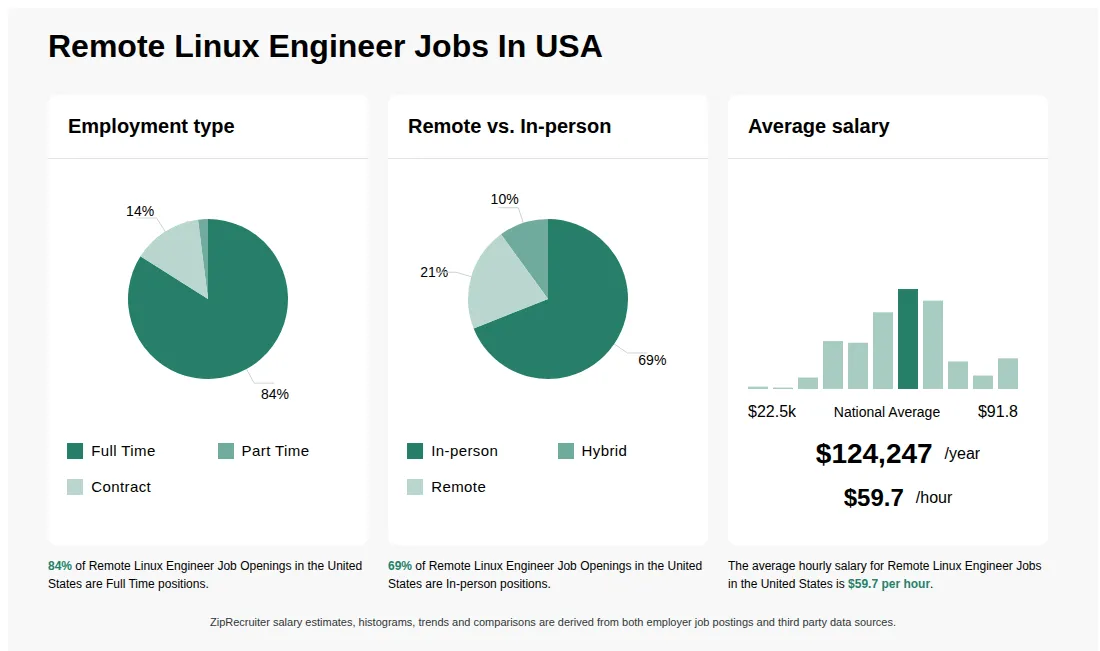
As of Sep 15, 2026, the average hourly pay for remote linux engineer in the United States is $59.73, according to ZipRecruiter salary data. Most workers in this role earn between $48.08 and $67.07 per hour, depending on experience, location, and employer.
What is a remote Linux engineer?
A Remote Linux Engineer is an IT professional responsible for designing, implementing, and maintaining Linux-based systems and servers while working remotely. They handle system administration tasks, troubleshoot issues, optimize performance, and ensure security and stability. This role often involves working with cloud platforms, automation tools, and scripting languages to manage infrastructure efficiently. Remote Linux Engineers collaborate with teams using communication tools and may support DevOps, networking, or cybersecurity functions based on business needs.
What are the key skills and qualifications needed to thrive as a remote Linux engineer?
To thrive as a Remote Linux Engineer, you need a solid understanding of Linux systems administration, networking, scripting languages (such as Bash or Python), and troubleshooting, often backed by a degree in computer science or related certifications like RHCE or CompTIA Linux+. Familiarity with tools like Docker, Ansible, Kubernetes, and virtualization platforms is typically required. Excellent problem-solving abilities, self-motivation, and strong written communication are essential soft skills for remote collaboration and effective support. These skills and qualities are vital to ensuring reliable system performance, efficient remote operations, and seamless teamwork across distributed environments.
What are common challenges faced by remote Linux engineers and how are they typically addressed?
Remote Linux Engineers often encounter challenges such as troubleshooting complex system issues without on-site access, maintaining secure remote connections, and staying aligned with distributed team members. These challenges are typically addressed through advanced remote monitoring tools, comprehensive documentation, and regular virtual meetings for knowledge sharing and collaboration. Effective time management and continuous learning are also crucial for staying updated on emerging technologies and best practices. Organizations often provide clear escalation paths and encourage peer support to help engineers resolve critical incidents quickly. Being proactive and adaptable helps ensure both productivity and strong system reliability in a remote environment.
More about Remote Linux Engineer jobs
What cities are hiring for Remote Linux Engineer jobs?
Cities with the most Remote Linux Engineer job openings:
What are the most commonly searched types of Linux Engineer jobs?
The most popular types of Linux Engineer jobs are:
What states have the most Remote Linux Engineer jobs?
States with the most job openings for Remote Linux Engineer jobs include:
What are popular job titles related to Remote Linux Engineer jobs?
For Remote Linux Engineer jobs, the most frequently searched job titles are:

Sr. Linux Systems Engineer - Object Storage (Remote)
Remote
CrowdStrike Holdings, Inc.
• IT Services • 1 - 5K employees1,001 - 5,000 employees
Full-time
Medical, Retirement, PTO
Posted 20 days ago
Job description
As a global leader in cybersecurity, CrowdStrike protects the people, processes and technologies that drive modern organizations. Since 2011, our mission hasn't changed - we're here to stop breaches, and we've redefined modern security with the world's most advanced AI-native platform. We work on large scale distributed systems, processing almost 3 trillion events per day and this traffic is growing daily. Our customers span all industries, and they count on CrowdStrike to keep their businesses running, their communities safe and their lives moving forward. We're proud to work for a mission-driven company leveraging AI to transform the way we work. CrowdStrikers drive their careers through flexibility and autonomy while also being expected to contribute to a culture of responsible AI adoption, experimentation, and innovation. We use an AI-first mindset as a force multiplier to proactively and continuously accelerate execution, build expertise, uncover insights, and solve complex problems. We're always looking to add talented CrowdStrikers to the team who have limitless passion, a relentless focus on innovation and a fanatical commitment to our customers, our community and each other. Ready to join a mission that matters? The future of cybersecurity starts with you.
About the Role:
The CrowdStrike Technical Operations team is seeking a highly skilled Senior Linux Systems Engineer to design, build, monitor and maintain our complex multi-cloud (on premise & public) distributed systems infrastructure with a focus on a rapidly growing third party object store. The ideal candidate will have extensive experience with a hybrid cloud 24x7 system in a critical production environment. You'll spearhead the design, development and implementation of a custom S3 compatible object store solution that spans across over 3,000 Linux servers. As a senior-level engineer, you will collaborate with cross-functional teams to ensure successful integration of solutions while providing mentorship and guidance to junior engineers on the team. In addition to leading complex technical projects across teams, you will be challenged to drive improvements to the processes, systems and tooling being utilized to forecast use of our solutions.
What You'll Do:
What You'll Need:
#LI-LY1
#LI-Remote
This role will require the candidate to periodically undergo and pass additional background and fingerprint check(s) consistent with government customer requirements.
Benefits of Working at CrowdStrike:
CrowdStrike is proud to be an equal opportunity employer. We are committed to fostering a culture of belonging where everyone is valued for who they are and empowered to succeed. We support veterans and individuals with disabilities through our affirmative action program.
CrowdStrike is committed to providing equal employment opportunity for all employees and applicants for employment. The Company does not discriminate in employment opportunities or practices on the basis of race, color, creed, ethnicity, religion, sex (including pregnancy or pregnancy-related medical conditions), sexual orientation, gender identity, marital or family status, veteran status, age, national origin, ancestry, physical disability (including HIV and AIDS), mental disability, medical condition, genetic information, membership or activity in a local human rights commission, status with regard to public assistance, or any other characteristic protected by law. We base all employment decisions--including recruitment, selection, training, compensation, benefits, discipline, promotions, transfers, lay-offs, return from lay-off, terminations and social/recreational programs--on valid job requirements.
If you need assistance accessing or reviewing the information on this website or need help submitting an application for employment or requesting an accommodation, please contact us at recruiting@crowdstrike.com for further assistance.
Find out more about your rights as an applicant.
CrowdStrike participates in the E-Verify program.
Notice of E-Verify Participation
Right to Work
CrowdStrike, Inc. is committed to fair and equitable compensation practices. Placement within the pay range is dependent on a variety of factors including, but not limited to, relevant work experience, skills, certifications, job level, supervisory status, and location. The base salary range for this position for all U.S. candidates is $140,000 - $215,000 per year, with eligibility for bonuses, equity grants and a comprehensive benefits package that includes health insurance, 401k and paid time off.
For detailed information about the U.S. benefits package, please click here.
Expected Close Date of Job Posting is:11-10-2026
About the Role:
The CrowdStrike Technical Operations team is seeking a highly skilled Senior Linux Systems Engineer to design, build, monitor and maintain our complex multi-cloud (on premise & public) distributed systems infrastructure with a focus on a rapidly growing third party object store. The ideal candidate will have extensive experience with a hybrid cloud 24x7 system in a critical production environment. You'll spearhead the design, development and implementation of a custom S3 compatible object store solution that spans across over 3,000 Linux servers. As a senior-level engineer, you will collaborate with cross-functional teams to ensure successful integration of solutions while providing mentorship and guidance to junior engineers on the team. In addition to leading complex technical projects across teams, you will be challenged to drive improvements to the processes, systems and tooling being utilized to forecast use of our solutions.
What You'll Do:
- Perform Linux engineering and administration for thousands of bare metal and virtual machines
- Engineer large-scale cloud environments for clustered object storage solutions while demonstrating proficiency with public cloud and cloud administration concepts
- Troubleshoot server hardware issues while monitoring, maintaining, and operating a production environment
- Automate complex routine tasks and then deploy using an IaaS model with tools like Chef or Ansible
- Configure and optimize Linux kernel parameters, file systems, and storage subsystems to maximize object storage performance across a wide range of hardware configurations
- Perform deep-dive troubleshooting of complex network and storage issues using tools like tcpdump, iperf, iostat, and custom monitoring solutions to maintain SLAs and SLOs
- Write complex scripts and programs for automation, tools, frameworks, dashboards, and alarms
- Work with internal peers and business partners to analyze requirements and craft elegant, robust, and reliable solutions to solve complex technical problems. From concept to completion, our engineers are involved in every step!
- Engage with other engineers to collaborate and disseminate best practices. You will be asked to raise the technical IQ of the team by being passionate about learning and sharing the newest technologies & tricks with others.
- Spearhead technical teams, manage project timelines, and keep tabs on progress from the big picture down to the nitty-gritty, all while juggling inter-team dependencies.
- Proactively track the status of project activities and ensure that schedules and priorities are being met.
- Ensure critical issues are identified, tracked through resolution, and escalated as necessary.
- Collaborate with leadership to develop tools for analyzing and forecasting both organic and surge-based growth within the operating environment.
- Represent the development team as a technical leader both vertically and horizontally across workgroups.
- Share on-call rotation with other team members
What You'll Need:
- US Citizen or Green Card holder
- 7+ years of professional experience working on large scale, distributed systems
- BS/MS degree in Computer Science or related field (or equivalent work experience).
- Extensive expertise in Linux internals including virtual memory management, process scheduling, and storage I/O subsystems with proven ability to diagnose and resolve kernel-level performance issues
- Proficiency with Linux performance analysis and monitoring tools and/or custom metrics collection to proactively identify and resolve system bottlenecks before they impact production
- Experience with on-premise storage (block and object) technologies, including hands-on usage with Kubernetes-native, AWS S3-compatible object storage solutions
- Strong networking fundamentals with hands-on experience in TCP/IP, routing protocols, network security, and/or high-bandwidth data transfer optimization for distributed storage environments
- Proficient with observability tools (Prometheus, Grafana, ELK stack) for large-scale monitoring
- Automation experience using Python/Go scripting and Chef config management
- Meticulous attention to detail and have the ability to make good, timely decisions.
- A strong focus on security when managing systems and/or developing/reviewing code
- A passion for documentation and a desire to constantly improve knowledge transfer across teams.
- Proficiency in the use of project and program tooling (e.g.: Jira, Gitlab).
- Excellent written and verbal communication skills.
- Comfort collaborating professionally distributed, cross-functional teams spanning multiple divisions around the globe
- A proactive, can-do attitude that excels both working independently and collaborating as part of a team
- A passion for getting into the weeds with data by using standard analytics and forecasting methods.
- Deep technical fluency of systems and organizations to drive team communications and facilitate cross team collaboration.
- Travel 2-3 business related trips per year for group meetings
- Proven experience utilizing AI technologies to enhance decision-making, streamline workflows and processes, improve efficiency and drive business outcomes.
#LI-LY1
#LI-Remote
This role will require the candidate to periodically undergo and pass additional background and fingerprint check(s) consistent with government customer requirements.
Benefits of Working at CrowdStrike:
- Market leader in compensation and equity awards
- Comprehensive physical and mental wellness programs
- Competitive vacation and holidays for recharge
- Paid parental and adoption leaves
- Professional development opportunities for all employees regardless of level or role
- Employee Networks, geographic neighborhood groups, and volunteer opportunities to build connections
- Vibrant office culture with world class amenities
- Great Place to Work Certified™ across the globe
CrowdStrike is proud to be an equal opportunity employer. We are committed to fostering a culture of belonging where everyone is valued for who they are and empowered to succeed. We support veterans and individuals with disabilities through our affirmative action program.
CrowdStrike is committed to providing equal employment opportunity for all employees and applicants for employment. The Company does not discriminate in employment opportunities or practices on the basis of race, color, creed, ethnicity, religion, sex (including pregnancy or pregnancy-related medical conditions), sexual orientation, gender identity, marital or family status, veteran status, age, national origin, ancestry, physical disability (including HIV and AIDS), mental disability, medical condition, genetic information, membership or activity in a local human rights commission, status with regard to public assistance, or any other characteristic protected by law. We base all employment decisions--including recruitment, selection, training, compensation, benefits, discipline, promotions, transfers, lay-offs, return from lay-off, terminations and social/recreational programs--on valid job requirements.
If you need assistance accessing or reviewing the information on this website or need help submitting an application for employment or requesting an accommodation, please contact us at recruiting@crowdstrike.com for further assistance.
Find out more about your rights as an applicant.
CrowdStrike participates in the E-Verify program.
Notice of E-Verify Participation
Right to Work
CrowdStrike, Inc. is committed to fair and equitable compensation practices. Placement within the pay range is dependent on a variety of factors including, but not limited to, relevant work experience, skills, certifications, job level, supervisory status, and location. The base salary range for this position for all U.S. candidates is $140,000 - $215,000 per year, with eligibility for bonuses, equity grants and a comprehensive benefits package that includes health insurance, 401k and paid time off.
For detailed information about the U.S. benefits package, please click here.
Expected Close Date of Job Posting is:11-10-2026

About CrowdStrike
Sourced by ZipRecruiter
#WeAreCrowdStrike and our mission is to stop breaches. As a global leader in cybersecurity, our team changed the game. Since our inception, our market leading cloud-native platform has offered unparalleled protection against the most sophisticated cyberattacks. We're looking for people with limitless passion, a relentless focus on innovation and a fanatical commitment to the customer to join us in shaping the future of cybersecurity. Consistently recognized as a top workplace, CrowdStrike is committed to cultivating an inclusive, remote-first culture that offers people the autonomy and flexibility to balance the needs of work and life while taking their career to the next level. Interested in working for a company that sets the standard and leads with integrity? Join us on a mission that matters - one team, one fight.
Industry
It services
Company size
1,001 - 5,000 Employees
Headquarters location
Sunnyvale, CA, US
Year founded
2012