2

Remote Computer Vision Engineer Jobs (NOW HIRING)

The Role We are looking for an exceptional Computer Vision Engineer to join our research team and own the perception layer that powers our autonomous aerial systems. You will design and build the ...

Senior AI/Computer Vision Engineer

San Francisco, CA ยท On-site +1

$195K - $255K/yr

We are a team of more than 175 people working in a hybrid-remote environment across North America ... As a Senior AI/Computer Vision Engineer, you will lead the design, development, optimization, and ...

Showing results 21-40

Remote Computer Vision Engineer information

See salary details

$48.5K

$121.5K

$137.5K

How much do remote computer vision engineer jobs pay per year?

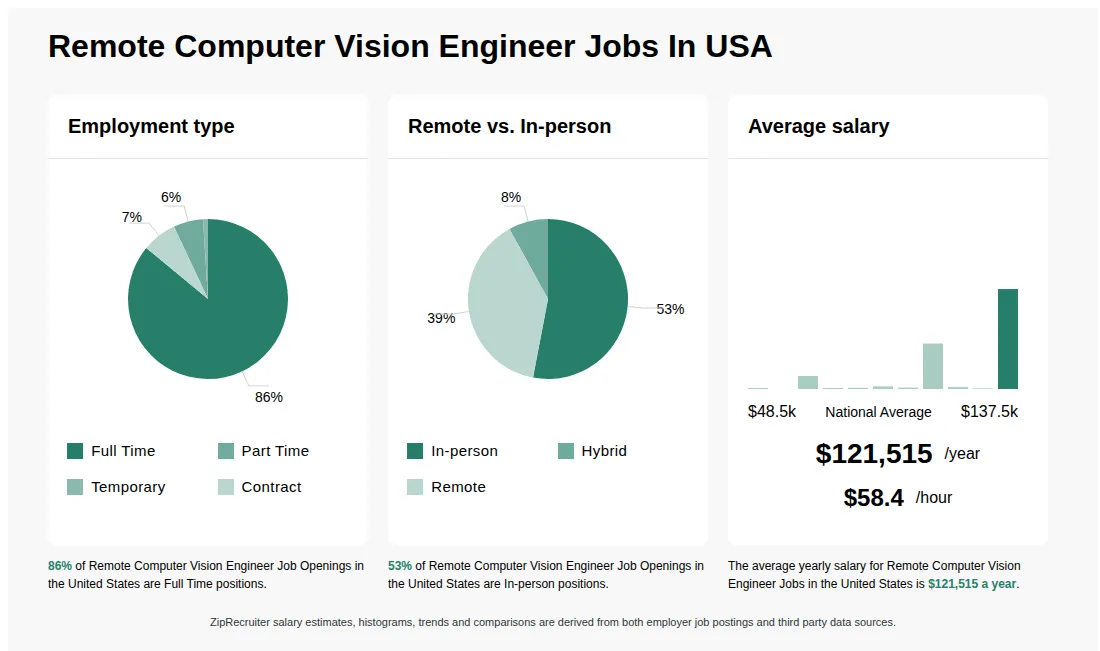
As of Sep 15, 2026, the average yearly pay for remote computer vision engineer in the United States is $121,515.00, according to ZipRecruiter salary data. Most workers in this role earn between $111,500.00 and $131,500.00 per year, depending on experience, location, and employer.

What is a remote computer vision engineer?

A Remote Computer Vision Engineer develops and implements computer vision algorithms and machine learning models to analyze and interpret visual data. They work with image and video processing, deep learning frameworks, and cloud-based or edge computing environments. This role involves tasks like object detection, image segmentation, and facial recognition, often using tools like OpenCV, TensorFlow, or PyTorch. Since it is a remote position, strong communication and collaboration skills are essential for working with distributed teams.

What are the key skills and qualifications needed to thrive as a remote computer vision engineer?

To excel as a Remote Computer Vision Engineer, you need strong proficiency in image processing, machine learning, and programming languages such as Python or C++, typically supported by a degree in computer science or a related field. Experience with frameworks like OpenCV, TensorFlow, or PyTorch, and familiarity with cloud platforms and version control systems, are highly valuable. Excellent problem-solving skills, self-motivation, and effective remote communication abilities set standout candidates apart. These skills ensure the successful development and deployment of advanced computer vision solutions in a collaborative, distributed work environment.

What are some typical challenges remote computer vision engineers face and how can they address them?

Remote computer vision engineers often encounter challenges such as aligning on project objectives with distributed teams, managing large datasets, and ensuring models perform well in real-world conditions. Effective communication through regular video meetings and clear documentation can help bridge distance-related gaps. Utilizing collaborative tools for code reviews and version control also streamlines teamwork. To overcome technical hurdles, staying updated on the latest frameworks and best practices in computer vision is important. Proactively addressing these challenges leads to more efficient project delivery and professional growth.

More about Remote Computer Vision Engineer jobs

What cities are hiring for Remote Computer Vision Engineer jobs?

Cities with the most Remote Computer Vision Engineer job openings:

What are the most commonly searched types of Computer Vision Engineer jobs?

The most popular types of Computer Vision Engineer jobs are:

What states have the most Remote Computer Vision Engineer jobs?

States with the most job openings for Remote Computer Vision Engineer jobs include:

What are popular job titles related to Remote Computer Vision Engineer jobs?

For Remote Computer Vision Engineer jobs, the most frequently searched job titles are:

Infographic showing various Remote Computer Vision Engineer job openings in the United States as of September 2026, with employment types broken down into 1% As Needed, 76% Full Time, 17% Part Time, and 6% Contract. Highlights an 94% Physical, 1% Hybrid, and 5% Remote job distribution, with an average salary of $121,515 per year, or $58.4 per hour.

Computer Vision Engineer, Aerial Autonomy

New York, NY โ€ข On-site, Remote

$180K - $220K/yr

Full-time

Medical, Dental, Vision, PTO

Posted 14 days ago


Key responsibilities

  • Design, implement, and improve vision-based situational awareness systems for autonomous aerial systems.

  • Build and maintain a shared 3D environment model by fusing perception data from multiple aircraft.

  • Develop perception algorithms such as object detection, tracking, classification, and semantic scene understanding for real-time operation in contested environments.


Job description

Description
AITAN is building the operating platform for multi-drone warfare, a battle-proven system that augments, deploys, and orchestrates autonomous drone fleets across any mission, any environment, and any vendor. With over 500,000 hours of frontline operational use and TRL-9 validation, our software is not a prototype. It runs in combat, every day, shaping outcomes in some of the most contested and complex environments on earth.
We unify drone control, edge-AI processing, and mission execution into a single operational loop, from detection to decision to strike. Our platform gives a single operator the ability to command and coordinate an entire fleet in real time: persistent aerial surveillance, automated target recognition, shared tactical picture, and seamless handoff from ISR to kinetic response, without manual delay.
We are expanding our US engineering team in the New York metropolitan area. Our office is easily accessible from New York City. If you want to work on technology that matters, not in a lab, but validated in the field, this is the role for you.
The Role
We are looking for an exceptional Computer Vision Engineer to join our research team and own the perception layer that powers our autonomous aerial systems. You will design and build the systems that give our drones and the operators behind them a real-time, shared understanding of the operational environment. Your algorithms will run at the edge, in contested airspace, with real operational stakes.
You will take perception capabilities from concept and simulation through live flight experiments to production deployment, iterating rapidly on real-world flight data and operational edge cases. The quality of your work directly determines what warfighters can see, understand, and act on.
What you'll do
  • Design, implement, and continuously improve vision-based situational awareness systems that give aircraft and ground operators a unified, real-time understanding of the operational environment
  • Build and maintain a shared world model across the fleet, fusing perception data from multiple aircraft into a coherent 3D representation that all agents can query and act on
  • Implement object detection, tracking, and classification pipelines covering dynamic obstacles, terrain, infrastructure, and other aircraft
  • Develop semantic scene understanding to power onboard autonomy and off-board mission planning
  • Design multi-agent perception architectures that aggregate observations across the fleet, resolve conflicting views, and maintain a consistent, up-to-date environmental state
  • Build perception that functions in GNSS-denied and EW-contested environments: your systems must work when GPS is unavailable and comms are degraded
  • Combine classical computer vision with modern deep learning to deliver robust, low-latency perception across diverse terrain, lighting, and atmospheric conditions
  • Own the full algorithm lifecycle: design โ†’ simulation โ†’ onboard and offboard deployment โ†’ production tuning and ongoing field improvement
  • Collaborate directly with flight controllers, system engineers, and operations teams, iterating rapidly on real-world flight data and operator feedback

Requirements
  • M.Sc. in Computer Science, Electrical Engineering, Robotics, Aerospace Engineering, or a closely related discipline
  • 4+ years of experience developing computer vision, perception, or autonomy algorithms for production systems
  • Strong command of both classical computer vision and modern deep learning; you know when to use each
  • Hands-on experience with object detection, SLAM, visual odometry, or 3D scene understanding
  • Proven track record of taking algorithms from research into real-world environments under genuine operational constraints
  • Proficiency in Python and C++; experience deploying algorithms under real-time and latency constraints
  • Comfortable working closely with hardware, sensors, and embedded compute platforms
  • Experience with modern neural network architectures and deploying trained models in constrained environments

Strong fit if
  • You have a Ph.D. in a relevant field
  • You have experience with drones, aerial systems, or autonomous robotics, ideally in a defense or field-tested context
  • You've built perception systems for GNSS-denied or GPS-degraded navigation (visual-inertial odometry, optical flow)
  • You have experience with multi-sensor fusion, sensor calibration, or sensor-agnostic perception pipelines
  • You've participated in simulation-to-real workflows and live flight testing programs
  • You have experience deploying models on edge compute hardware such as NVIDIA Jetson, Qualcomm, or similar
  • You've worked in a fast-paced defense tech or deep-tech startup environment where field feedback drives rapid iteration

Benefits:
  • Dental Insurance
  • Health Insurance
  • Paid time off
  • Vision Insurance

Compensation: $180,000 - $220,000 base salary