
Overview of Global Risk Analytics (GRA) Bank of America has an opportunity for a Quantitative Financial Analyst within the Global Risk Analytics (GRA) organization. GRA is part of Global Risk ...
Overview of Global Risk Analytics (GRA) Bank of America has an opportunity for a Quantitative Financial Analyst within the Global Risk Analytics (GRA) organization. GRA is part of Global Risk ...
Principal Quant
New York, NY · On-site
... in financial markets utilizing high-frequency techniques. Specific Responsibilities * High ... PhD or exceptional Masters / Bachelors qualification in a quantitative subject * Expertise in ...
Principal Quant
New York, NY · On-site
... in financial markets utilizing high-frequency techniques. Specific Responsibilities * High ... PhD or exceptional Masters / Bachelors qualification in a quantitative subject * Expertise in ...
Overview of Global Risk Analytics (GRA) Bank of America has an opportunity for a Quantitative Financial Analyst within the Global Risk Analytics (GRA) organization. GRA is part of Global Risk ...
Overview of Global Risk Analytics (GRA) Bank of America has an opportunity for a Quantitative Financial Analyst within the Global Risk Analytics (GRA) organization. GRA is part of Global Risk ...
Overview of Global Risk Analytics (GRA) Bank of America has an opportunity for a Quantitative Financial Analyst within the Global Risk Analytics (GRA) organization. GRA is part of Global Risk ...
Overview of Global Risk Analytics (GRA) Bank of America has an opportunity for a Quantitative Financial Analyst within the Global Risk Analytics (GRA) organization. GRA is part of Global Risk ...
Overview of Global Risk Analytics (GRA) Bank of America has an opportunity for a Quantitative Financial Analyst within the Global Risk Analytics (GRA) organization. GRA is part of Global Risk ...
Overview of Global Risk Analytics (GRA) Bank of America has an opportunity for a Quantitative Financial Analyst within the Global Risk Analytics (GRA) organization. GRA is part of Global Risk ...

Principal Quant Developer
Jersey City, NJ · On-site
The Role The Quantitative Research & Investing Technology (QRIT) team within Fidelity's Asset ... A Bachelor's degree in Computer Science, Financial Engineering, Information Technology, Information ...
Principal Quant Developer
Jersey City, NJ · On-site
The Role The Quantitative Research & Investing Technology (QRIT) team within Fidelity's Asset ... A Bachelor's degree in Computer Science, Financial Engineering, Information Technology, Information ...
Bank of America Merrill Lynch has an opportunity for a Quantitative Finance Analyst within our Global Risk Analytics (GRA) function. GRA is a sub-line of business within Global Risk Management (GRM)
Bank of America Merrill Lynch has an opportunity for a Quantitative Finance Analyst within our Global Risk Analytics (GRA) function. GRA is a sub-line of business within Global Risk Management (GRM)
Principal Quant Developer
Boston, MA · On-site
The Role The Quantitative Research & Investing Technology (QRIT) team within Fidelity's Asset ... A Bachelor's degree in Computer Science, Financial Engineering, Information Technology, Information ...
Principal Quant Developer
Boston, MA · On-site
The Role The Quantitative Research & Investing Technology (QRIT) team within Fidelity's Asset ... A Bachelor's degree in Computer Science, Financial Engineering, Information Technology, Information ...
Quantitative Developer
New York, NY · Hybrid
Quantitative Developer Location: New York, USA - Hybrid Employment Type: Contract About the Role We ... This role focuses on building and implementing financial models, analytics, and pricing systems ...
Quantitative Developer
New York, NY · Hybrid
Quantitative Developer Location: New York, USA - Hybrid Employment Type: Contract About the Role We ... This role focuses on building and implementing financial models, analytics, and pricing systems ...
Bank of America Merrill Lynch has an opportunity for a Quantitative Finance Analyst within our Global Risk Analytics (GRA) function. GRA is a sub-line of business within Global Risk Management (GRM)
Bank of America Merrill Lynch has an opportunity for a Quantitative Finance Analyst within our Global Risk Analytics (GRA) function. GRA is a sub-line of business within Global Risk Management (GRM)
Bank of America Merrill Lynch has an opportunity for a Quantitative Finance Analyst within our Global Risk Analytics (GRA) function. GRA is a sub-line of business within Global Risk Management (GRM)
Bank of America Merrill Lynch has an opportunity for a Quantitative Finance Analyst within our Global Risk Analytics (GRA) function. GRA is a sub-line of business within Global Risk Management (GRM)
Quantitative Developer Location: New Jersey, Jersey City, USA - Hybrid Employment Type: Contract ... This role focuses on building and implementing financial models, analytics, and pricing systems ...
Quantitative Developer Location: New Jersey, Jersey City, USA - Hybrid Employment Type: Contract ... This role focuses on building and implementing financial models, analytics, and pricing systems ...
Quantitative Developer
New York, NY · On-site
Quantitative Developer Location: New York, USA - Hybrid Employment Type: Contract About the Role We ... This role focuses on building and implementing financial models, analytics, and pricing systems ...
Quantitative Developer
New York, NY · On-site
Quantitative Developer Location: New York, USA - Hybrid Employment Type: Contract About the Role We ... This role focuses on building and implementing financial models, analytics, and pricing systems ...
Quantitative Developer
Jersey City, NJ · On-site
Quantitative Developer Location: New Jersey, Jersey City, USA Hybrid Employment Type: Contract ... This role focuses on building and implementing financial models, analytics, and pricing systems ...
Quick apply
Quantitative Developer
Jersey City, NJ · On-site
Quantitative Developer Location: New Jersey, Jersey City, USA Hybrid Employment Type: Contract ... This role focuses on building and implementing financial models, analytics, and pricing systems ...
Bank of America Merrill Lynch has an opportunity for a Quantitative Finance Analyst within our Global Risk Analytics (GRA) function. GRA is a sub-line of business within Global Risk Management (GRM)
Bank of America Merrill Lynch has an opportunity for a Quantitative Finance Analyst within our Global Risk Analytics (GRA) function. GRA is a sub-line of business within Global Risk Management (GRM)
This role sits within Market Risk Analytics Quant group (MRQ), which covers analytics and tools for ... Overview of the Role - As a Quantitative Finance Analyst on Market Risk Analytics team, your ...
This role sits within Market Risk Analytics Quant group (MRQ), which covers analytics and tools for ... Overview of the Role - As a Quantitative Finance Analyst on Market Risk Analytics team, your ...
Quantitative Developer
Jersey City, NJ · On-site
Quantitative Developer Location: New Jersey, Jersey City, USA - Hybrid Employment Type: Contract ... This role focuses on building and implementing financial models, analytics, and pricing systems ...
Quantitative Developer
Jersey City, NJ · On-site
Quantitative Developer Location: New Jersey, Jersey City, USA - Hybrid Employment Type: Contract ... This role focuses on building and implementing financial models, analytics, and pricing systems ...

If you are looking to join a small, dynamic, growing firm in the financial technology sector, you ... Involvement in the entire project life-cycle including communication with quants and traders to ...
If you are looking to join a small, dynamic, growing firm in the financial technology sector, you ... Involvement in the entire project life-cycle including communication with quants and traders to ...

Also Consultant Quantitative Finance / Financial Engineering (m/w/d) nutzt du deine quantitativen Fahigkeiten und entwickelst Losungsansatze fur aktuelle Herausforderungen und Chancen unserer ...
Also Consultant Quantitative Finance / Financial Engineering (m/w/d) nutzt du deine quantitativen Fahigkeiten und entwickelst Losungsansatze fur aktuelle Herausforderungen und Chancen unserer ...
This role sits within Market Risk Analytics Quant group (MRQ), which covers analytics and tools for ... Overview of the Role - As a Quantitative Finance Analyst on Market Risk Analytics team, your ...
This role sits within Market Risk Analytics Quant group (MRQ), which covers analytics and tools for ... Overview of the Role - As a Quantitative Finance Analyst on Market Risk Analytics team, your ...
Quant Finance information
See salary details
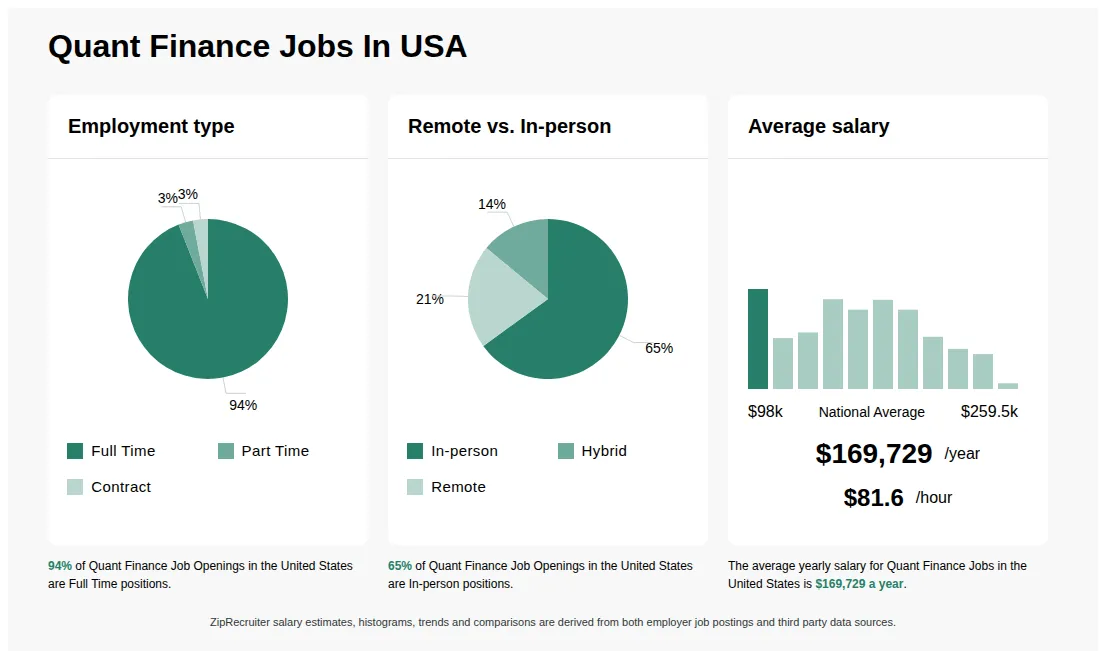
$98K - $112.7K
15% of jobs
$112.7K - $127.4K
7% of jobs
$132K is the 25th percentile. Wages below this are outliers.
$127.4K - $142K
9% of jobs
$142K - $156.7K
14% of jobs
The median wage is $163.4K / yr.
$156.7K - $171.4K
12% of jobs
$171.4K - $186.1K
14% of jobs
$192.1K is the 75th percentile. Wages above this are outliers.
$186.1K - $200.8K
12% of jobs
$200.8K - $215.5K
7% of jobs
$215.5K - $230.1K
5% of jobs
$230.1K - $244.8K
5% of jobs
$244.8K - $259.5K
0% of jobs
$98K
$169.7K
$259.5K
How much do quant finance jobs pay per year?
As of Sep 3, 2026, the average yearly pay for quant finance in the United States is $169,729.00, according to ZipRecruiter salary data. Most workers in this role earn between $134,500.00 and $199,000.00 per year, depending on experience, location, and employer.
What is a quant finance?
A Quant Finance job involves applying mathematical models, statistical techniques, and programming skills to analyze financial markets and develop trading or risk management strategies. Quantitative analysts, or “quants,” work in areas like algorithmic trading, portfolio management, and derivatives pricing. They use advanced concepts from mathematics, statistics, and computer science to optimize investment decisions and manage financial risk.
What do quant finance professionals do?
Quant Finance professionals are often involved in designing, developing, and implementing mathematical models to price securities, manage risk, and optimize investment strategies. Their day-to-day work can include analyzing large data sets, running simulations, building algorithmic trading systems, and collaborating with traders, portfolio managers, and software engineers. They may also contribute to scenario analysis, stress testing portfolios, and validating existing models to ensure regulatory compliance and accuracy. The role demands adaptability and close teamwork, as projects can shift rapidly in response to market changes or new research findings.
What skills and qualifications are needed to thrive in quant finance?
To thrive in Quant Finance, a strong background in mathematics, statistics, computer science, and finance, often supplemented by a graduate degree in a quantitative field, is essential. Mastery of programming languages such as Python, R, or C++, and familiarity with financial modeling platforms and certifications like CFA or FRM, are typically required. Excellent analytical thinking, problem-solving abilities, and effective communication skills help individuals excel in complex, collaborative environments. These skills ensure the ability to design robust quantitative models, interpret data-driven insights, and collaborate successfully with both technical and non-technical colleagues.
What are quant finance jobs in finance?
Quant finance jobs involve developing and applying mathematical models and algorithms to analyze financial markets, manage risk, and optimize investment strategies. These roles typically require strong skills in mathematics, programming, and finance, often utilizing tools like Python, R, or MATLAB. Quantitative analysts, or quants, work in trading firms, investment banks, and hedge funds to support data-driven decision-making.
More about Quant Finance jobs
What cities are hiring for Quant Finance jobs?
Cities with the most Quant Finance job openings:
What are the most commonly searched types of Quant Finance jobs?
The most popular types of Quant Finance jobs are:
What states have the most Quant Finance jobs?
States with the most job openings for Quant Finance jobs include:
What job categories do people searching Quant Finance jobs look for?
The top searched job categories for Quant Finance jobs are:
Bank Of America rating

8.2
Based on 534 frontline employees who took The Breakroom Quiz
52nd of 174 rated banks
Job description
Job Description:
At Bank of America, we are guided by a common purpose to help make financial lives better through the power of every connection. We do this by driving Responsible Growth and delivering for our clients, teammates, communities and shareholders every day.
Being a Great Place to Work and providing a culture of caring is core to how we drive Responsible Growth. We are intentional about fostering an inclusive workplace where every teammate has the opportunity to succeed, build a career and contribute to our shared success. This includes attracting and developing exceptional talent, recognizing and rewarding performance, and supporting our teammates' physical, emotional, and financial wellness through affordable, competitive and flexible benefits.
We value the unique perspectives individuals bring from all backgrounds and career paths - whether shaped by military service, community college education, or a wide range of work and life experiences. These journeys foster resilience, leadership and innovation, strengthening our workforce and positively impact the communities we serve.
Bank of America is committed to an in-office culture that supports collaboration, engagement, and career development. Our approach includes clear in-office expectations, while providing an appropriate level of flexibility based on role-specific responsibilities and business needs.
At Bank of America, you can build a successful career with opportunities to learn, grow, and make an impact. Join us!
Job Description:
This job is responsible for conducting quantitative analytics and modeling projects for specific business units or risk types. Key responsibilities include developing new models, analytic processes, or systems approaches, creating technical documentation for related activities, and working with Technology staff in the design of systems to run models developed. Job expectations include having a broad knowledge of financial markets and products.
Responsibilities:
Champion the integration of AI capabilities into existing applications, workflows, and analytics platforms to improve efficiency, automation, and decision-making.
Implement, maintain, and enhance analytical models supporting customer decisioning, consumer behavior analytics, credit risk assessment, and stress testing initiatives.
Translate business requirements and model specifications into scalable production solutions using Python, SQL, and enterprise data platforms.
Develop and support model execution, validation, monitoring, and deployment processes while partnering with business, analytics, and technology teams to ensure reliable implementation and operational performance.
Overview of Global Risk Analytics (GRA)
Bank of America has an opportunity for a Quantitative Financial Analyst within the Global Risk Analytics (GRA) organization. GRA is part of Global Risk Management (GRM) and is responsible for developing a consistent and coherent set of models and analytical capabilities for effective risk and capital measurement, management, and reporting across the bank. GRA partners with the Lines of Business and Enterprise functions to deliver solutions that address both business and regulatory requirements while remaining responsive to evolving portfolios, economic conditions, and emerging risks. Through its work, GRA drives innovation, process improvement, automation, and analytical excellence.
Overview of Consumer Model Development and Operations
The Consumer Model Development & Operations (CMDO) team is part of Global Risk Analytics. It provides quantitative solutions to enable effective risk and capital management across the Retail and Global Wealth & Investments Management (GWIM) lines of business. The team places strong emphasis on delivering world class quantitative solutions for Front Line Unit (FLU) model owners and stakeholders through a disciplined and iterative development process. The team has responsibilities across a number of areas:
Quantitative Modeling - Develop and maintain risk and capital Models and Model Systems across Retail and GWIM product lines. Models and Model Systems provide insight into many risk areas, including loan default, exposure at default (EAD), loss given default (LGD), delinquency, prepayment, balances, pricing, risk appetite, revenues and cash flows.
Quantitative Development - Architect, implement, maintain, improve and integrate quantitative solutions on strategic GRA platforms. Outputs include GRA libraries that perform consumer risk model calculations, analytical tools, processes and documentation. Partner in defining, adopting, and executing GRA's technical strategy.
Risk and Capital Management Capabilities - Build best in class quantitative solutions that enable the Retail and GWIM lines of business to effectively manage risk and capital, through the application of the disciplined BAU development process that includes extensive interaction with the FLU model owners and stakeholders throughout the quantitative lifecycle.
Infrastructure - Partner in driving forward the infrastructure to support the goals of GRA through code efficiencies, and expansion of quantitative capabilities to better leverage infrastructure and computational resources.
Documentation - Deliver concise, quantitative documentation to inform stakeholders, meet policy requirements, and enable successful engagement in regulatory exams (e.g., CCAR, CECL) via automated, modularized, and standardized documentation and presentations.
Minimum Education Requirement: Masters or PhD in Computer Science, Engineering, Statistics, or similar discipline, and a minimum 2 year relevant experience.
Successful candidates will possess the following skills:
Ability to work in a large, complex organization, and influence various stakeholders and partners
Self-starter; Initiates work independently, before being asked
Strong team player able to seamlessly transition between contributing individually and collaborating on team projects; Understands that individual actions may require input from manager or peers; Knows when to include others
Strong communication skills and ability to effectively communicate quantitative topics to technical and non-technical audiences
Experience with engineering complex, multifaceted processes that span across teams; Able to document process steps, inputs, outputs, requirements, identify gaps and improve workflow
Strong programming skills, e.g. Python, R, or similar language
Strong analytical and problem-solving skills
Preferred Programming & Analytics Experience:
Strong Python development skills with experience leveraging AI/ML frameworks and software engineering best practices, including Git, CI/CD, and automated testing.
Experience designing, developing, and maintaining scalable software applications, data pipelines, and processing solutions using Python, SQL, and distributed computing technologies in enterprise environments.
Proven ability to translate business requirements and analytical models into production-ready applications, including consumer behavior, credit risk, and stress testing model implementations.
Skills:
Critical Thinking
Quantitative Development
Risk Analytics
Risk Modeling
Technical Documentation
Adaptability
Collaboration
Problem Solving
Risk Management
Test Engineering
Data Modeling
Data and Trend Analysis
Process Performance Measurement
Research
Written Communications
Shift:
1st shift (United States of America)Hours Per Week:
40Pay Transparency details
US - IL - Chicago - 540 W Madison St - Bank Of America Plaza (IL4540)Pay and benefits informationPay range$89,800.00 - $155,000.00 annualized salary, offers to be determined based on experience, education and skill set.Discretionary incentive eligibleThis role is eligible to participate in the annual discretionary plan. Employees are eligible for an annual discretionary award based on their overall individual performance results and behaviors, the performance and contributions of their line of business and/or group; and the overall success of the Company.BenefitsThis role is currently benefits eligible. We provide industry-leading benefits, access to paid time off, resources and support to our employees so they can make a genuine impact and contribute to the sustainable growth of our business and the communities we serve.What Bank Of America employees say
Pay
Benefits
Hours and flexibility
Workplace
Get the full story on Breakroom

About Bank Of America
Sourced by ZipRecruiter
At Bank of America, we are guided by a common purpose to help make financial lives better through the power of every connection. Responsible Growth is how we run our company and how we deliver for our clients, teammates, communities and shareholders every day. One of the keys to driving Responsible Growth is being a great place to work for our teammates around the world. We're devoted to being a diverse and inclusive workplace for everyone. We hire individuals with a broad range of backgrounds and experiences and invest heavily in our teammates and their families by offering competitive benefits to support their physical, emotional, and financial well-being.
Industry
Finance and insurance
Company size
10,000+ Employees
Headquarters location
Charlotte, NC, US