1

Positive Behaviour Support Practitioner Jobs (NOW HIRING)

Positive Support Specialist Position Overview: As a member of Mains'l's Wellness Team, the Positive ... This position is ideal for someone who enjoys building relationships, solving complex behavioral ...

Positive Support Specialist Position Overview: As a member of Mains'l's Wellness Team, the Positive ... This position is ideal for someone who enjoys building relationships, solving complex behavioral ...

Develop and train Positive Behavior Support Plans and Psychotropic Medication Treatment Plans as needed, including accompanying data collection and monitoring systems. * Work collaboratively and ...

Positive Behavior Supports Clinician

Ashland, MA ยท On-site

$63K - $87K/yr

Develop and train Positive Behavior Support Plans and Psychotropic Medication Treatment Plans as needed, including accompanying data collection and monitoring systems. * Work collaboratively and ...

Showing results 21-40

Positive Behaviour Support Practitioner information

See salary details

$9

$29

$59

How much do positive behaviour support practitioner jobs pay per hour?

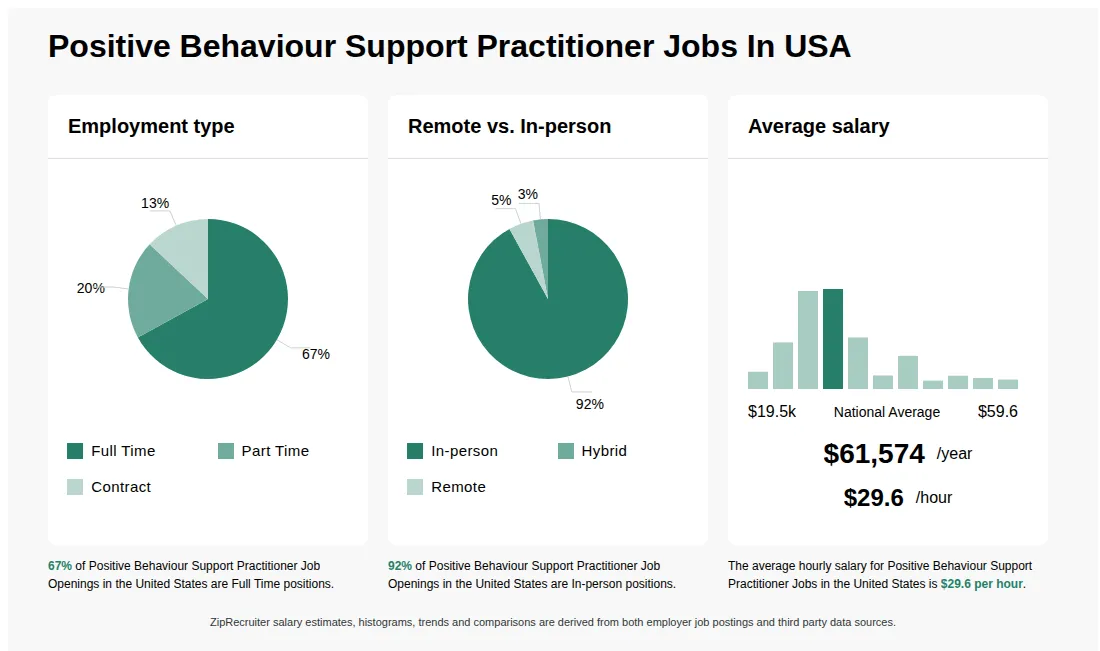
As of Sep 8, 2026, the average hourly pay for positive behaviour support practitioner in the United States is $29.60, according to ZipRecruiter salary data. Most workers in this role earn between $19.95 and $32.93 per hour, depending on experience, location, and employer.

What is a positive behaviour support practitioner?

A Positive Behaviour Support (PBS) Practitioner works with individuals who display behaviours of concern, often due to disabilities or complex needs. They use evidence-based strategies to understand the reasons behind these behaviours and develop personalised support plans. Their goal is to improve quality of life by promoting positive behaviours, enhancing skills, and reducing restrictive practices. PBS Practitioners collaborate with families, carers, and other professionals to implement and monitor interventions effectively.

What are the key skills and qualifications needed to thrive as a positive behaviour support practitioner?

To thrive as a Positive Behaviour Support Practitioner, you need knowledge of behavioural theories, assessment methods, and support planning, typically supported by a degree in psychology, social work, or a related field. Experience with data collection tools, behavioural analysis software, and familiarity with PBS frameworks or relevant certifications such as PBS or ABA credentials are often required. Strong soft skills like empathy, patience, and effective communication help practitioners build trust with clients and collaborate with families and multidisciplinary teams. These capabilities are essential for developing effective support strategies that improve quality of life for individuals with challenging behaviours.

What are some typical challenges faced by positive behaviour support practitioners, and how do they manage them?

Positive Behaviour Support Practitioners often work with individuals who have complex behavioural needs, which can sometimes present unpredictable or high-stress situations. Common challenges include developing individualized support plans that are both effective and sustainable, coordinating care with various professionals, and adapting strategies to evolving client needs. Practitioners manage these challenges through ongoing training, multidisciplinary teamwork, and by regularly evaluating and adjusting interventions based on data and client feedback. Many organizations offer supervision, peer support networks, and opportunities for professional development to help practitioners maintain best practices and resilience in their roles.

What qualifications do I need to be a Positive Behaviour Support Practitioner?

To become a Positive Behaviour Support Practitioner, individuals typically need a relevant qualification such as a degree or diploma in psychology, behaviour analysis, or a related field. Certification from a recognised body, such as the Board Certified Behaviour Analyst (BCBA) or equivalent, is often required, along with practical experience in behaviour support and strong communication skills.
More about Positive Behaviour Support Practitioner jobs

What are the most commonly searched types of Positive Behaviour Support Practitioner jobs?

The most popular types of Positive Behaviour Support Practitioner jobs are:

What states have the most Positive Behaviour Support Practitioner jobs?

States with the most job openings for Positive Behaviour Support Practitioner jobs include:

What job categories do people searching Positive Behaviour Support Practitioner jobs look for?

The top searched job categories for Positive Behaviour Support Practitioner jobs are:

Infographic showing various Positive Behaviour Support Practitioner job openings in the United States as of August 2026, with employment types broken down into 1% As Needed, 73% Full Time, 22% Part Time, and 4% Contract. Highlights an 91% Physical, 2% Hybrid, and 7% Remote job distribution, with an average salary of $61,574 per year, or $29.6 per hour.

Positive Behavior Support Specialist

Colleton County School District

Walterboro, SC โ€ข On-site

$16.75 - $23.25/hr

Full-time

Re-posted 24 days ago


Job description

JOB PURPOSE
Under occasional supervision, assists with general supervision of the student population in the assigned school. Reports to the Principal.
ESSENTIAL JOB FUNCTIONS
Keeps the principal or his/her designee informed on all problems and accomplishments within the assigned area.
Provides primary intervention to students who are identified as exhibiting behavioral difficulties which impede their social development and academic success.
Works with individual students or small groups of students to students to provide educational interventions and progress monitoring.
Works with school personnel in the Problem Solving Model Response to Intervention process by assisting in determining intervention plans and program services for student(s) exhibiting behavioral difficulties.
Works as a collaborative member of the school discipline committee providing intervention strategies for students identified as exhibiting behavioral difficulties.
Provides behavioral intervention support to students identified as exhibiting behavioral difficulties by developing a plan of action to assist student in positive behavioral change.
Meets with parents, school personnel, law enforcement and other professionals to address the student safety.
Provides resources support, information and strategies for parents to assist them in addressing the behavioral challenges of their children.
Provides data to the school discipline committee and participate in discussion and decision about student progress.
Utilizes data system to maintain lists of students participating in interventions.
Maintains records of interventions to include behavior intervention plans for special needs students and progress monitoring to insure process fidelity.
Complies with FERPA and all federal and state confidentiality laws and mandated reporting laws.
Supervises and controls activities of students assigned by the principal's or his/her designee's control.
Consults with the principal or his/her designee and take immediate action to resolve conflicts between student and/or students and staff.
Reports the status of student behavior regularly to the principal or his/her designee.
Provides feedback to the staff about students and special needs.
Receives, evaluates, and forwards reports from students and staff, taking necessary action to determine causes, resolving problems and informing the principal or his/her designee.
Establishes priorities for work to be completed.
Enforces safety rules and regulations.
Attends meetings, seminars, etc., to enhance knowledge required for the position as directed by the principal or his/her designee.
Serves to mediate and advocate for students in problem situations.
Monitors designated areas assigned within the school setting.
Provides support for diffusing potential conflict situations.
Serves as advisor to administrators of school and mentor to students.
Maintains a degree of high visibility among students and staff.
Performs related duties as required.
QUALIFICATIONS
Requires an Associate's Degree and five years of related experience or an equivalent combination of education, training and experience that provides the required knowledge, skills and abilities. Experience working with high risk youth in a supervisory or advisory capacity. Must possess a valid state driver's license.
ย