We recommend you connect with us on LinkedIn for more insights. to verify the application or details of the person you have been speaking to.
We recommend you connect with us on LinkedIn for more insights. to verify the application or details of the person you have been speaking to.
We recommend you connect with us on LinkedIn for more insights. to verify the application or details of the person you have been speaking to.
We recommend you connect with us on LinkedIn for more insights. to verify the application or details of the person you have been speaking to.
We recommend you connect with us on LinkedIn for more insights. to verify the application or details of the person you have been speaking to.
We recommend you connect with us on LinkedIn for more insights. to verify the application or details of the person you have been speaking to.
We recommend you connect with us on LinkedIn for more insights. to verify the application or details of the person you have been speaking to.
We recommend you connect with us on LinkedIn for more insights. to verify the application or details of the person you have been speaking to.
We recommend you connect with us on LinkedIn for more insights. to verify the application or details of the person you have been speaking to.
We recommend you connect with us on LinkedIn for more insights. to verify the application or details of the person you have been speaking to.
We recommend you connect with us on LinkedIn for more insights. to verify the application or details of the person you have been speaking to.
We recommend you connect with us on LinkedIn for more insights. to verify the application or details of the person you have been speaking to.
We recommend you connect with us on LinkedIn for more insights. to verify the application or details of the person you have been speaking to.
We recommend you connect with us on LinkedIn for more insights. to verify the application or details of the person you have been speaking to.
We recommend you connect with us on LinkedIn for more insights. to verify the application or details of the person you have been speaking to.
We recommend you connect with us on LinkedIn for more insights. to verify the application or details of the person you have been speaking to.
We recommend you connect with us on LinkedIn for more insights. to verify the application or details of the person you have been speaking to.
We recommend you connect with us on LinkedIn for more insights. to verify the application or details of the person you have been speaking to.
We recommend you connect with us on LinkedIn for more insights. to verify the application or details of the person you have been speaking to.
We recommend you connect with us on LinkedIn for more insights. to verify the application or details of the person you have been speaking to.
We recommend you connect with us on LinkedIn for more insights. to verify the application or details of the person you have been speaking to.
We recommend you connect with us on LinkedIn for more insights. to verify the application or details of the person you have been speaking to.
We recommend you connect with us on LinkedIn for more insights. to verify the application or details of the person you have been speaking to.
We recommend you connect with us on LinkedIn for more insights. to verify the application or details of the person you have been speaking to.
We recommend you connect with us on LinkedIn for more insights. to verify the application or details of the person you have been speaking to.
We recommend you connect with us on LinkedIn for more insights. to verify the application or details of the person you have been speaking to.
We recommend you connect with us on LinkedIn for more insights. to verify the application or details of the person you have been speaking to.
We recommend you connect with us on LinkedIn for more insights. to verify the application or details of the person you have been speaking to.

Plant Health Care Specialist
$30 - $40/hr
You bring: • A degree in Arboriculture, Urban Forestry, Horticulture, Plant Science, Plant Pathology, Environmental Sciences, Landscape Management, Turfgrass--or related experience (preferred) • ...
Quick apply
Plant Health Care Specialist
$30 - $40/hr
You bring: • A degree in Arboriculture, Urban Forestry, Horticulture, Plant Science, Plant Pathology, Environmental Sciences, Landscape Management, Turfgrass--or related experience (preferred) • ...

Plant Pathology * Agronomy * Horticulture * Plant Propagation * Arboriculture * Controlled Environmental Agriculture * Soil Science * Entomology * Plant Breeding & Genetics * Weed Science
Plant Pathology * Agronomy * Horticulture * Plant Propagation * Arboriculture * Controlled Environmental Agriculture * Soil Science * Entomology * Plant Breeding & Genetics * Weed Science

Teaches a full range of landscapecourses including equipment operations and maintenance, landscape practices,greenhouse production, turf grass, plant, pathology, entomology, soils, basicand advanced ...
Teaches a full range of landscapecourses including equipment operations and maintenance, landscape practices,greenhouse production, turf grass, plant, pathology, entomology, soils, basicand advanced ...
We recommend you connect with us on LinkedIn for more insights. to verify the application or details of the person you have been speaking to.
We recommend you connect with us on LinkedIn for more insights. to verify the application or details of the person you have been speaking to.
We recommend you connect with us on LinkedIn for more insights. to verify the application or details of the person you have been speaking to.
We recommend you connect with us on LinkedIn for more insights. to verify the application or details of the person you have been speaking to.
We recommend you connect with us on LinkedIn for more insights. to verify the application or details of the person you have been speaking to.
We recommend you connect with us on LinkedIn for more insights. to verify the application or details of the person you have been speaking to.
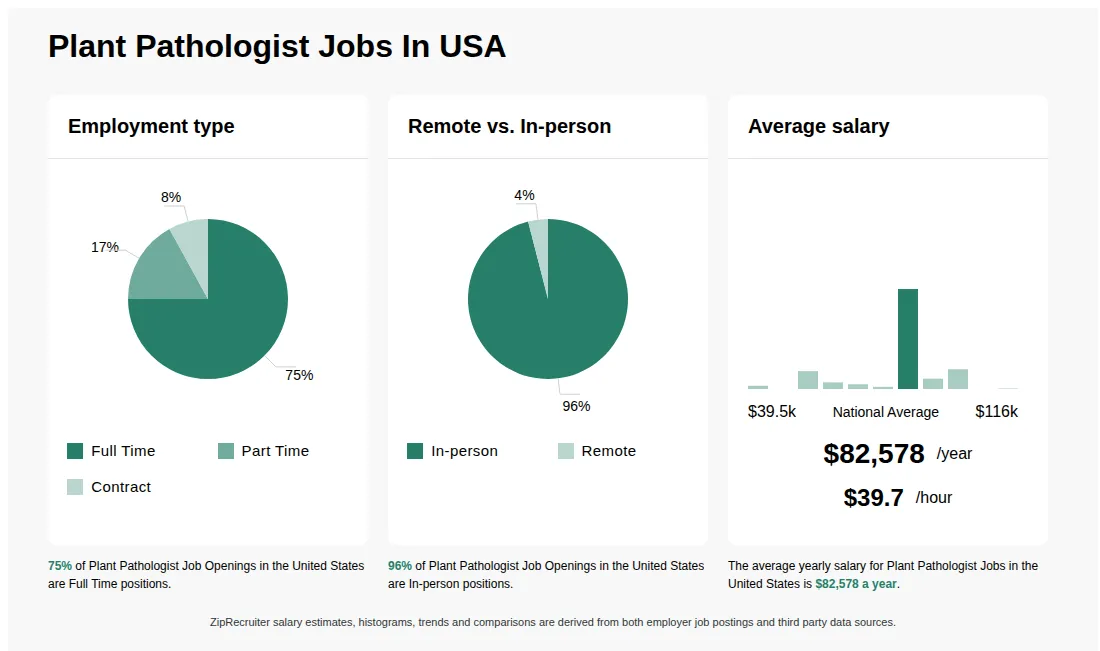
Plant Pathologist information
See salary details
$39.5K - $46.5K
1% of jobs
$46.5K - $53.4K
0% of jobs
$53.4K - $60.4K
11% of jobs
$60.4K - $67.3K
3% of jobs
$67.3K - $74.3K
2% of jobs
$74.3K - $81.2K
1% of jobs
$82K is the 25th percentile. Wages below this are outliers.
$81.2K - $88.2K
64% of jobs
$88.2K - $95.1K
6% of jobs
$95.1K - $102.1K
12% of jobs
$102.1K - $109K
0% of jobs
$109K - $116K
0% of jobs
$39.5K
$82.6K
$116K
How much do plant pathologist jobs pay per year?
As of Jul 21, 2026, the average yearly pay for plant pathologist in the United States is $82,578.00, according to ZipRecruiter salary data. Most workers in this role earn between $82,500.00 and $83,000.00 per year, depending on experience, location, and employer.
What are the key skills and qualifications needed to thrive as a Plant Pathologist, and why are they important?
To excel as a Plant Pathologist, you need a strong background in plant biology, microbiology, and disease diagnostics, typically supported by a degree in plant pathology or a related field. Familiarity with laboratory equipment, molecular diagnostic tools, and data analysis software such as PCR systems and GIS applications is essential. Strong analytical thinking, attention to detail, and effective communication skills help in problem-solving and collaborating with agricultural stakeholders. These abilities are vital for accurately identifying plant diseases, developing effective management strategies, and supporting sustainable agricultural production.
What is the difference between Plant Pathologist vs Plant Biologist?
| Aspect | Plant Pathologist | Plant Biologist |
|---|---|---|
| Credentials | Bachelor's or Master's in Plant Pathology, Ph.D. often preferred | Bachelor's or Master's in Botany, Plant Science, or related field; Ph.D. for advanced roles |
| Work Environment | Research labs, agricultural settings, plant disease diagnostics | Research labs, academic institutions, field studies, conservation areas |
| Industry Usage | Agriculture, plant disease management, research institutions | Research, academia, conservation, biotechnology |
While both roles focus on plants, a Plant Pathologist specializes in diagnosing and managing plant diseases, often working in agricultural and research settings. A Plant Biologist studies plant functions, growth, and development, with broader research interests. The roles overlap in education and research but differ in their specific focus areas and applications.
What are plant pathologists?
Plant pathologists are scientists who study plant diseases, including their causes, effects, and management. They investigate how pathogens such as fungi, bacteria, viruses, and nematodes affect plant health, and develop methods to prevent and control plant diseases. Plant pathologists work in various settings, including agriculture, research institutions, government agencies, and universities. Their work is essential for ensuring healthy crops, food security, and sustainable agricultural practices.
What Is a Plant Pathologist?
Plant pathologists are scientists who work in agriculture and related fields. As a plant pathologist, you work both in a laboratory setting and out in the field to monitor the conditions that affect plant and crop health. In the laboratory setting, you analyze samples of plants, microorganisms, and other aspects of the natural environment. When there are soil problems or a crop disease, you make onsite visits to determine the cause of the problem and recommend best solutions to treat or eradicate the issue. You must keep up to date with the latest research and innovations in biological and agricultural sciences related to diseases or pathogens that may plague plants. Working closely with biologists, farmers, breeders, and botanists at farms, you create quality control measures and improve practices for maintaining safe environments for the plants and find ways to increase crop yields or develop disease resistance.
What are some common challenges plant pathologists face when diagnosing plant diseases in the field?
Plant pathologists often encounter challenges such as distinguishing between similar disease symptoms, environmental stresses, and pest damage, which can all present similar signs in plants. Limited access to advanced diagnostic tools in field settings can make accurate identification more difficult, requiring strong observational skills and sometimes sending samples to a laboratory for further analysis. Additionally, keeping up with emerging diseases and adapting to new pathogens can be demanding, but collaboration with other scientists and ongoing professional development help address these challenges.
More about Plant Pathologist jobs
What cities are hiring for Plant Pathologist jobs? Cities with the most Plant Pathologist job openings:
What are the most commonly searched types of Plant Pathologist jobs? The most popular types of Plant Pathologist jobs are:
Who are the top companies hiring for Plant Pathologist jobs? The top employers for Plant Pathologist jobs are:
What states have the most Plant Pathologist jobs? States with the most job openings for Plant Pathologist jobs include:
What job categories do people searching Plant Pathologist jobs look for? The top searched job categories for Plant Pathologist jobs are:
What are popular job titles related to Plant Pathologist jobs? For Plant Pathologist jobs, the most frequently searched job titles are:
Full-time
This job post has expired 1 day ago. Applications are no longer accepted.
Job description
We recommend you connect with us on LinkedIn for more insights.
to verify the application or details of the person you have been speaking to.