1

Parachute Rigger Jobs (NOW HIRING)

Participate in booster build and integration, pre-launch parachute packing and rigging, pneumatic and hydraulic system setup, system level integration & testing, data review, troubleshooting and ...

next page

Showing results 1-20

Parachute Rigger information

See salary details

$11K

$47.8K

$72.5K

How much do parachute rigger jobs pay per year?

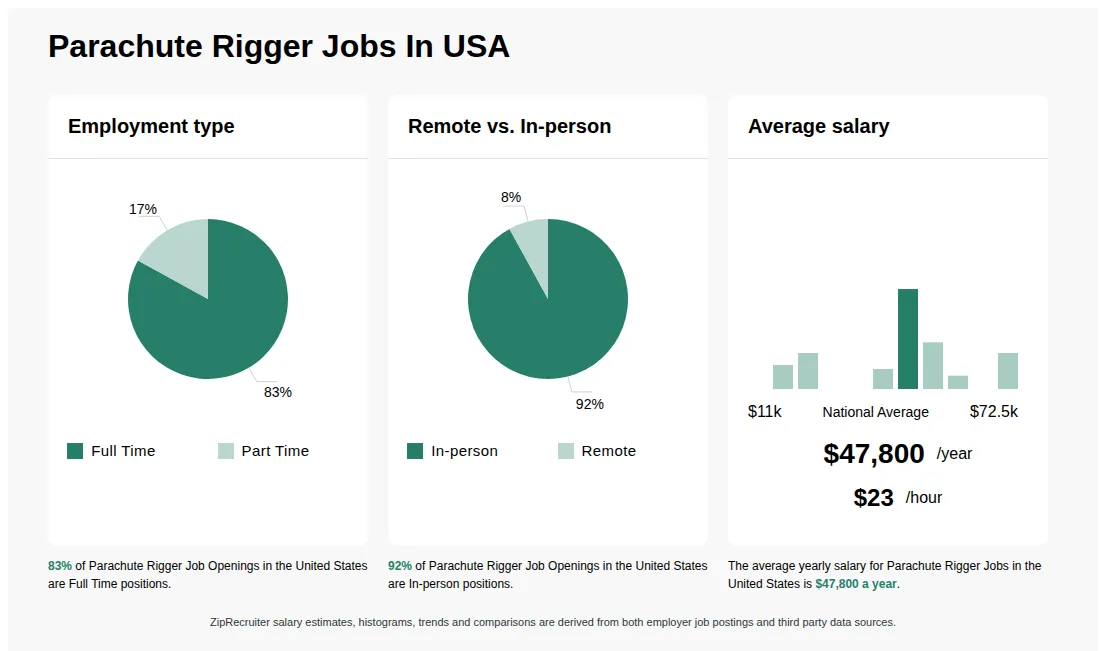
As of Jun 11, 2026, the average yearly pay for parachute rigger in the United States is $47,800.00, according to ZipRecruiter salary data. Most workers in this role earn between $45,000.00 and $55,000.00 per year, depending on experience, location, and employer.

How much money do parachute riggers make?

Parachute riggers typically earn a median annual salary of around $40,000 to $60,000, depending on experience, certification level, and work environment. Experienced riggers with specialized skills or working in military or commercial sectors can earn higher wages, and overtime or shift work may increase total compensation.

What is the difference between Parachute Rigger vs Aircraft Maintenance Technician?

AspectParachute RiggerAircraft Maintenance Technician
CertificationsFAA Parachute Rigger CertificateFAA Airframe & Powerplant (A&P) Certificate
Work EnvironmentAirports, parachute manufacturing, military basesAirlines, maintenance hangars, repair stations
Industry UsageMilitary, recreational, commercial parachutingAviation, commercial and private aircraft maintenance

Parachute Riggers focus on packing, inspecting, and repairing parachutes, often working in parachuting or military environments. Aircraft Maintenance Technicians perform repairs and inspections on aircraft, ensuring safety and compliance. While both roles require FAA certifications and work in aviation-related settings, their specific duties and certifications differ significantly.

What Does a Parachute Rigger Do?

Parachute riggers pack, unpack, inspect, and repair parachutes and other parachute equipment, such as lines, fabric, and backpacks. You usually find parachute riggers in the armed forces, but they also work in civilian aviation, particularly for small prop planes or skydiving companies. As a parachute rigger, you must understand how to manage and repair the parachute fabrics and hardware, as well as the regulations related to packing up a parachute. Some job duties may vary between military and civilian positions, but all parachute riggers must perform extensive quality assurance and testing to ensure that everyone who uses the parachutes they pack is safe when they make their jumps.

What are Parachute Riggers?

Parachute Riggers are specialized professionals trained to inspect, repair, pack, and maintain parachutes and related equipment to ensure they function safely and reliably. They work with various types of parachutes used in military, sport, and emergency applications. Their responsibilities also include conducting safety checks, replacing worn components, and sometimes providing training on parachute use. Parachute Riggers must be detail-oriented and often require certification to perform their duties legally.

Is Parachute Rigger a hard job?

Parachute riggers perform detailed inspections, packing, and maintenance of parachutes, requiring precision, attention to detail, and knowledge of safety standards. The job involves physical work and adherence to strict procedures, and often requires certification and training, making it a challenging but manageable profession for those with technical skills. The difficulty depends on individual aptitude and experience with safety protocols and equipment handling.

What are the key skills and qualifications needed to thrive as a Parachute Rigger, and why are they important?

To thrive as a Parachute Rigger, you need strong attention to detail, manual dexterity, and a solid understanding of aerodynamics, often supported by specialized training and FAA certification. Familiarity with sewing machines, inspection tools, and parachute packing procedures is essential. Excellent problem-solving skills, reliability, and the ability to work under pressure set outstanding riggers apart. These skills ensure the safety and functionality of parachute equipment, which is critical for the lives of users.

What are some common challenges Parachute Riggers face during their daily responsibilities?

Parachute Riggers often encounter challenges such as maintaining meticulous attention to detail under time constraints, as improper packing or inspection can lead to serious safety risks. They must also keep up with rigorous documentation and adhere to strict regulatory standards, which can be demanding. Additionally, Riggers frequently work in environments where teamwork is essential, coordinating closely with pilots, jumpers, and maintenance staff to ensure all equipment is safe and ready for use.

What jobs pay 2000 a day?

Parachute riggers typically do not earn $2000 a day; their pay is usually hourly or salary-based. High-paying jobs that can reach or exceed $2000 daily often include specialized roles such as experienced surgeons, corporate executives, or certain high-level consultants, which require advanced skills, certifications, and significant experience. These roles are often in industries like healthcare, finance, or technology and may involve long hours or high responsibility.

What is the highest paying rigger job?

The highest paying parachute rigger jobs are typically found in the military, aerospace, or government sectors, where riggers may work as senior or master riggers with specialized certifications. These roles often require extensive experience, advanced skills, and security clearances, resulting in higher salaries compared to standard parachute rigging positions.
What cities are hiring for Parachute Rigger jobs? Cities with the most Parachute Rigger job openings:
What are the most commonly searched types of Parachute Rigger jobs? The most popular types of Parachute Rigger jobs are:
Who are the top companies hiring for Parachute Rigger jobs? The top employers for Parachute Rigger jobs are:
What states have the most Parachute Rigger jobs? States with the most job openings for Parachute Rigger jobs include:
What job categories do people searching Parachute Rigger jobs look for? The top searched job categories for Parachute Rigger jobs are:
What are popular job titles related to Parachute Rigger jobs? For Parachute Rigger jobs, the most frequently searched job titles are:
Infographic showing various Parachute Rigger job openings in the United States as of June 2026, with employment types broken down into 86% Full Time, 7% Part Time, and 7% Temporary. Highlights an 93% In-person, and 7% Remote job distribution, with an average salary of $47,800 per year, or $23 per hour.

Forestry Technician (Smokejumper Specialist)

Office of the Secretary of the Interior

Boise, ID • On-site, Remote

$67K - $87K/yr

Full-time

Posted 13 days ago


Job description

Summary
This position is a Forestry Technician (Smokejumper Specialist), GW-0462-8 working in Boise, Idaho for the US Wildland Fire Service.
Career-Seasonal appointments are permanent positions and include the same benefits as Career appointments, but do not provide work on a year-round basis. You will work for a minimum of 6 months, and any add'l employment is dependent on the organizational needs. During periods when you are not scheduled to work, you may be placed in a non-pay status.
Learn more about this agency
Duties
Help
This announcement will fill four types of positions (multiple vacancies per position).
  • Training Specialist: This position develops and implements a schedule and syllabus for parachute and fire training, leads a cadre of smokejumpers in various phases of smokejumper training, and evaluates the performance of individuals in such training.
  • Loft Specialist: This position supervises parachute rigging, maintenance, and repairs, constructs and maintains smokejumper parachuting equipment, and trains less experienced smokejumpers in parachute loft equipment and procedures.
  • Fire Operations Specialist: This position serves as an Incident Commander Type 3 or interim incident commander on complex and emerging wildfires and smokejumper rigging supervisor, providing oversight during ram air rigging and assessing parachute equipment airworthiness.
  • Paracargo Specialist: This position serves as loadmaster and oversees and trains others in paracargo rigging, aircraft ramp operations, and aircraft loading.

As a Forestry Technician (Smokejumper Specialist), your duties will include but are not limited to the following:
  • Parachute into rugged terrain to perform fire suppression and related duties.
  • Perform as an initial attack Incident Commander on wildfires nationwide.
  • Cooperate with land managers, aerial and ground firefighting resources, dispatch centers, and other Incident Command Teams.
  • Repair, pack, and maintain parachutes and related equipment.
  • Assist with establishing, writing, editing, and updating internal protocols and guidelines.
  • Assist with work assignment planning, prioritization, and scheduling.
  • Perform other duties as assigned.

Requirements
Help
Conditions of employment
  • Must be a U.S. Citizen or National.
  • Suitability for Federal employment, as determined by background investigation.
  • Direct Deposit Required.
  • You will be required to submit to a drug test and receive a negative drug test result prior to appointment. In addition, this position is subject to random testing for illegal drug use.
  • Selectees must pass a pre-employment medical examination and may be subject to post-employment medical examinations to determine if they are maintaining the fitness standards for this position.
  • You must also pass the work capacity test for arduous positions.
  • Individuals assigned male at birth after 12-31-59 must be registered for the Selective Service. To verify registration, visit SSS.gov.
  • You must be 18 years of age or older to be assigned to a hazardous position.
  • Must meet the maximum age requirement. See qualifications section for more information.
  • Subject to frequent extended travel up to 21 days at a time particularly during fire season, and you must obtain a government charge card for travel.
  • Must meet state drivers licensing requirements. This license must be obtained and valid prior to employment.
  • A condition of employment for accepting this position, you may be required to serve a 1-year probationary period during which your fitness and whether your continued employment advances the public interest will be evaluated.

This position is covered by the special retirement provisions of 5 U.S.C. 8336 (c) and 5 U.S.C. 8412 (d) as a Primary/Rigorous Firefighter. Applicants must be 18 years of age, but not have reached their 37th birthday by the closing date of this announcement. These positions are covered by the special enhanced annuity retirement provisions for Federal Firefighters and Law Enforcement officers and have a mandatory retirement age of 57. Two exceptions are allowed: 1) an applicant has prior Federal service in documented special retirement covered position(s) sufficient to count toward 20 years of covered service on or before the mandatory retirement age of 57; or 2) an applicant is a qualified veterans' preference eligible, in which case the MEA is waived and their corresponding retirement age may be higher than 57 after completing 20 years of service. Applicants must submit proof of their previous and/or current status in the Fire Fighter or Law Enforcement special enhanced annuity retirement system.
Qualifications
This announcement will fill four positions (multiple vacancies per position): Training Specialist, Loft Specialist, Fire Operations Specialist, and Paracargo Specialist.
In order to qualify for this position, you must possess the Minimum Qualification requirements listed below.
Selective Placement Factors (SPFs): This position requires a special qualification that has been determined to be essential to perform the duties and will be used as a screen out element. Those who do not provide evidence they possess the following selective factor(s) will be rated not qualified.
SPF #1: Required for ALL vacancies:
  • This position is a Primary Firefighter position and is subject to a maximum entry age (MEA). The MEA is the date immediately preceding your 37th birthday. Applicants must not have reached age 37 at the time of appointment, unless proof is provided of prior Federal service in another primary covered position, or you are a preference eligible veteran. If you are a preference eligible veteran, you may be eligible for this position after your 37th birthday. You must supply a copy of your Defense Department Form 214 (DD-214) along with Standard Form 15 (if applicable) and any associated documentation in accordance with the instructions in this vacancy announcement. Failure to provide this documentation with your application may result in loss of consideration. Please refer to the Required Documents section for further guidance on what documentation is required to meet this requirement. If over the MEA and you are not a veteran, proof of prior covered service must be submitted prior to employment. Acceptable proof consists of SF-50s showing beginning and ending dates of covered/creditable appointments and copies of approved letters based on individual claims.

SPF #2 : Required for ALL vacancies:
  • Prior Primary Wildland Firefighting Experience: Applicants must have documented prior primary firefighting experience, with substantial service defined as either:
    • At least one full fire season working in a primary wildland firefighting role (e.g., Engine Crew, Fire Effects Crew, Prescribed Fire/Fuels Crew, Hand Crew, Helitack Crew, Hotshot Crew, Smokejumper, Wildland Fire Modules or Fire Suppression Crews, etc.) with a federal, state, tribal, local, or private-sector organization;- OR -
    • At least 14-days of on-the-ground fireline experience (cumulative or consecutive).

Prior primary wildland fire experience must be clearly documented in your resume. Note: an IQCS Master Record or equivalent document will not be used to determine or calculate prior primary wildland fire experience eligibility for this requirement.
SPF #3: Required for ALL vacancies:
  • Prior smokejumping experience required. This experience must be documented in the online application or resume with specific to AND from dates (MM/YY), description of work performed, AND hours worked per week.

SPF #4: Required for Loft Specialist and Fire Operations Specialist ONLY:
  • FAA Certified Senior or Master Rigger: To be FAA certified as a Senior or Master Rigger, a person must complete the required number of parachute packs and complete written, oral, and practical exams administered by the designated FAA examiner(s). Documentation must be submitted at the time of application.

SPF#5: Required for Fire Operations Specialist ONLY:
  • Incident Commander Type 3 (ICT3) qualified. You must provide a copy of your Incident Qualification and Certification System (IQCS) Master Record or other equivalent documentation which verifies you meet the required NWCG minimum qualifications

In addition to the requirements described above, the following additional experience is required.
Only experience and education obtained by 06/11/2026 will be considered.
Credit will be given for all appropriate qualifying experience. Please be sure to include this information in your resume. No assumptions will be made about your experience.
For the GW-08 level: At least one year of specialized experience equivalent to the GW/GS-07 level, or higher, in the Federal service, or equivalent. Examples of specialized experience include but are not limited to: experience in forest and rangeland fire suppression as an initial attack incident commander coordinating multiple firefighting resources, and interfacing with land managers, cooperators, and the public; experience in Smokejumper operations including parachuting into rugged terrain, parachute rigging and repair, and the use of smokejumper specific firefighting tools and equipment; experience in the development of training syllabi and schedules; experience in the repair and construction of smokejumper equipment.
-OR-
Two full years (36 semester hours) of graduate level education or a master's degree directly related to the work of a forestry technician
-OR-
An equivalent combination of experience and education.
Experience refers to paid and unpaid experience, including volunteer work done through National Service programs (e.g., Peace Corps, AmeriCorps) and other organizations (e.g., professional; philanthropic; religious; spiritual; community, student, social). Volunteer work helps build critical competencies, knowledge, and skills and can provide valuable training and experience that translates directly to paid employment. You will receive credit for all qualifying experience, including volunteer experience.
Physical Requirements:
Employment in this position is conditional upon your successful completion of the following smokejumper physical fitness performance tests:
When you report for duty, you will be given a physical condition test. The test is given in one time period with a 5-minute break between exercises. The test consists of performing the following exercises:
  • 30 push-ups
  • 6 pull-ups
  • Run 1.5 miles in 10.47 minutes or less and backpacking a 110 pound load three miles in less than 65 minutes.

Work Capacity Test at the Arduous Level: All arduous wildland firefighters must backpack a 45 pound load for three miles in 45 minutes or less.
Physical Demands:
The incumbent must be able to work under extreme physical exertion regularly working 16 hour shifts or longer on the fireline. Work on the fireline requires considerable strenuous physical exertion.
Working Conditions: Forty-five percent of the work is performed outdoors in a wide variety of weather and terrain conditions or in a crowded airplane. Meals frequently consist of cold rations and sleeping accommodations may be a sleeping bag and a piece of plastic. The remainder of the work is accomplished in sometimes tense and stressful office environment. Incumbent risks death or serious injury during parachute jumps, cargo dropping or firefighting.
Eligibility and Qualification Requirements: Applicants must meet both eligibility and qualification requirements for the position of interest by the closing date of the Job Announcement. Specifically,
i. Area of Consideration.
ii. Time-in-grade (TIG) requirements as specified in 5 CFR 300, Subpart F.
iii. Time after competitive appointment as specified in 5 CFR 330.502.
iv. Qualification requirements outlined in OPM's Qualifications Standards for General Schedule Positions.
Education
PROOF OF EDUCATION:
All applicants who are using education or a combination of education and experience to qualify must submit copies of official or unofficial transcripts which include grades, credit hours earned, major(s), grade point average or class ranking, institution name, and student name.
If any required coursework is not easily recognizable on transcripts, or if you believe a portion of a particular course can be credited toward meeting an educational requirement, you must also provide a memorandum on letterhead from the institution's registrar, dean, or other appropriate official stating the percentage of the course that should be considered to meet the requirement and the equivalent number of units. Unofficial transcripts are acceptable; however, if you are selected for the position, you will be required to produce the original official transcripts.
PASS/FAIL COURSES:
If more than 10 percent of your undergraduate course work (credit hours) were taken on a pass/fail basis, your claim of superior academic achievement must be based upon class standing or membership in an honor society.
GRADUATE EDUCATION:
One academic year of graduate education is considered to be the number of credits hours your graduate school has determined to represent one academic year of full-time study. Such study may have been performed on a full-time or part-time basis. If you cannot obtain your graduate school's definition of one year of graduate study, 18 semester hours (or 27 quarter hours) should be considered as satisfying the requirement for one year of full-time graduate study.
FOREIGN EDUCATION:
If you are using education completed in foreign colleges or universities to meet the qualification requirements, ...