1

Painting Inspector Jobs (NOW HIRING)

Perform visual inspections and coating thickness testing at various stages of the painting process. Identify and report potential safety hazards associated with bridge coating inspections. Verify ...

... Paint Inspector certification strongly preferred • Knowledge of coatings, surface preparation, and industrial quality standards preferred • NACE certification is a plus • Ability to read and ...

... Paint Inspector certification strongly preferred • Knowledge of coatings, surface preparation, and industrial quality standards preferred • NACE certification is a plus • Ability to read and ...

... Paint Inspector certification strongly preferred • Knowledge of coatings, surface preparation, and industrial quality standards preferred • NACE certification is a plus • Ability to read and ...

... Paint Inspector certification strongly preferred • Knowledge of coatings, surface preparation, and industrial quality standards preferred • NACE certification is a plus • Ability to read and ...

next page

Showing results 1-20

Painting Inspector information

See salary details

$12

$27

$52

How much do painting inspector jobs pay per hour?

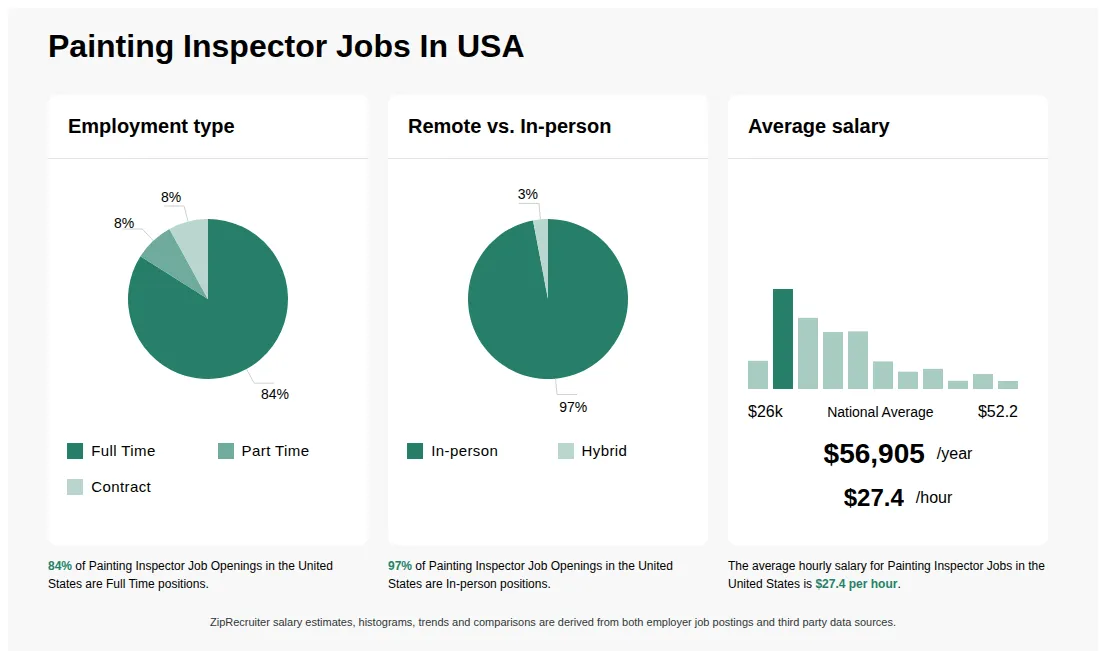
As of Jul 8, 2026, the average hourly pay for painting inspector in the United States is $27.36, according to ZipRecruiter salary data. Most workers in this role earn between $18.51 and $31.49 per hour, depending on experience, location, and employer.

What kind of inspectors make the most money?

Senior or specialized painting inspectors, such as those with certifications like NACE or SSPC, tend to earn higher salaries due to their expertise and experience. Inspectors working in high-risk environments or on large-scale projects often receive higher pay, especially if they have advanced skills in quality control and safety standards.

Are coating inspectors in demand?

Coating inspectors, including painting inspectors, are in demand in industries such as construction, manufacturing, and maintenance, especially where quality control and corrosion prevention are critical. Employment opportunities often require certifications like NACE or SSPC and knowledge of inspection tools and standards. The demand can vary based on industry growth and infrastructure projects.

What does a paint inspector do?

A paint inspector evaluates painted surfaces to ensure they meet quality and safety standards, checking for proper adhesion, thickness, and finish. They often use tools like gauges and microscopes, and may hold certifications such as NACE or SSPC. Their work helps prevent coating failures and extends the lifespan of structures.

What is a Painting Inspector job?

A Painting Inspector is responsible for ensuring that paint coatings on surfaces meet industry standards, specifications, and regulations. They inspect surface preparation, application methods, and coating thickness to verify compliance with project requirements. Painting Inspectors often work in construction, manufacturing, or marine industries, assessing and documenting coating quality. They use specialized tools like thickness gauges and adhere to industry standards such as SSPC, NACE, or ISO guidelines. Their role helps prevent corrosion, improve durability, and maintain safety and aesthetic standards.


How to become a painting inspector?

To become a painting inspector, typically one needs a high school diploma or equivalent, followed by specialized training in paint inspection, coatings, or related fields. Certification from organizations like the NACE International or SSPC enhances job prospects and demonstrates expertise in surface preparation, coating application, and quality standards.

What are the typical challenges faced by Painting Inspectors on the job?

Painting Inspectors often encounter challenges such as working in harsh outdoor environments, variable weather conditions, and ensuring compliance with strict industry standards while managing tight project deadlines. They must also coordinate with contractors, project managers, and sometimes clients to resolve discrepancies and document all inspection findings accurately. Balancing thorough inspections with efficient workflow is a key aspect of the role. These challenges make it important for inspectors to stay organized, communicative, and attentive to detail throughout each project.

What are the key skills and qualifications needed to thrive in the Painting Inspector position, and why are they important?

To thrive as a Painting Inspector, you need a solid understanding of surface preparation, coating application techniques, and industry standards, often supported by a background in engineering or construction and relevant certifications like NACE or SSPC. Familiarity with inspection tools such as dry film thickness gauges, holiday detectors, and specialized reporting software is typically required. Attention to detail, clear communication, and problem-solving skills are valuable soft skills that set top candidates apart. These competencies ensure that coatings are applied correctly and meet client specifications, preventing costly errors and maintaining quality on industrial or commercial projects.

More about Painting Inspector jobs
What cities are hiring for Painting Inspector jobs? Cities with the most Painting Inspector job openings:
What are the most commonly searched types of Painting Inspector jobs? The most popular types of Painting Inspector jobs are:
What states have the most Painting Inspector jobs? States with the most job openings for Painting Inspector jobs include:
Infographic showing various Painting Inspector job openings in the United States as of July 2026, with employment types broken down into 83% Full Time, 6% Part Time, 1% Temporary, 9% Contract, and 1% Nights. Highlights an 99% Physical, and 1% Remote job distribution, with an average salary of $56,905 per year, or $27.4 per hour.

Certified Lead-Based Paint Inspector

STRUCTION SOLUTIONS

Montgomery, AL • On-site

Contractor

Posted 11 days ago


Job description

Position Overview
The Certified Lead-Based Paint Inspector will be responsible for conducting inspections and risk assessments in residential properties, ensuring compliance with HUD, EPA, and local regulations. This individual will play a critical role in CDBG-funded projects and other government-supported housing initiatives.
Key Responsibilities
Perform lead-based paint inspections and risk assessments on residential and commercial properties.
Prepare detailed reports, risk assessments, and compliance documentation.
Ensure all inspections are conducted in accordance with HUD regulations (24 CFR Part 35), EPA guidelines, and applicable local codes.
Support community development initiatives by ensuring project compliance with CDBG requirements and lead-safe housing rules.
Maintain up-to-date certifications and training related to lead-based paint inspection and risk assessment.
Qualifications
Valid certification as a Lead-Based Paint Inspector and Risk Assessor (EPA-certified or equivalent) in the State of Alabama.
Experience operating an XRF instrument (preferably Viken Detection Pb200e Handheld XRF Lead Paint Analyzer) for use in LBP inspections.
Experience with procedures for collecting lead paint chip samples.
Minimum of 2 years' experience performing lead inspections, preferably within CDBG programs or other HUD-funded initiatives.
Knowledge of HUD Lead Safe Housing Rule (24 CFR Part 35), EPA Renovation, Repair and Painting (RRP) Rule, and other relevant regulations.
Familiarity with CDBG regulations and experience working on federally-funded housing projects.
Strong written and verbal communication skills.
Proficiency in using XRF analyzers and other lead testing equipment.
Valid driver's license and willingness to travel locally.