Experience you'll need to have: * 10+ years of experience in Enterprise Risk Management, Operational Risk Management, Internal Audit, or related disciplines. * Expertise maintaining, operating ...
Experience you'll need to have: * 10+ years of experience in Enterprise Risk Management, Operational Risk Management, Internal Audit, or related disciplines. * Expertise maintaining, operating ...

Operational Risk Intern [2027 Internship Program]
Jersey City, NJ · Hybrid
$16.75 - $21.75/hr
You will contribute to risk management activities, reporting, analytics, and continuous improvement initiatives while building a practical understanding of operational risk management and resilience ...
Operational Risk Intern [2027 Internship Program]
Jersey City, NJ · Hybrid
$16.75 - $21.75/hr
You will contribute to risk management activities, reporting, analytics, and continuous improvement initiatives while building a practical understanding of operational risk management and resilience ...

Operational Risk Intern [2027 Internship Program]
Jersey City, NJ · Hybrid
$16.75 - $21.75/hr
You will contribute to risk management activities, reporting, analytics, and continuous improvement initiatives while building a practical understanding of operational risk management and resilience ...
Operational Risk Intern [2027 Internship Program]
Jersey City, NJ · Hybrid
$16.75 - $21.75/hr
You will contribute to risk management activities, reporting, analytics, and continuous improvement initiatives while building a practical understanding of operational risk management and resilience ...
$16 - $21/hr
You will contribute to risk management activities, reporting, analytics, and continuous improvement initiatives while building a practical understanding of operational risk management and resilience ...
New
$16 - $21/hr
You will contribute to risk management activities, reporting, analytics, and continuous improvement initiatives while building a practical understanding of operational risk management and resilience ...
New
Our Risk Management teams work to protect the safety and soundness of our systems and are ... Operational Risk and Resilience protects the firm's interests by fostering a consistent, enterprise ...
Our Risk Management teams work to protect the safety and soundness of our systems and are ... Operational Risk and Resilience protects the firm's interests by fostering a consistent, enterprise ...
Operational Risk Intern [2027 Internship Program]
Jersey City, NJ · On-site
$27 - $40/hr
You will contribute to risk management activities, reporting, analytics, and continuous improvement initiatives while building a practical understanding of operational risk management and resilience ...
Operational Risk Intern [2027 Internship Program]
Jersey City, NJ · On-site
$27 - $40/hr
You will contribute to risk management activities, reporting, analytics, and continuous improvement initiatives while building a practical understanding of operational risk management and resilience ...
Operational Risk Intern [2027 Internship Program]
Jersey City, NJ · On-site
$16.75 - $21.75/hr
You will contribute to risk management activities, reporting, analytics, and continuous improvement initiatives while building a practical understanding of operational risk management and resilience ...
Operational Risk Intern [2027 Internship Program]
Jersey City, NJ · On-site
$16.75 - $21.75/hr
You will contribute to risk management activities, reporting, analytics, and continuous improvement initiatives while building a practical understanding of operational risk management and resilience ...

Risk Manager
Atlantic City, NJ · On-site
$50K - $95K/yr
The risk manager may or may not have supervisory responsibilities over a subordinate staff although ... them with operations of the departments through specific plans and procedures stressing ...
Risk Manager
Atlantic City, NJ · On-site
$50K - $95K/yr
The risk manager may or may not have supervisory responsibilities over a subordinate staff although ... them with operations of the departments through specific plans and procedures stressing ...

Sr. Risk Manager, Cyber & Technology Risk Management
Jersey City, NJ · Hybrid
$140K - $190K/yr
Cyber & Technology Risk Management is an independent second-line risk function within Enterprise ... Partner with technology, security, and operations teams to identify, assess, and manage cyber and ...
Sr. Risk Manager, Cyber & Technology Risk Management
Jersey City, NJ · Hybrid
$140K - $190K/yr
Cyber & Technology Risk Management is an independent second-line risk function within Enterprise ... Partner with technology, security, and operations teams to identify, assess, and manage cyber and ...
Risk Manager
Atlantic City, NJ · On-site
$50K - $95K/yr
The risk manager may or may not have supervisory responsibilities over a subordinate staff although ... them with operations of the departments through specific plans and procedures stressing ...
Risk Manager
Atlantic City, NJ · On-site
$50K - $95K/yr
The risk manager may or may not have supervisory responsibilities over a subordinate staff although ... them with operations of the departments through specific plans and procedures stressing ...

Group Risk Specialist, Operational Risk Management (2nd Line of Defense) - U.S. Treasury
Mount Laurel, NJ · On-site
$91K - $145K/yr
S. Operational Risk Management and serves as an independent second line of defense partner to the 1st Line U.S. Treasury function. The position is responsible for providing effective oversight ...
Group Risk Specialist, Operational Risk Management (2nd Line of Defense) - U.S. Treasury
Mount Laurel, NJ · On-site
$91K - $145K/yr
S. Operational Risk Management and serves as an independent second line of defense partner to the 1st Line U.S. Treasury function. The position is responsible for providing effective oversight ...

Lead execution of risk control self-assessments, risk event management, operational risk heatmap at ... divisional level, and promotion of a strong risk culture in close coordination with first line risk ...
Lead execution of risk control self-assessments, risk event management, operational risk heatmap at ... divisional level, and promotion of a strong risk culture in close coordination with first line risk ...
Lead execution of risk control self-assessments, risk event management, operational risk heatmap at ... divisional level, and promotion of a strong risk culture in close coordination with first line risk ...
Lead execution of risk control self-assessments, risk event management, operational risk heatmap at ... divisional level, and promotion of a strong risk culture in close coordination with first line risk ...

Senior Compliance Manager - Corporate Trust & Custody Services (Hybrid - See Job Description for Lis
Iselin, NJ · On-site
$157K - $262K/yr
The Senior Compliance and Operational Risk Manager, Corporate Trust & Custody Services is responsible for providing independent second line oversight of Corporate Trust, Custody, Agency Services ...
Senior Compliance Manager - Corporate Trust & Custody Services (Hybrid - See Job Description for Lis
Iselin, NJ · On-site
$157K - $262K/yr
The Senior Compliance and Operational Risk Manager, Corporate Trust & Custody Services is responsible for providing independent second line oversight of Corporate Trust, Custody, Agency Services ...

Technology Operational Risk Management Lead (Blockchain / Cryptocurrency) - Vice President
Jersey City, NJ · On-site
$180 - $250/hr
As a Technology Risk Management Vice President within the Commercial & Investment Bank (CIB), you will be responsible for analyzing and identifying technology and cyber operational risks.
Technology Operational Risk Management Lead (Blockchain / Cryptocurrency) - Vice President
Jersey City, NJ · On-site
$180 - $250/hr
As a Technology Risk Management Vice President within the Commercial & Investment Bank (CIB), you will be responsible for analyzing and identifying technology and cyber operational risks.
Senior Compliance Manager - Corporate Trust & Custody Services (Hybrid - See Job Description for ...
Iselin, NJ · Hybrid
$157K - $262K/yr
The Senior Compliance and Operational Risk Manager, Corporate Trust & Custody Services is responsible for providing independent second line oversight of Corporate Trust, Custody, Agency Services ...
Senior Compliance Manager - Corporate Trust & Custody Services (Hybrid - See Job Description for ...
Iselin, NJ · Hybrid
$157K - $262K/yr
The Senior Compliance and Operational Risk Manager, Corporate Trust & Custody Services is responsible for providing independent second line oversight of Corporate Trust, Custody, Agency Services ...

Senior Technology Risk Analyst
Woodbridge, NJ · On-site
$70 - $100/hr
With direction from the Operational Risk Manager, the Technology Risk Analyst operates with autonomy and fosters strong connections with risk and compliance teams, digital and technology teams, as ...
Senior Technology Risk Analyst
Woodbridge, NJ · On-site
$70 - $100/hr
With direction from the Operational Risk Manager, the Technology Risk Analyst operates with autonomy and fosters strong connections with risk and compliance teams, digital and technology teams, as ...
Senior Compliance Manager - Corporate Trust & Custody Services (Hybrid - See Job Description fo[...]
Woodbridge, NJ · On-site
$157 - $262/hr
The Senior Compliance and Operational Risk Manager, Corporate Trust & Custody Services is responsible for providing independent second line oversight of Corporate Trust, Custody, Agency Services ...
Senior Compliance Manager - Corporate Trust & Custody Services (Hybrid - See Job Description fo[...]
Woodbridge, NJ · On-site
$157 - $262/hr
The Senior Compliance and Operational Risk Manager, Corporate Trust & Custody Services is responsible for providing independent second line oversight of Corporate Trust, Custody, Agency Services ...

Compliance - Technology Operational Risk Management Lead - Vice President
Jersey City, NJ · On-site
$150 - $210/hr
As a Technology Operational Risk Management Lead with Compliance, Conduct and Operational Risk (CCOR), you will be responsible for independent oversight of technology and cybersecurity operational ...
Compliance - Technology Operational Risk Management Lead - Vice President
Jersey City, NJ · On-site
$150 - $210/hr
As a Technology Operational Risk Management Lead with Compliance, Conduct and Operational Risk (CCOR), you will be responsible for independent oversight of technology and cybersecurity operational ...

WHAT YOU WILL DO LIST Manage the ongoing third-party risk assessment process by monitoring vendor ... Track and categorize vendor related operational risk incidents and losses. Conduct deep dives on ...
WHAT YOU WILL DO LIST Manage the ongoing third-party risk assessment process by monitoring vendor ... Track and categorize vendor related operational risk incidents and losses. Conduct deep dives on ...
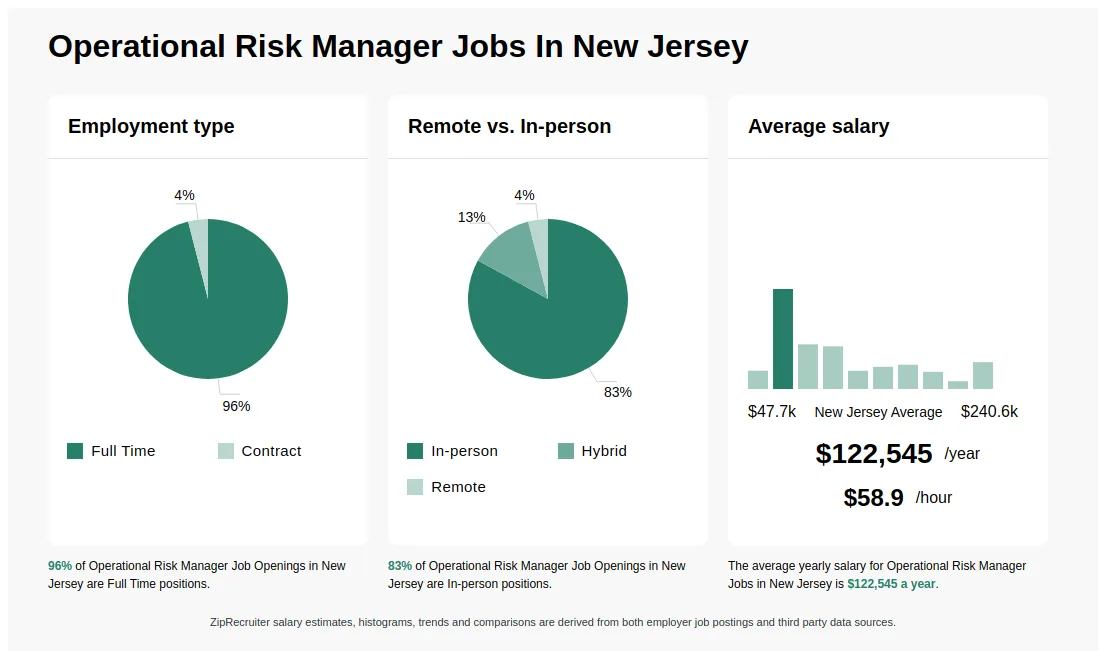
Operational Risk Manager information
See New Jersey salary details
$47.7K - $65.3K
5% of jobs
$75.9K is the 25th percentile. Wages below this are outliers.
$65.3K - $82.8K
33% of jobs
The median wage is $98.3K / yr.
$82.8K - $100.3K
14% of jobs
$100.3K - $117.9K
14% of jobs
$117.9K - $135.4K
5% of jobs
$147.8K is the 75th percentile. Wages above this are outliers.
$135.4K - $152.9K
6% of jobs
$152.9K - $170.5K
7% of jobs
$170.5K - $188K
5% of jobs
$188K - $205.5K
2% of jobs
$205.5K - $223.1K
8% of jobs
$223.1K - $240.6K
0% of jobs
$47.7K
$122.5K
$240.6K
How much do operational risk manager jobs pay per year?
As of Sep 3, 2026, the average yearly pay for operational risk manager in New Jersey is $122,545.00, according to ZipRecruiter salary data. Most workers in this role earn between $74,600.00 and $161,400.00 per year, depending on experience, location, and employer.
What does an operational risk manager do?
An operational risk manager works to identify and limit the risk associated with a company’s operations. As an operational risk manager, your responsibilities involve assessing business operations, identifying issues, and creating reports on your findings. You then help develop policies and implement changes to lessen operational risks. Other duties include continually monitoring the business to find potential new threats and ensuring company compliance with laws and regulations.
What are the key skills and qualifications needed to thrive as an operational risk manager, and why are they important?
To thrive as an Operational Risk Manager, you need a solid understanding of risk assessment, regulatory compliance, and internal controls, typically supported by a degree in finance, business, or a related field. Familiarity with risk management frameworks, GRC (governance, risk, and compliance) systems, and certifications such as FRM or ORM are highly valued. Strong analytical thinking, attention to detail, and effective communication skills set top performers apart in this role. These competencies are crucial for identifying, mitigating, and communicating operational risks, ensuring organizational stability and regulatory adherence.
What are some common challenges faced by operational risk managers in maintaining effective risk controls across different departments?
Operational Risk Managers often encounter challenges in ensuring consistent risk controls due to varying processes, priorities, and risk appetites across departments. Communication gaps and resistance to change can make it difficult to implement standardized procedures. Successfully overcoming these challenges involves building strong cross-functional relationships, conducting regular training, and fostering a risk-aware culture to ensure alignment on risk management practices throughout the organization.
What is the difference between Operational Risk Manager vs Risk Analyst?
| Aspect | Operational Risk Manager | Risk Analyst |
|---|---|---|
| Certifications | CFA, FRM, or similar | CFA, FRM, or similar |
| Work Environment | Financial institutions, banks, insurance companies | Financial firms, consulting, corporate risk teams |
| Responsibilities | Identify, assess, and mitigate operational risks; develop risk frameworks | Analyze risk data, support risk assessments, prepare reports |
The Operational Risk Manager focuses on managing and mitigating operational risks within organizations, often holding certifications like CFA or FRM. In contrast, Risk Analysts primarily analyze risk data and support risk management processes. Both roles are vital in financial sectors and share similar credentials, but the Operational Risk Manager has a broader responsibility for risk mitigation strategies.
More about Operational Risk Manager jobs
What are the most commonly searched types of Operational Risk jobs in New Jersey?
The most popular types of Operational Risk jobs in New Jersey are:
What are popular job titles related to Operational Risk Manager jobs in New Jersey?
For Operational Risk Manager jobs in New Jersey, the most frequently searched job titles are:
What job categories do people searching Operational Risk Manager jobs in New Jersey look for?
The top searched job categories for Operational Risk Manager jobs in New Jersey are:
What cities in New Jersey are hiring for Operational Risk Manager jobs?
Cities in New Jersey with the most Operational Risk Manager job openings:
Full-time
Medical, Dental, Vision, Life, Retirement
Posted 10 days ago
Job description
Calling all innovators - find your future at Fiserv.
We're Fiserv, a global leader in Fintech and payments, and we move money and information in a way that moves the world. We connect financial institutions, corporations, merchants and consumers to one another millions of times a day - quickly, reliably, and securely. Any time you swipe your credit card, pay through a mobile app, or withdraw money from the bank, we're involved. If you want to make an impact on a global scale, come make a difference at Fiserv.
Job Title
Enterprise Risk Management DirectorAbout your role:
The Director provides enterprise leadership and oversight for the Enterprise Risk Management (ERM) framework and related governance capabilities, including framework maintenance, methodology standards, risk appetite, taxonomy governance, program integration, risk aggregation, reporting, GRC business requirements, and continuous improvement. The role strengthens enterprise risk consistency and decision-making while maintaining regulatory and audit readiness through sustainable, well-documented practices.
What you'll do:
- Maintain, govern, and continuously enhance the Enterprise Risk Management Framework, ensuring alignment with business strategy, regulatory expectations, risk appetite, and industry leading practices.
- Oversee and evolve the Enterprise Risk Appetite Framework to ensure alignment with business strategy, corporate objectives, regulatory expectations, and the enterprise risk profile.
- Provide enterprise-wide oversight and stewardship of enterprise risk taxonomy, including risk definitions, hierarchy, ownership, coverage expectations, and change governance.
- Set, maintain, and govern enterprise standards, methodologies, minimum requirements, and operating expectations for risk programs, including RCSA, ORE, Issue Management, KRIs, Control Testing, and related risk management activities.
- Maintain and enhance enterprise risk aggregation and roll-up methodologies that translate process-level, program-level, and business-level risk information into meaningful executive and Board-level insights.
- Partner with Technology, Risk, ORM program owners, and business stakeholders to support implementation, configuration, enhancement, and optimization of GRC platforms such as Archer and related risk management technologies.
- Evaluate ERM effectiveness through quality assurance, methodology reviews, data-quality reviews, coverage analysis, maturity assessments, and independent validation.
Experience you'll need to have:
- 10+ years of experience in Enterprise Risk Management, Operational Risk Management, Internal Audit, or related disciplines.
- Expertise maintaining, operating, governing, and continuously improving Enterprise Risk Management frameworks.
- Knowledge of ERM frameworks and practices, including risk appetite, risk taxonomy, RCSA standards, Operational Risk Events, Issue Management, KRIs, control testing standards, risk aggregation, governance, and executive risk reporting.
- Experience assessing risks, testing controls, and evaluating remediation activities in a regulated or highly controlled environment.
- Experience preparing risk assessments, control documentation, and reporting for senior stakeholders or audit activities.
- Experience leading cross-functional reviews of complex processes, issues, or control environments.
- Experience presenting risk insights, program updates, maturity assessments, and recommendations to senior business and technology stakeholders.
- Bachelor's degree in finance, accounting, business, information systems, or a related field, or equivalent combination of education, related experience and/or military experience.
Experience that would be great to have:
- Knowledge of COSO ERM, ISO 31000, OCC Heightened Standards, Basel operational risk principles, and other relevant industry frameworks.
- Experience supporting ERM transformations, target operating model enhancements, GRC modernization efforts, or enterprise risk reporting improvements.
- Experience building Board and Executive Risk Committee reporting packages, risk dashboards, and risk analytics capabilities using Power BI, Tableau, or comparable analytics tools.
- Experience maintaining or governing enterprise risk taxonomies, risk appetite frameworks, RCSA methodologies, ORE standards, Issue Management standards, or cross-program risk integration models.
- Experience supporting regulatory examinations, audit remediation, program transformation, and maturity enhancement initiatives.
- Professional certification such as Certified Internal Auditor (CIA), Certified Information Systems Auditor (CISA), Certified Public Accountant (CPA), Certified Risk Management Professional (CRMP), Financial Risk Manager (FRM), Certified Regulatory Compliance Manager (CRCM), or equivalent certification.
How you'll work:
- This role is on-site Monday through Friday. Fiserv considers in-person collaboration to be an essential part of this role as in-person office experiences help you with your overall onboarding experience and leads to stronger productivity.
- This role requires use of a computer and audio equipment.
Travel:
- This role requires occasional travel (up to 5%).
Sponsorship:
- You must currently possess valid and unrestricted U.S. work authorization to be considered for this role. Individuals with temporary visas including, but not limited to, F-1 (OPT, CPT, STEM), H-1B, H-2, or TN, or any candidate requiring sponsorship, now or in the future, will not be considered for this role.
Benefits at Fiserv:
- Fuel Your Life program to support your physical, financial, social, and emotional well-being.
- Paid holidays and generous time away policies.
- No-cost mental health support through Employee Assistance Programs.
- Living Proof program to recognize your peers' extra effort with points redeemable for rewards.
- Eight Employee Resource Groups to foster a collaborative culture and expand your network.
- Unparalleled professional growth with training, development, and internal mobility opportunities.
- Medical, dental, vision, life, and disability insurance options available from day one.
- Retirement planning including 401k match and discounted shares with the Employee Stock Purchase Plan.
- Tuition assistance and reimbursement program.
- Paid parental and military leave.
#LI-CR1
Salary Range
$150,000.00 - $240,000.00These pay ranges apply to employees in New Jersey and New York. Pay ranges for employees in other states may differ.
It is unlawful to discriminate against a prospective employee due to the individual's status as a veteran.
For incentive eligible associates, the successful candidate is eligible for an annual incentive opportunity which may be delivered as a mix of cash bonus and equity awards in the Company's sole discretion.Thank you for considering employment with Fiserv. Please:
- Apply using your legal name
- Complete the step-by-step profile and attach your resume (either is acceptable, both are preferable).
Our commitment to Equal Opportunity:
Fiserv is proud to be an Equal Opportunity Employer. All qualified applicants will receive consideration for employment without regard to race, color, religion, national origin, gender, gender identity, sexual orientation, age, disability, protected veteran status, or any other category protected by law.
If you have a disability and require a reasonable accommodation in completing a job application or otherwise participating in the overall hiring process, please contactAskHR.US@fiserv.com. Please note our AskHR representatives do not have visibility to your application status. Current associates who require a workplace accommodation should refer to Fiserv's Disability Accommodation Policy for additional information.
Note to agencies:
Fiserv does not accept resume submissions from agencies outside of existing agreements.Please do not send resumes to Fiserv associates. Fiserv is not responsible for any fees associated with unsolicited resume submissions.
Warning about fake job posts:
Please be aware of fraudulent job postings that are not affiliated with Fiserv. Fraudulent job postings may be used by cyber criminals to target your personally identifiable information and/or to steal money or financial information. Any communications from a Fiserv representative will come from a legitimate Fiserv email address.