1

Operating Engineer Union Jobs in Alaska (NOW HIRING)

This is a union-represented position* Essential Job Accountabilities * Ability to operate motor ... Read engineering drawing * Practice good safety habits * Work in dusty or dirty surroundings

This is a union-represented position* Essential Job Accountabilities * Ability to operate motor ... Read engineering drawing * Practice good safety habits * Work in dusty or dirty surroundings

next page

Showing results 1-20

Operating Engineer Union information

See Alaska salary details

$64.6K

$94.5K

$127.1K

How much do operating engineer union jobs pay per year?

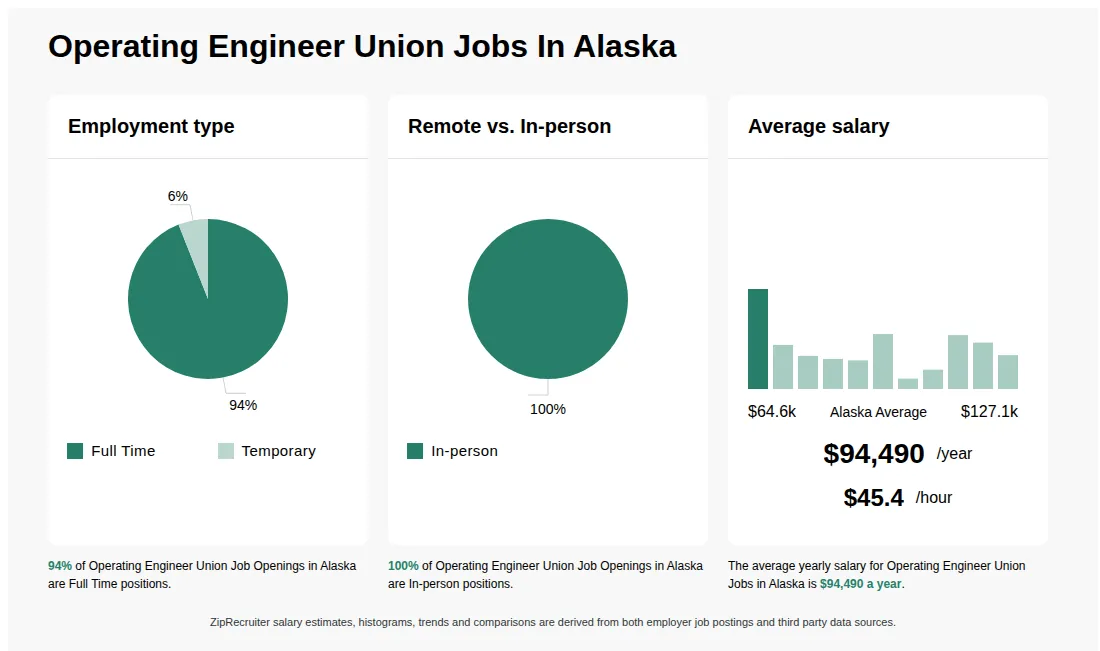
As of Jul 22, 2026, the average yearly pay for operating engineer union in Alaska is $94,490.00, according to ZipRecruiter salary data. Most workers in this role earn between $72,200.00 and $114,700.00 per year, depending on experience, location, and employer.

What are the key skills and qualifications needed to thrive as an Operating Engineer (Union), and why are they important?

To thrive as an Operating Engineer (Union), you need strong mechanical aptitude, a solid understanding of heavy equipment operation, and typically a high school diploma or equivalent, along with union apprenticeship completion. Familiarity with equipment such as cranes, bulldozers, forklifts, and safety systems, as well as relevant certifications like OSHA or NCCCO, is often required. Outstanding problem-solving skills, attention to detail, and effective teamwork set exceptional professionals apart in this role. These skills and qualifications are crucial for ensuring safe, precise, and efficient operation of machinery on construction sites.

What is the difference between Operating Engineer Union vs Heavy Equipment Operator?

AspectOperating Engineer UnionHeavy Equipment Operator
Credentials/CertificationsUnion membership, OSHA certifications, specialized trainingOSHA certifications, equipment-specific training
Work EnvironmentConstruction sites, power plants, industrial facilitiesConstruction sites, mining, infrastructure projects
Employer/Industry UsageUnionized construction and industrial companiesPrivate contractors, construction firms

The Operating Engineer Union and Heavy Equipment Operator roles often overlap, with both requiring OSHA certifications and equipment training. Operating Engineers typically work in unionized environments on large-scale projects, handling complex machinery and systems. Heavy Equipment Operators focus on operating specific machinery like bulldozers or cranes, often in similar settings. While their skills are related, Operating Engineers usually have broader responsibilities and union benefits.

What are Operating Engineer Union jobs?

Operating Engineer Union jobs refer to positions held by skilled workers who operate and maintain heavy equipment, such as cranes, bulldozers, excavators, and other machinery used in construction and industrial projects. These professionals are typically members of a union, such as the International Union of Operating Engineers (IUOE), which provides training, job placement, and collective bargaining for better wages and benefits. Union operating engineers often work on major construction sites, road projects, and infrastructure developments, ensuring equipment is run safely and efficiently. Membership in the union may require completing an apprenticeship program and meeting certain qualifications.

What are some common challenges Operating Engineer Union members face on the job site, and how can they prepare to handle them?

Operating Engineer Union members often work with heavy machinery in dynamic environments, which can present challenges such as adapting to rapidly changing site conditions, maintaining strict safety standards, and troubleshooting equipment malfunctions. Staying updated with ongoing safety training and being proactive about preventative maintenance are key to minimizing risks. Additionally, strong communication skills help coordinate activities with other trades and supervisors, ensuring smooth workflow and reducing potential hazards. Union resources and peer support also play a vital role in overcoming these workplace challenges.
What job categories do people searching Operating Engineer Union jobs in Alaska look for? The top searched job categories for Operating Engineer Union jobs in Alaska are:
What cities in Alaska are hiring for Operating Engineer Union jobs? Cities in Alaska with the most Operating Engineer Union job openings:
Infographic showing various Operating Engineer Union job openings in Alaska as of July 2026, with employment types broken down into 94% Full Time, and 6% Part Time. Highlights an 100% In-person job distribution, with an average salary of $94,490 per year, or $45.4 per hour.
Adjunct Faculty - CTC Computer Networking Technology

Adjunct Faculty - CTC Computer Networking Technology

University of Alaska

Anchorage, AK โ€ข On-site

Full-time, Part-time

Posted 6 days ago


Job description

The University of Alaska Anchorage's Community and Technical College (CTC) is a major center for development and delivery of career and technical education programs within the community. In keeping with the mission of the University of Alaska (UA), CTC has a commitment to offering high quality education and training. The Computer Networking and Systems Technology program is recruiting qualified applicants for our pool of adjunct instructors.
Adjunct faculty are responsible for teaching courses in the Computer Networking Technology program. The instructor is responsible for identifying and meeting the needs of the students, contributing to curriculum development, and maintaining up-to-date knowledge of subject areas. The ability to work with colleagues and students of various cultural and socio-economic backgrounds is a must.
Demonstrated knowledge and experience with current software and hardware. A broad sample includes the following:
Current Windows Server operating systems and related deployment/implementations (Active Directory)
Current Windows desktop operating systems
Cisco Routing and Switching coursework and certifications
Current CompTIA certifications such as A+/Sec+/Net+
Amazon Web Services or Microsoft Azure
Foundational programming experience in Python or Microsoft Powershell
Core project management experience
Minimum Qualifications:
Two years of recent full time industry and/or teaching experience in computer networking and related computing hardware and operating systems is required. Up-to-date, current level of industry certification for courses that are taught. Knowledge of networking and telecommunications job skills with the ability to encourage students to use critical thinking and problem solving skills.
An Associate's degree (Bachelor's degree preferred) from a regionally accredited institution indicating academic preparation in a technical field is required.
Position Details:
This is a part-time, adjunct instructor position. Minimum salaries are set by the United Academic - Adjunct, AAUP-AT/AFL-CIO collective bargaining agreement. Salaries may vary based upon education and experience.
This is a pooled position and applications are reviewed as needed. Submission of an application does not guarantee review or a job offer.
If you have any questions regarding this position, please contact Steffany Willhauck, Community and Technical College HR Coordinator, at srwillhauck@alaska.edu.
*To be eligible for this position, applicants must be legally authorized to work in the United States without restriction. Applicants who now or may in the future require visa sponsorship to work in the United States are not eligible.
This is an at-will, union represented adjunct position, and may be canceled based upon the needs of the university.
This position is represented by United Academic - Adjuncts, AAUP-AFT/AFL-CIO.
The University of Alaska (UA) is responsible for providing reasonable accommodations to individuals with disabilities throughout the applicant screening process. If you need assistance in completing this application or during any phase of the interview process, please contact the ADA team at ua-ada@alaska.edu .
The University of Alaska ( www.alaska.edu ) is an Equal Opportunity/Equal Access Employer and Educational Institution. The University is committed to a policy of non-discrimination ( www.alaska.edu/nondiscrimination ) against individuals on the basis of any legally protected status.
The successful applicant is required to complete a background check. Any offer of employment is contingent on the background check.
Your application for employment with the University of Alaska is subject to public disclosure under the Alaska Public Records Act.
All employees at the University of Alaska are expected to uphold the highest standards of ethics and professionalism when conducting or engaged in university business.
Each university within the University of Alaska system publishes an Annual Security and Fire Safety Report which contains information regarding campus safety and security including topics such as: campus law enforcement authority; crime reporting policies; campus alerts (Timely Warnings and Emergency Notifications); fire safety policies and procedures; programs to prevent dating violence, domestic violence, sexual assault and stalking; the procedures the University will follow when one of these crimes is reported; and other matters of importance related to security on campus. The report also contains information about crime statistics for the three most recent calendar years concerning reported crimes that occurred on campus; in On-Campus Student Housing Facilities; in Noncampus buildings or property owned or controlled by the University or a recognized student organization; and on public property within, or immediately adjacent to and accessible from, the campus. The report also contains fire statistics for any fires occurring in an On-Campus Student Housing Facility during the three most recent calendar years.
Access to the reports is available at:
UAA: (Addresses Anchorage Campus, Aviation Technology Complex, JBER - Elmendorf Extension, JBER - Richardson Extension, Kenai Peninsula College - Kachemak Bay Campus, Kenai Peninsula College - Kenai River Campus, Kodiak College, Kodiak High School Extension, Matanuska-Susitna College, Prince William Sound College, and Prince William Sound College - Cordova Extension) Online: https://www.uaa.alaska.edu/students/safety . Request a paper copy in person: UAA Police Department Office at Room 114 of Eugene Short Hall on the Anchorage campus / UAA Dean of Students Office at Room 122 of Rasmuson Hall on the Anchorage campus. Request a paper copy by mail: 907-786-1120 or police@uaa.alaska.edu / 907-786-1214 or uaa_deanofstudents@alaska.edu.
UAF: (Addresses Fairbanks Campus, Bristol Bay Campus, Chukchi Campus, Community and Technical College, Kasitsna Bay Campus, Seward Marine Center, Tok Campus, Kuskokwim Campus, and Northwest Campus) Online: https://www.uaf.edu/orca/files/ASFSR.pdf . Request a paper copy in person: UAF Office of Rights, Compliance and Accountability on the 3rd Floor of Constitution Hall. Request a paper copy by mail: 907-474-7300 or uaf-orca@alaska.edu .
UAS: (Addresses the Juneau Auke Bay Campus, Juneau Technical Education Center, Sitka Campus, & Ketchikan Campus) Online: https://uas.alaska.edu/equity-and-compliance/docs/clery/UAS_ASFSR.pdf . Request a paper copy in person: Hendrickson Building, Suite 202 on the Juneau campus. Request a paper copy by mail: 907-796-6371 or emailing uas.clery@alaska.edu .

University of Alaska logo

About University of Alaska

Sourced by ZipRecruiter

The University of Alaska is a prominent player in the education industry, located in Fairbanks, AK, US. Established in 1917, it is a well-known public research university providing a range of academic programs in various spheres like research, arts, technology, and natural sciences. As part of the broader University of Alaska System, the institution thrives in fulfilling its central mission - to inspire learning and to advance and disseminate knowledge through teaching, research, and public service, emphasizing the North and its diverse peoples.

Industry

Colleges, universities, and professional schools

Company size

1,001 - 5,000 Employees

Headquarters location

Fairbanks, AK, US

Year founded

1917

Social media