1

Ocean Engineer Jobs (NOW HIRING)

US Citizen or PR Based in Houston, Texas Bachelor's or Master's degree in Civil Engineering, Mechanical Engineering, Ocean Engineering, or a related engineering discipline 2-5 years of relevant ...

Understanding of ocean environments and offshore operations * Hands-on engineering mindset with ... ability to build, test, and debug systems PREFERRED * Graduate-level research (MS or PhD) in a ...

Job Title Laboratory Coordinator I Agency Texas A&M Engineering Department Ocean Engineering Proposed Minimum Salary Commensurate Job Location College Station, Texas Job Type Staff Why work for Texas ...

next page

Showing results 1-20

Ocean Engineer information

See salary details

$26K

$76.7K

$147K

How much do ocean engineer jobs pay per year?

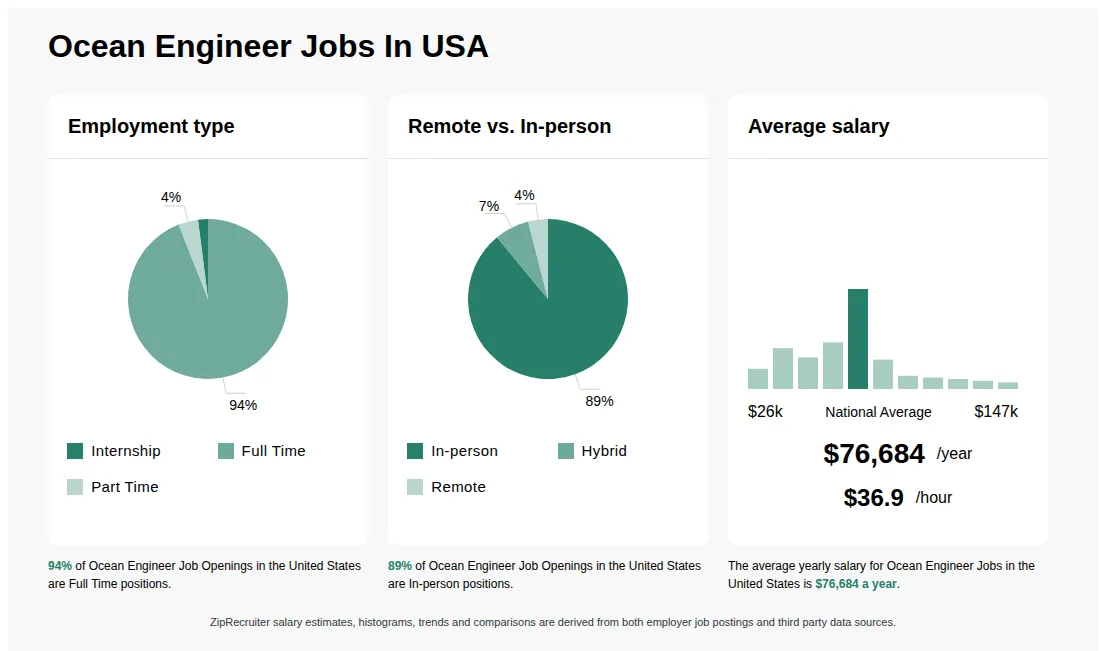
As of Jun 13, 2026, the average yearly pay for ocean engineer in the United States is $76,684.00, according to ZipRecruiter salary data. Most workers in this role earn between $53,500.00 and $81,500.00 per year, depending on experience, location, and employer.

What do you do as an ocean engineer?

An ocean engineer designs, develops, and maintains equipment and systems used in marine environments, such as ships, offshore platforms, and underwater vehicles. They often work with hydrodynamics, structural analysis, and environmental considerations, using tools like CAD software and adhering to safety and environmental standards.

What does an Ocean Engineer do?

An Ocean Engineer designs, develops, and maintains technology and structures used in marine environments. They work on offshore platforms, underwater robotics, coastal protection systems, and renewable ocean energy projects. Their role involves solving engineering challenges related to underwater pressure, corrosion, and wave impact. Ocean Engineers collaborate with marine scientists and environmentalists to create sustainable solutions for ocean exploration and resource utilization.

What are the key skills and qualifications needed to thrive in the Ocean Engineer position, and why are they important?

To thrive as an Ocean Engineer, you need a strong background in marine engineering principles, physics, mathematics, and a relevant engineering degree such as naval architecture or ocean engineering. Familiarity with CAD software, computational modeling tools, underwater robotics, and certifications like Professional Engineer (PE) licensure are often required. Excellent problem-solving, teamwork, and communication skills help Ocean Engineers excel in multidisciplinary and often remote environments. These abilities ensure safe, innovative, and efficient solutions to complex challenges encountered in marine and offshore projects.


What are typical work environments and daily tasks for an Ocean Engineer?

Ocean Engineers often split their time between office-based design work and field assignments, such as conducting underwater surveys or supervising offshore installations. Daily tasks may include designing marine structures, analyzing environmental data, preparing technical reports, and collaborating with scientists, divers, and other engineers. Many projects involve working as part of a multidisciplinary team to address challenges like corrosion, environmental impact, and safety compliance. The role can require travel and periods working at sea, offering a dynamic and varied work environment for those who enjoy both technical and hands-on experiences.

What engineers make $500,000?

Senior engineers in specialized fields such as petroleum, aerospace, or software engineering can earn $500,000 or more annually, often through a combination of base salary, bonuses, and stock options. High-level roles typically require extensive experience, advanced skills, and sometimes leadership responsibilities or advanced certifications.

Do ocean engineers make good money?

Ocean engineers typically earn competitive salaries that vary based on experience, education, and location. Entry-level positions often start around $60,000 annually, with experienced engineers earning over $100,000, especially in specialized fields or with advanced certifications. The profession offers strong earning potential for those with technical skills and industry experience.

Is 40 too late to be an engineer?

Ocean engineering is a field that values skills, experience, and continuous learning over age. Many engineers start or transition into the profession later in life, and relevant education or certifications can help facilitate entry regardless of age.
What cities are hiring for Ocean Engineer jobs? Cities with the most Ocean Engineer job openings:
What are the most commonly searched types of Ocean Engineer jobs? The most popular types of Ocean Engineer jobs are:
What states have the most Ocean Engineer jobs? States with the most job openings for Ocean Engineer jobs include:
What job categories do people searching Ocean Engineer jobs look for? The top searched job categories for Ocean Engineer jobs are:
Infographic showing various Ocean Engineer job openings in the United States as of June 2026, with employment types broken down into 1% Internship, 60% Full Time, 11% Part Time, 1% Temporary, 25% Contract, and 2% Nights. Highlights an 87% Physical, 5% Hybrid, and 8% Remote job distribution, with an average salary of $76,684 per year, or $36.9 per hour.
Adjunct Faculty, Division of Marine Science, School of Ocean Science and Engineering

Adjunct Faculty, Division of Marine Science, School of Ocean Science and Engineering

University of Southern Mississippi

Stennis Space Center, MS

Other

Posted 8 days ago


University Of Southern Mississippi rating

4.4

Company rating: 4.4 out of 10

Based on 7 frontline employees who took The Breakroom Quiz

530th of 536 rated colleges and universities


Job description

Special Instructions to Applicants
Applicants must be currently authorized to work in theUnited States on a full-time basis without the need for visa sponsorship. TheUniversity will not sponsor applicants for work visas (e.g., H-1B).

Job Summary

This position is for adjunct teaching opportunities in the Division of Marine Science of the School of Ocean Science and Engineering, which includes academic programs in marine science, hydrographic science, and ocean engineering. Course delivery may occur at either our Stennis Space Center location or our Gulf Park Campus in Long Beach, MS depending on the course.
Primary Duties and Responsibilities
  

  1. Deliver course instruction as detailed in course syllabi.
  2. Course assessments, grading and communications with students.
  3. Work with teaching assistants, when appropriate, to deliver laboratory/practical sections of courses.
  4. Other duties as assigned.