1

Network Cabling Technician Jobs (NOW HIRING)

Projects range from structured cabling and network deployments in commercial facilities to high-touch residential and executive environments. Technicians work with experienced project teams, interact ...

Cable Technician

Cheyenne, WY Ā· On-site

$24 - $27/hr

... network cabling, or security and camera cabling, depending on project needs. Technicians will support installation efforts both outdoors and indoors, working hands‐on with cabling systems and ...

Structured Cabling Technician Location: Remote - 100% Travel Position Overview: Prime Telecom ... Configure network addresses. * Test cable and ensure the accuracy of cable testing, documentation ...

Structured Cabling Technicians assist with data cabling projects, perform work according to project ... Basic understanding of TCP/IP networking * Experience running and terminating Cat5e, Cat6, or fiber ...

Structured Cabling Technician

Oklahoma City, OK Ā· On-site

$19.25 - $24.25/hr

Structured Cabling Technician Reports To: Physical Security Manager Location: Oklahoma City, OK ... Each company in the network maintains its unique identity while working toward shared goals. If you ...

Structured Cabling Technician

Oklahoma City, OK Ā· On-site

$19.25 - $24.25/hr

Structured Cabling Technician Reports To: Physical Security Manager Location: Oklahoma City, OK ... Each company in the network maintains its unique identity while working toward shared goals. If you ...

Cable Technician I

Arlington, VA Ā· On-site

$34K - $57K/yr

The Cable Technician will adhere to all applicable rules and regulations, focusing on the ... Must be well versed in the use of network cabling test equipment including network testers, copper ...

next page

Showing results 1-20

Network Cabling Technician information

See salary details

$14

$26

$38

How much do network cabling technician jobs pay per hour?

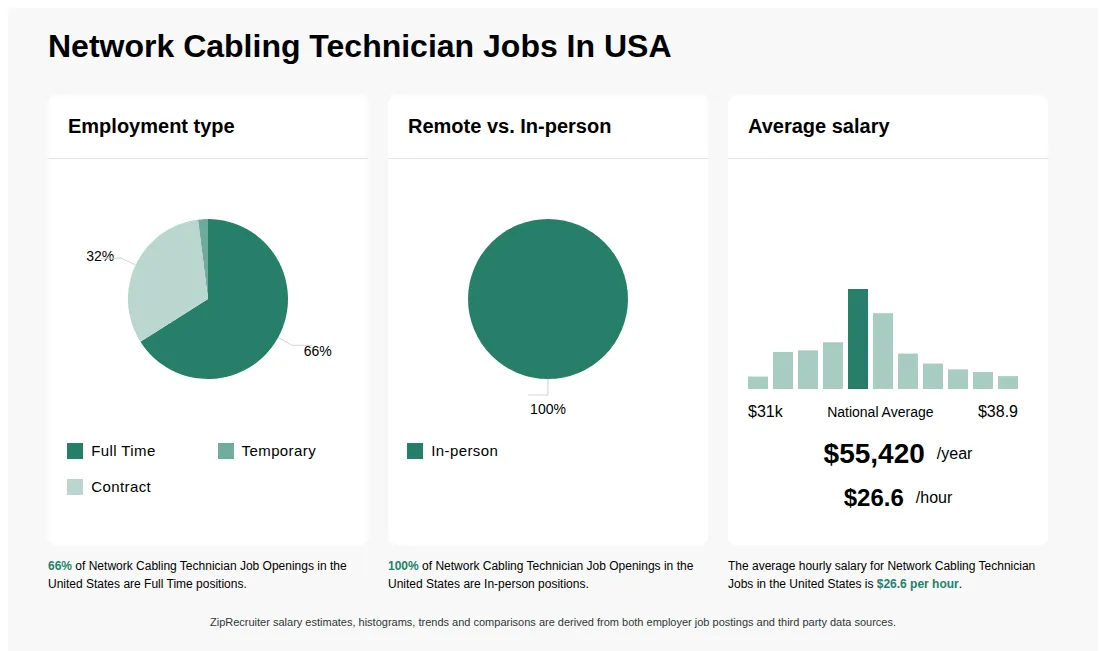
As of Jul 4, 2026, the average hourly pay for network cabling technician in the United States is $26.64, according to ZipRecruiter salary data. Most workers in this role earn between $22.60 and $29.09 per hour, depending on experience, location, and employer.

What are Network Cabling Technicians?

Network Cabling Technicians are professionals who install, maintain, and troubleshoot the cables and wiring that support data, voice, and video communications in a building or across multiple locations. They work with fiber optic and copper cables, ensuring proper connectivity for networks such as Ethernet, telephone systems, and security cameras. Their responsibilities also include testing cables, repairing faults, and adhering to safety standards to ensure reliable communication infrastructure.

Is cabling a good career?

Network cabling technicians install and maintain structured cabling systems for data and telecommunications, which are essential for modern networks. The field offers steady demand, opportunities for certification, and the potential for advancement into specialized or supervisory roles.

What is a network cabling technician?

A network cabling technician installs, maintains, and repairs structured cabling systems that support data, voice, and video communications. They work with cables such as Ethernet, fiber optic, and coaxial, often using tools like crimpers and testers, and may require certifications like BICSI or OSHA compliance. The role typically involves working in commercial or residential environments and following safety standards and technical specifications.

How much do Verizon cable technicians make?

Verizon cable technicians typically earn between $40,000 and $60,000 annually, depending on experience, location, and certifications. Entry-level technicians may start at lower wages, while experienced technicians with specialized skills can earn higher salaries. Compensation often includes benefits such as health insurance and paid time off.

What are some common challenges faced by Network Cabling Technicians on job sites, and how can they be addressed?

Network Cabling Technicians often encounter challenges such as working in tight or difficult-to-access spaces, navigating building codes and safety regulations, and troubleshooting connectivity issues in complex environments. To address these, technicians should prioritize pre-job site assessments, maintain up-to-date knowledge of industry standards, and use proper safety equipment. Collaborating closely with project managers and other trades on-site also helps ensure smooth installation and minimizes potential delays.

What is the difference between Network Cabling Technician vs Data Center Technician?

AspectNetwork Cabling TechnicianData Center Technician
CertificationsOSHA, BICSI, CompTIA A+CompTIA Server+, Cisco CCNA
Work EnvironmentCommercial buildings, offices, telecom sitesData centers, server rooms, network infrastructure
Job FocusInstalling and maintaining cabling infrastructureManaging hardware, servers, and network equipment
Industry UsageTelecom, IT, constructionIT, data center operations, cloud services

While both roles involve working with network infrastructure, Network Cabling Technicians focus on installing and maintaining cabling systems, whereas Data Center Technicians handle hardware and server management within data centers. The roles often overlap in environments but differ in primary responsibilities and certifications.

What are the key skills and qualifications needed to thrive as a Network Cabling Technician, and why are they important?

To thrive as a Network Cabling Technician, you need knowledge of structured cabling, electrical systems, and network protocols, typically supported by a high school diploma and technical certifications like BICSI or CompTIA. Familiarity with cable testers, wire mapping tools, labeling systems, and blueprints is essential for efficient installations and troubleshooting. Strong attention to detail, problem-solving skills, and effective communication help technicians ensure accuracy, safety, and coordination with team members. These skills and qualities are vital for delivering reliable network infrastructure and minimizing costly errors or downtime.

What tech jobs pay $400,000 a year?

High-paying tech jobs that can reach $400,000 annually include senior roles such as software engineering managers, solutions architects, and cloud infrastructure directors, often requiring advanced skills, certifications, and extensive experience. These positions typically involve leadership, complex problem-solving, and expertise in areas like cloud computing, cybersecurity, or enterprise software. Compensation varies based on industry, location, and company size.
More about Network Cabling Technician jobs
What cities are hiring for Network Cabling Technician jobs? Cities with the most Network Cabling Technician job openings:
What states have the most Network Cabling Technician jobs? States with the most job openings for Network Cabling Technician jobs include:
What job categories do people searching Network Cabling Technician jobs look for? The top searched job categories for Network Cabling Technician jobs are:
Infographic showing various Network Cabling Technician job openings in the United States as of June 2026, with employment types broken down into 1% As Needed, 98% Full Time, and 1% Nights. Highlights an 95% Physical, 1% Hybrid, and 4% Remote job distribution, with an average salary of $55,420 per year, or $26.6 per hour.
Cable Technician II

$23 - $29.25/hr

Full-time

Posted 17 days ago


Job description

Job Description:

Competitive Range partners with the government to plan and deploy complex, IT-enabled, and mission-essential capabilities. Our goal is to help you develop and expand your professional capabilities while working on challenging, exciting projects in a collaborative, congenial environment.

Cable Technician II requires the expertise of a talented and experienced Cable Technician to assist in the direction and management of the program's executive support group. The candidate must reference their ability and experience working in a Department of Defense (DoD) customer environment and effective integration with a government multi-contractor team.

The Cable Technician II is an integral part of the Network Infrastructure and Support team, focusing on installing, maintaining, and repairing structured cabling systems within the DISA enterprise transport network. The Cable Technician II requires a hands-on approach to ensure the physical infrastructure meets the high standards as are necessary for operational efficiency, security, and compliance with the DoD STIG and engineering standards.

Roles and Responsibilities:

  • Install, maintain, and repair structured cabling systems, including copper, fiber optic, and other telecommunications media.
  • Analyzes, administers, and maintains telecommunications and network cabling infrastructure.
  • Dress, terminate, and test cables and components-the ability to work with power tools and ladders.
  • Tests, locates, installs, and repairs cabling infrastructure associated with trouble calls and performs routine maintenance.
  • Installs, maintains, and repairs voice and data communications systems.
  • Identify, track, and remove abandoned cable, and keep cable neatly tied and bundled while maintaining safety standards.
  • Ensure all installations are properly baselined, tested, and validated in accordance with DoD STIG before deployment.
  • Conduct regular system testing and validation to ensure ongoing compliance.
  • Assist in documenting the baseline configuration of all network assets related to structured cabling systems.
  • Ensure accurate representation and reporting of the assets in the Government-provided system.
  • Work closely with the Registered Communications Distribution Designer (RCDD), IT team, and other stakeholders to ensure a cohesive approach to network infrastructure management.

Qualifications/Experience:

  • 3+ years of related telecommunication experience
  • 3+ years of experience working as a Cable Technician within the DoD environment.
  • Must know Building Industry Consulting Services International (BICSI) rules.
  • Well-versed in network cabling test equipment, including network testers, copper cable testers, fiber Optical Time Domain Reflectometers (OTDRs), and fiber power meters.
  • Must have the ability to communicate effectively with personnel of various expertise levels.
  • Solid customer support skills in a high-visibility environment.
  • Problem analysis and problem-solving
  • Attention to detail and accuracy.
  • Active TS/SCI Clearance

Education/Certifications:

  • Bachelor's Degree in a related technical discipline or the equivalent combination of education, technical training, or work experience (required).
  • Related certifications for Fiber Optic Cable and CAT6 Cable Installation (required).


Employment Type: FULL_TIME