1

Microsoft Sql Server Jobs (NOW HIRING)

Microsoft SQL Server Administrator

Bethesda, MD ยท On-site

$107K - $195K/yr

Leidos is seeking a skilled Microsoft SQL Server Administrator to join our team supporting the National Digital Exploitation & OSINT Center (NDOC). In this role, you will manage and optimize ...

Ability to work with Microsoft BI Stack - Microsoft SQL Server Reporting Services (SSRS), Microsoft SQL Server Integration Services SSIS, Microsoft SQL Server Analysis Services (SSAS). Knowledgeable ...

Microsoft SQL Server Administrator

Bethesda, MD ยท On-site

$107K - $195K/yr

Leidos is seeking a skilledMicrosoft SQL Server Administratorto join our team supporting theNational Digital Exploitation & OSINT Center (NDOC). In this role, you will manage and optimize enterprise ...

Must attend in person interview. 8+ years of Microsoft SQL Server Database Administration Must have Financial Services experience Must have Microsoft SQL Server Certification Must be able to support ...

Experience required: 6+ years of experience with complete Microsoft SQL Server stack o Microsoft SQL Server 2008-2016 o SQL Server Reporting Services o SQL Server Analysis Services o SQL Server ...

The ideal candidate will have extensive hands-on experience managing Microsoft SQL Server environments, performing upgrades and migrations, optimizing database performance, and implementing high ...

Be Seen First

Sr. SQL Server Database Administrator Job Summary The Senior SQL Server DBA manages, maintains, patches, and secures Client's clustered and standalone Microsoft SQL Server database instances. This ...

next page

Showing results 1-20

Microsoft Sql Server information

See salary details

$28

$48

$69

How much do microsoft sql server jobs pay per hour?

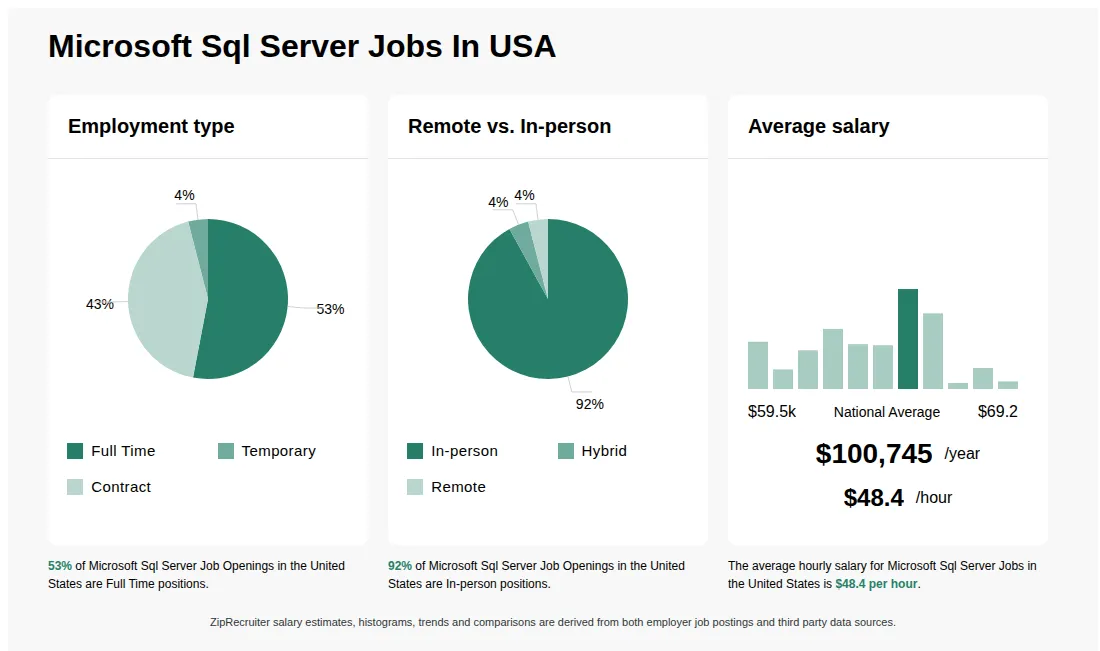
As of Jul 5, 2026, the average hourly pay for microsoft sql server in the United States is $48.44, according to ZipRecruiter salary data. Most workers in this role earn between $40.87 and $54.81 per hour, depending on experience, location, and employer.

Do SQL jobs pay well?

Microsoft SQL Server professionals typically earn competitive salaries that vary based on experience, location, and certifications. Skilled database administrators and developers with expertise in SQL Server and related tools often command higher pay, especially in enterprise environments. Continuous learning and certifications can further enhance earning potential in this field.

What is a Microsoft SQL Server job?

A Microsoft SQL Server job typically involves managing, developing, and optimizing databases using Microsoft SQL Server. Responsibilities may include database administration (DBA), query optimization, performance tuning, backup and recovery, and ensuring data security. Professionals in this role often work with SQL queries, stored procedures, indexing, and database design to support applications and business needs. Depending on the position, roles may range from database administrators (DBAs) to SQL developers and data analysts.

What are the primary responsibilities of a Microsoft SQL Server professional on a typical workday?

A Microsoft SQL Server professional is commonly responsible for database installation, configuration, maintenance, and monitoring to ensure optimal performance and data integrity. Daily tasks may include writing and optimizing queries, automating backup and recovery processes, troubleshooting issues, and managing user permissions. Collaboration with software developers, data analysts, and IT teams is often required to support application development and resolve data-related challenges. This role also demands staying up to date with security best practices and system updates to safeguard sensitive information. Workplace settings can range from working in a dedicated database team to supporting multiple departments within an organization.

What are the jobs in SQL Server?

Jobs related to SQL Server include database administrator, database developer, data analyst, and database architect. These roles involve managing, developing, and optimizing SQL Server databases, often requiring skills in T-SQL, performance tuning, and familiarity with tools like SQL Server Management Studio. Certifications such as Microsoft Certified: Azure Data Engineer or SQL Server certifications can enhance job prospects.

Is SQL Server in demand?

SQL Server professionals are in high demand due to the widespread use of Microsoft SQL Server for data management and enterprise applications. Skills in database administration, T-SQL, and cloud integration increase employability in various industries, with certifications like Microsoft Certified: Azure Data Engineer Associate enhancing job prospects.

What careers can I do with SQL?

With SQL skills, you can pursue careers such as database administrator, data analyst, data engineer, business intelligence developer, or SQL developer. These roles involve designing, managing, and analyzing data using SQL and related tools, often requiring knowledge of database management systems like Microsoft SQL Server and certifications such as Microsoft Certified: Data Analyst Associate.

What are the key skills and qualifications needed to thrive in the Microsoft Sql Server position, and why are they important?

To excel as a Microsoft SQL Server professional, you need deep knowledge of database design, T-SQL scripting, performance tuning, and backup/restore procedures, often supported by a degree in computer science or a related field. Hands-on experience with Microsoft SQL Server Management Studio (SSMS), SQL Server Integration Services (SSIS), and certifications like Microsoft Certified: Azure Database Administrator Associate are valuable assets. Strong analytical thinking, problem-solving, and clear communication skills set top candidates apart. These abilities are essential for efficiently managing mission-critical data, collaborating with developers and stakeholders, and ensuring database security and performance.

More about Microsoft Sql Server jobs
What cities are hiring for Microsoft Sql Server jobs? Cities with the most Microsoft Sql Server job openings:
What are the most commonly searched types of Microsoft Sql Server jobs? The most popular types of Microsoft Sql Server jobs are:
What states have the most Microsoft Sql Server jobs? States with the most job openings for Microsoft Sql Server jobs include:
What job categories do people searching Microsoft Sql Server jobs look for? The top searched job categories for Microsoft Sql Server jobs are:
Infographic showing various Microsoft Sql Server job openings in the United States as of June 2026, with employment types broken down into 88% Full Time, 6% Temporary, and 6% Contract. Highlights an 96% Physical, 1% Hybrid, and 3% Remote job distribution, with an average salary of $100,745 per year, or $48.4 per hour.
Microsoft SQL Database Administrator

Microsoft SQL Database Administrator

Smart Caliber Technology

Manhattan, NY โ€ข On-site

$55 - $69/hr

Other

Posted 2 days ago


Job description

Role: Microsoft SQL Database Administrator (Development Experience Required)
Location: New York (Local/Onsite)ย 
Employment Type:ย Contract

Job Description

Position Overview

Client Financial Services (FS) DCX Marketing Agency is seeking an experienced Microsoft SQL Database Administrator with strong SQL Development experience to join its Software Engineering team.

The ideal candidate will have extensive hands-on experience with Microsoft SQL Server Administration, T-SQL development, performance tuning, database security, high availability/disaster recovery, and automation. Experience with AWS RDS and cloud database environments is highly preferred.

Key Responsibilities

Microsoft SQL Server Administration

  • Administer and maintain Microsoft SQL Server environments across on-premises and cloud platforms.
  • Monitor database health and optimize overall database performance.
  • Troubleshoot performance bottlenecks, blocking, deadlocks, and long-running queries.
  • Implement and support High Availability (HA) and Disaster Recovery (DR) solutions, including:
    • AlwaysOn Availability Groups
    • Database Mirroring
    • Log Shipping
  • Perform SQL Server upgrades, patching, migrations, and capacity planning.
  • Design and manage backup, recovery, and restore strategies aligned with RPO/RTO objectives.
  • Conduct routine database integrity checks and disaster recovery testing.
  • Ensure database security through encryption, auditing, access controls, and compliance best practices.
  • Utilize SQL Server Profiler, Extended Events, and monitoring tools to proactively maintain database performance.

SQL Development & Automation

  • Develop and maintain:
    • Stored Procedures
    • Views
    • Functions
    • Triggers
  • Optimize SQL queries and database schemas in collaboration with application development teams.
  • Automate routine administrative tasks using:
    • T-SQL
    • PowerShell
    • Other scripting tools

Cloud Database Management (Preferred)

  • Administer SQL Server databases hosted on AWS RDS.
  • Support migration of on-premises SQL Server databases to AWS cloud environments.
  • Optimize cloud database performance, availability, and security.

Required Qualifications

  • 5+ years of hands-on Microsoft SQL Server Administration experience.
  • Strong experience in both:
    • SQL Server Administration
    • SQL Development (T-SQL coding)
  • Expertise in:
    • Performance tuning
    • Backup & Recovery
    • Database Security
  • Strong knowledge of SQL Server HA/DR technologies:
    • AlwaysOn Availability Groups
    • Database Mirroring
    • Log Shipping
  • Advanced T-SQL programming skills.
  • Experience developing stored procedures, views, functions, and triggers.
  • Hands-on scripting experience using PowerShell or similar automation tools.
  • Familiarity with AWS RDS or other cloud database platforms.

Preferred Qualifications

  • Microsoft SQL Server Certifications (MCSA/MCSE or equivalent)
  • AWS Cloud experience
  • SQL Server migration experience to AWS/cloud platforms
  • Experience with DevOps and CI/CD pipelines for database deployments
  • Strong troubleshooting and analytical skills
  • Excellent communication and collaboration abilities
  • Ability to manage multiple priorities in a fast-paced environment.