Material Science Opening Date: 01/01/2025 Closing Date: Continuous Summary of Purpose Oakland ... Classified, Exempt (Non-union), Faculty, Maintenance, Operating Engineers, Public Safety, Teamsters ...
Material Science Opening Date: 01/01/2025 Closing Date: Continuous Summary of Purpose Oakland ... Classified, Exempt (Non-union), Faculty, Maintenance, Operating Engineers, Public Safety, Teamsters ...

Material Scientist
Oxnard, CA · On-site
$111K - $186K/yr
... Engineering, Material Science, Physics, Biology, or Chemistry is essential, along with 5 to 10 years of experience in aerospace design and manufacturing. Proven expertise as a technical lead is ...
Material Scientist
Oxnard, CA · On-site
$111K - $186K/yr
... Engineering, Material Science, Physics, Biology, or Chemistry is essential, along with 5 to 10 years of experience in aerospace design and manufacturing. Proven expertise as a technical lead is ...
Material Scientist
Oxnard, CA · On-site
... Engineering, Material Science, Physics, Biology, or Chemistry is essential, along with 5 to 10 years of experience in aerospace design and manufacturing. Proven expertise as a technical lead is ...
Material Scientist
Oxnard, CA · On-site
... Engineering, Material Science, Physics, Biology, or Chemistry is essential, along with 5 to 10 years of experience in aerospace design and manufacturing. Proven expertise as a technical lead is ...
Material Scientist
Oxnard, CA · On-site
$111K - $186K/yr
... Engineering, Material Science, Physics, Biology, or Chemistry is essential, along with 5 to 10 years of experience in aerospace design and manufacturing. Proven expertise as a technical lead is ...
Quick apply
Material Scientist
Oxnard, CA · On-site
$111K - $186K/yr
... Engineering, Material Science, Physics, Biology, or Chemistry is essential, along with 5 to 10 years of experience in aerospace design and manufacturing. Proven expertise as a technical lead is ...

UNT-Materials Science & Engineer-130330 Job Location: Denton Salary: Compensation is competitive and commensurate with the candidate's qualifications, experience, and discipline, in accordance with ...
UNT-Materials Science & Engineer-130330 Job Location: Denton Salary: Compensation is competitive and commensurate with the candidate's qualifications, experience, and discipline, in accordance with ...

Materials Engineer
Lorton, VA · On-site
$99K - $225K/yr
Specifically, the focus is around material science and chemical technologies. You will work on unusually complex problems and provide highly innovative solutions by collaborating with engineers ...
Materials Engineer
Lorton, VA · On-site
$99K - $225K/yr
Specifically, the focus is around material science and chemical technologies. You will work on unusually complex problems and provide highly innovative solutions by collaborating with engineers ...
Materials Engineer
Lorton, VA · On-site
$99K - $225K/yr
Specifically, the focus is around material science and chemical technologies. You will work on unusually complex problems and provide highly innovative solutions by collaborating with engineers ...
Materials Engineer
Lorton, VA · On-site
$99K - $225K/yr
Specifically, the focus is around material science and chemical technologies. You will work on unusually complex problems and provide highly innovative solutions by collaborating with engineers ...
Materials Engineer
Lorton, VA · On-site +1
$99K - $225K/yr
Specifically, the focus is around material science and chemical technologies. You will work on unusually complex problems and provide highly innovative solutions by collaborating with engineers ...
Materials Engineer
Lorton, VA · On-site +1
$99K - $225K/yr
Specifically, the focus is around material science and chemical technologies. You will work on unusually complex problems and provide highly innovative solutions by collaborating with engineers ...
Materials Engineer
Lorton, VA · On-site
$99K - $225K/yr
Specifically, the focus is around material science and chemical technologies. You will work on unusually complex problems and provide highly innovative solutions by collaborating with engineers ...
Materials Engineer
Lorton, VA · On-site
$99K - $225K/yr
Specifically, the focus is around material science and chemical technologies. You will work on unusually complex problems and provide highly innovative solutions by collaborating with engineers ...
Materials Engineer
Lorton, VA · On-site
$99K - $225K/yr
Specifically, the focus is around material science and chemical technologies. You will work on unusually complex problems and provide highly innovative solutions by collaborating with engineers ...
Materials Engineer
Lorton, VA · On-site
$99K - $225K/yr
Specifically, the focus is around material science and chemical technologies. You will work on unusually complex problems and provide highly innovative solutions by collaborating with engineers ...
Materials Engineer
Lorton, VA · On-site
$99K - $225K/yr
Specifically, the focus is around material science and chemical technologies. You will work on unusually complex problems and provide highly innovative solutions by collaborating with engineers ...
Materials Engineer
Lorton, VA · On-site
$99K - $225K/yr
Specifically, the focus is around material science and chemical technologies. You will work on unusually complex problems and provide highly innovative solutions by collaborating with engineers ...

Materials Engineer, Packaging Product Design
Austin, TX · On-site
$134K/yr
... Engineering ... Strong knowledge of material science fundamentals * Strong analytical/creative problem-solving ...
Materials Engineer, Packaging Product Design
Austin, TX · On-site
$134K/yr
... Engineering ... Strong knowledge of material science fundamentals * Strong analytical/creative problem-solving ...
Materials Science Expert Role Type: Contractor Location: Global, Fully Remote Schedule: ~15 hours ... You'll solve, validate, and review materials-engineering tasks and create reproducible ...
Quick apply
Materials Science Expert Role Type: Contractor Location: Global, Fully Remote Schedule: ~15 hours ... You'll solve, validate, and review materials-engineering tasks and create reproducible ...

Master's degree in Material Science & Engineering, Chemical Engineering, Civil Engineering, Mechanical Engineering, Polymer Science, Building Science, or related field with 4+ years of relevant ...
Quick apply
Master's degree in Material Science & Engineering, Chemical Engineering, Civil Engineering, Mechanical Engineering, Polymer Science, Building Science, or related field with 4+ years of relevant ...
Materials Engineer II
Austin, TX · On-site
Ph.D. in Civil Engineering or Material Science (with a focus on cement-based materials), or Master's with 3+ years of industry experience, or BS in Civil Engineering /Material Science Engineering ...
Materials Engineer II
Austin, TX · On-site
Ph.D. in Civil Engineering or Material Science (with a focus on cement-based materials), or Master's with 3+ years of industry experience, or BS in Civil Engineering /Material Science Engineering ...
Polymer Materials Scientist (Must have rubber or silicone experience)
Riverside, CA · On-site
$125K - $170K/yr
The ideal candidate will have R&D level proficiency in polymer chemistry (ideally silicone and/or organic rubbers), material science, and applied materials science/mechanical engineering. You Should ...
Polymer Materials Scientist (Must have rubber or silicone experience)
Riverside, CA · On-site
$125K - $170K/yr
The ideal candidate will have R&D level proficiency in polymer chemistry (ideally silicone and/or organic rubbers), material science, and applied materials science/mechanical engineering. You Should ...
UNT-Materials Science & Engineer-130330 Job Location: Denton Salary: Compensation is competitive and commensurate with the candidate's qualifications, experience, and discipline, in accordance with ...
Quick apply
UNT-Materials Science & Engineer-130330 Job Location: Denton Salary: Compensation is competitive and commensurate with the candidate's qualifications, experience, and discipline, in accordance with ...
UNT-Materials Science & Engineer-130330 Job Location: Denton Salary: Compensation is competitive and commensurate with the candidate's qualifications, experience, and discipline, in accordance with ...
UNT-Materials Science & Engineer-130330 Job Location: Denton Salary: Compensation is competitive and commensurate with the candidate's qualifications, experience, and discipline, in accordance with ...

Materials Engineer II
Austin, TX · On-site
Ph.D. in Civil Engineering or Material Science (with a focus on cement-based materials), or Master's with 3+ years of industry experience, or BS in Civil Engineering /Material Science Engineering ...
Materials Engineer II
Austin, TX · On-site
Ph.D. in Civil Engineering or Material Science (with a focus on cement-based materials), or Master's with 3+ years of industry experience, or BS in Civil Engineering /Material Science Engineering ...
PTI Material Scientist
Oxnard, CA · On-site
... Engineering, Material Science, Physics, Biology, or Chemistry is essential, along with 5 to 10 years of experience in aerospace design and manufacturing. Proven expertise as a technical lead is ...
PTI Material Scientist
Oxnard, CA · On-site
... Engineering, Material Science, Physics, Biology, or Chemistry is essential, along with 5 to 10 years of experience in aerospace design and manufacturing. Proven expertise as a technical lead is ...
Material Science Engineer information
See salary details
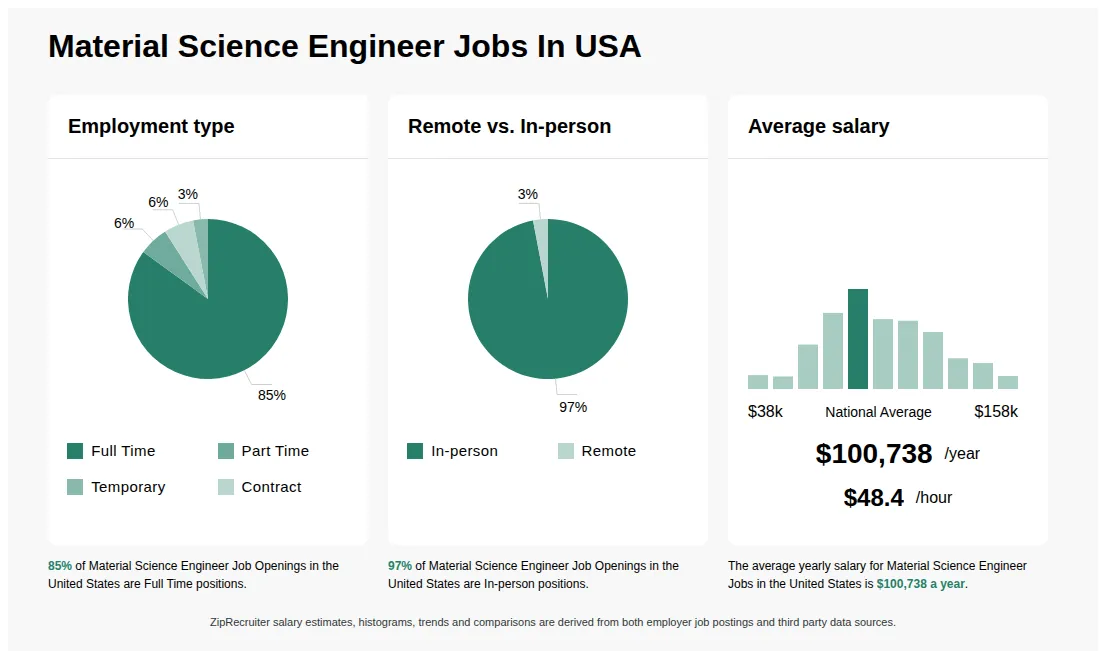
$38K - $48.9K
2% of jobs
$48.9K - $59.8K
2% of jobs
$59.8K - $70.7K
9% of jobs
$79.7K is the 25th percentile. Wages below this are outliers.
$70.7K - $81.6K
15% of jobs
$81.6K - $92.5K
20% of jobs
The median wage is $94.2K / yr.
$92.5K - $103.5K
14% of jobs
$113.9K is the 75th percentile. Wages above this are outliers.
$103.5K - $114.4K
14% of jobs
$114.4K - $125.3K
12% of jobs
$125.3K - $136.2K
5% of jobs
$136.2K - $147.1K
5% of jobs
$147.1K - $158K
2% of jobs
$38K
$100.7K
$158K
How much do material science engineer jobs pay per year?
As of Sep 13, 2026, the average yearly pay for material science engineer in the United States is $100,738.00, according to ZipRecruiter salary data. Most workers in this role earn between $80,000.00 and $116,500.00 per year, depending on experience, location, and employer.
What is a material science engineer?
Material Science Engineers are professionals who study, develop, and test materials used to create a wide range of products, from electronics to medical devices to construction materials. They apply principles of chemistry, physics, and engineering to understand how materials behave and how they can be improved or adapted for specific uses. Their work often involves researching new materials, analyzing their properties, and collaborating with other engineers or scientists to solve complex problems. Material Science Engineers play a crucial role in advancing technology and making products safer, stronger, and more efficient.
What are the key skills and qualifications needed to thrive as a material science engineer?
To thrive as a Material Science Engineer, you need a solid background in materials engineering, chemistry, and physics, usually supported by a degree in materials science or a related field. Familiarity with laboratory analysis tools, materials characterization instruments (like SEM, XRD), and simulation software (such as MATLAB or ANSYS) is commonly required. Problem-solving, analytical thinking, and effective collaboration are crucial soft skills for innovating and working on multidisciplinary projects. These competencies ensure the development of advanced materials and solutions that meet industry standards and drive technological progress.
What are the most common challenges material science engineers face when working on cross-functional project teams?
Material Science Engineers often collaborate with professionals from mechanical, electrical, and manufacturing disciplines, which can present challenges in aligning technical requirements and timelines. Communication gaps may arise due to differences in technical language or priorities, making it essential to clearly convey material properties and limitations. Successfully navigating these challenges typically involves proactive collaboration, flexibility, and a willingness to learn about related fields to ensure project goals are met and innovative solutions are developed.
What is the difference between Material Science Engineer vs Materials Engineer?
| Aspect | Material Science Engineer | Materials Engineer |
|---|---|---|
| Credentials | Bachelor's or Master's in Materials Science, Engineering, or related field | Bachelor's or Master's in Materials Science, Materials Engineering, or related field |
| Work Environment | Research labs, manufacturing facilities, R&D departments | Manufacturing plants, R&D labs, quality control |
| Industry Usage | Research, development, testing of new materials | Material selection, processing, and quality assurance |
Both roles focus on materials, but Material Science Engineers primarily engage in research and development of new materials, while Materials Engineers often work on applying and processing materials in manufacturing. The roles overlap in credentials and work environments, but their core responsibilities differ slightly.
Are material science engineers in demand?
Material science engineers are in demand due to their expertise in developing new materials for industries such as aerospace, automotive, and electronics. Employment opportunities are expected to grow as innovation and technological advancements continue, requiring skills in research, testing, and materials characterization tools like microscopy and spectroscopy.
What do material science engineers do?
Material science engineers research and develop new materials or improve existing ones for various applications, such as aerospace, electronics, and healthcare. They analyze material properties, use tools like microscopy and spectroscopy, and often work in laboratories or manufacturing environments to ensure materials meet performance and safety standards.
What is the average salary for a material science engineer in the US?
The average salary for a material science engineer in the US is approximately $80,000 to $100,000 per year, depending on experience, education, and location. Professionals with advanced skills in materials characterization and proficiency with tools like CAD or simulation software may earn higher salaries.
More about Material Science Engineer jobs
What cities are hiring for Material Science Engineer jobs?
Cities with the most Material Science Engineer job openings:
Who are the top companies hiring for Material Science Engineer jobs?
The top employers for Material Science Engineer jobs are:
What states have the most Material Science Engineer jobs?
States with the most job openings for Material Science Engineer jobs include:
What are popular job titles related to Material Science Engineer jobs?
For Material Science Engineer jobs, the most frequently searched job titles are:

Adjunct Material Science Instructor
Auburn Hills, MI • On-site
Oakland Community College
• Colleges, Universities, and Professional Schools • 1 - 5K employees1,001 - 5,000 employees
Other
Medical, Dental, Vision, Life, Retirement
Re-posted 27 days ago
Job description
Salary: See Position Description
Location : Auburn Hills Campus
Job Type: Adjunct
Job Number: 202300221
Division: Material Science
Opening Date: 01/01/2025
Closing Date: Continuous
Summary of Purpose
Oakland Community College, a multi-campus institution in Oakland County, Michigan is a student-centered community dedicated to providing quality learning opportunities for individuals, the community and organizations on an accessible, affordable basis. We are one of the largest community colleges in the state of Michigan, with a multi-campus system, serving more than 12,000 students. OCC is seeking Adjunct Faculty Instructors who value diversity, shared responsibility, open communication, personal empowerment, integrity and ethical commitment. Adjunct Faculty must be committed to using modern technology in the classroom.
Applications for adjunct positions are accepted continuously and entered into a candidate pool. Adjunct Instructors are hired on an as-needed basis throughout the academic year, depending on enrollment needs. If a need arises, applications in the pool are reviewed and the Department reaches out directly to candidates.
Candidates who do not have legal residence in the State of Michigan will become Edustaff employees. Employment offers, salary, and benefits are provided by Edustaff, not OCC (Oakland Community College).
To be considered for this position, please include the following as attachments to your online application: resume, cover letter, copies of unofficial transcripts (showing date degree was conferred) and any applicable licenses/certifications. Please note that if hired, official transcripts (from school to school) are required within 30 days of hire.
Typical Duties
Primary responsibility will be to teach anticipated day and/or evening Material Science and Metallurgy courses, which range from basic to advanced skill levels. Where applicable, adjuncts are required to maintain and/or provide licensure and certifications.
Knowledge and Skills Required
Minimum Education and Experience
Master's degree in Material Science
Salary
$1,000 per instructional credit hour
We are excited to have you consider Oakland Community College (OCC) as your employer of choice!
OCC strives to provide valuable and empowering services not only to our students, but also to our employees.
See below the benefits offered by the College under the benefit types: full-time and part-time
Full-Time Positions for the Following Employee Groups:
Classified, Exempt (Non-union), Faculty, Maintenance, Operating Engineers, Public Safety, Teamsters
Benefit Effective Date: First of the month after date of hire
Medical
Employee Group: Classified Part-Time
Benefit Effective Date: First of the month after date of hire
Part-time Classified employees are offered the opportunity to have medical, dental, vision at the full monthly premium; life insurance is also available at a nominal cost. Participation requires that benefit costs be taken via payroll deduction.
Medical
Employee Group: Adjunct Faculty, Part-time Hourly (Non-union), and Casual Instructors*
Retirement
Contact Information:
01
Do you have a a Master's degree in Material Science?
Required Question
Location : Auburn Hills Campus
Job Type: Adjunct
Job Number: 202300221
Division: Material Science
Opening Date: 01/01/2025
Closing Date: Continuous
Summary of Purpose
Oakland Community College, a multi-campus institution in Oakland County, Michigan is a student-centered community dedicated to providing quality learning opportunities for individuals, the community and organizations on an accessible, affordable basis. We are one of the largest community colleges in the state of Michigan, with a multi-campus system, serving more than 12,000 students. OCC is seeking Adjunct Faculty Instructors who value diversity, shared responsibility, open communication, personal empowerment, integrity and ethical commitment. Adjunct Faculty must be committed to using modern technology in the classroom.
Applications for adjunct positions are accepted continuously and entered into a candidate pool. Adjunct Instructors are hired on an as-needed basis throughout the academic year, depending on enrollment needs. If a need arises, applications in the pool are reviewed and the Department reaches out directly to candidates.
Candidates who do not have legal residence in the State of Michigan will become Edustaff employees. Employment offers, salary, and benefits are provided by Edustaff, not OCC (Oakland Community College).
To be considered for this position, please include the following as attachments to your online application: resume, cover letter, copies of unofficial transcripts (showing date degree was conferred) and any applicable licenses/certifications. Please note that if hired, official transcripts (from school to school) are required within 30 days of hire.
Typical Duties
Primary responsibility will be to teach anticipated day and/or evening Material Science and Metallurgy courses, which range from basic to advanced skill levels. Where applicable, adjuncts are required to maintain and/or provide licensure and certifications.
Knowledge and Skills Required
- Experience with multi-cultural students and staff preferred
- Ability to work as a team player in a multi-cultural working environment
- Online teaching experience preferred
Minimum Education and Experience
Master's degree in Material Science
Salary
$1,000 per instructional credit hour
We are excited to have you consider Oakland Community College (OCC) as your employer of choice!
OCC strives to provide valuable and empowering services not only to our students, but also to our employees.
See below the benefits offered by the College under the benefit types: full-time and part-time
Full-Time Positions for the Following Employee Groups:
Classified, Exempt (Non-union), Faculty, Maintenance, Operating Engineers, Public Safety, Teamsters
Benefit Effective Date: First of the month after date of hire
Medical
- Multiple PPO medical plans with prescription coverage to choose from; Plans provided by Blue Cross Blue Shield of Michigan (BCBSM)
- Free preventive services on every plan
- Health Savings Account (HSA) available with the High Deductible medical plans
- BCBSM through the Western Michigan Health Insurance Pool (WMHIP) medical is offered to all employment groups
- There is a $2,000 prorated Medical Opt Out stipend with proof of other applicable medical coverage
- Blue Cross Blue Shield of Michigan (BCBSM) plan provided by the College, no payroll deductions
- NVA (National Vision Administrators) plan provided by the College, no payroll deductions
- Health Care, Limited Purpose, Dependent Care, and Adoption FSAs are available
- TheCollege provides $120,000 of coverage (portion is subject to taxation), no payroll deductions
- 70% of wages provided for Short-Term and Long-Term Disability
- College employees are part of the Michigan Public School Employees Retirement System (MPSERS) provided by the Michigan Office of Retirement Services (ORS)
- The Exempt, Faculty, and Teamsters employee groups can elect the Optional Retirement Plan (ORP) provided by TIAA; opting out of MPSERS
- Employees can open and contribute via payroll deduction into 403(b) and/or 457(b) voluntary retirement accounts provided by TIAA
- Employees can elect voluntary benefits of optional life insurance (for self, spouse, and/or children), cancer protection, pet insurance, legal & ID shield, long term and/or critical care during annual open enrollment in November
- OCC tuition waiver program for employees and their dependents
- Employees may take Non-OCC classes using the tuition reimbursement program
- Employees have a free resource to assist with a wide-range of needs, including counseling sessions
Employee Group: Classified Part-Time
Benefit Effective Date: First of the month after date of hire
Part-time Classified employees are offered the opportunity to have medical, dental, vision at the full monthly premium; life insurance is also available at a nominal cost. Participation requires that benefit costs be taken via payroll deduction.
Medical
- Multiple PPO medical plans with prescription coverage to choose from; Plans provided by Blue Cross Blue Shield of Michigan (BCBSM)
- Free preventive services on every plan
- Health Savings Account (HSA) available with the High Deductible medical plans
- BCBSM through the Western Michigan Health Insurance Pool (WMHIP) medical is offered to all employment groups
- Blue Cross Blue Shield of Michigan (BCBSM) plan that has free in-network preventive services including two annual cleanings
- NVA (National Vision Administrators) plan that includes annual examinations with participating providers
- Employees can choose to have a life insurance policy of $10,000 or $20,000
- College employees are part of the Michigan Public School Employees Retirement System (MPSERS) provided by the Michigan Office of Retirement Services (ORS)
- Employees can open and contribute, via payroll deduction, into 403(b) and/or 457(b) voluntary retirement accounts provided by TIAA
- OCC tuition waiver program for employees and their dependents
- Employees may take Non-OCC classes using the tuition reimbursement program
Employee Group: Adjunct Faculty, Part-time Hourly (Non-union), and Casual Instructors*
Retirement
- College employees are part of the Michigan Public School Employees Retirement System (MPSERS) provided by the Michigan Office of Retirement Services (ORS)
- Employees can open and contribute, via payroll deduction, into 403(b) and/or 457(b) voluntary retirement accounts provided by TIAA
- OCC tuition reimbursement program available for Adjunct Employees
Contact Information:
01
Do you have a a Master's degree in Material Science?
- Yes
- No
Required Question

About Oakland Community College
Sourced by ZipRecruiter
Industry
Colleges, universities, and professional schools
Company size
1,001 - 5,000 Employees
Headquarters location
Bloomfield Hills, MI, US
Year founded
1965