1

Llm Training Jobs (NOW HIRING)

LLM Dataset Engineer

San Francisco, CA · On-site

$155K - $210K/yr

Post-Training & Alignment Data: Lead the development of high-quality post-training datasets ... Experience building massive LLM training sets from scratch , including raw web crawls (e.g., Common ...

This leader would partner with our clients (leading LLM labs) research teams to: * Identify opportunities for building training datasets to improve model capabilities and performance * Generate these ...

This leader would partner with our clients (leading LLM labs) research teams to: * Identify opportunities for building training datasets to improve model capabilities and performance * Generate these ...

Showing results 41-60

Llm Training information

See salary details

$32K

$68.7K

$112K

How much do llm training jobs pay per year?

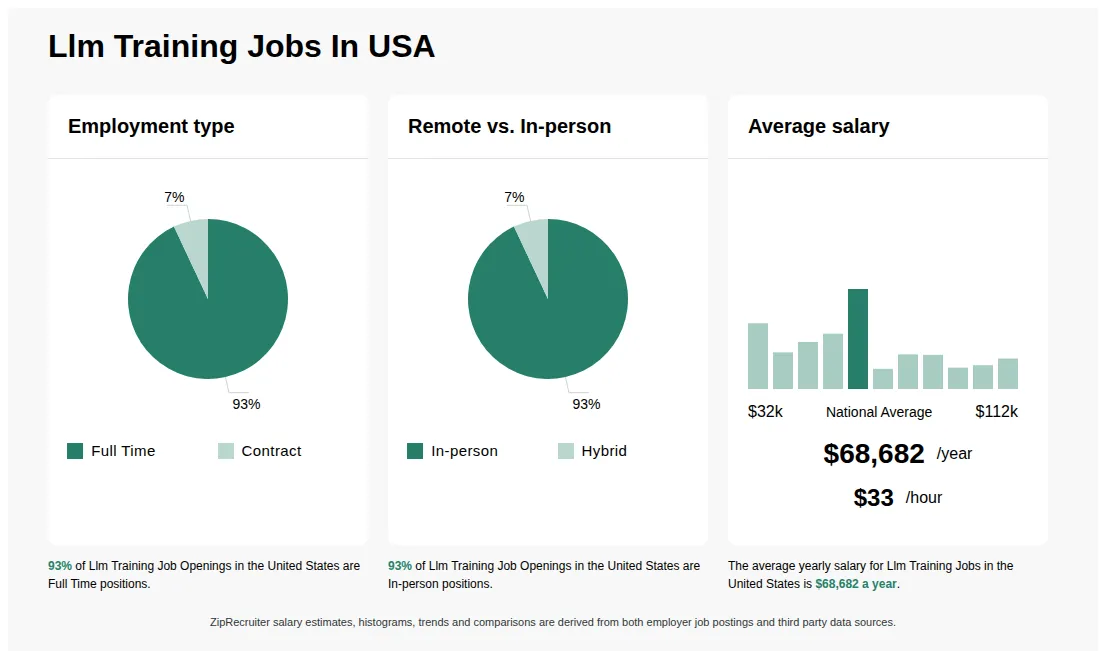
As of Aug 20, 2026, the average yearly pay for llm training in the United States is $68,682.00, according to ZipRecruiter salary data. Most workers in this role earn between $50,000.00 and $84,500.00 per year, depending on experience, location, and employer.

What is an LLM Training?

An LLM Training job involves developing, fine-tuning, and optimizing large language models (LLMs) to improve their performance and accuracy. This role typically includes data collection, preprocessing, model training, evaluation, and troubleshooting issues related to bias, efficiency, and scalability. Professionals in this field work with machine learning frameworks, large datasets, and computational resources to enhance AI capabilities. They may also collaborate with researchers, engineers, and product teams to deploy models for real-world applications.

What are the key skills and qualifications needed to thrive in the LLM Training position?

To excel in LLM Training, you need a strong background in machine learning, natural language processing (NLP), and computer science, often backed by an advanced degree in a related field. Experience with programming languages such as Python, frameworks like PyTorch or TensorFlow, and familiarity with data annotation tools are essential, along with knowledge of cloud platforms and distributed computing. Strong analytical thinking, effective communication, and the ability to collaborate across interdisciplinary teams set top candidates apart. These skills ensure high-quality model development, efficient project execution, and the ability to adapt to evolving AI technologies.

What types of teams or professionals does an LLM Training specialist typically collaborate with?

Professionals specializing in LLM Training often work closely with data engineers, software developers, domain experts, product managers, and quality assurance analysts. Collaboration is essential for collecting and preprocessing training data, integrating models into products, and ensuring outputs meet business and user requirements. These roles frequently participate in agile project workflows, contribute to cross-functional team meetings, and collaborate on continuous model improvements. Engaging with diverse teams expands your understanding of product goals and helps you deliver robust and reliable language models that align with organizational objectives.

Is it possible to train Llm Training?

Training large language models (LLMs) is possible but requires significant computational resources, expertise in machine learning, and access to large datasets. It typically involves using specialized hardware like GPUs or TPUs and knowledge of frameworks such as TensorFlow or PyTorch. Many organizations opt to fine-tune pre-trained models rather than train from scratch due to the high costs and complexity involved.

What cities are hiring for Llm Training jobs?

Cities with the most Llm Training job openings:

What are the most commonly searched types of Llm Training jobs?

The most popular types of Llm Training jobs are:

What states have the most Llm Training jobs?

States with the most job openings for Llm Training jobs include:

Infographic showing various Llm Training job openings in the United States as of August 2026, with employment types broken down into 1% As Needed, 82% Full Time, 16% Part Time, and 1% Contract. Highlights an 89% Physical, 1% Hybrid, and 10% Remote job distribution, with an average salary of $68,682 per year, or $33 per hour.

LLM Dataset Engineer

Sciforium

San Francisco, CA • On-site

$155K - $210K/yr

Full-time

Medical, Dental, Vision, Retirement

Re-posted 14 days ago


Job description

Sciforium is an AI infrastructure company developing next-generation multimodal AI models and a proprietary, high-efficiency serving platform. Backed by multi-million-dollar funding and direct sponsorship from AMD with hands-on support from AMD engineers the team is scaling rapidly to build the full stack powering frontier AI models and real-time applications.
Role Overview
Sciforium is seeking a highly technical and visionary LLM Dataset Engineer to lead the strategy, creation, and curation of the massive datasets that power our foundation models. We believe that in the era of LLMs, data is the primary competitive advantage. In this role, you will own the end-to-end data lifecycle-from raw web-scale crawling to the fine-grained human-alignment datasets that define model behavior.
This position is ideal for a scientist who views data as a high-scale engineering challenge and an analytical puzzle. You will not just "provide" data; you will design the taxonomies, filtering heuristics, and post-training pipelines that ensure our models are world-class in reasoning, safety, and multimodal understanding.
Key Responsibilities
  • Foundation Dataset Strategy: Own the end-to-end creation of pre-training datasets for LLMs. This includes defining the mix of web data, code, books, and technical papers to optimize for downstream model performance.
  • Petabyte-Scale Curation: Design and implement sophisticated pipelines for data cleaning, exact/fuzzy deduplication, and high-quality signal extraction from petabytes of raw, unstructured data.
  • Post-Training & Alignment Data: Lead the development of high-quality post-training datasets, including Supervised Fine-Tuning (SFT) instructions, multi-turn dialogues, and preference modeling data (RLHF/DPO).
  • Multimodal Expansion: Drive the acquisition and processing of vision and video data, navigating the complexities of multimodal alignment, video compression, and temporal data consistency.
  • High-Performance Engineering: Develop high-throughput data processing scripts using Python, leveraging multiprocessing and multithreading to handle massive-scale ingestion and transformation without bottlenecks.
  • Data Profiling & Analysis: Conduct deep-dive statistical analysis on training corpora to identify biases, gaps in knowledge, and quality regressions, ensuring the "diet" of the model is mathematically balanced.
  • Synthetic Data Generation: (Added Value) Design pipelines to generate high-reasoning synthetic data to augment gaps in natural datasets, utilizing existing models for data labeling and refinement.
Must-Haves
  • 5+ years of industry experience in Data Science or Machine Learning, with a proven track record of building and managing datasets for foundation models.
  • Deep Proficiency in Python: Expert-level skills with a focus on high-performance code, including multiprocessing, multithreading, and efficient memory management for large-scale data tasks.
  • Petabyte-Scale Experience: Demonstrated experience working with petabyte-scale datasets that have been directly used to train production-grade LLMs or Large Vision Models.
  • Dataset Reconstruction: Experience building massive LLM training sets from scratch, including raw web crawls (e.g., Common Crawl) and specialized domain data.
  • Post-Training Expertise: Hands-on experience building datasets for RLHF, DPO, and multi-turn instruction following, including the management of human-labeling workflows and quality gold-sets.
  • Data Tooling: Mastery of data-at-scale frameworks such as Spark, Ray, or high-performance data-loading formats (e.g., WebDataset, Parquet).
Nice-to-Haves
  • Computer Vision (CV) Curation: Experience building large-scale image or video datasets from scratch (e.g., LAION-style pipelines).
  • Multimodal Crawling: Familiarity with large-scale crawling of multimodal data and the associated challenges of video processing, codecs, and compression.
  • Taxonomy Design: Experience in designing complex labeling schemas for reasoning, coding, and mathematical benchmarks.
  • Research Background: A Master's or PhD in a quantitative field with a focus on data-centric AI or information retrieval.

Benefits include
  • Medical, dental, and vision insurance
  • 401k plan
  • Daily lunch, snacks, and beverages
  • Flexible time off
  • Competitive salary and equity

Equal opportunity
Sciforium is an equal opportunity employer. All applicants will be considered for employment without attention to race, color, religion, sex, sexual orientation, gender identity, national origin, veteran or disability status.