As an AI/ML Research Engineer, LLM Training & Evaluation, you will build and optimize the technical foundations that power model improvement for foundation model builders and leading labs. This role ...
As an AI/ML Research Engineer, LLM Training & Evaluation, you will build and optimize the technical foundations that power model improvement for foundation model builders and leading labs. This role ...
As an AI/ML Research Engineer, LLM Training & Evaluation, you will build and optimize the technical foundations that power model improvement for foundation model builders and leading labs. This role ...
As an AI/ML Research Engineer, LLM Training & Evaluation, you will build and optimize the technical foundations that power model improvement for foundation model builders and leading labs. This role ...
About the role You will optimize, operate and develop large-scale distributed LLM training systems that power AI scientific research. You will work closely with researchers to bring up, debug, and ...
New
About the role You will optimize, operate and develop large-scale distributed LLM training systems that power AI scientific research. You will work closely with researchers to bring up, debug, and ...
New
Curate and preprocess training corpora for domain-specific instruction tuning. * Fine-tune open ... Prior experience contributing to open-source LLM projects. * Background in NLP research or applied ...
Quick apply
Curate and preprocess training corpora for domain-specific instruction tuning. * Fine-tune open ... Prior experience contributing to open-source LLM projects. * Background in NLP research or applied ...

We are now looking for a Senior High-Performance LLM Training Engineer. NVIDIA is seeking experienced engineers specializing in performance analysis and optimization to improve the efficiency of LLM ...
We are now looking for a Senior High-Performance LLM Training Engineer. NVIDIA is seeking experienced engineers specializing in performance analysis and optimization to improve the efficiency of LLM ...
We are now looking for a Senior High-Performance LLM Training Engineer! NVIDIA is seeking experienced engineers specializing in performance analysis and optimization to improve the efficiency of LLM ...
We are now looking for a Senior High-Performance LLM Training Engineer! NVIDIA is seeking experienced engineers specializing in performance analysis and optimization to improve the efficiency of LLM ...
We are now looking for a Senior High-Performance LLM Training Engineer! NVIDIA is seeking experienced engineers specializing in performance analysis and optimization to improve the efficiency of LLM ...
We are now looking for a Senior High-Performance LLM Training Engineer! NVIDIA is seeking experienced engineers specializing in performance analysis and optimization to improve the efficiency of LLM ...

Propio is hiring an Applied Scientist/Research Engineer, LLM Training Data to own the data strategy, curation pipelines, annotation workflows, and evaluation datasets that power our multilingual AI ...
Propio is hiring an Applied Scientist/Research Engineer, LLM Training Data to own the data strategy, curation pipelines, annotation workflows, and evaluation datasets that power our multilingual AI ...

Propio is hiring an Applied Scientist/Research Engineer, LLM Training Data to own the data strategy, curation pipelines, annotation workflows, and evaluation datasets that power our multilingual AI ...
Propio is hiring an Applied Scientist/Research Engineer, LLM Training Data to own the data strategy, curation pipelines, annotation workflows, and evaluation datasets that power our multilingual AI ...
Senior Machine Learning Engineer, Speech & LLM Training Data
Overland Park, KS · On-site
$111K - $133K/yr
Propio is hiring a Senior Machine Learning Engineer, Speech & LLM Training Data to transform large volumes of multilingual conversational audio into high-quality training and evaluation datasets.
Senior Machine Learning Engineer, Speech & LLM Training Data
Overland Park, KS · On-site
$111K - $133K/yr
Propio is hiring a Senior Machine Learning Engineer, Speech & LLM Training Data to transform large volumes of multilingual conversational audio into high-quality training and evaluation datasets.
Senior Machine Learning Engineer, Speech & LLM Training Data
Overland Park, KS · On-site
$111K - $133K/yr
Propio is hiring a Senior Machine Learning Engineer, Speech & LLM Training Data to transform large volumes of multilingual conversational audio into high-quality training and evaluation datasets.
Senior Machine Learning Engineer, Speech & LLM Training Data
Overland Park, KS · On-site
$111K - $133K/yr
Propio is hiring a Senior Machine Learning Engineer, Speech & LLM Training Data to transform large volumes of multilingual conversational audio into high-quality training and evaluation datasets.
Lead end-to-end performance analysis and optimization of innovative LLM pre-training and post-training workloads on the latest NVIDIA hardware and software platforms. * Drive workloads closer to ...
Lead end-to-end performance analysis and optimization of innovative LLM pre-training and post-training workloads on the latest NVIDIA hardware and software platforms. * Drive workloads closer to ...

Machine Learning Systems Research Engineer, Agent Post-training - Enterprise GenAI
Manhattan, NY · On-site
Required : • At least 1-3 years of LLM training in a production environment • Passionate about system optimization • Experience with post-training methods like RLHF/RLVR and related algorithms ...
Machine Learning Systems Research Engineer, Agent Post-training - Enterprise GenAI
Manhattan, NY · On-site
Required : • At least 1-3 years of LLM training in a production environment • Passionate about system optimization • Experience with post-training methods like RLHF/RLVR and related algorithms ...
Machine Learning Systems Research Engineer, Agent Post-training - Enterprise GenAI
Manhattan, NY · On-site
Required : • At least 1-3 years of LLM training in a production environment • Passionate about system optimization • Experience with post-training methods like RLHF/RLVR and related algorithms ...
Machine Learning Systems Research Engineer, Agent Post-training - Enterprise GenAI
Manhattan, NY · On-site
Required : • At least 1-3 years of LLM training in a production environment • Passionate about system optimization • Experience with post-training methods like RLHF/RLVR and related algorithms ...
Machine Learning Systems Research Engineer, Agent Post-training - Enterprise GenAI
San Francisco, CA · On-site
Required : • At least 1-3 years of LLM training in a production environment • Passionate about system optimization • Experience with post-training methods like RLHF/RLVR and related algorithms ...
Machine Learning Systems Research Engineer, Agent Post-training - Enterprise GenAI
San Francisco, CA · On-site
Required : • At least 1-3 years of LLM training in a production environment • Passionate about system optimization • Experience with post-training methods like RLHF/RLVR and related algorithms ...
Lead end-to-end performance analysis and optimization of innovative LLM pre-training and post-training workloads on the latest NVIDIA hardware and software platforms. * Drive workloads closer to ...
Lead end-to-end performance analysis and optimization of innovative LLM pre-training and post-training workloads on the latest NVIDIA hardware and software platforms. * Drive workloads closer to ...
This role sits at the intersection of distributed training, GPU architecture, systems software, deep learning frameworks, and performance engineering. You will analyze and optimize frontier-scale LLM ...
This role sits at the intersection of distributed training, GPU architecture, systems software, deep learning frameworks, and performance engineering. You will analyze and optimize frontier-scale LLM ...

Senior Research Engineer, LLM Training & Post-Training
New York, NY · On-site +1
$114K - $157K/yr
Experience with modern LLM training and post-training techniques such as continued pretraining, SFT, RLHF, preference optimization (DPO, PPO, GRPO), reward modeling, or similar approaches. * Strong ...
Senior Research Engineer, LLM Training & Post-Training
New York, NY · On-site +1
$114K - $157K/yr
Experience with modern LLM training and post-training techniques such as continued pretraining, SFT, RLHF, preference optimization (DPO, PPO, GRPO), reward modeling, or similar approaches. * Strong ...

Our team develops the core training and serving infrastructure that powers one of the world ... This role is ideal for candidates who are passionate about LLM systems, distributed computing, GPU ...
Our team develops the core training and serving infrastructure that powers one of the world ... This role is ideal for candidates who are passionate about LLM systems, distributed computing, GPU ...
AI Infra Engineer Graduate (Recommendation & LLM) - 2027 Start
San Jose, CA · On-site
$128K - $316K/yr
Our team develops the core training and serving infrastructure that powers one of the world ... This role is ideal for candidates who are passionate about LLM systems, distributed computing, GPU ...
AI Infra Engineer Graduate (Recommendation & LLM) - 2027 Start
San Jose, CA · On-site
$128K - $316K/yr
Our team develops the core training and serving infrastructure that powers one of the world ... This role is ideal for candidates who are passionate about LLM systems, distributed computing, GPU ...
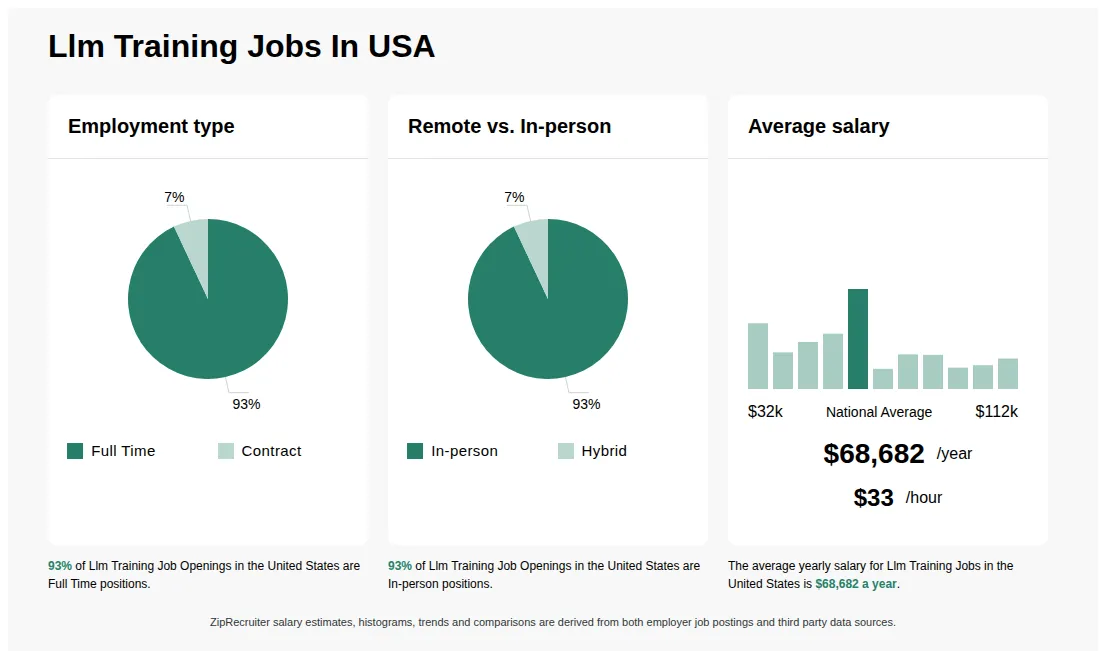
Llm Training information
See salary details
$32K - $39.3K
15% of jobs
$39.3K - $46.5K
7% of jobs
$48.7K is the 25th percentile. Wages below this are outliers.
$46.5K - $53.8K
10% of jobs
$53.8K - $61.1K
11% of jobs
The median wage is $63.2K / yr.
$61.1K - $68.4K
22% of jobs
$68.4K - $75.6K
4% of jobs
$80.8K is the 75th percentile. Wages above this are outliers.
$75.6K - $82.9K
7% of jobs
$82.9K - $90.2K
7% of jobs
$90.2K - $97.5K
4% of jobs
$97.5K - $104.7K
5% of jobs
$104.7K - $112K
6% of jobs
$32K
$68.7K
$112K
How much do llm training jobs pay per year?
As of Sep 13, 2026, the average yearly pay for llm training in the United States is $68,682.00, according to ZipRecruiter salary data. Most workers in this role earn between $50,000.00 and $84,500.00 per year, depending on experience, location, and employer.
What is an LLM Training?
An LLM Training job involves developing, fine-tuning, and optimizing large language models (LLMs) to improve their performance and accuracy. This role typically includes data collection, preprocessing, model training, evaluation, and troubleshooting issues related to bias, efficiency, and scalability. Professionals in this field work with machine learning frameworks, large datasets, and computational resources to enhance AI capabilities. They may also collaborate with researchers, engineers, and product teams to deploy models for real-world applications.
What are the key skills and qualifications needed to thrive in the LLM Training position?
To excel in LLM Training, you need a strong background in machine learning, natural language processing (NLP), and computer science, often backed by an advanced degree in a related field. Experience with programming languages such as Python, frameworks like PyTorch or TensorFlow, and familiarity with data annotation tools are essential, along with knowledge of cloud platforms and distributed computing. Strong analytical thinking, effective communication, and the ability to collaborate across interdisciplinary teams set top candidates apart. These skills ensure high-quality model development, efficient project execution, and the ability to adapt to evolving AI technologies.
What types of teams or professionals does an LLM Training specialist typically collaborate with?
Professionals specializing in LLM Training often work closely with data engineers, software developers, domain experts, product managers, and quality assurance analysts. Collaboration is essential for collecting and preprocessing training data, integrating models into products, and ensuring outputs meet business and user requirements. These roles frequently participate in agile project workflows, contribute to cross-functional team meetings, and collaborate on continuous model improvements. Engaging with diverse teams expands your understanding of product goals and helps you deliver robust and reliable language models that align with organizational objectives.
Is it possible to train Llm Training?
Training large language models (LLMs) is possible but requires significant computational resources, expertise in machine learning, and access to large datasets. It typically involves using specialized hardware like GPUs or TPUs and knowledge of frameworks such as TensorFlow or PyTorch. Many organizations opt to fine-tune pre-trained models rather than train from scratch due to the high costs and complexity involved.
More about Llm Training jobs
What cities are hiring for Llm Training jobs?
Cities with the most Llm Training job openings:
What are the most commonly searched types of Llm Training jobs?
The most popular types of Llm Training jobs are:
What states have the most Llm Training jobs?
States with the most job openings for Llm Training jobs include:
What job categories do people searching Llm Training jobs look for?
The top searched job categories for Llm Training jobs are:
What other helpful pages are available for Llm Training?
Other pages related to Llm Training:

AI/ML Research Engineer, LLM Post-Training & Evaluation
Remote
Innodata Inc.
• IT Services • 501 - 1,000 employees501 - 1,000 employees
Full-time
Re-posted 9 days ago
Innodata rating

7.5
Based on 6 frontline employees who took The Breakroom Quiz
Job description
Innodata (Nasdaq: INOD) is a global data engineering company. We believe that data and Artificial Intelligence (AI) are inextricably linked. Our mission is to enable the responsible advancement of artificial intelligence by providing the data, evaluation frameworks, and human expertise required to build AI systems that can be trusted at scale. We provide a range of transferable solutions, platforms, and services for Generative AI / AI builders and adopters. In every relationship, we honor our 36+ year legacy delivering the highest quality data and outstanding outcomes for our customers.
Scope of the Role:
Innodata is expanding its team of technical experts in LLM training, post-training, and evaluation systems. As an AI/ML Research Engineer, LLM Training & Evaluation, you will build and optimize the technical foundations that power model improvement for foundation model builders and leading labs.
This role is ideal for someone who has hands-on experience fine-tuning and evaluating large language models (and ideally multimodal models), and who can bridge research and engineering in real-world customer environments. You will work closely with Language Data Scientists, Applied Research Scientists, data engineers, and client technical stakeholders to design and implement robust training/evaluation pipelines using both human-in-the-loop and AI-augmented methods.
The ideal candidate brings a strong computer science / machine learning engineering background, experience with modern LLM post-training workflows, and the ability to engage credibly with technical counterparts at leading AI organizations.
What You'll Own:
As an AI/ML Research Engineer, LLM Training & Evaluation, you will design and implement the pipelines and tooling that connect data, evaluation, and post-training. You will help customers and internal teams move from evaluation findings to measurable model improvements.
Your work may include building fine-tuning workflows (e.g., supervised fine-tuning and preference-based optimization), integrating evaluation harnesses into model development loops, improving experiment reliability and throughput, and supporting advanced evaluation scenarios such as long-context, cross-modal, and dynamic multi-turn interactions.
You will also contribute to Innodata's internal R&D efforts, including benchmark datasets, evaluation frameworks, and reusable infrastructure for model assessment and post-training experimentation. Additional responsibilities include (but are not limited to):
You'll Thrive in This Role If You Have:
Technical Skills
ML / LLM Engineering
Evaluation & Experimentation
Software / Data Engineering
The expected salary range for this position is $80,000 - $175,000 USD per year, based on experience, skills, and qualifications.
Please be aware of recruitment scams involving individuals or organizations falsely claiming to represent employers. Innodata will never ask for payment, banking details, or sensitive personal information during the application process. To learn more on how to recognize job scams, please visit the Federal Trade Commission's guide at https://consumer.ftc.gov/articles/job-scams.
If you believe you've been targeted by a recruitment scam, please report it to Innodata at verifyjoboffer@innodata.com and consider reporting it to the FTC at ReportFraud.ftc.gov.
Scope of the Role:
Innodata is expanding its team of technical experts in LLM training, post-training, and evaluation systems. As an AI/ML Research Engineer, LLM Training & Evaluation, you will build and optimize the technical foundations that power model improvement for foundation model builders and leading labs.
This role is ideal for someone who has hands-on experience fine-tuning and evaluating large language models (and ideally multimodal models), and who can bridge research and engineering in real-world customer environments. You will work closely with Language Data Scientists, Applied Research Scientists, data engineers, and client technical stakeholders to design and implement robust training/evaluation pipelines using both human-in-the-loop and AI-augmented methods.
The ideal candidate brings a strong computer science / machine learning engineering background, experience with modern LLM post-training workflows, and the ability to engage credibly with technical counterparts at leading AI organizations.
What You'll Own:
As an AI/ML Research Engineer, LLM Training & Evaluation, you will design and implement the pipelines and tooling that connect data, evaluation, and post-training. You will help customers and internal teams move from evaluation findings to measurable model improvements.
Your work may include building fine-tuning workflows (e.g., supervised fine-tuning and preference-based optimization), integrating evaluation harnesses into model development loops, improving experiment reliability and throughput, and supporting advanced evaluation scenarios such as long-context, cross-modal, and dynamic multi-turn interactions.
You will also contribute to Innodata's internal R&D efforts, including benchmark datasets, evaluation frameworks, and reusable infrastructure for model assessment and post-training experimentation. Additional responsibilities include (but are not limited to):
- Lead or co-lead technically complex ML engineering projects from initial customer discussions through implementation and delivery
- Design, build, and improve LLM training and post-training pipelines, including data ingestion, preprocessing, fine-tuning, evaluation, and experiment tracking
- Implement and optimize evaluation systems for LLMs and multimodal models, including offline benchmarks and task-specific test harnesses
- Integrate human-in-the-loop and AI-augmented evaluation signals into model development workflows
- Build robust infrastructure and tooling for reproducible experimentation, metrics logging, and regression monitoring
- Diagnose model behavior and pipeline failures, including data issues, training instability, metric inconsistencies, and evaluation drift
- Collaborate with Language Data Scientists and Applied Research Scientists to translate evaluation frameworks into executable systems
- Work closely with customer technical stakeholders to understand goals, constraints, and success criteria; propose and implement technically sound solutions
- Contribute to internal research and platform development, including benchmark frameworks, evaluation tooling, and post-training workflow improvements
- Contribute to best practices and standards for LLM training, evaluation, and quality assurance across projects
- Mentor junior engineers and contribute to technical design reviews, documentation, and engineering rigor across the team
You'll Thrive in This Role If You Have:
- BS/MS/PhD in Computer Science, Machine Learning, AI, Applied Mathematics, or a related quantitative technical field (MS/PhD preferred)
- 2-3 years of relevant industry or research engineering experience in ML/AI systems
- Hands-on experience with LLM training / fine-tuning / post-training, including at least one of:
- supervised fine-tuning (SFT)
- preference optimization (e.g., DPO or related methods)
- RLHF / RLAIF-style workflows
- task- or domain-adaptation of foundation models
- Strong programming skills in Python and experience building production-quality ML code
- Experience with modern ML frameworks (e.g., PyTorch, JAX, TensorFlow) and model libraries/tooling (e.g., Hugging Face ecosystem, vLLM, distributed training stacks)
- Experience designing and implementing evaluation pipelines for LLM/ML systems, including metrics computation, dataset handling, and experiment comparisons
- Strong understanding of data pipelines and ML systems engineering, including reproducibility, observability, and debugging
- Experience with large-scale distributed ML systems and performance optimization for training/evaluation workloads (GPU/accelerator environments preferred)
- Experience with large-scale data processing and workflow orchestration in support of model training/evaluation
- Ability to collaborate directly with technical stakeholders including research scientists, ML engineers, data engineers, and customer technical leads
- Strong written and verbal communication skills, including the ability to explain complex technical tradeoffs to both technical and non-technical audiences
Technical Skills
ML / LLM Engineering
- Experience training, fine-tuning, and evaluating transformer-based models
- Understanding of post-training workflows and model iteration loops
- Familiarity with inference-time considerations (latency, throughput, memory/performance tradeoffs) where relevant to evaluation or deployment
Evaluation & Experimentation
- Experience implementing automated evaluation pipelines and test harnesses
- Experience with experiment tracking, versioning, and reproducibility practices
- Ability to assess metric quality and ensure consistency across model comparisons
Software / Data Engineering
- Proficiency in Python and strong software engineering fundamentals
- Experience with data processing pipelines, storage formats, and scalable dataset workflows
- Familiarity with CI/CD, testing, and engineering quality practices for ML systems
The expected salary range for this position is $80,000 - $175,000 USD per year, based on experience, skills, and qualifications.
Please be aware of recruitment scams involving individuals or organizations falsely claiming to represent employers. Innodata will never ask for payment, banking details, or sensitive personal information during the application process. To learn more on how to recognize job scams, please visit the Federal Trade Commission's guide at https://consumer.ftc.gov/articles/job-scams.
If you believe you've been targeted by a recruitment scam, please report it to Innodata at verifyjoboffer@innodata.com and consider reporting it to the FTC at ReportFraud.ftc.gov.

About Innodata
Sourced by ZipRecruiter
Industry
It services
Company size
501 - 1,000 Employees
Headquarters location
Hackensack, NJ, US
Year founded
1988