1

Law Enforcement Computer Forensics Jobs in Texas

Computer forensics including disk imaging, collection and eDiscovery practices preferred. * 3-5+ ... federal, state, or local law. Purpose Legal is committed to providing veteran employment ...

Provide AF OSI DCO technical support to law enforcement and counter intelligence activities. * Turn ... FTK, XWays Forensics, FireEye, Volatility, Sleuthkit, BlackBag tools) and various Open Source ...

Provide AF OSI DCO technical support to law enforcement and counter intelligence activities. * Turn ... FTK, XWays Forensics, FireEye, Volatility, Sleuthkit, BlackBag tools) and various Open Source ...

PathGroup's forensic pathology division is seeking a Board-Certified or Board-Eligible Forensic ... Collaborate with law enforcement, legal professionals, and investigative teams * Ensure accurate ...

PathGroup's forensic pathology division is seeking a Board-Certified or Board-Eligible Forensic ... Collaborate with law enforcement, legal professionals, and investigative teams * Ensure accurate ...

PathGroup's forensic pathology division, Forensic Medical Management Services of Texas, is seeking ... Collaborate with law enforcement, legal professionals, and investigative teams * Ensure accurate ...

next page

Showing results 1-20

Law Enforcement Computer Forensics information

See Texas salary details

$9

$33

$64

How much do law enforcement computer forensics jobs pay per hour?

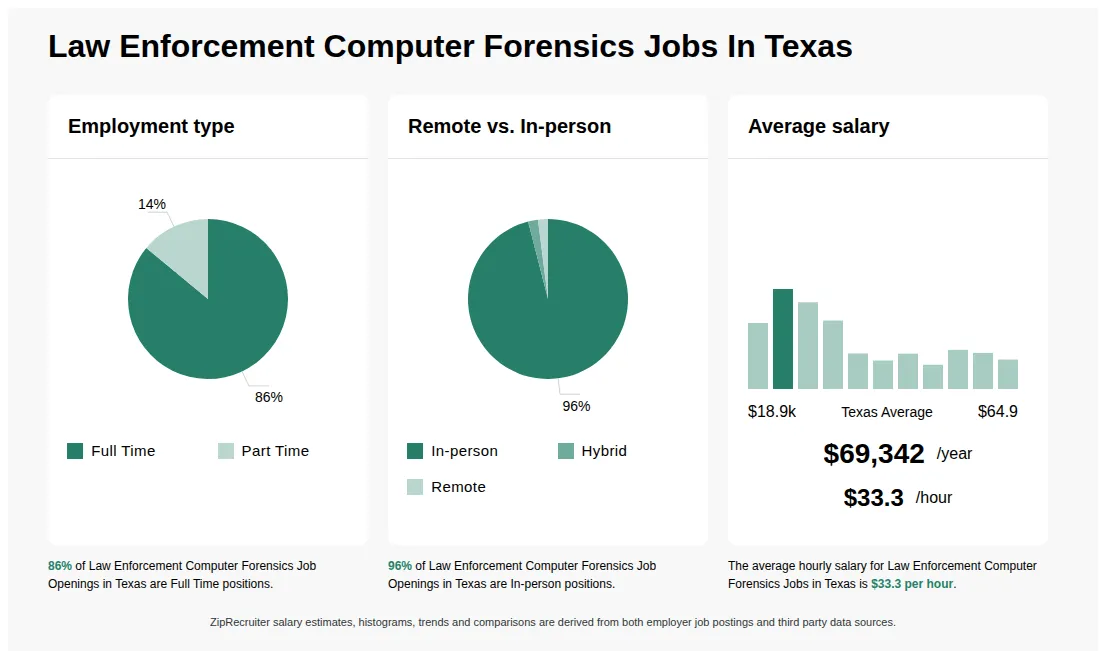
As of Jul 28, 2026, the average hourly pay for law enforcement computer forensics in Texas is $33.34, according to ZipRecruiter salary data. Most workers in this role earn between $17.55 and $49.26 per hour, depending on experience, location, and employer.

What are the key skills and qualifications needed to thrive as a Law Enforcement Computer Forensics Specialist, and why are they important?

To thrive as a Law Enforcement Computer Forensics Specialist, you need expertise in digital evidence collection, analysis, and a background in criminal justice or computer science, often supported by certifications such as EnCE or GCFA. Familiarity with forensic software like EnCase, FTK, and knowledge of operating systems and data recovery tools is crucial. Attention to detail, analytical thinking, and strong communication skills set top performers apart in this role. These capabilities are essential to ensure the integrity, security, and admissibility of digital evidence in criminal investigations.

What Jobs Can I Get With a Background in Law Enforcement and Computer Forensics?

Jobs that focus on law enforcement and computer forensics include jobs in which you investigate suspects after people report evidence of a crime. You analyze their digital activity and access information on their computer to help uncover more information about them. Forensic investigators do not make determinations about guilt or innocence but often testify before courts and juries to explain uncovered material and help the judicial system reach a conclusion. As part of this job, you may talk with product manufacturers to find ways to access data, request search warrants, and coordinate with other officers. This job category refers specifically to law enforcement officers and should not be confused with computer forensics jobs performed by other people.

What is law enforcement computer forensics?

Law enforcement computer forensics is the practice of collecting, analyzing, and preserving digital evidence from computers, mobile devices, and other electronic sources to support criminal investigations. Specialists in this field use specialized tools and techniques to recover deleted files, track online activity, and uncover digital traces that can be presented in court. Their work is critical in solving crimes involving cyberattacks, fraud, child exploitation, and other offenses where digital evidence is involved. These professionals must follow strict protocols to ensure the integrity and admissibility of the evidence they handle.

How much does a computer forensics investigator make?

The average salary for a computer forensics investigator ranges from $60,000 to $100,000 annually, depending on experience, certifications, and location. Entry-level roles typically start around $50,000, while experienced professionals with specialized skills can earn over $120,000. The job often requires knowledge of digital evidence handling, forensic tools, and sometimes certifications like CFCE or GCFA.

What is the difference between Law Enforcement Computer Forensics vs Digital Forensics Analyst?

AspectLaw Enforcement Computer ForensicsDigital Forensics Analyst
CredentialsCertifications like CFCE, EnCE, or LE-specific trainingCertifications like GCFA, EnCE, or CISSP
Work EnvironmentLaw enforcement agencies, criminal investigationsPrivate sector, cybersecurity firms, consulting
Employer & IndustryPolice departments, federal agenciesCorporations, cybersecurity companies, legal firms

While both roles involve digital evidence analysis, Law Enforcement Computer Forensics focuses on criminal investigations within law enforcement agencies, often requiring specific certifications and working in a law enforcement environment. Digital Forensics Analysts may work in private sectors, handling cybersecurity incidents and digital investigations outside of law enforcement settings.

What job could I do with computer forensics?

A career in computer forensics typically involves working as a digital forensic analyst, investigator, or specialist within law enforcement, cybersecurity firms, or private investigation agencies. These roles require skills in data recovery, analysis of digital evidence, and familiarity with forensic tools and software, often supported by certifications like EnCE or CFCE.

What is computer forensics in law enforcement?

Computer forensics in law enforcement involves the identification, preservation, analysis, and presentation of digital evidence from computers, networks, and storage devices. Forensic specialists use specialized tools and techniques to investigate cybercrimes, recover deleted data, and support criminal cases, often requiring certifications and adherence to legal standards.

What are the typical challenges faced by Law Enforcement Computer Forensics professionals when handling digital evidence?

Law Enforcement Computer Forensics professionals often encounter challenges such as rapidly evolving technology, encrypted or damaged data, and the need to maintain strict evidence integrity. They must be adept at staying current with new digital tools and forensic software while ensuring every step is meticulously documented for legal proceedings. Additionally, they regularly collaborate with investigators, legal teams, and sometimes testify in court, requiring strong communication skills and an understanding of both technical and legal standards.

How to get into digital forensics for law enforcement?

To pursue a career in law enforcement computer forensics, candidates typically need a background in criminal justice, cybersecurity, or computer science, along with knowledge of digital evidence handling and forensic tools like EnCase or FTK. Earning certifications such as Certified Computer Examiner (CCE) or EnCase Certified Examiner (EnCE) can improve job prospects. Relevant experience in law enforcement or cybersecurity and a thorough understanding of legal procedures are also important for entry into this field.
What are popular job titles related to Law Enforcement Computer Forensics jobs in Texas? For Law Enforcement Computer Forensics jobs in Texas, the most frequently searched job titles are:
What job categories do people searching Law Enforcement Computer Forensics jobs in Texas look for? The top searched job categories for Law Enforcement Computer Forensics jobs in Texas are:
What cities in Texas are hiring for Law Enforcement Computer Forensics jobs? Cities in Texas with the most Law Enforcement Computer Forensics job openings:
Infographic showing various Law Enforcement Computer Forensics job openings in Texas as of July 2026, with employment types broken down into 60% Full Time, 30% Part Time, and 10% Temporary. Highlights an 100% In-person job distribution, with an average salary of $69,342 per year, or $33.3 per hour.
Senior Forensic Analyst

Senior Forensic Analyst

Purpose Legal

Dallas, TX • On-site

Other

This job post has expired today. Applications are no longer accepted.


Job description

Join Purpose Legal as a Senior Forensic Analyst to help drive innovation, quality, and efficiency in the rapidly evolving legal technology landscape.


Senior Forensic Analyst Overview


As a Senior Forensic Analyst, you gather, standardize, and analyze voluminous transactional electronic data and will provide file system analysis using proven forensic methodology with attorneys, forensic accountants, clients, and other investigators to produce analyses in support of an investigation. The Senior Forensic Analyst will act as a point for information gathering and clearing in support of digital forensic inquiries, investigations, incident response, and automating data collections for investigations. The Senior Forensic Analyst will work a hybrid schedule and will travel as needed within the US. The ideal candidate will be based in Dallas.


Senior Forensic Analyst Responsibilities


  • Perform digital forensic acquisitions, electronic evidence collections and forensic analysis.
  • Follow strict data and evidence handling procedures.
  • Report technical examinations, analyze and report on computer-based evidence.
  • Collaborate with Lead Investigators, Forensic Examiners and Forensic Project Managers.
  • Prepare and maintain case files and write reports with attention to detail and completeness.
  • Assist the response process, as the escalation point for matters requiring forensics support.
  • Produce quality written work product, presenting complex technical matters clearly and concisely.
  • Undertake various forensic technology and data processing assignments along with general tasks and client work for the wider department as assigned.
  • Lead Forensic services training presentations to internal teams.
  • Monitor and record all incident responses, work with incident response tools and escalate to the appropriate individuals and/or teams.
  • Review cyber claims to include peer review of forensic reports, expertise of understanding IT & forensic costs associated with the cyber incidents, etc.


Senior Forensic Analyst Requirements:


  • Bachelor’s degree in a related field or equivalent experience.
  • Computer forensics including disk imaging, collection and eDiscovery practices preferred.
  • 3-5+ years of experience in digital investigations, forensic analysis, mobile phone extractions or computer incident response team.
  • Certifications from one of the following: GIAC Certified Forensic Examiner (GCFE), GIAC Certified Forensic Analyst (GCFA), GIAC Certified Reverse Engineering Malware (GREM), Certified Computer Examiner (CCE), AccessData Certified Examiner (ACE), EnCE
  • Solid understanding of forensics preservation, chain of custody procedures, evidence-handling and forensics lab best practices.
  • Extensive working knowledge of Windows and Mac operating systems and file systems
  • Demonstrated skills in digital investigations including computer forensics, network forensics, malware analysis and memory analysis.
  • Experience with programming languages such as Pearl, Python, Java, Java script, C++, ASP, .NET, Unix/Linux


At Purpose Legal, we combine exceptional talent with award-winning technology and service solutions to help clients transform legal operations, managed review, and AI-driven review workflows. Our expertise and innovative approach enable legal organizations and legal service providers to increase efficiency, reduce risk, and achieve better project outcomes at every stage of the legal manage review process.


Purpose Legal is an Equal Opportunity Employer. We believe that no one should be discriminated against because of their differences, such as age, disability, ethnicity, gender, gender identity and expression, religion or sexual orientation. All employment decisions shall be made without regard to age, race, creed, color, religion, sex, national origin, ancestry, disability status, veteran status, sexual orientation, gender identity or expression, genetic information, marital status, citizenship status or any other basis as protected by federal, state, or local law. Purpose Legal is committed to providing veteran employment opportunities to our service men and women.