Laser Scanning Technician We are seeking a dedicated individual to join our team as a Laser Scanning Technician. If you have a passion for precision and proficiency in handling 3D data using cutting ...
Laser Scanning Technician We are seeking a dedicated individual to join our team as a Laser Scanning Technician. If you have a passion for precision and proficiency in handling 3D data using cutting ...
Laser Scanning Technician We are seeking a dedicated individual to join our team as a Laser Scanning Technician. If you have a passion for precision and proficiency in handling 3D data using cutting ...
Laser Scanning Technician We are seeking a dedicated individual to join our team as a Laser Scanning Technician. If you have a passion for precision and proficiency in handling 3D data using cutting ...
We are seeking a dedicated individual to join our team as a Laser Scanning Technician. If you have a passion for precision and proficiency in handling 3D data using cutting-edge technology, we ...
We are seeking a dedicated individual to join our team as a Laser Scanning Technician. If you have a passion for precision and proficiency in handling 3D data using cutting-edge technology, we ...
Job Title Laser Scanning Project Technician Job Type Full-time Location Houston - Stafford, TX 77477 US (Primary) Category Survey Education Some College Coursework Completed T. Baker Smith is ...
Job Title Laser Scanning Project Technician Job Type Full-time Location Houston - Stafford, TX 77477 US (Primary) Category Survey Education Some College Coursework Completed T. Baker Smith is ...
We are seeking a dedicated individual to join our team as a Laser Scanning Technician. If you have a passion for precision and proficiency in handling.
We are seeking a dedicated individual to join our team as a Laser Scanning Technician. If you have a passion for precision and proficiency in handling.

VDC Engineer - Laser Scanning Technician
Queens, NY · On-site
$75K - $90K/yr
Perform on-site 3D laser scanning using Faro, Leica, and NavVis scanners. * Process, register, and QA/QC scan data. * Coordinate scan data with survey, BIM, and design models. * Assist with scanning ...
Quick apply
VDC Engineer - Laser Scanning Technician
Queens, NY · On-site
$75K - $90K/yr
Perform on-site 3D laser scanning using Faro, Leica, and NavVis scanners. * Process, register, and QA/QC scan data. * Coordinate scan data with survey, BIM, and design models. * Assist with scanning ...
VDC Engineer - Laser Scanning Technician
New York, NY · On-site
$75K - $90K/yr
Perform on-site 3D laser scanning using Faro, Leica, and NavVis scanners. * Process, register, and QA/QC scan data. * Coordinate scan data with survey, BIM, and design models. * Assist with scanning ...
VDC Engineer - Laser Scanning Technician
New York, NY · On-site
$75K - $90K/yr
Perform on-site 3D laser scanning using Faro, Leica, and NavVis scanners. * Process, register, and QA/QC scan data. * Coordinate scan data with survey, BIM, and design models. * Assist with scanning ...
Phase Manager - 3D Laser Scanning
Indianapolis, IN · On-site
$90 - $125/hr
Manage hands-on laser scanning projects in the field * Train, mentor, and manage staff, promoting technical growth and team performance * Communicate scope, safety requirements, and quality ...
Phase Manager - 3D Laser Scanning
Indianapolis, IN · On-site
$90 - $125/hr
Manage hands-on laser scanning projects in the field * Train, mentor, and manage staff, promoting technical growth and team performance * Communicate scope, safety requirements, and quality ...
$75 - $90/hr
Perform on‑site 3D laser scanning using Faro, Leica, and NavVis scanners. * Process, register, and QA/QC scan data. * Coordinate scan data with survey, BIM, and design models. * Assist with ...
New
$75 - $90/hr
Perform on‑site 3D laser scanning using Faro, Leica, and NavVis scanners. * Process, register, and QA/QC scan data. * Coordinate scan data with survey, BIM, and design models. * Assist with ...
New
SURVEY TECHNICIAN (ENTRY LEVEL) 3D LASER SCANNING & POINT CLOUD TEMPORARY (6 MONTHS) WITH OPPORTUNITY FOR PERMANENT EMPLOYMENT Washington, D.C. Metropolitan Area and Beyond (eastern U.S.) THE ...
SURVEY TECHNICIAN (ENTRY LEVEL) 3D LASER SCANNING & POINT CLOUD TEMPORARY (6 MONTHS) WITH OPPORTUNITY FOR PERMANENT EMPLOYMENT Washington, D.C. Metropolitan Area and Beyond (eastern U.S.) THE ...
SURVEY TECHNICIAN (ENTRY LEVEL) 3D LASER SCANNING & POINT CLOUD TEMPORARY (6 MONTHS) WITH OPPORTUNITY FOR PERMANENT EMPLOYMENT Washington, D.C. Metropolitan Area and Beyond (eastern U.S.) THE ...
SURVEY TECHNICIAN (ENTRY LEVEL) 3D LASER SCANNING & POINT CLOUD TEMPORARY (6 MONTHS) WITH OPPORTUNITY FOR PERMANENT EMPLOYMENT Washington, D.C. Metropolitan Area and Beyond (eastern U.S.) THE ...
VDC Engineer - Laser Scanning Technician
Manhattan, NY · On-site
$75 - $90/hr
Perform on‑site 3D laser scanning using Faro, Leica, and NavVis scanners. * Process, register, and QA/QC scan data. * Coordinate scan data with survey, BIM, and design models. * Assist with ...
New
VDC Engineer - Laser Scanning Technician
Manhattan, NY · On-site
$75 - $90/hr
Perform on‑site 3D laser scanning using Faro, Leica, and NavVis scanners. * Process, register, and QA/QC scan data. * Coordinate scan data with survey, BIM, and design models. * Assist with ...
New
VDC Engineer - Laser Scanning Technician
Manhattan, NY · On-site
$75 - $90/hr
Perform on‑site 3D laser scanning using Faro, Leica, and NavVis scanners. * Process, register, and QA/QC scan data. * Coordinate scan data with survey, BIM, and design models. * Assist with ...
VDC Engineer - Laser Scanning Technician
Manhattan, NY · On-site
$75 - $90/hr
Perform on‑site 3D laser scanning using Faro, Leica, and NavVis scanners. * Process, register, and QA/QC scan data. * Coordinate scan data with survey, BIM, and design models. * Assist with ...

Position Summary As a Reality Capture 3D Laser Scanning Specialist , you will use advanced 3D laser scanning, drone capture, and reality capture technologies to document existing buildings and ...
Position Summary As a Reality Capture 3D Laser Scanning Specialist , you will use advanced 3D laser scanning, drone capture, and reality capture technologies to document existing buildings and ...
SURVEY TECHNICIAN (ENTRY LEVEL) 3D LASER SCANNING & POINT CLOUD TEMPORARY (6 MONTHS) WITH OPPORTUNITY FOR PERMANENT EMPLOYMENT Washington, D.C. Metropolitan Area and Beyond (eastern U.S.) THE ...
Quick apply
SURVEY TECHNICIAN (ENTRY LEVEL) 3D LASER SCANNING & POINT CLOUD TEMPORARY (6 MONTHS) WITH OPPORTUNITY FOR PERMANENT EMPLOYMENT Washington, D.C. Metropolitan Area and Beyond (eastern U.S.) THE ...

3D Laser Scan Technician
Houston, TX · On-site
Carry out a minimum of 75% of all aspects of Dimensional Control and Laser Scanning (as required within general survey work activities) * Prepare scans for site registration * Train and assess ...
3D Laser Scan Technician
Houston, TX · On-site
Carry out a minimum of 75% of all aspects of Dimensional Control and Laser Scanning (as required within general survey work activities) * Prepare scans for site registration * Train and assess ...
3D Laser Scan Technician
Houston, TX · On-site
Carry out a minimum of 75% of all aspects of Dimensional Control and Laser Scanning (as required within general survey work activities) * Prepare scans for site registration * Train and assess ...
3D Laser Scan Technician
Houston, TX · On-site
Carry out a minimum of 75% of all aspects of Dimensional Control and Laser Scanning (as required within general survey work activities) * Prepare scans for site registration * Train and assess ...
Carry out a minimum of 75% of all aspects of Dimensional Control and Laser Scanning (as required within general survey work activities) * Prepare scans for site registration * Train and assess ...
Carry out a minimum of 75% of all aspects of Dimensional Control and Laser Scanning (as required within general survey work activities) * Prepare scans for site registration * Train and assess ...
Carry out a minimum of 75% of all aspects of Dimensional Control and Laser Scanning (as required within general survey work activities) * Prepare scans for site registration * Train and assess ...
Carry out a minimum of 75% of all aspects of Dimensional Control and Laser Scanning (as required within general survey work activities) * Prepare scans for site registration * Train and assess ...
3D Laser Scan Technician
Houston, TX · On-site
Carry out a minimum of 75% of all aspects of Dimensional Control and Laser Scanning (as required within general survey work activities) * Prepare scans for site registration * Train and assess ...
3D Laser Scan Technician
Houston, TX · On-site
Carry out a minimum of 75% of all aspects of Dimensional Control and Laser Scanning (as required within general survey work activities) * Prepare scans for site registration * Train and assess ...
Laser Scanning information
See salary details
$13.22 - $14.51
3% of jobs
$14.51 - $15.80
9% of jobs
$16.97 is the 25th percentile. Wages below this are outliers.
$15.80 - $17.09
14% of jobs
$17.09 - $18.38
15% of jobs
The median wage is $19.06 / hr.
$18.38 - $19.67
17% of jobs
$19.67 - $20.96
15% of jobs
$21.28 is the 75th percentile. Wages above this are outliers.
$20.96 - $22.25
9% of jobs
$22.25 - $23.54
7% of jobs
$23.54 - $24.83
5% of jobs
$24.83 - $26.11
3% of jobs
$26.11 - $27.40
2% of jobs
$13
$19
$27
How much do laser scanning jobs pay per hour?
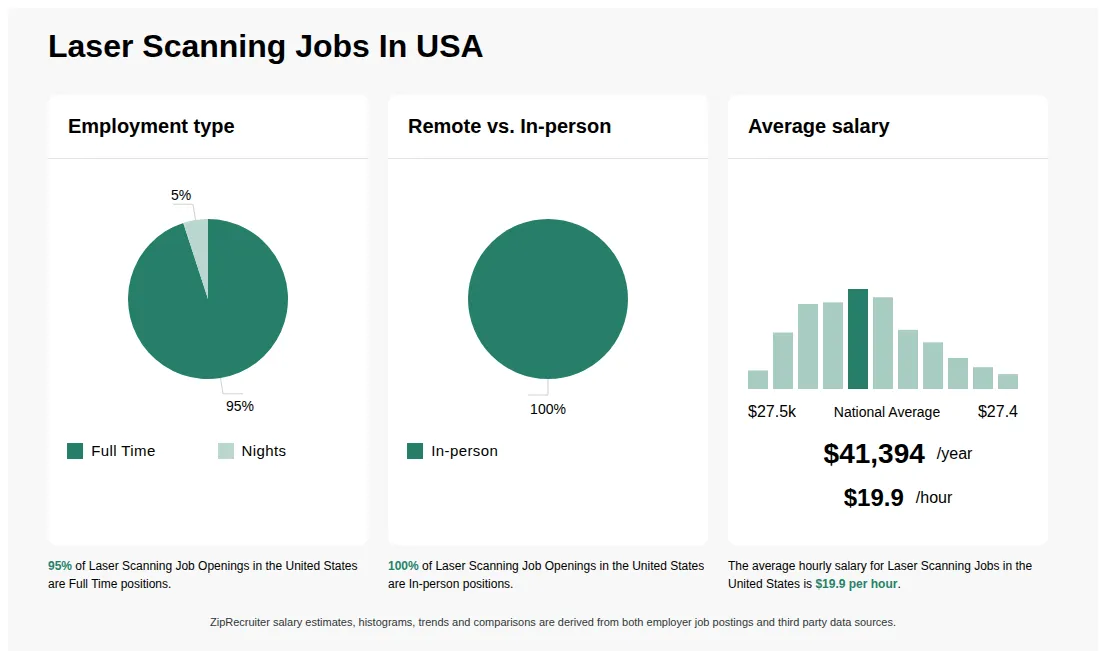
As of Sep 4, 2026, the average hourly pay for laser scanning in the United States is $19.90, according to ZipRecruiter salary data. Most workers in this role earn between $17.07 and $21.63 per hour, depending on experience, location, and employer.
What is laser scanning?
A Laser Scanning job involves using specialized equipment to capture high-precision 3D data of objects, buildings, or landscapes. Professionals in this field operate laser scanners to collect spatial information, which is then processed into digital models for applications in construction, engineering, archaeology, and other industries. They may also analyze and interpret scan data to assist in project planning, inspections, or restorations. This role requires knowledge of scanning technology, software, and data processing techniques.
What does a laser scanning professional do?
In a Laser Scanning role, your daily tasks generally involve preparing, operating, and maintaining laser scanning equipment at job sites to capture accurate 3D data of structures or landscapes. You’ll also process and analyze point cloud data using specialized software, create detailed reports or 3D models, and collaborate closely with surveyors, engineers, or architects to ensure the data meets project specifications. Most roles require a mix of fieldwork and office work, so adaptability is important. Attention to safety protocols and quality assurance checks is also a regular part of the job to guarantee high-quality deliverables that support project success.
What skills and qualifications are needed for laser scanning?
To excel in Laser Scanning, you need expertise in 3D data acquisition, spatial analysis, and site documentation, often backed by experience or education in surveying, engineering, or geospatial sciences. Familiarity with laser scanning equipment (such as terrestrial LiDAR scanners), data processing software (like Autodesk ReCap or Leica Cyclone), and relevant certifications (e.g., Certified Survey Technician) is crucial. Attention to detail, problem-solving, and strong communication skills help professionals accurately interpret data and effectively work with project teams. These skills are essential to ensure precise data capture, meet project requirements, and facilitate smooth collaboration in various environments.
More about Laser Scanning jobs
What cities are hiring for Laser Scanning jobs?
Cities with the most Laser Scanning job openings:
What states have the most Laser Scanning jobs?
States with the most job openings for Laser Scanning jobs include:
What job categories do people searching Laser Scanning jobs look for?
The top searched job categories for Laser Scanning jobs are:
Full-time
This job post has expired today. Applications are no longer accepted.
Job description
Laser Scanning Technician
We are seeking a dedicated individual to join our team as a Laser Scanning Technician. If you have a passion for precision and proficiency in handling 3D data using cutting-edge technology, we encourage you to apply. Key Responsibilities:
- Data Capture: Capture 3D data using company-supplied laser scanning equipment such as Leica RTC 360 and BLK 360 scanners.
- Data Registration: Register the captured 3D data using company-supplied laser scanning equipment or other data collection methods.
- Data Transfer: Use proprietary software like Leica Cyclone FIELD3D or FARO SCENE for initial data transfer from the scanner.
- Data Processing and Organization: Process and organize captured 3D data using industry-standard software. This includes tasks like registration of multiple scans, cleaning and editing point clouds, and preparing data for visualization and modeling workflows.
- Data Optimization: Optimize data using Leica Cyclone REGISTER/Geocoder, FARO Scene, Geomagic Essentials/Wrap, or CloudCompare.
- Software Proficiency: Proficiency in using company-supplied software for 3D data processing, visualization, and modeling. Specific software titles will be provided during the interview process.
- Quality Assurance and Control: Implement and maintain quality control procedures to ensure the accuracy and integrity of the 3D data throughout the processing workflow.
- Collaboration: Work closely with project managers, laser scanning specialists, and BIM modelers to understand project requirements and deliver high-quality 3D data sets that meet project specifications.
- Technical Expertise: Maintain a basic understanding of laser scanning technology and stay current with advancements in 3D data processing software.
Requirements:
- Experience working on 3D Laser scanners - Leica RTC360 & BLK 360
- Experience in Cyclone Register software for data registration, transfer & optimization
- Familiarity with BIM processes and workflows
- Bachelor's or Associate degree in Engineering
- Strong organizational skills and a meticulous eye for detail.
Note: Only qualified candidates will be invited for the next step.