1

Human Computer Interaction Jobs (NOW HIRING)

UX Designer II

New York, NY · On-site +1

$137K - $206K/yr

S. or foreign equivalent) in Human-Computer Interaction (HCI), Interaction Design, Graphic Design or related field and three (3) years of experience in the job offered or related role OR Master ...

Masters degree in Eng. (Human Factor Eng.), Biomedical Eng., Human Computer Interaction or related fields& 10 yrs exp req Salary: $245,000 to 260,000. Send res. To S. Teel, Infoblox, 2106 Pacific ...

Showing results 41-60

Human Computer Interaction information

See salary details

$26.5K

$44.2K

$60K

How much do human computer interaction jobs pay per year?

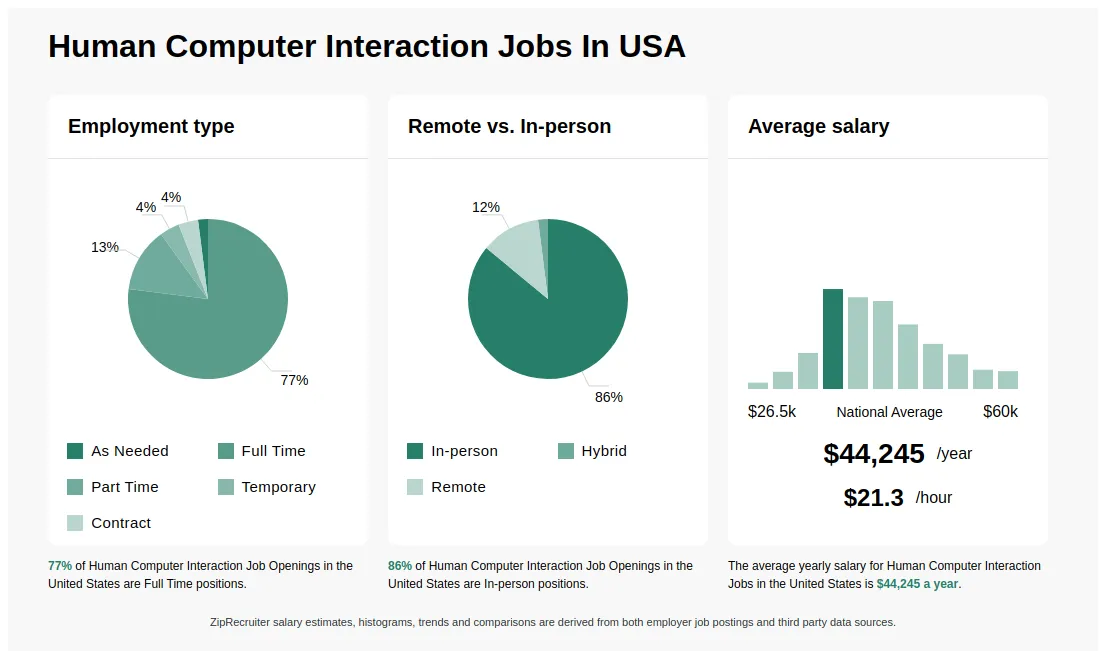
As of Aug 7, 2026, the average yearly pay for human computer interaction in the United States is $44,245.00, according to ZipRecruiter salary data. Most workers in this role earn between $37,500.00 and $48,000.00 per year, depending on experience, location, and employer.

What are the key skills and qualifications needed to thrive in human computer interaction?

To thrive in Human Computer Interaction, you need a strong background in usability principles, user research, and experience design, often supported by a degree in HCI, computer science, or a related field. Familiarity with prototyping tools (like Figma, Sketch, or Adobe XD), user testing platforms, and understanding of accessibility standards are crucial. Strong analytical thinking, creativity, and excellent communication skills help professionals excel in this collaborative, user-centered environment. These competencies enable the creation of intuitive, effective interactive systems that meet both user needs and organizational goals.

What is a human computer interaction?

A Human-Computer Interaction (HCI) job focuses on designing and improving the interaction between people and technology. Professionals in this field work on creating user-friendly interfaces, enhancing usability, and researching how humans engage with digital systems. Their roles often include UX design, usability research, software development, and accessibility improvements. HCI jobs are common in industries like tech, healthcare, gaming, and education, where optimizing user experience is critical.

Is human computer interaction in demand?

Human Computer Interaction (HCI) is a growing field with increasing demand across industries such as technology, healthcare, and education. Professionals in HCI with skills in user experience design, usability testing, and interaction design are sought after as organizations prioritize user-centered products and services.

What does a human computer interaction professional do?

Human Computer Interaction professionals commonly engage in user research, design user flows and wireframes, conduct usability testing, and analyze user data to refine digital interfaces. They often collaborate closely with software engineers, product managers, and graphic designers to ensure the end product is both functional and user-friendly. Regular activities can include organizing focus groups, creating interactive prototypes, and presenting research findings to stakeholders. This role is highly iterative, requiring adaptability and frequent communication with diverse teams throughout the design and development process.

Is human computer interaction a good career?

Human Computer Interaction (HCI) is a growing field that focuses on designing user-friendly interfaces and improving user experience. It often requires skills in psychology, design, and programming, and offers opportunities in technology, research, and product development. The career can be rewarding for those interested in combining technology with human-centered design.

What can I do with a human computer interaction degree?

A human computer interaction degree prepares individuals for roles such as user experience designer, usability analyst, interaction designer, or user researcher. These roles involve designing and improving digital interfaces, conducting user testing, and applying skills in psychology, design, and technology to create user-friendly products.
More about Human Computer Interaction jobs
What cities are hiring for Human Computer Interaction jobs? Cities with the most Human Computer Interaction job openings:
What are the most commonly searched types of Human Computer Interaction jobs? The most popular types of Human Computer Interaction jobs are:
What states have the most Human Computer Interaction jobs? States with the most job openings for Human Computer Interaction jobs include:
Infographic showing various Human Computer Interaction job openings in the United States as of August 2026, with employment types broken down into 14% Internship, and 86% Full Time. Highlights an 71% In-person, and 29% Remote job distribution, with an average salary of $44,245 per year, or $21.3 per hour.

LTVS Human Factors Engineer (All Levels)

Astrolab

Hawthorne, CA

Full-time

Medical, Dental, Vision, Retirement, PTO

Re-posted 27 days ago


Job description

Venturi Astrolab, Inc. (Astrolab) is pioneering new ways to explore and operate on distant planetary bodies. We are singularly focused on designing, building, and operating a fleet of multi-purpose commercial planetary rovers to extend and enhance humanity's presence in the solar system. We are seeking motivated, creative, and exceptional people to join our world-class team.   
As a Human Factors Engineer supporting the NASA Lunar Terrain Vehicle Services (LTVS) within the Extravehicular Activity and Human Surface Mobility Program (EHP), you will champion the human-centered design of Astrolab's FLEX-LTV, which will be used by Artemis Crew to traverse and explore the lunar environment. You will work closely with cross-disciplinary teams including Systems Engineering & Integration (SEI), Subsystem Responsible Engineers (REs), Crew Accommodations, User Interface (UI) Designers, Simulation & Training, and Operators/Astronauts to ensure that human safety, performance, and usability are engrained in the LTV design. You will report to the Astrolab Human Systems Integration (HSI) Lead under the Program Management Office (PMO). 
  • Carry out the HSI Plan across the development lifecycle in support of a safe & efficient user experience (UX) for our astronauts 
  • Work with our partners at Axiom Space to align the LTV design to suited crew capabilities & limitations while prioritizing safety, operational effectiveness, and crew time efficiency 
  • Collaborate with engineers & designers to optimize for suited crew use of LTV displays, controls, and mechanical interfaces 
  • Coordinate cross-disciplinary input & testing of LTV Crew Task Lighting to ensure the necessary visual access of all visual targets according to crew procedures and mission objectives 
  • Utilize Figma and other rapid prototyping tools to produce interactive graphical user interface (GUI) wireframes and mockups in alignment with Artemis GUI standards and commonality 
  • Conduct human factors engineering analyses and evaluations (e.g., Task Analysis (TA), Human Error Analysis (HEA), Human-in-the-Loop (HITL) Testing, Crew Operational Loads, Risk Assessments, etc.) and process findings for design and/or operational impacts 
  • Support simulation & training events with astronauts and representative participants using Astrolab test artifacts located at Odyssey Space Research and the Texas A&M Space Institute 
  • Manage, adjudicate, and track the flow of human factors design feedback/concerns from ticket creation through design unit implementation in compliance with human systems requirements 
  • Assist SEI efforts in executing the Verification, Validation, & Certification Plan as it pertains to the closure of human systems requirements and total-system human-rating 
  • Inform and attend cadenced discussions with NASA to share LTV development progress and review key decisions/changes 
  • Update and maintain technical documentation, including contractual HSI deliverables to NASA
Basic Qualifications
  •  Bachelor's degree in Human Factors, Human-Computer Interaction, Human-Centered Design, Ergonomics, Biomechanics, Psychology, Industrial Design, or a related field 
  •  2+ years of experience in human factors engineering, human systems integration, or UI/UX development, including user research and usability testing 
  •  Knowledge of human factors standards such as NASA-STD-3001, MIL-STD-1472, FAA HF-STD-001, or similar industry standards 
  •  Knowledge of systems engineering or project management processes, tools, and methodologies 
Preferred Qualifications
  •  Graduate degree in Human Factors, Human-Computer Interaction, Human-Centered Design, Ergonomics, Biomechanics, Psychology, Industrial Design, or a related field 
  •  Experience in human spaceflight or another regulated or safety-critical industry 
  •  Experience in space architecture, bioastronautics, aerospace physiology, optical engineering, vehicle cabin or interior development, or extreme environment analogs 
  •  Knowledge of extravehicular activity (EVA) systems, including pressurized suits, EVA tools, or related technologies 
  •  Knowledge of design thinking, rapid prototyping, or iterative product development methodologies
  • Join a team of best-in-class engineers building the foundation of planetary surface exploration
  • Equity ownership in the company
  • Comprehensive health benefits, including medical, dental, vision, and mental health support
  • 401(k) plan with company match
  • Flexible PTO and parental leave
  • Home office set up reimbursement
  • Fully flexible and remote friendly work environment
  • Weekly lunch stipend, plus complimentary snacks and beverages on-site
  • Once a month social hour on-site with food and drinks