The HealthCare Ombudsman/Mediator functions as a trained alternative dispute professional offering patients, family members, staff and providers a conflict management program to resolve patient ...
The HealthCare Ombudsman/Mediator functions as a trained alternative dispute professional offering patients, family members, staff and providers a conflict management program to resolve patient ...

Healthcare Attorney
San Diego, CA · Remote
$125K - $180K/yr
Represent healthcare clients in litigation-related matters with a primary emphasis on mediation ... arbitration, and other dispute resolution proceedings. * Counsel health plans, hospitals, and ...
Quick apply
Healthcare Attorney
San Diego, CA · Remote
$125K - $180K/yr
Represent healthcare clients in litigation-related matters with a primary emphasis on mediation ... arbitration, and other dispute resolution proceedings. * Counsel health plans, hospitals, and ...
Circuit Mediator
San Francisco, CA · On-site
$147K - $209K/yr
... health and life insurance plans. Dental, vision, flexible spending account, long-term care plans ... mediation process and how the experience has prepared you for this position. 3. Describe a ...
New
Circuit Mediator
San Francisco, CA · On-site
$147K - $209K/yr
... health and life insurance plans. Dental, vision, flexible spending account, long-term care plans ... mediation process and how the experience has prepared you for this position. 3. Describe a ...
New

Medical Malpractice / Healthcare Liability Defense Attorney
Atlanta, GA · Hybrid
$120K - $150K/yr
Participate in witness preparation, expert development, hearings, mediations, and trials * Collaborate with clients, insurers, risk management professionals, and healthcare administrators on defense ...
Quick apply
Medical Malpractice / Healthcare Liability Defense Attorney
Atlanta, GA · Hybrid
$120K - $150K/yr
Participate in witness preparation, expert development, hearings, mediations, and trials * Collaborate with clients, insurers, risk management professionals, and healthcare administrators on defense ...
Medical Malpractice / Healthcare Liability Defense Attorney
Charlotte, NC · On-site
$120K - $150K/yr
... mediation, and trial • Analyze medical records and work with expert witnesses and consulting ... healthcare administrators on defense strategies • Assist with regulatory investigations and ...
Medical Malpractice / Healthcare Liability Defense Attorney
Charlotte, NC · On-site
$120K - $150K/yr
... mediation, and trial • Analyze medical records and work with expert witnesses and consulting ... healthcare administrators on defense strategies • Assist with regulatory investigations and ...
Circuit Mediator
San Francisco, CA · On-site
$147K - $209K/yr
... health and life insurance plans. Dental, vision, flexible spending account, long-term care plans ... mediation process and how the experience has prepared you for this position. 3. Describe a ...
New
Quick apply
Circuit Mediator
San Francisco, CA · On-site
$147K - $209K/yr
... health and life insurance plans. Dental, vision, flexible spending account, long-term care plans ... mediation process and how the experience has prepared you for this position. 3. Describe a ...
New

Health Care Counselor
Utica, NY · On-site
$37K/yr
Heavily subsidized Health Insurance with co-pays. * Vision and Dental insurance. * Flexible ... Mediation, negotiation, advocacy, planning, community networking, innovation, oral and written ...
Quick apply
Health Care Counselor
Utica, NY · On-site
$37K/yr
Heavily subsidized Health Insurance with co-pays. * Vision and Dental insurance. * Flexible ... Mediation, negotiation, advocacy, planning, community networking, innovation, oral and written ...

Healthcare Provider
Glennallen, AK · On-site
$118K - $153K/yr
Communicates professionally and effectively with patients, families, and healthcare team members to ... Subject to CRHM grievance and mediation policies for contract disputes or terminations.
Healthcare Provider
Glennallen, AK · On-site
$118K - $153K/yr
Communicates professionally and effectively with patients, families, and healthcare team members to ... Subject to CRHM grievance and mediation policies for contract disputes or terminations.
Healthcare Provider
Glennallen, AK · On-site
$118K - $153K/yr
Communicates professionally and effectively with patients, families, and healthcare team members to ... Subject to CRHM grievance and mediation policies for contract disputes or terminations.
Quick apply
Healthcare Provider
Glennallen, AK · On-site
$118K - $153K/yr
Communicates professionally and effectively with patients, families, and healthcare team members to ... Subject to CRHM grievance and mediation policies for contract disputes or terminations.
Healthcare Provider
Glennallen, AK · On-site
$118K - $153K/yr
Category Healthcare Description Physician Assistant (PA) / Nurse Practitioner (NP) Position Summary ... Subject to CRHM grievance and mediation policies for contract disputes or terminations. Full-Time ...
Healthcare Provider
Glennallen, AK · On-site
$118K - $153K/yr
Category Healthcare Description Physician Assistant (PA) / Nurse Practitioner (NP) Position Summary ... Subject to CRHM grievance and mediation policies for contract disputes or terminations. Full-Time ...
Healthcare Provider
Glennallen, AK · On-site
$118K - $153K/yr
Category Healthcare Description Physician Assistant (PA) / Nurse Practitioner (NP) Position Summary ... Subject to CRHM grievance and mediation policies for contract disputes or terminations. Full-Time ...
Healthcare Provider
Glennallen, AK · On-site
$118K - $153K/yr
Category Healthcare Description Physician Assistant (PA) / Nurse Practitioner (NP) Position Summary ... Subject to CRHM grievance and mediation policies for contract disputes or terminations. Full-Time ...
Healthcare Provider
Glennallen, AK · On-site
$118K - $153K/yr
Category Healthcare Description Physician Assistant (PA) / Nurse Practitioner (NP) Position Summary ... Subject to CRHM grievance and mediation policies for contract disputes or terminations. Full-Time ...
Healthcare Provider
Glennallen, AK · On-site
$118K - $153K/yr
Category Healthcare Description Physician Assistant (PA) / Nurse Practitioner (NP) Position Summary ... Subject to CRHM grievance and mediation policies for contract disputes or terminations. Full-Time ...

... Healthcare, Telecommunications, Hospitality, Pharmaceuticals, Banking & Financial Services ... Identify mediation trends and adhere to best conflict resolution practices. * Have a strong ...
... Healthcare, Telecommunications, Hospitality, Pharmaceuticals, Banking & Financial Services ... Identify mediation trends and adhere to best conflict resolution practices. * Have a strong ...

Health Care Litigation Attorney
Sacramento, CA · Hybrid
$200K - $275K/yr
Participate in mediations, arbitrations, and trial proceedings * Conduct in-depth legal research and monitor developments in health care law and compliance * Manage multiple active matters while ...
Quick apply
Health Care Litigation Attorney
Sacramento, CA · Hybrid
$200K - $275K/yr
Participate in mediations, arbitrations, and trial proceedings * Conduct in-depth legal research and monitor developments in health care law and compliance * Manage multiple active matters while ...
Healthcare Construction Superintendent
Dallas, TX · On-site
$115K - $160K/yr
Act as mediator for subcontractor/supplier and staff-related issues. Administer first aid when ... Description Lead and manage healthcare construction projects from start to finish, ensuring quality ...
Healthcare Construction Superintendent
Dallas, TX · On-site
$115K - $160K/yr
Act as mediator for subcontractor/supplier and staff-related issues. Administer first aid when ... Description Lead and manage healthcare construction projects from start to finish, ensuring quality ...
Healthcare Litigation Attorney
Boston, MA · On-site
Healthcare Litigation Attorney Boston law firm Krokidas & Bluestein LLP , a premier boutique firm ... Litigation in state and federal courts, as well as mediation and arbitration of disputes;
Healthcare Litigation Attorney
Boston, MA · On-site
Healthcare Litigation Attorney Boston law firm Krokidas & Bluestein LLP , a premier boutique firm ... Litigation in state and federal courts, as well as mediation and arbitration of disputes;
... Healthcare, Telecommunications, Hospitality, Pharmaceuticals, Banking & Financial Services ... Identify mediation trends and adhere to best conflict resolution practices. * Have a strong ...
... Healthcare, Telecommunications, Hospitality, Pharmaceuticals, Banking & Financial Services ... Identify mediation trends and adhere to best conflict resolution practices. * Have a strong ...
... Healthcare, Telecommunications, Hospitality, Pharmaceuticals, Banking & Financial Services ... Identify mediation trends and adhere to best conflict resolution practices. * Have a strong ...
... Healthcare, Telecommunications, Hospitality, Pharmaceuticals, Banking & Financial Services ... Identify mediation trends and adhere to best conflict resolution practices. * Have a strong ...
... Healthcare, Telecommunications, Hospitality, Pharmaceuticals, Banking & Financial Services ... Identify mediation trends and adhere to best conflict resolution practices. * Have a strong ...
... Healthcare, Telecommunications, Hospitality, Pharmaceuticals, Banking & Financial Services ... Identify mediation trends and adhere to best conflict resolution practices. * Have a strong ...
... Healthcare, Telecommunications, Hospitality, Pharmaceuticals, Banking & Financial Services ... Identify mediation trends and adhere to best conflict resolution practices. * Have a strong ...
... Healthcare, Telecommunications, Hospitality, Pharmaceuticals, Banking & Financial Services ... Identify mediation trends and adhere to best conflict resolution practices. * Have a strong ...
Healthcare Mediator information
See salary details
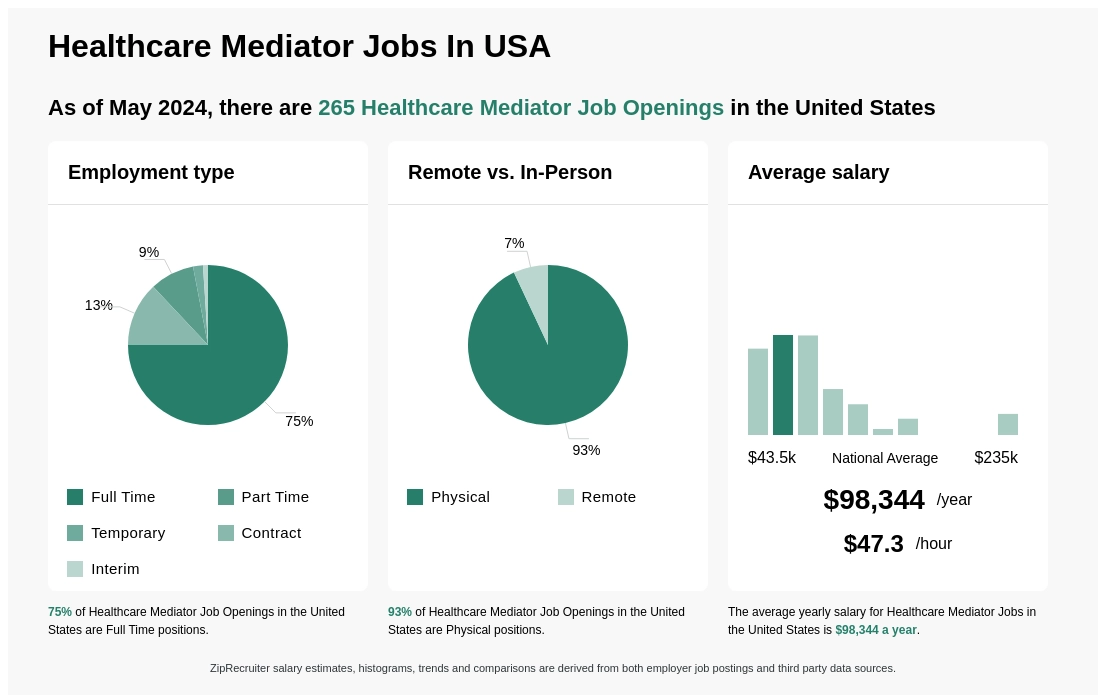
$43.5K - $60.9K
22% of jobs
$63.3K is the 25th percentile. Wages below this are outliers.
$60.9K - $78.3K
25% of jobs
The median wage is $80.9K / yr.
$78.3K - $95.7K
25% of jobs
$101.7K is the 75th percentile. Wages above this are outliers.
$95.7K - $113.1K
11% of jobs
$113.1K - $130.5K
7% of jobs
$130.5K - $148K
1% of jobs
$148K - $165.4K
4% of jobs
$165.4K - $182.8K
0% of jobs
$182.8K - $200.2K
0% of jobs
$200.2K - $217.6K
0% of jobs
$217.6K - $235K
5% of jobs
$43.5K
$98.3K
$235K
How much do healthcare mediator jobs pay per year?
As of Sep 12, 2026, the average yearly pay for healthcare mediator in the United States is $98,344.00, according to ZipRecruiter salary data. Most workers in this role earn between $65,000.00 and $107,000.00 per year, depending on experience, location, and employer.
What is a healthcare mediator?
A Healthcare Mediator helps resolve conflicts between patients, healthcare providers, and insurers by facilitating communication and finding mutually acceptable solutions. They work to reduce misunderstandings, improve patient satisfaction, and ensure fair treatment. Their role often involves negotiating medical bills, clarifying healthcare policies, and addressing concerns about care quality. Mediators must remain neutral and confidential while guiding discussions to achieve positive outcomes.
What are the key skills and qualifications needed to thrive as a healthcare mediator?
To thrive as a Healthcare Mediator, you need a background in conflict resolution, healthcare systems knowledge, and often a degree in a related field such as healthcare administration, social work, or law. Certification in mediation or alternative dispute resolution (ADR) and familiarity with case management systems are highly beneficial. Exceptional communication, neutrality, cultural competence, and active listening are standout soft skills in this role. These abilities are crucial for successfully navigating sensitive disputes, fostering understanding, and achieving positive outcomes for patients, families, and healthcare professionals.
What are the most common challenges faced by healthcare mediators on the job?
Healthcare Mediators often encounter emotionally charged situations where patients, families, and providers have differing perspectives on care or treatment decisions. Managing confidentiality, balancing multiple stakeholders’ interests, and facilitating productive conversations amid stress are frequent challenges in this role. Success depends on remaining impartial while guiding parties toward common ground and mutually agreeable solutions. Developing strong relationships with hospital staff and maintaining ongoing professional development are also important to address the evolving complexities in healthcare mediation.
More about Healthcare Mediator jobs
What cities are hiring for Healthcare Mediator jobs?
Cities with the most Healthcare Mediator job openings:
What are the most commonly searched types of Healthcare Mediator jobs?
The most popular types of Healthcare Mediator jobs are:
What states have the most Healthcare Mediator jobs?
States with the most job openings for Healthcare Mediator jobs include:
What are popular job titles related to Healthcare Mediator jobs?
For Healthcare Mediator jobs, the most frequently searched job titles are:

Health Care Ombudsman Mediator Specialist VI
Walnut Creek, CA • On-site
Kaiser Permanente
• Health Care and Social Assistance • 10K+ employees10,000+ employees
Other
Posted 16 days ago
Kaiser Permanente rating

8.2
Based on 929 frontline employees who took The Breakroom Quiz
Job description
Job Summary:
#J-18808-LjbffrThe HealthCare Ombudsman/Mediator functions as a trained alternative dispute professional offering patients, family members, staff and providers a conflict management program to resolve patient/ provider health care disputes early and reducing the costs of health care dispute resolution. Serves as a trusted and informal information resource, communication channel, complaint handler, facilitator, consultant and practitioner for dispute resolution. Acts to seek fair and equitable solutions to patient/provider problems and for suggesting dispute resolution processes for addressing and managing conflicts and for policy and procedural changes. Brings issues to senior leadership to address care delivery improvement efforts. Promotes effective relationships/communication between patients and providers.
Essential Responsibilities:- Promotes learning in others by communicating information and providing advice to drive projects forward; builds collaborative, cross-functional relationships. Solicits and acts on performance feedback; provides actionable feedback to others, including upward feedback to leadership; influences, mentors, and coaches team members. Practices self-leadership; creates, evaluates, and responds to the strengths and weaknesses of self and unit or team members. Leads the adaptation to competing demands and new responsibilities; adapts to and learns from change, challenges, and feedback. Fosters open dialogue amongst team members.
- Drives the execution of multiple work streams by identifying member and operational needs; translates business strategy into actionable business requirements; develops and updates new procedures and policies. Gains cross-functional support for objectives and priorities; determines and carries out processes and methodologies; solves highly complex issues; escalates and resolves issues as appropriate; sets standards and measures progress. Develops work plans to meet business priorities and deadlines; coordinates, obtains and distributes resources. Removes obstacles that impact performance; guides performance and develops contingency plans accordingly; influences the completion of project tasks by others.
- Facilitates a fair, open, and creative atmosphere by: ensuring effective communication and collaboration with key stakeholders at all levels of the organization, including reporting to leaders at the highest levels (e.g., Senior Vice Presidents, Chief Operating Officers, Area Medical Directors, Executive Legal Attorneys); maintaining strict confidentiality and discretion and serving as a role model emphasizing the importance of confidentiality to all stakeholders (e.g., patients, physicians, executives, KP staff); fostering trusting relationships and acting as a champion for the diverse and complex needs of stakeholders across the organizational landscape; developing collaborative relationships within the Medical Centers, Local, Regional, and National departments and working with stakeholders across all levels of the organization (including those at the highest levels) in order to resolve conflicts, and address highly emotional situations; fostering strategic partnerships with senior and executive leadership to consult and influence the development and refinement of key priorities and strategy; and initiating contact with other appropriate Local, Regional, Legal, and/or National departments as necessary (e.g., Risk, Quality).
- Serves as a conflict resolution expert following unanticipated adverse medical outcomes by: sharing successful practices and disseminating learning in collaboration with Local, Regional, and National Patient Safety and Risk Management functions; leveraging a deep understanding and comprehension of complex clinical and medical information to effectively assess and identify potential issues or conflicts (e.g., staff/provider rounds, communicating with health care teams and/or administration to ensure adverse medical outcomes of care are addressed); receiving referrals for conflict resolution and evaluating the appropriate method of resolution (e.g., shuttle diplomacy, mediation, coaching) and/or referring or escalating to appropriate department(s); deescalating highly complex, sensitive, and emotionally charged situations; working with key stakeholders to facilitate conflict resolution for executive leadership (e.g., Kaiser Foundation Health Plans, Permanente Medical Group) across all levels of the organization, locally, regionally and nationally; and acting as a consultant on physician disclosure discussions and complex patient case scenarios.
- Mediates physician/provider/patient conflict following unanticipated adverse medical outcomes by: facilitating communication between disputing parties; practicing narrative mediation which seeks to identify unique narratives each party holds related to a conflict; investigating issues thoroughly and impartially by gathering information and conducting informal fact-finding to understand the context of the dispute, assess the gravity of the situation, and address the concerns presented by all sides; identifying issues to allow parties to hear and understand one anothers perspectives and demonstrating empathy to assist in finding common ground between disputing parties; assisting parties in externalizing conflict to allow for greater constructive dialogue, while encouraging understanding and empathy towards one another; preparing all parties and facilitating protected, confidential, and privileged mediations; effectively translating and communicating complex medical information to stakeholders ensuring a high level of accuracy and clarity in order to facilitate decision-making and problem-solving in the dispute resolution processes; and remaining neutral, making independent recommendations, and assisting parties in identifying potential solutions to resolve their conflict.
- Supports education, training, and continuous organizational awareness related to the HealthCare Ombuds/Mediator (HCOM) program by: developing and implementing ongoing communications, programs, educational events, training, program awareness, and supporting materials (e.g., informational materials, videos, brochures); leveraging deep subject matter expertise to create and conduct trainings (e.g., on communication skills, communicating unanticipated adverse outcomes) for individuals and groups (administrative and clinical); serving as a consultant regarding conflict resolution for the development of provider, physician and leadership communication and education programs across KP; and acting as a trusted senior advisor to provide coaching and guidance to key stakeholders, providers, and executive leadership regarding complex issues (e.g., communication, dispute resolution strategies).
- Ensures the continued success of the HealthCare Ombuds/Mediator (HCOM) program by: developing and maintaining HCOM program in coordination with the HCOM Executive Sponsorship Committee (HESC), including charter, guidelines, HCOM goals, and promotional materials; facilitating and participating in a self-governance model (e.g., rotational leadership team, work groups, peer support, mentoring); establishing and maintaining an internal network of HCOM professionals to foster ongoing program improvement and development; working with senior and executive leadership within the organization, including hospital, health plan, and physician groups to promote and integrate the HCOM program locally, regionally, and nationally; and upholding the HCOM program core principles of neutrality, independence, confidentiality, and informality.
- Supports identification of patient safety, risk, and/or quality trends by: utilizing expert knowledge to identify patterns, trends, and systemic issues affecting patient care by analyzing patient, provider, and senior and executive leader concerns; providing insights and feedback based on identified patterns and trends to senior and executive management at the local, regional, and national levels; and proactively and persuasively driving identification and communication of patterns, trends, and systemic issues to senior and executive leadership, both across and upward in the organization.
- Ambiguity/Uncertainty Management
- Attention to Detail
- Business Knowledge
- Communication
- Critical Thinking
- Cross-Group Collaboration
- Decision Making
- Dependability
- Diversity, Equity, and Inclusion Support
- Drives Results
- Facilitation Skills
- Health Care Industry
- Influencing Others
- Integrity
- Learning Agility
- Organizational Savvy
- Problem Solving
- Short- and Long-term Learning & Recall
- Teamwork
- Topic-Specific Communication
- Acts with Compassion
- Autonomy
- Confidentiality
- Conflict Resolution
- Discretion
- External Health Care Compliance
- Health Care Operations
- Interpersonal Skills
- Legal Risk Management
- Managing Complexity
- Medical Information Comprehension
- Patient Safety
- Persuasion
- Quality Assurance and Effectiveness
- Relationship Building
- Stakeholder Management
- Trend Analysis
- Masters degree in Business, Counseling, Health Care, Social Work, or related field AND minimum ten (10) years of experience in a health care or clinical environment or a directly related field.
- Minimum five (5) years of experience in a leadership role with or without direct reports.
- Completion of a 40-hour or more mediator certification course or equivalent within three (3) months from date of hire/transfer.
10 years of social work or other hospital/healthcare experience
What Kaiser Permanente employees say
Pay
Benefits
Hours and flexibility
Workplace
Get the full story on Breakroom

About Kaiser Permanente
Sourced by ZipRecruiter
Industry
Health care and social assistance, hospitals and arts, entertainment, and recreation
Company size
10,000+ Employees
Headquarters location
Oakland, CA, US