Academic Forensic/Autopsy Pathologist Opening in Greenville, NC Raleigh 86mSeeking a forensic ... Established program with two forensic pathologists and one pathologist assistant* Center completes ...
Academic Forensic/Autopsy Pathologist Opening in Greenville, NC Raleigh 86mSeeking a forensic ... Established program with two forensic pathologists and one pathologist assistant* Center completes ...
Primary responsibility will be as a Forensic/Autopsy Pathologist. Additional responsibility includes teaching of fellows, residents, pathologists' assistants and medical students. * Opportunity for ...
Primary responsibility will be as a Forensic/Autopsy Pathologist. Additional responsibility includes teaching of fellows, residents, pathologists' assistants and medical students. * Opportunity for ...
... Forensic Pathology will be providing leadership and direction for the service and performing autopsies. Additional responsibility includes teaching of fellows, residents, pathologists' assistants and ...
... Forensic Pathology will be providing leadership and direction for the service and performing autopsies. Additional responsibility includes teaching of fellows, residents, pathologists' assistants and ...
Forensic Pathologist
North Charleston, SC · On-site
$275K/yr
The principal function and responsibility of an employee in this class is to assist the Coroner in ... Forensic pathologists in fellowship training may be considered eligible in lieu of above.
Forensic Pathologist
North Charleston, SC · On-site
$275K/yr
The principal function and responsibility of an employee in this class is to assist the Coroner in ... Forensic pathologists in fellowship training may be considered eligible in lieu of above.

The principal function and responsibility of an employee in this class is to assist the Coroner in ... Forensic pathologists in fellowship training may be considered eligible in lieu of above.
The principal function and responsibility of an employee in this class is to assist the Coroner in ... Forensic pathologists in fellowship training may be considered eligible in lieu of above.

Forensic Pathologist - Academic Facility - New Grads Welcome!
Greenville, NC · On-site
$200K - $300K/yr
Forensic Pathologist POSITION TYPE: Provider / Medical Specialist SPECIALTY UNIT: Forensic ... Direction of assistants in preparing bodies for autopsy including appropriate photography for ...
Quick apply
Forensic Pathologist - Academic Facility - New Grads Welcome!
Greenville, NC · On-site
$200K - $300K/yr
Forensic Pathologist POSITION TYPE: Provider / Medical Specialist SPECIALTY UNIT: Forensic ... Direction of assistants in preparing bodies for autopsy including appropriate photography for ...

Associate Medical Examiner (Forensic Pathologist)
Decatur, GA · On-site
$260K - $280K/yr
... assistant. The average caseload per pathologist, when fully staffed, is between 225-275 cases (not ... The statewide GBI Crime Laboratory also includes Forensic Impressions and Trace Evidence. The ...
Associate Medical Examiner (Forensic Pathologist)
Decatur, GA · On-site
$260K - $280K/yr
... assistant. The average caseload per pathologist, when fully staffed, is between 225-275 cases (not ... The statewide GBI Crime Laboratory also includes Forensic Impressions and Trace Evidence. The ...
Associate Medical Examiner (Forensic Pathologist)
Decatur, GA · On-site
$260K - $280K/yr
... assistant. The average caseload per pathologist, when fully staffed, is between 225-275 cases (not ... The statewide GBI Crime Laboratory also includes Forensic Impressions and Trace Evidence. The ...
Associate Medical Examiner (Forensic Pathologist)
Decatur, GA · On-site
$260K - $280K/yr
... assistant. The average caseload per pathologist, when fully staffed, is between 225-275 cases (not ... The statewide GBI Crime Laboratory also includes Forensic Impressions and Trace Evidence. The ...

Current work experience as a forensic pathologist or senior autopsy assistant in a morgue setting. Physical Requirements/Working Conditions * The employee must be able to move about 2/3 of the time ...
Current work experience as a forensic pathologist or senior autopsy assistant in a morgue setting. Physical Requirements/Working Conditions * The employee must be able to move about 2/3 of the time ...
Current work experience as a forensic pathologist or senior autopsy assistant in a morgue setting. Physical Requirements/Working Conditions * The employee must be able to move about 2/3 of the time ...
Current work experience as a forensic pathologist or senior autopsy assistant in a morgue setting. Physical Requirements/Working Conditions * The employee must be able to move about 2/3 of the time ...

Pathologists' Assistant - Medical Examiner's Office Wayne State University is searching for an ... Conducts medical research under direction of forensic pathologist or anthropologist. Analyzes or ...
Pathologists' Assistant - Medical Examiner's Office Wayne State University is searching for an ... Conducts medical research under direction of forensic pathologist or anthropologist. Analyzes or ...

Seeking a BE/BC Forensic Pathologist . Applicants must be board certified by the American Board of ... Direct assistants in body preparation and scene documentation • Perform autopsies and collect ...
Seeking a BE/BC Forensic Pathologist . Applicants must be board certified by the American Board of ... Direct assistants in body preparation and scene documentation • Perform autopsies and collect ...
Provide training to rotating medical students and Pathologists' Assistant students. Provides ... Conducts medical research under direction of forensic pathologist or anthropologist. Analyzes or ...
Provide training to rotating medical students and Pathologists' Assistant students. Provides ... Conducts medical research under direction of forensic pathologist or anthropologist. Analyzes or ...

The forensic fellowship is designed to furnish to an already trained pathologist the fundamental ... Assistant Medical Examiner. * Fellow participates in the departmental teaching and research ...
The forensic fellowship is designed to furnish to an already trained pathologist the fundamental ... Assistant Medical Examiner. * Fellow participates in the departmental teaching and research ...
Forensic Pathology Fellow 2028-2029
Houston, TX · On-site
$20/hr
The forensic fellowship is designed to furnish to an already trained pathologist the fundamental ... an Assistant Medical Examiner. Fellow participates in the departmental teaching and research ...
Forensic Pathology Fellow 2028-2029
Houston, TX · On-site
$20/hr
The forensic fellowship is designed to furnish to an already trained pathologist the fundamental ... an Assistant Medical Examiner. Fellow participates in the departmental teaching and research ...
The forensic fellowship is designed to furnish to an already trained pathologist the fundamental ... an Assistant Medical Examiner. Fellow participates in the departmental teaching and research ...
The forensic fellowship is designed to furnish to an already trained pathologist the fundamental ... an Assistant Medical Examiner. Fellow participates in the departmental teaching and research ...

Forensic/Autopsy Pathologist Opening in North CarolinaLocation: Greenville, North Carolina Raleigh ... Join two experienced forensic pathologists and a dedicated pathologist assistant Annual caseload ...
Forensic/Autopsy Pathologist Opening in North CarolinaLocation: Greenville, North Carolina Raleigh ... Join two experienced forensic pathologists and a dedicated pathologist assistant Annual caseload ...

Pathologist Assistant ASCP
Simpson, IL · On-site
$38.06/hr
ASCP - Pathologist Assistant (PA) Location: Near Naperville, Illinois MLR is seeking a part-time, ... No forensic or autopsy work involved. * Basic Life Support (BLS) certification required. If you are ...
Pathologist Assistant ASCP
Simpson, IL · On-site
$38.06/hr
ASCP - Pathologist Assistant (PA) Location: Near Naperville, Illinois MLR is seeking a part-time, ... No forensic or autopsy work involved. * Basic Life Support (BLS) certification required. If you are ...
Pathologist Assistant ASCP
Pinckneyville, IL · On-site
$38.06/hr
ASCP - Pathologist Assistant (PA) Location: Near Naperville, Illinois MLR is seeking a part-time, ... No forensic or autopsy work involved. * Basic Life Support (BLS) certification required. If you are ...
Pathologist Assistant ASCP
Pinckneyville, IL · On-site
$38.06/hr
ASCP - Pathologist Assistant (PA) Location: Near Naperville, Illinois MLR is seeking a part-time, ... No forensic or autopsy work involved. * Basic Life Support (BLS) certification required. If you are ...

... arrange and assist with specialized examinations (i.e., neuropathology & cardio-pathology ... FORENSIC MORTUARY TECHNICIAN - 52040 Qualifications 1. A four year high school diploma or its ...
... arrange and assist with specialized examinations (i.e., neuropathology & cardio-pathology ... FORENSIC MORTUARY TECHNICIAN - 52040 Qualifications 1. A four year high school diploma or its ...
Forensic Pathologist Assistant information
See salary details
$14.66 - $21.50
5% of jobs
$21.50 - $28.34
7% of jobs
$28.34 - $35.18
5% of jobs
$35.18 - $42.02
6% of jobs
$42.45 is the 25th percentile. Wages below this are outliers.
$42.02 - $48.86
9% of jobs
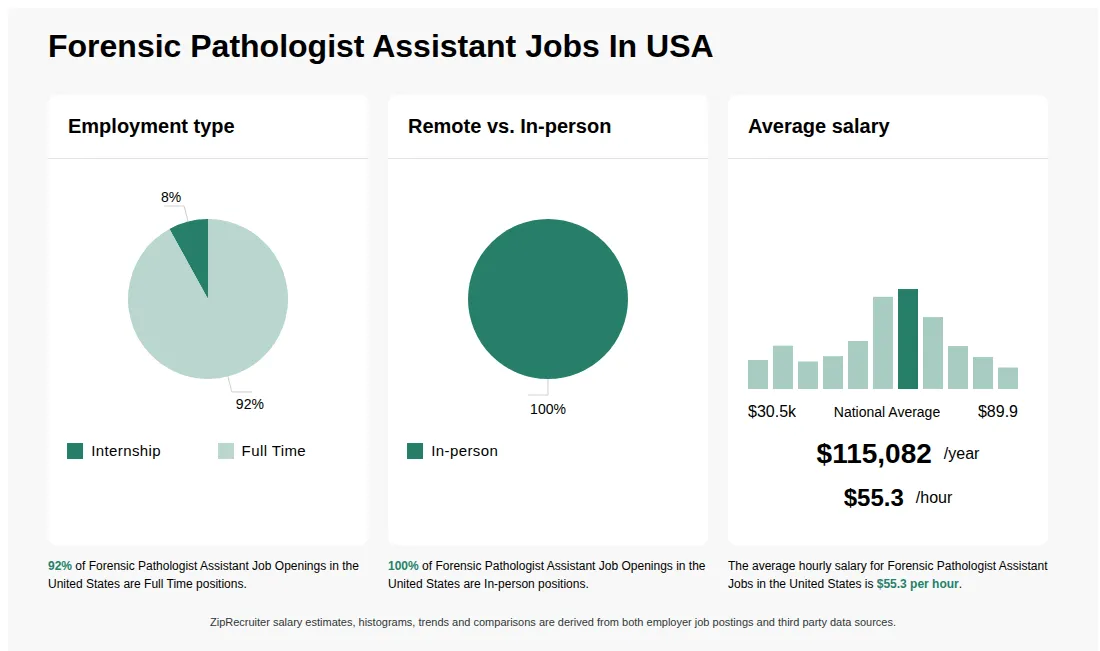
The median wage is $55.30 / hr.
$48.86 - $55.70
18% of jobs
$55.70 - $62.54
19% of jobs
$64.91 is the 75th percentile. Wages above this are outliers.
$62.54 - $69.38
14% of jobs
$69.38 - $76.22
7% of jobs
$76.22 - $83.06
5% of jobs
$83.06 - $89.90
3% of jobs
$14
$55
$89
How much do forensic pathologist assistant jobs pay per hour?
As of Sep 7, 2026, the average hourly pay for forensic pathologist assistant in the United States is $55.33, according to ZipRecruiter salary data. Most workers in this role earn between $43.51 and $67.31 per hour, depending on experience, location, and employer.
What is a forensic pathologist assistant?
Forensic Pathologist Assistants are trained professionals who support forensic pathologists in the examination of bodies to determine the cause and manner of death, particularly in cases involving suspicious or unexplained circumstances. Their duties include assisting in autopsies, preparing and maintaining detailed reports, collecting and preserving evidence, and sometimes testifying in court. They work closely with law enforcement, medical examiners, and other forensic specialists to help provide critical information for legal investigations. These assistants require specialized education, typically a bachelor's degree in a related field, followed by specific on-the-job training.
What does a forensic pathologist assistant do?
A forensic pathologist assistant assists during autopsies and criminal investigations by collecting specimens for analysis in a laboratory. In this career, you often collect and photograph evidence on-site. Your duties also involve careful and thorough documentation to preserve the chain of evidence. You may work in the field, a morgue, or a laboratory setting. You are typically part of a team led by a medical examiner or coroner. Most forensic pathologist assistants find employment with local or state governments.
What skills and qualifications are needed to be a forensic pathologist assistant?
To thrive as a Forensic Pathologist Assistant, you need a solid background in biological sciences, experience in laboratory procedures, and typically an associate’s or bachelor’s degree in a relevant field. Familiarity with autopsy tools, laboratory instruments, and case management software is essential, and certification through the American Society for Clinical Pathology (ASCP) can be beneficial. Attention to detail, strong organizational skills, and the ability to communicate findings clearly are vital soft skills for this role. These capabilities ensure accurate, efficient support for forensic pathologists and contribute to reliable medico-legal investigations.
What are common challenges faced by forensic pathologist assistants in their daily work?
Forensic pathologist assistants often encounter emotionally challenging situations due to frequent exposure to traumatic cases, including homicides and accidental deaths. They must maintain meticulous attention to detail while assisting with autopsies, documenting findings, and managing sensitive evidence. Additionally, the role requires strict adherence to legal and ethical guidelines, which can be demanding in high-pressure or time-sensitive environments. Strong communication and collaboration with pathologists, law enforcement, and other medical professionals are essential to ensure accuracy and integrity throughout the investigative process.
What is the difference between Forensic Pathologist Assistant vs Forensic Autopsy Technician?
| Aspect | Forensic Pathologist Assistant | Forensic Autopsy Technician |
|---|---|---|
| Required Credentials | Associate degree, certification often preferred | High school diploma or equivalent, on-the-job training |
| Work Environment | Medical examiner offices, morgues, labs | Morgues, medical examiner offices, forensic labs |
| Job Responsibilities | Assist in autopsies, prepare reports, support pathologists | Assist with specimen collection, prepare bodies, maintain equipment |
While both roles support forensic autopsies, Forensic Pathologist Assistants typically have formal education and assist pathologists directly, whereas Forensic Autopsy Technicians focus on specimen handling and body preparation with less formal education.
Is it worth becoming a forensic pathologist assistant?
A forensic pathologist assistant supports medical examiners by preparing bodies, documenting findings, and assisting with autopsies, often requiring a relevant degree and certification. The role offers steady employment in forensic laboratories or medical examiner offices, with opportunities for specialization and advancement. It can be a rewarding career for those interested in forensic science and pathology, but it involves exposure to potentially disturbing scenes and irregular hours.
More about Forensic Pathologist Assistant jobs
What cities are hiring for Forensic Pathologist Assistant jobs?
Cities with the most Forensic Pathologist Assistant job openings:
What are the most commonly searched types of Forensic Pathologist jobs?
The most popular types of Forensic Pathologist jobs are:
What states have the most Forensic Pathologist Assistant jobs?
States with the most job openings for Forensic Pathologist Assistant jobs include:
What job categories do people searching Forensic Pathologist Assistant jobs look for?
The top searched job categories for Forensic Pathologist Assistant jobs are:

Other
Re-posted 3 days ago
Job description
Academic Forensic/Autopsy Pathologist Opening in Greenville, NCRaleigh 86mSeeking a forensic/autopsy pathologist. * Applicants should be board certified in AP or AP/CP and will be expected to obtain Forensic Pathology board certification within one year of hire. * Knowledge of principles, practices, techniques, and advances in the field of forensic pathology and medicolegal death investigation is preferred.* Established program with two forensic pathologists and one pathologist assistant* Center completes 600 medical examiner autopsies and 300 external examinations annually* Center also serves at the autopsy service for Medical Center, teaching hospital for School of Medicine, by completing 80-100 medical autopsies each year* Assistant or Associate Professor commensurate with qualifications* Experience RequiredJob Duties include:* Performing forensic autopsies and external examinations; performance of hospital autopsies* Reviewing investigative reports to determine jurisdiction.* Determination of cause and manner of death, and completion of death certificates* Preparation and completion of reports of findings in a timely manner* Provide expert witness testimony in court; consult with prosecution and defense attorneys in preparation for court proceedings* Participation in the education of medical students, pathology residents, and forensic pathology fellows

About Archway Physician Recruitment
Sourced by ZipRecruiter
Archway Physician Recruitment, located in Saint Louis, MO, US, is a leading company in the healthcare industry specializing in medical staffing. Their primary service is to recruit highly-qualified physicians and connect them with healthcare facilities in need. The company was grounded on principles of ensuring complete transparency, dedication, and ethical practices, which they maintain firmly as they continue to grow their operations. Archway Physician Recruitment's mission is to provide healthcare facilities with the highest caliber of medical professionals while also assisting the physicians in discovering ideal career opportunities. The company takes great pride in being recognized as a reliable and trusted organization in the healthcare industry.
Industry
Recruiting and staffing services
Company size
11 - 50 Employees
Headquarters location
Saint Louis, MO, US
Year founded
2013