1

Fish Processing Jobs in Alaska (NOW HIRING)

Fresh fish processing, handling and packaging. * Assist other Retreat staff with loading and unloading of supplies, luggage and guests from Retreat airplane, boats, and vehicles, as well as other ...

Fresh fish processing, handling and packaging. * Assist other Retreat staff with loading and unloading of supplies, luggage and guests from Retreat airplane, boats, and vehicles, as well as other ...

$21.26/hr

Independent judgment and performance is exercised in initiating and/or implementing hatchery projects, processes and schedules. Incumbents may supervise technical personnel. Fish Culturist II is ...

... fish processing equipment including but not limited to food grade conveyors, processing pumps, grinders and a variety of seafood processing equipment. This includes troubleshooting mechanical and ...

next page

Showing results 1-20

Fish Processing information

See Alaska salary details

$15

$27

$52

How much do fish processing jobs pay per hour?

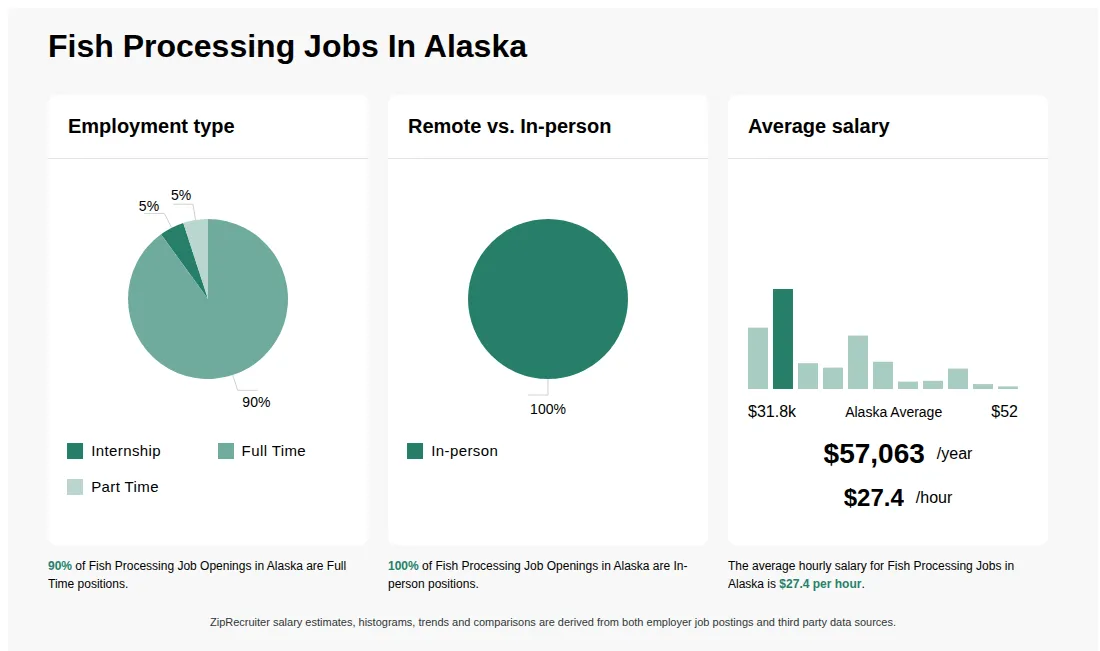
As of Jun 12, 2026, the average hourly pay for fish processing in Alaska is $27.43, according to ZipRecruiter salary data. Most workers in this role earn between $18.89 and $31.83 per hour, depending on experience, location, and employer.

What are the typical working conditions and hours for a Fish Processing job?

Fish Processing roles are commonly performed in cold, wet environments to maintain product freshness and safety, often requiring standing for extended periods and handling repetitive tasks. Shifts may vary, with early morning, late evening, or even overnight schedules depending on production demands and the seasonality of the fish industry. Teams are usually collaborative, as processing lines require coordination to keep up with workflow and meet strict deadlines. While the work can be physically demanding, it offers opportunities to gain industry experience that may lead to supervisory or specialized roles over time.

What is the highest paying fishing job?

The highest paying fishing jobs are often those involving offshore or deep-sea fishing, such as captain or master fisherman roles on commercial vessels, which can earn six-figure salaries. These positions typically require extensive experience, specialized skills, and certifications like STCW or USCG licenses, and often involve long hours at sea.

What is a Fish Processing job?

A Fish Processing job involves preparing and packaging fish for sale or distribution. Duties include cleaning, gutting, filleting, deboning, and freezing or smoking fish. Workers may operate machinery, inspect fish for quality, and ensure food safety standards are met. It is often physically demanding and takes place in cold or wet environments.

What are the key skills and qualifications needed to thrive in the Fish Processing position, and why are they important?

To thrive in a Fish Processing role, you need physical stamina, attention to detail, and basic knowledge of food safety and hygiene practices, often supported by a high school diploma or equivalent. Familiarity with filleting tools, automated processing machinery, and adherence to HACCP (Hazard Analysis and Critical Control Point) protocols or similar certifications are common requirements. Reliability, teamwork, and the ability to work efficiently under time constraints are valuable soft skills in this field. These capabilities are essential to maintain quality standards, ensure safety, and support fast-paced production environments in the seafood industry.

How much do seafood processors get paid?

Seafood processors typically earn an hourly wage ranging from $12 to $20, depending on experience, location, and the complexity of tasks. Entry-level positions may pay closer to minimum wage, while experienced workers or those with specialized skills can earn higher wages, often with opportunities for overtime. Certifications in food safety and machinery operation can also influence pay rates.

What skills do you need to be a fish processor?

Fish processors need strong attention to detail, good manual dexterity, and the ability to work in cold, wet environments. Basic knowledge of food safety standards and the use of processing equipment are also important skills for this role.
What are the most commonly searched types of Fish Processing jobs in Alaska? The most popular types of Fish Processing jobs in Alaska are:
What are popular job titles related to Fish Processing jobs in Alaska? For Fish Processing jobs in Alaska, the most frequently searched job titles are:
What job categories do people searching Fish Processing jobs in Alaska look for? The top searched job categories for Fish Processing jobs in Alaska are:
What cities in Alaska are hiring for Fish Processing jobs? Cities in Alaska with the most Fish Processing job openings:
Infographic showing various Fish Processing job openings in Alaska as of June 2026, with employment types broken down into 60% Full Time, 20% Part Time, 13% Temporary, and 7% Contract. Highlights an 100% In-person job distribution, with an average salary of $57,063 per year, or $27.4 per hour.
Fish and Wildlife Technician 3 (Data Entry and QA/QC Technician - PCN 11N26115)

Fish and Wildlife Technician 3 (Data Entry and QA/QC Technician - PCN 11N26115)

State of Alaska

Juneau, AK

$22.15/hr

Other

Posted 18 days ago


State Of Alaska rating

8.4

Company rating: 8.4 out of 10

Based on 73 frontline employees who took The Breakroom Quiz

2nd of 50 rated states


Job description

Job Description This position is open to Alaska Residents only. Please check our residency definition to determine if you qualify. The Alaska Department of Fish and Game, Division of Sport Fish is recruiting for a Fish and Wildlife Technician 3 located in Anchorage, Alaska.

What you will be doing: This 2-month position will work with data collected by our fish passage team, which is surveying more than 100 culverts this summer. You will perform data entry and quality control on the collected data; the data includes measurements, survey data, photographs and site sketches. The information is entered into a statewide database and is used to determine which culverts pose barriers to fish passage and should be removed or replaced.

Our mission, values, and culture: The mission of the Division of Sport Fish is to protect, maintain and improve the State's sport fisheries. Protecting and maintaining fish habitat is essential to that mission. Our fish passage improvement program aims to maintain or restore the stream connectivity that allows fish populations to flourish.

This position is vital to the success of the program. In terms of our values the Alaska Department of Fish & Game strives for a diverse and inclusive workforce where safety and wellbeing are paramount and employees at all levels promote a culture where everyone is valued, treated equitably, and treated respectfully. The benefits of joining our team: If you are self-disciplined with an eye for detail, and are interested in Alaska's fishery resources, we look forward to your application.

While an understanding of data collection and data entry is helpful, experience is not required, and training will be provided. This is a great opportunity to gain experience and maybe even begin a career with the Alaska Department of Fish and Game. The working environment you can expect: This position is based in Anchorage with great access to the Campbell Creek green belt and its walking and biking path.

You will be working with a dedicated team of professional biologists. The work requires long hours of sitting at a computer. Who we are looking for: We are interested in candidates who possess some or all of the following position specific competencies: Keen attention to detail.

Ability to work independently in a self-motivated and self-directed manner. Experience with data entry and QA/QC methods. To view the general description and example of duties for a Fish and Wildlife Technician 3 please go to the following link: https://www.governmentjobs.com/careers/Alaska/classspecs Special Note: This is a 2-month position

Minimum Qualifications High school graduation or the equivalent. AND Six months experience at the developmental level of fish and wildlife technician or aide. With the State of Alaska, this experience is equivalent to Fish and Wildlife Technician 2.

OR One year of technical laboratory and/or field experience involving fish or wildlife research, management, or habitat protection; as a commercial fisher, guide, or trapper; or a subsistence hunter or fisher. Substitutions: An additional six months of work experience involving fish, wildlife, outdoor manual labor, or in a laboratory may substitute for the high school graduation or equivalent. Bachelor of Science degree in fisheries, wildlife, or habitat protection may substitute for a maximum of two years of technical laboratory or field experience, involving fish or wildlife research, management, or habitat protection.

Special Requirements: Work may involve exposure to animals, insects, inclement weather, low level flying, travel by boat or skiff, or contact with drugs and chemicals. Housing may consist of bunkhouses, vessels, or wall tents. Positions are seasonal or temporary.

Special Note: "High school diploma equivalent" means one of the following: 1) a GED (general educational development); 2) completion of any basic adult education course equivalent to 480 class hours (16 weeks at 30 course hours per week); 3) acceptance in full standing by an accredited college or university; or 4) highest grade of school completed plus an amount of paid or volunteer experience that totals 12 years. Fields of study comparable to fisheries, wildlife or habitat protection include aquaculture, biology, ichthyology, microbiology, ornithology, and zoology. Additional Required Information REQUIRED DOCUMENTS If selected, please provide the following at the time of the interview: Three (3) references, including current phone numbers, two of which must be supervisors from recent employment.

Transcripts, if using education to meet minimum qualifications (unofficial copies are acceptable). A cover letter is NOT required for this position. Your complete application, including supplemental questions, will be used to determine which applicants will advance to the interview phase of the recruitment and selection process.

EDUCATION To verify education is being used to meet and/or support the required minimum qualifications/competences, you must fill in the Education section of the application. If you have not obtained a degree, please indicate the number of units completed. Copies of transcripts are required to verify educational credentials used to meet or support the minimum qualifications/competencies for a position and are required.

(Unofficial is okay; please ensure the institution/URL name is listed on the transcripts). SPECIAL INSTRUCTIONS FOR FOREIGN EDUCATION Education completed in foreign colleges or universities may be used to meet the above requirements, if applicable. If utilizing this education you must show that the education credentials have been submitted to a private organization that specializes in interpretation of foreign educational credentials and that such education has been deemed to be at least equivalent to that gained in conventional U.S

education programs; or an accredited U.S. state university reports the other institution as one whose transcript is given full value, or full value is given in subject areas applicable to the curricula at the state university. It is your responsibility to provide such evidence

WORK EXPERIENCE If using work experience not already documented in your application, also provide the employer's name, your job title, dates of employment, and whether full-or part-time. Applications will be reviewed to determine if the responses are supported and minimum qualifications are clearly met. If they are not, the applicant may not advance to the interview and selection phase of the recruitment.

NOTE: Attaching a resume or curriculum vitae is not an alternative to filling out the application in its entirety. Noting "see resume or CV" or any similar response on any portion of your application may lead to a determination your application is incomplete and removal from consideration for this job posting. MULTIPLE VACANCIES This recruitment may be used for more than one (1) vacancy.

The applicant pool acquired during this recruitment may be used for future vacancies for up to ninety (90) days after this recruitment closes. Interested applicants are encouraged to apply to each recruitment notice to ensure consideration for all vacancies. EEO STATEMENT The State of Alaska complies with Title I of the Americans with Disabilities Act (ADA).

Individuals with disabilities, who require accommodation, auxiliary aids or services, or alternative communication formats, please call 1-800-587-0430 or (907) 465-4095 in Juneau or TTY: Alaska Relay 711 or 1-800-770-8973 or correspond with the Division of Personnel & Labor Relations at: P.O. Box 110201, Juneau, AK 99811-0201. The State of Alaska is an equal opportunity employer

NOTICE If you choose to be contacted by email, please ensure your email address is correct on your application and that the spam filter will permit email from the 'govermentjobs.com' domains. For information on allowing emails from the 'governmentjobs.com' domains, visit the Lost Password Help page located at https://www.governmentjobs.com/OnlineApplication/User/ResetPassword. WORKPLACE ALASKA APPLICATION QUESTIONS & ASSISTANCE Questions regarding application submission or system operation errors should be directed to the Workplace Alaska hotline at 1-800-587-0430 (toll free) or (907) 465-4095 if you are located in the Juneau area

Requests for information may also be emailed torecruitment.services@alaska.gov. For applicant password assistance please visit: https://www.governmentjobs.com/OnlineApplication/User/ResetPassword Contact Information For specific information in reference to the position please contact the hiring manager: Kevin Keith, Habitat Biologist 4 Phone: (907) 267-2836 kevin.keith@alaska.gov


What State Of Alaska employees say

Pay

Benefits

Hours and flexibility

Workplace

Get the full story on Breakroom


State of Alaska logo

About State of Alaska

Sourced by ZipRecruiter

The State of Alaska is not a traditional company, but rather a governmental body responsible for running the state, the largest in the U.S. by area. This body's responsibilities include public utilities, healthcare, transportation, environmental protection, and public safety services among others. Designed to serve the interests of the Alaskan people, it was established in 1959 when Alaska was officially accepted as the 49th U.S. State. The official website, alaska.gov, is a comprehensive resource offering access to a multitude of departments, services, and information pertaining to the state.

Industry

Public administration

Company size

10,000+ Employees

Headquarters location

Anchorage, AK, US

Year founded

1959

Social media