1

Environmental Data Scientist Jobs (NOW HIRING)

... National Environmental Satellite, Data, and Information Service (NESDIS), National Centers for ... Mathematics, statistics, computer science, data science or field directly related to the position.

New

... National Environmental Satellite, Data, and Information Service (NESDIS), National Centers for ... Mathematics, statistics, computer science, data science or field directly related to the position.

New

... National Environmental Satellite, Data, and Information Service (NESDIS), National Centers for ... Mathematics, statistics, computer science, data science or field directly related to the position.

... National Environmental Satellite, Data, and Information Service (NESDIS), National Centers for ... Mathematics, statistics, computer science, data science or field directly related to the position.

New

... National Environmental Satellite, Data, and Information Service (NESDIS), National Centers for ... Mathematics, statistics, computer science, data science or field directly related to the position.

... National Environmental Satellite, Data, and Information Service (NESDIS), National Centers for ... Mathematics, statistics, computer science, data science or field directly related to the position.

New

... National Environmental Satellite, Data, and Information Service (NESDIS), National Centers for ... Mathematics, statistics, computer science, data science or field directly related to the position.

New

Experience with cloud-based environments (e.g., AWS) or Linux * Strong communication skills and the ... data science solutions in a regulatory environment (including but not limited to insurance, healt ...

next page

Showing results 1-20

Environmental Data Scientist information

See salary details

$37.5K

$122.7K

$196.5K

How much do environmental data scientist jobs pay per year?

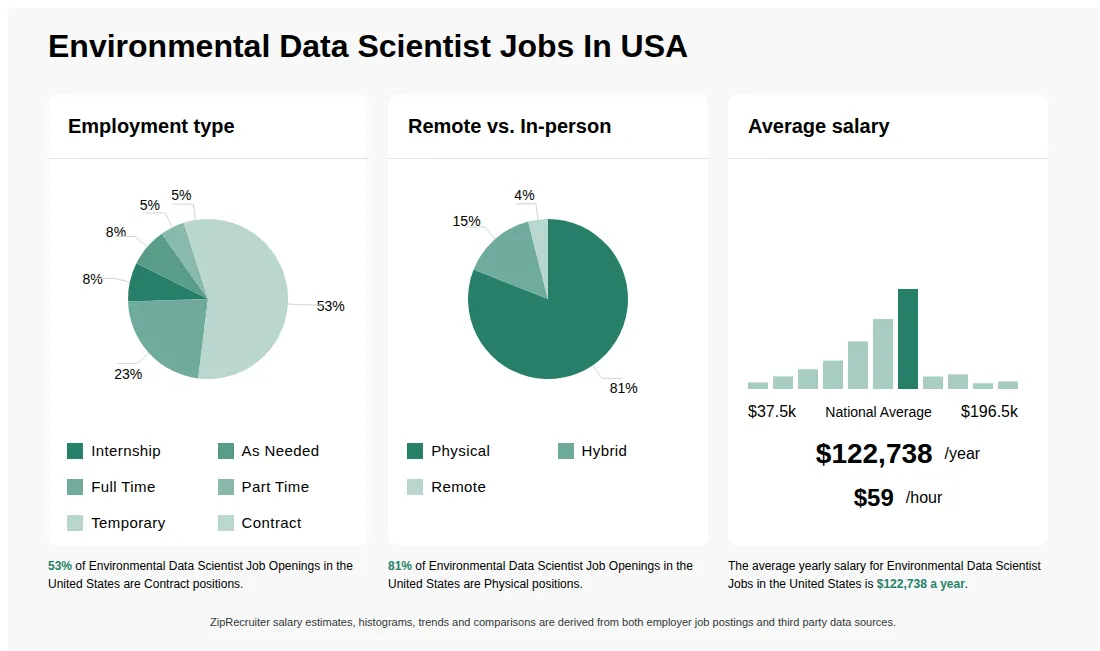
As of Jul 23, 2026, the average yearly pay for environmental data scientist in the United States is $122,738.00, according to ZipRecruiter salary data. Most workers in this role earn between $98,500.00 and $136,000.00 per year, depending on experience, location, and employer.

Is 40 too late for data science?

Environmental Data Scientists can enter the field at any age, as skills in programming, statistics, and domain knowledge are more important than age. Many professionals transition into data science later in their careers by gaining relevant certifications or training. Age should not be a barrier if you develop the necessary technical skills and experience.

What are the key skills and qualifications needed to thrive in the Environmental Data Scientist position, and why are they important?

Environmental Data Scientists typically require a solid background in statistics, environmental science, and data analysis, often supported by a relevant bachelor’s or master’s degree. Familiarity with programming languages such as Python or R, experience using GIS software, and knowledge of data visualization tools are key, while certifications in data science or environmental analysis can be advantageous. Strong problem-solving abilities, attention to detail, and effective communication skills help professionals articulate complex findings and collaborate across multidisciplinary teams. These capabilities enable Environmental Data Scientists to reliably interpret large datasets and provide actionable insights for environmental decision-making.

What does an environmental data scientist do?

An environmental data scientist analyzes environmental data to identify patterns, assess environmental risks, and support decision-making. They use statistical tools, programming languages like Python or R, and GIS software to interpret data related to climate, pollution, and natural resources, often working in research or consulting environments.

Is there a high demand for environmental scientists?

Environmental Data Scientists are in high demand due to increasing focus on sustainability, climate change, and environmental regulations. The field offers growth opportunities in government agencies, research institutions, and private companies, often requiring skills in data analysis, GIS, and environmental modeling.

Can data scientists make $300k?

Environmental Data Scientists can potentially earn $300,000 or more, especially with extensive experience, advanced skills in machine learning and statistical analysis, and work in high-paying industries or senior roles. However, such salaries are typically achieved through senior positions, specialized expertise, or in competitive markets, and are not common for entry-level roles.

What does a typical workday look like for an Environmental Data Scientist?

A typical workday for an Environmental Data Scientist involves gathering and cleaning environmental datasets, conducting statistical analyses or modeling, and visualizing results for various stakeholders. You may collaborate with environmental engineers, researchers, and policy makers to interpret data trends and support ecological assessments or sustainability initiatives. Regular tasks often include coding, preparing reports, and presenting findings to team members or clients. The role blends independent analytical work with teamwork, making communication and project management skills essential for success.

What is an Environmental Data Scientist job?

An Environmental Data Scientist analyzes large datasets related to environmental issues, such as climate change, pollution, and biodiversity. They use statistical models, machine learning, and geospatial analysis to extract insights and support decision-making. Their work helps organizations develop sustainable solutions and policies based on data-driven evidence. Environmental Data Scientists often collaborate with scientists, policymakers, and industry professionals to address ecological challenges.

What cities are hiring for Environmental Data Scientist jobs? Cities with the most Environmental Data Scientist job openings:
What are the most commonly searched types of Environmental Data Scientist jobs? The most popular types of Environmental Data Scientist jobs are:
What states have the most Environmental Data Scientist jobs? States with the most job openings for Environmental Data Scientist jobs include:
Infographic showing various Environmental Data Scientist job openings in the United States as of July 2026, with employment types broken down into 1% As Needed, 84% Full Time, 11% Part Time, 1% Temporary, and 3% Contract. Highlights an 87% Physical, 3% Hybrid, and 10% Remote job distribution, with an average salary of $122,738 per year, or $59 per hour.

$147K/yr

Other

Posted 2 days ago


Job description

This position is located in the National Oceanic and Atmospheric Administration (NOAA), National Environmental Satellite, Data, and Information Service (NESDIS), National Centers for Environmental Information (NCEI), Data Stewardship Division (DSD), with 1 vacancy in Silver Spring, MD; Lanham, MD; Riverdale, MD; Suitland, MD; Boulder, CO; Fort Collins, CO; College Park, MD; Greenbelt, MD; Stennis Space Center, MS; Asheville, NC; or Madison, WI.Qualifications:

Qualification requirements in the vacancy announcements are based on the U.S. Office of Personnel Management (OPM) Qualification Standards Handbook, which contains federal qualification standards. This handbook is available on the Office of Personnel Management's website located at: https://www.opm.gov/policy-data-oversight/classification-qualifications/general-schedule-qualification-standards/
BASIC REQUIREMENTS: This position requires applicants to meet a Basic Education Requirement in addition to at least one full year (52 weeks) of specialized experience in order to be found minimally qualified. Transcripts must be submitted with your application package. You MUST meet one of the following basic education requirements:
To qualify for the 1560 series:
EDUCATION:
A. Degree: Mathematics, statistics, computer science, data science or field directly related to the position. The degree must be in a major field of study (at least at the baccalaureate level) that is appropriate for the position.
OR
B. Combination of education and experience: Courses equivalent to a major field of study (30 semester hours) as shown in paragraph A above, plus additional education or appropriate experience.
-AND-
SPECIALIZED EXPERIENCE: Applicants must possess one year of specialized experience equivalent in difficulty and responsibility to the next lower grade level in the Federal Service. Specialized experience is experience that has equipped the applicant with the particular competencies/knowledge, skills and abilities to successfully perform the duties of the position. This experience need not have been in the federal government.
Experience refers to paid and unpaid experience, including volunteer work done through National Service programs (e.g., Peace Corps, AmeriCorps) and other organizations e.g., professional; philanthropic, religious; spiritual; community, student, social). Volunteer work helps build critical competencies; knowledge, and skills and can provide valuable training and experience that translates directly to paid employment. You will receive credit for all qualifying experience, including volunteer experience.
To qualify at the ZP-5 or GS-15 level:
SPECIALIZED EXPERIENCE: In addition to meeting the Basic Requirements above, applicants must also possess one full year (52 weeks) of specialized experience equivalent to the ZP-4 or GS-14 in the Federal service. Specialized experience MUST include all of the following:

  • Designing or implementing artificial intelligence and machine learning models to analyze or interpret environmental data;
  • Developing automated workflows utilizing statistical and mathematical techniques; and
  • Providing guidance or consultations to scientific professionals in areas such as environmental data acquisition, processing, data basing, or information generation and visualization.
Education:

Substitution of education for specialized experience is not applicable to this vacancy.
College Transcript:If you are qualifying based on education, submit a copy of your college transcript that lists college courses detailing each course by the number and department (i.e., Bio 101, Math 210, etc.), name of accredited institution, course title, number of credit hours and grade earned. You must submit evidence that any education completed in a foreign institution is equivalent to U.S. education standards with your resume. You may submit an unofficial copy of the transcript at the initial phase of the application process. If course content cannot be easily identified from the title of the course as listed on your transcript, you must submit an official course description from the college/university that reflects the content at the time the course was taken.
Note: Your college transcript is used to verify successful completion of degree, or college course work. An official college transcript will be required before you can report to duty.
Education completed in colleges or universities outside the United States may be used to meet the above requirements. You must provide acceptable documentation that the foreign education is comparable to that received in an accredited educational institution in the United States. For more information on how foreign education is evaluated, visit: OPM Foreign Education Evaluation.

Employment Type: OTHER