Summary LEVEL II - RISK ADJUSTMENT CODING SPECIALIST (Intermediate) (Includes all Level I responsibilities + the following) Responsibilities Abstract and assign ICD 10 CM diagnosis codes supported in ...
Summary LEVEL II - RISK ADJUSTMENT CODING SPECIALIST (Intermediate) (Includes all Level I responsibilities + the following) Responsibilities Abstract and assign ICD 10 CM diagnosis codes supported in ...
Certified Risk Adjustment Coder (CRC) & Certified Coding Specialist (CCS-P), CCS, CPC Minimum of two years' experience in medical coding Reliable transportation/Valid Driver's License/Must be able to ...
Certified Risk Adjustment Coder (CRC) & Certified Coding Specialist (CCS-P), CCS, CPC Minimum of two years' experience in medical coding Reliable transportation/Valid Driver's License/Must be able to ...

Certified Risk Adjustment Coder (CRC) & Certified Coding Specialist (CCS-P), CCS, CPC Minimum of two years' experience in medical coding Reliable transportation/Valid Driver's License/Must be able to ...
Certified Risk Adjustment Coder (CRC) & Certified Coding Specialist (CCS-P), CCS, CPC Minimum of two years' experience in medical coding Reliable transportation/Valid Driver's License/Must be able to ...

... Coder (CPC) or Certified Coding Specialist-Physician, (CCS-P), or other related certification required • Certification as Risk Adjustment Coder preferred • Experience with Hierarchical Coding ...
... Coder (CPC) or Certified Coding Specialist-Physician, (CCS-P), or other related certification required • Certification as Risk Adjustment Coder preferred • Experience with Hierarchical Coding ...
Risk Adjustment Analyst
North Palm Beach, FL · On-site
$65K - $75K/yr
Our team partners with providers to improve patient outcomes while ensuring accurate clinical documentation and coding practices. Position Overview We are seeking a detail-oriented Risk Adjustment ...
Quick apply
Risk Adjustment Analyst
North Palm Beach, FL · On-site
$65K - $75K/yr
Our team partners with providers to improve patient outcomes while ensuring accurate clinical documentation and coding practices. Position Overview We are seeking a detail-oriented Risk Adjustment ...
... Coder (CPC) or Certified Coding Specialist-Physician, (CCS-P), or other related certification required • Certification as Risk Adjustment Coder preferred • Experience with Hierarchical Coding ...
... Coder (CPC) or Certified Coding Specialist-Physician, (CCS-P), or other related certification required • Certification as Risk Adjustment Coder preferred • Experience with Hierarchical Coding ...
Coding Associate
$55/hr
Qualifications Required Certifications • CPC, CCS, RHIT, or CRC (Certified Risk Adjustment Coder) required. Experience • Minimum 1-2 years of medical coding experience, preferably in risk ...
Coding Associate
$55/hr
Qualifications Required Certifications • CPC, CCS, RHIT, or CRC (Certified Risk Adjustment Coder) required. Experience • Minimum 1-2 years of medical coding experience, preferably in risk ...
Risk Adjustment Clinical Documentation Specialist
Allentown, PA · On-site
$34.25 - $46.25/hr
The Risk Adjustment Clinical Documentation Specialist facilitates accurate, complete, consistent ... Certified Coder (COC or CPC) preferred. TRAINING AND EXPERIENCE: Required: 5 years of adult acute ...
Risk Adjustment Clinical Documentation Specialist
Allentown, PA · On-site
$34.25 - $46.25/hr
The Risk Adjustment Clinical Documentation Specialist facilitates accurate, complete, consistent ... Certified Coder (COC or CPC) preferred. TRAINING AND EXPERIENCE: Required: 5 years of adult acute ...
Risk Adjustment Clinical Documentation Specialist
$34.50 - $46.25/hr
The Risk Adjustment Clinical Documentation Specialist facilitates accurate, complete, consistent ... Certified Coder (COC or CPC) preferred. TRAINING AND EXPERIENCE: Required: 5 years of adult acute ...
Risk Adjustment Clinical Documentation Specialist
$34.50 - $46.25/hr
The Risk Adjustment Clinical Documentation Specialist facilitates accurate, complete, consistent ... Certified Coder (COC or CPC) preferred. TRAINING AND EXPERIENCE: Required: 5 years of adult acute ...

Risk Adjustment Clinical Documentation Specialist
Allentown, PA · On-site
$34.25 - $46.25/hr
The Risk Adjustment Clinical Documentation Specialist facilitates accurate, complete, consistent ... Certified Coder (COC or CPC) preferred. TRAINING AND EXPERIENCE: Required: 5 years of adult acute ...
Risk Adjustment Clinical Documentation Specialist
Allentown, PA · On-site
$34.25 - $46.25/hr
The Risk Adjustment Clinical Documentation Specialist facilitates accurate, complete, consistent ... Certified Coder (COC or CPC) preferred. TRAINING AND EXPERIENCE: Required: 5 years of adult acute ...
Risk Adjustment Clinical Documentation Specialist
Allentown, PA · On-site
$34.25 - $46.25/hr
The Risk Adjustment Clinical Documentation Specialist facilitates accurate, complete, consistent ... Certified Coder (COC or CPC) preferred. TRAINING AND EXPERIENCE: Required: 5 years of adult acute ...
Risk Adjustment Clinical Documentation Specialist
Allentown, PA · On-site
$34.25 - $46.25/hr
The Risk Adjustment Clinical Documentation Specialist facilitates accurate, complete, consistent ... Certified Coder (COC or CPC) preferred. TRAINING AND EXPERIENCE: Required: 5 years of adult acute ...
Risk Adjustment Clinical Documentation Specialist
Allentown, PA · On-site
$34.25 - $46.25/hr
The Risk Adjustment Clinical Documentation Specialist facilitates accurate, complete, consistent ... Certified Coder (COC or CPC) preferred. TRAINING AND EXPERIENCE: Required: 5 years of adult acute ...
Risk Adjustment Clinical Documentation Specialist
Allentown, PA · On-site
$34.25 - $46.25/hr
The Risk Adjustment Clinical Documentation Specialist facilitates accurate, complete, consistent ... Certified Coder (COC or CPC) preferred. TRAINING AND EXPERIENCE: Required: 5 years of adult acute ...

Director, Provider Education & Risk Adjustment
$175K - $200K/yr
They are the primary resource for participating providers to address issues, questions and learning needs related to coding and documentation in the medical record and the various risk adjustment ...
Director, Provider Education & Risk Adjustment
$175K - $200K/yr
They are the primary resource for participating providers to address issues, questions and learning needs related to coding and documentation in the medical record and the various risk adjustment ...

Certified Risk Adjustment Coder (CRC), Certified Professional Coder (CPC), Certified Coding Specialist (CCS), or equivalent credential is required. * Requires a minimum of 7 years of experience in ...
Certified Risk Adjustment Coder (CRC), Certified Professional Coder (CPC), Certified Coding Specialist (CCS), or equivalent credential is required. * Requires a minimum of 7 years of experience in ...
Director, Provider Education & Risk Adjustment
Manhattan, NY · On-site
$175K - $200K/yr
New York, NY Zip Code: 10041 Category: Management - Non-Clinical Agency: Elderplan Status: Regular ... They will provide feedback to Operations-Risk Adjustment management and work collaboratively and ...
Director, Provider Education & Risk Adjustment
Manhattan, NY · On-site
$175K - $200K/yr
New York, NY Zip Code: 10041 Category: Management - Non-Clinical Agency: Elderplan Status: Regular ... They will provide feedback to Operations-Risk Adjustment management and work collaboratively and ...
Director, Provider Education & Risk Adjustment
Manhattan, NY · On-site
$175K - $200K/yr
They are the primary resource for participating providers to address issues, questions and learning needs related to coding and documentation in the medical record and the various risk adjustment ...
Director, Provider Education & Risk Adjustment
Manhattan, NY · On-site
$175K - $200K/yr
They are the primary resource for participating providers to address issues, questions and learning needs related to coding and documentation in the medical record and the various risk adjustment ...
They are the primary resource for participating providers to address issues, questions and learning needs related to coding and documentation in the medical record and the various risk adjustment ...
They are the primary resource for participating providers to address issues, questions and learning needs related to coding and documentation in the medical record and the various risk adjustment ...
Director, Provider Education & Risk Adjustment
Manhattan, NY · On-site
$175K - $200K/yr
They are the primary resource for participating providers to address issues, questions and learning needs related to coding and documentation in the medical record and the various risk adjustment ...
Director, Provider Education & Risk Adjustment
Manhattan, NY · On-site
$175K - $200K/yr
They are the primary resource for participating providers to address issues, questions and learning needs related to coding and documentation in the medical record and the various risk adjustment ...
Risk Adjustment Program Manager
Manhattan, NY · Hybrid
$125K - $145K/yr
As a Risk Adjustment Program Manager, you will develop strategies to ensure risk adjustment data ... coding trends. * Work proactively with vendors: Monitor and guide external vendor partners to ...
Risk Adjustment Program Manager
Manhattan, NY · Hybrid
$125K - $145K/yr
As a Risk Adjustment Program Manager, you will develop strategies to ensure risk adjustment data ... coding trends. * Work proactively with vendors: Monitor and guide external vendor partners to ...

Medicare Risk Adjustment Specialist - Medical Assistant
$16.50 - $20.75/hr
... Risk Adjustment Specialist. ESSENTIAL JOB FUNCTIONS ... Reviews medical record and claims information to identify all appropriate coding based on Centers ...
Medicare Risk Adjustment Specialist - Medical Assistant
$16.50 - $20.75/hr
... Risk Adjustment Specialist. ESSENTIAL JOB FUNCTIONS ... Reviews medical record and claims information to identify all appropriate coding based on Centers ...
Entry Level Risk Adjustment Coder information
See salary details
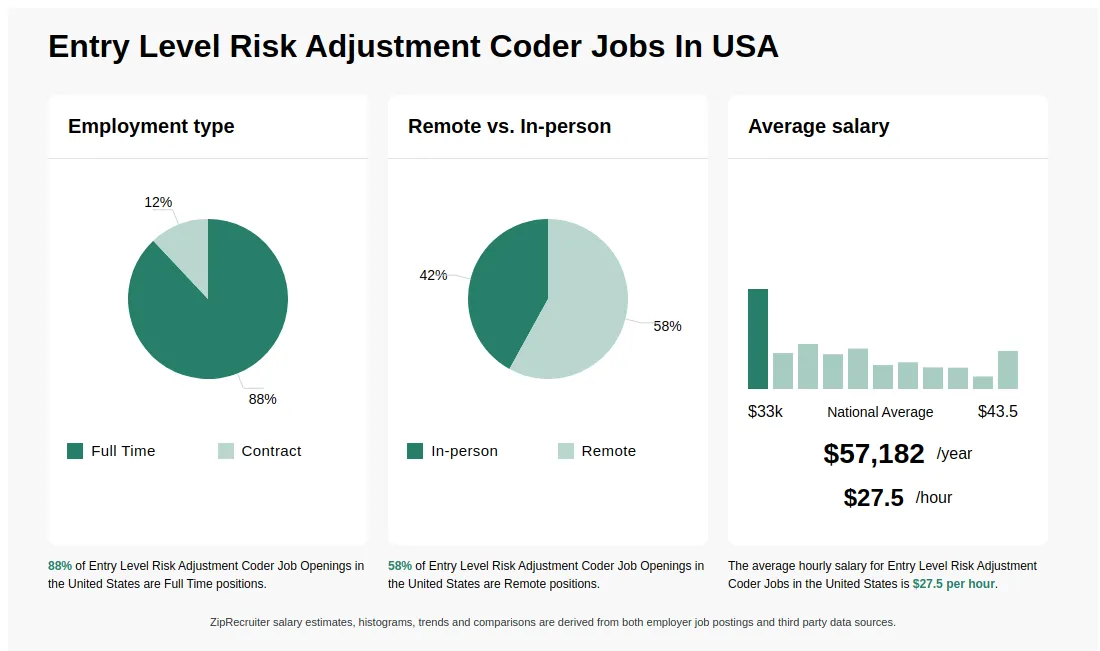
$18.33 is the 25th percentile. Wages below this are outliers.
$15.87 - $18.38
26% of jobs
$18.38 - $20.89
9% of jobs
$20.89 - $23.40
12% of jobs
The median wage is $24.66 / hr.
$23.40 - $25.92
9% of jobs
$25.92 - $28.43
11% of jobs
$28.43 - $30.94
5% of jobs
$32.83 is the 75th percentile. Wages above this are outliers.
$30.94 - $33.46
6% of jobs
$33.46 - $35.97
5% of jobs
$35.97 - $38.48
5% of jobs
$38.48 - $41
3% of jobs
$41 - $43.51
10% of jobs
$15
$27
$43
How much do entry level risk adjustment coder jobs pay per hour?
As of Jun 19, 2026, the average hourly pay for entry level risk adjustment coder in the United States is $27.49, according to ZipRecruiter salary data. Most workers in this role earn between $18.99 and $34.62 per hour, depending on experience, location, and employer.
What is an Entry Level Risk Adjustment Coder job?
An Entry Level Risk Adjustment Coder reviews medical records to identify and assign accurate diagnosis codes for risk adjustment purposes. Their work ensures healthcare organizations receive appropriate reimbursement based on patient health conditions. They typically use ICD-10-CM codes and follow guidelines from CMS and other regulatory bodies. This role requires strong attention to detail, knowledge of medical terminology, and an understanding of risk adjustment models. Entry-level coders may work in various healthcare settings, including insurance companies, hospitals, or coding firms.
What are the key skills and qualifications needed to thrive in the Entry Level Risk Adjustment Coder position, and why are they important?
To thrive as an Entry Level Risk Adjustment Coder, you need a strong understanding of medical terminology, anatomy, and ICD-10-CM coding guidelines, typically supported by completion of a coding training program or relevant coursework. Familiarity with coding software, electronic medical records (EMR) systems, and coding certification such as CPC or CRC is often preferred. Attention to detail, analytical thinking, and effective communication are essential soft skills for this role. These skills and qualifications ensure the accurate coding of diagnoses for risk adjustment, compliance with regulations, and contribute to optimal healthcare reimbursement.
What does a typical workday look like for an entry level risk adjustment coder?
A typical day for an entry level risk adjustment coder involves reviewing patient medical records to identify and assign appropriate diagnostic codes based on clinical documentation. You’ll use specialized coding software and electronic health record systems to ensure accuracy and compliance with federal guidelines. Collaboration with senior coders, team leads, and occasionally clinicians is common when clarification or additional documentation is needed. Most entry level coders work in an office or remote environment and spend much of their day analyzing records, updating databases, and participating in training sessions to stay current on coding updates.
More about Entry Level Risk Adjustment Coder jobs
What cities are hiring for Entry Level Risk Adjustment Coder jobs? Cities with the most Entry Level Risk Adjustment Coder job openings:
What are the most commonly searched types of Risk Adjustment Coder jobs? The most popular types of Risk Adjustment Coder jobs are:
What states have the most Entry Level Risk Adjustment Coder jobs? States with the most job openings for Entry Level Risk Adjustment Coder jobs include:
What job categories do people searching Entry Level Risk Adjustment Coder jobs look for? The top searched job categories for Entry Level Risk Adjustment Coder jobs are:
- Medicare Risk Adjustment Coder
- Risk Adjustment Coding
- Internship Hcc Risk Adjustment Coder
- Crc Risk Adjustment Coder
- Risk Adjustment Auditor
- Evening Risk Adjustment Specialist
- Risk Adjustment Coding Specialist
- Remote Risk Adjustment Coding
- Freelance Hcc Risk Adjustment Coder
- Day Shift Risk Adjustment Specialist

Full-time
Posted 27 days ago
Millennium Physician Group rating



6.4
Based on 61 frontline employees who took The Breakroom Quiz
635th of 873 rated healthcare providers
Job description
Job Description Summary
LEVEL II - RISK ADJUSTMENT CODING SPECIALIST (Intermediate)(Includes all Level I responsibilities + the following)
Responsibilities
Abstract and assign ICD 10 CM diagnosis codes supported in encounter documentation and work independently with minimal oversight from leadership or higher level coders.
Conduct retrospective audits of medical records to validate diagnosis coding accuracy, completeness, and claim submission quality.[HO1.1]
Perform comprehensive reviews of provider actions within the Value Based Alert Tool (VBAT) to identify outliers and improvement opportunities.
Analyze Medicare Risk Adjustment (MRA) data to identify coding or documentation patterns and assist in developing interventions at the provider or regional level.
Keep leadership aware of project activities through written and oral updates; proactively identify project risks.
Consistently meet or exceed accuracy and productivity benchmarks.
May be assigned additional projects or a higher workload volume than a Level I specialist.
How will you make an impact & Requirements
LEVEL II - RISK ADJUSTMENT CODING SPECIALIST (Intermediate)
(Includes all Level I responsibilities + the following)
Responsibilities
- Abstract and assign ICD10CM diagnosis codes supported in encounter documentation and work independently with minimal oversight from leadership or higherlevel coders.
- Conduct retrospective audits of medical records to validate diagnosis coding accuracy, completeness, and claim submission quality.
- Perform comprehensive reviews of provider actions within the ValueBased Alert Tool (VBAT) to identify outliers and improvement opportunities.
- Analyze Medicare Risk Adjustment (MRA) data to identify coding or documentation patterns and assist in developing interventions at the provider or regional level.
- Keep leadership aware of project activities through written and oral updates; proactively identify project risks.
- Consistently meet or exceed accuracy and productivity benchmarks.
- May be assigned additional projects or a higher workload volume than a Level I specialist.
Qualifications
(In addition to Level I minimum qualifications)
- Minimum 2 years of coding or related medical experience, including 1 year of HCC coding.
- Advanced knowledge of medical terminology, anatomy, physiology, and disease processes.
- Extensive understanding of ICD10CM conventions, documentation standards, and reimbursement systems.
- Strong technical skills, including proficiency with MS Office (Excel, Word, Access, PowerPoint).
- Demonstrated ability to use a variety of electronic medical record systems.
- Ability to manage a significant workload and meet deadlines with minimal supervision.
- Strong organizational, analytical, mathematical, and problemsolving skills.
- Effective written and verbal communication abilities.
- Experience contributing to project work, educational development, or group presentations.
What Millennium Physician Group employees say
Pay
Benefits
Hours and flexibility
Workplace
Get the full story on Breakroom

About Millennium Physician Group
Sourced by ZipRecruiter
Industry
Health care and social assistance
Company size
1,001 - 5,000 Employees
Headquarters location
Port Charlotte, FL, US
Year founded
2008