2

Entry Level Network Engineer Jobs (NOW HIRING)

Exposure to VCF platform concepts and lifecycle components. Entry-level or associate networking and ... Required Qualifications Bachelor's degree in Information Technology, Computer Science, Engineering ...

Exposure to VCF platform concepts and lifecycle components. Entry-level or associate networking and ... Required Qualifications Bachelor's degree in Information Technology, Computer Science, Engineering ...

Network Technician

Brentwood, TN · Hybrid

$30 - $38/hr

This will be an entry level (2-3 yrs of experience) network engineer supporting a hybrid Cisco/HP Aruba environment. The role is designed for candidates with foundational experience who will ...

Network Technician

Brentwood, TN · Hybrid

$30 - $38/hr

This will be an entry level (2-3 yrs of experience) network engineer supporting a hybrid Cisco/HP Aruba environment. The role is designed for candidates with foundational experience who will ...

... Senior Network Engineer roles. * Full Health Benefits: Medical, dental, vision, PTO, 401K, and ... Whether you're an entry-level worker or a senior executive, an HR Manager or a front line ...

Senior Network ENGINEER

Washington, DC · On-site

$55 - $60/hr

Job Summary We are seeking a Tier 3 Network Lead responsible for managing and optimizing enterprise ... We have openings for entry level as well as senior positions across a variety of specializations ...

next page

Showing results 1-20

Entry Level Network Engineer information

See salary details

$31K

$109K

$158K

How much do entry level network engineer jobs pay per year?

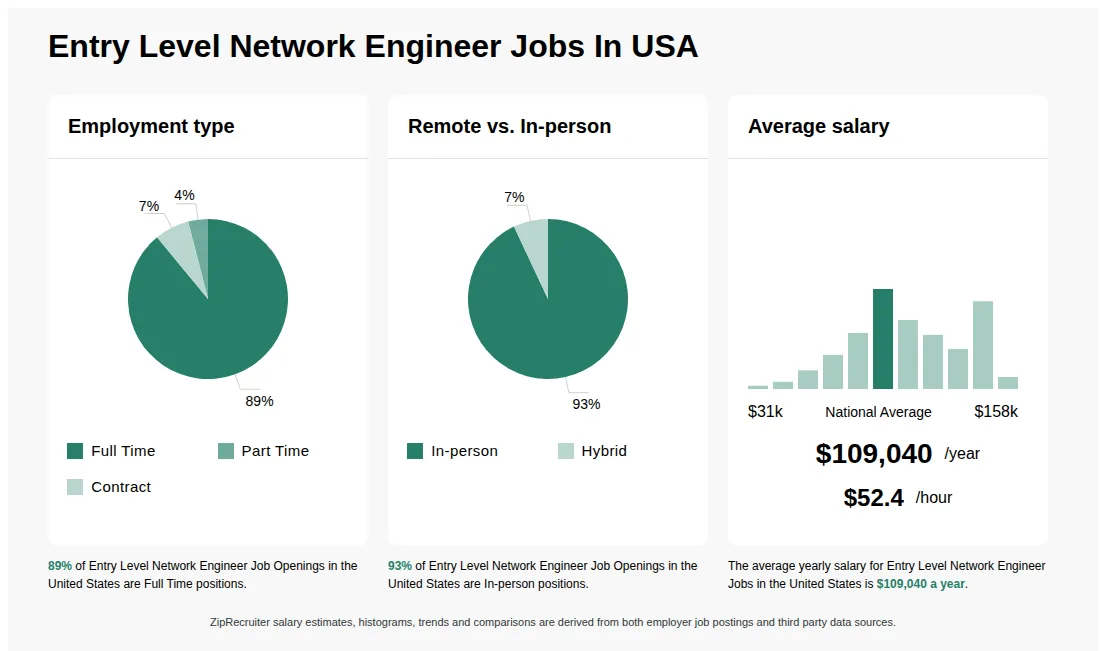
As of Jun 24, 2026, the average yearly pay for entry level network engineer in the United States is $109,040.00, according to ZipRecruiter salary data. Most workers in this role earn between $89,000.00 and $133,500.00 per year, depending on experience, location, and employer.

What are the key skills and qualifications needed to thrive as an Entry Level Network Engineer, and why are they important?

To thrive as an Entry Level Network Engineer, you need a solid understanding of networking fundamentals, TCP/IP protocols, and often a degree in computer science or a related field. Familiarity with tools like Cisco IOS, network monitoring software, and entry-level certifications such as CompTIA Network+ or Cisco CCNA is commonly expected. Strong problem-solving skills, attention to detail, and effective communication set standout candidates apart. These skills and qualifications are vital for ensuring reliable network performance, troubleshooting issues efficiently, and collaborating with IT teams.

What is the difference between Entry Level Network Engineer vs Network Technician?

AspectEntry Level Network EngineerNetwork Technician
Required CredentialsAssociate's/Bachelor's degree in IT or related field, certifications like CompTIA Network+High school diploma or equivalent, certifications like CompTIA Network+ often preferred
Work EnvironmentDesign, implement, and troubleshoot network systems; often involved in planning and configurationInstall, maintain, and repair network hardware and connections; more hands-on troubleshooting
Employer & Industry UsageUsed in corporate, telecom, and IT service providers; entry-level role for network design and supportCommon in retail, small business, and technical support roles; focus on hardware and connectivity issues

While both roles involve working with networks, Entry Level Network Engineers focus on designing and planning network systems, requiring more technical knowledge and certifications. Network Technicians primarily handle hardware installation and troubleshooting, often with less formal education. Both roles are essential in maintaining network infrastructure but differ in scope and responsibilities.

Can you become a network engineer with no experience?

Entry level network engineers can start without prior experience by gaining foundational knowledge through certifications like CompTIA Network+ or Cisco CCNA, and developing skills in networking concepts, hardware, and troubleshooting. Internships, labs, and hands-on practice are also valuable for building relevant experience and improving job prospects.

Can you get an entry level job with CCNA?

An entry-level network engineer position often considers the CCNA certification as a valuable credential that demonstrates foundational networking knowledge. While some employers may require or prefer CCNA for entry-level roles, practical experience and other skills like troubleshooting and familiarity with Cisco devices also play important roles in hiring decisions.

What does an Entry Level Network Engineer do?

An Entry Level Network Engineer assists in the design, implementation, and maintenance of a company's computer networks. They support troubleshooting network issues, configuring network hardware, and monitoring network performance under the guidance of senior engineers. These professionals often work with routers, switches, firewalls, and other networking equipment to ensure secure and efficient network operations. Entry level engineers also help with documentation and may participate in installing new technologies as the organization grows.

What engineers make $500,000?

Highly experienced engineers in specialized fields such as software engineering, data engineering, or certain senior network engineering roles can earn $500,000 or more annually, often through a combination of base salary, bonuses, and stock options. Achieving this level typically requires advanced skills, certifications, and extensive industry experience.

What entry-level jobs can you get with Network+?

Entry-level network engineers with a Network+ certification can qualify for roles such as network technician, help desk technician, or network support specialist. These positions typically involve troubleshooting, installing, and maintaining network hardware and software, and often require familiarity with networking tools and protocols.

What types of projects and tasks can I expect to work on as an entry level network engineer?

As an entry level network engineer, you will typically assist with configuring, monitoring, and troubleshooting network devices such as switches, routers, and firewalls. You may also support more senior engineers in implementing network upgrades, performing routine maintenance, and responding to network outages or security incidents. Participating in documentation, inventory management, and helping to onboard new users are also common tasks. These responsibilities provide valuable hands-on experience and a strong foundation for career growth in network engineering.

What Does an Entry-Level Network Engineer Do?

An entry-level network engineer helps plan, build, install, and troubleshoot networks or technology systems for a customer. They commonly work under the supervision of a senior-level network engineer as they gain skills and experience. The responsibilities of an entry-level network engineer include working to troubleshoot customer issues, creating data backups, performing recovery operations, monitoring network performance, and performing network security measures such as examining hardware components that may need to be replaced and managing virus protection software. The minimum qualifications to become an entry-level network engineer include a bachelor’s degree in information technology, computer engineering, or a similar discipline.

What cities are hiring for Entry Level Network Engineer jobs? Cities with the most Entry Level Network Engineer job openings:
What are the most commonly searched types of Network Engineer jobs? The most popular types of Network Engineer jobs are:
What states have the most Entry Level Network Engineer jobs? States with the most job openings for Entry Level Network Engineer jobs include:
What job categories do people searching Entry Level Network Engineer jobs look for? The top searched job categories for Entry Level Network Engineer jobs are:
Infographic showing various Entry Level Network Engineer job openings in the United States as of June 2026, with employment types broken down into 1% Locum Tenens, 2% As Needed, 53% Full Time, 43% Part Time, and 1% Contract. Highlights an 87% Physical, 5% Hybrid, and 8% Remote job distribution, with an average salary of $109,040 per year, or $52.4 per hour.

Network Engineer I - Enterprise Network Operations & Lifecycle

Milwaukee Tool

Menomonee Falls, WI

Full-time

Medical, Dental, Vision, Retirement

Posted 26 days ago


Job description

Job Description:

Network Engineer I - Enterprise Network Operations & Lifecycle

We are seeking a Network Engineer I to support the daily operations of our global enterprise network environment. This role is responsible for supporting day-to-day enterprise network operations, resolving standard network incidents, executing approved changes, and contributing to hardware lifecycle activities across routing, switching, firewall, wireless, and SD-WAN platforms.

This position plays an active role in maintaining network stability, supporting operational consistency, and executing defined network tasks within established standards and processes.

**Applicants must be authorized to work in the U.S.; Sponsorship is not available for this position

Key Responsibilities

Enterprise Network Operations

  • Provide operational support for enterprise network platforms including switching, routing, firewalls, wireless, and SD-WAN systems.
  • Monitor network performance, respond to alerts, and troubleshoot standard network incidents.
  • Diagnose and resolve common network issues including connectivity, wireless performance, DHCP/DNS, VLAN, and port-related issues.
  • Execute approved standard network changes such as port activations, VLAN assignments, access point replacements, and routine configuration updates following established standards.
  • Resolve standard issues independently and escalate non-standard or complex issues with clear analysis, troubleshooting history, and recommended next steps where appropriate.

Incident & Queue Management

  • Own assigned network incidents and service requests from triage through resolution, ensuring timely updates, accurate documentation, and appropriate escalation when required.
  • Apply established troubleshooting methodologies to resolve incidents efficiently.
  • Maintain accurate and timely updates within the ticketing system.
  • Participate in on-call rotation and incident response processes.

Hardware Lifecycle Support

  • Perform installation, refresh, and decommissioning activities for network hardware including switches, access points, firewalls, and related infrastructure.
  • Execute lifecycle and deployment tasks across multiple locations following defined procedures.
  • Maintain accurate inventory, asset tracking, and lifecycle documentation.
  • Coordinate with field resources, logistics, and internal teams to support successful deployment and transition activities.

Change & Process Execution

  • Support approved change activities by completing assigned tasks, validating results, and documenting outcomes in accordance with change management processes.
  • Execute against established operational processes, standards, and runbooks.
  • Identify recurring issues or trends and communicate findings to engineering teams.
  • Contribute to maintaining network reliability, consistency, and operational efficiency.

Collaboration & Communication

  • Work closely with network engineering, infrastructure teams, field resources, and service delivery teams to resolve issues and complete assigned work.
  • Communicate technical updates clearly to both technical and non-technical stakeholders.
  • Engage with team members to align on solutions and escalate when appropriate.

Documentation & Standards

  • Document troubleshooting steps, configurations, changes, and resolutions in a consistent and auditable manner.
  • Maintain and update support documentation, runbooks, diagrams, and asset records as needed.
  • Adhere to change management, security, compliance, and operational standards.

Required Skills & Qualifications

  • Practical working knowledge of networking fundamentals, including TCP/IP, DNS, DHCP, VLANs, subnetting, routing/switching concepts, and wireless connectivity.
  • Hands-on familiarity with enterprise networking platforms such as Cisco, Juniper, Aruba, Palo Alto, or similar technologies.
  • Strong troubleshooting and analytical skills.
  • Ability to resolve standard network issues independently and escalate complex issues with clear supporting documentation.
  • Experience working in a ticket-driven, SLA-based support environment.
  • Ability to execute tasks consistently within defined processes, standards, and change control requirements.
  • Effective written and verbal communication skills.
  • Ability to produce clear, complete, and timely technical documentation.

Preferred Qualifications

  • 1-3 years of networking or infrastructure experience, or equivalent hands-on experience.
  • Entry-level certifications such as CCNA, JNCIA, Network+, or similar.
  • Experience with network monitoring tools.
  • Experience supporting multi-site or enterprise network environments.
  • Basic familiarity with SD-WAN concepts.
  • Familiarity with ITIL or structured support environments.

What We Offer

  • Opportunity to contribute to a large-scale enterprise network environment.
  • Hands-on experience supporting critical infrastructure platforms.
  • Participation in enterprise network lifecycle and modernization efforts.
  • A collaborative team environment with opportunities to expand technical responsibilities.

Perks & Benefits

  • Robust health, dental, and vision insurance plans.
  • Generous 401(k) savings plan.
  • Education assistance.
  • On-site wellness, fitness center, food, and coffee service.
  • And many more - visit our benefits site for additional details.

Milwaukee Tool is an equal opportunity employer.