2

Entry Level Financial Advisor Jobs (NOW HIRING)

A New York Life Financial Advisors will entail: Comprehensive professional training with TAS (Training allowance Subsidy)Competitive benefits plus Residuals Trails and RenewalsPension Plan* (Only 2% ...

next page

Showing results 1-20

Entry Level Financial Advisor information

See salary details

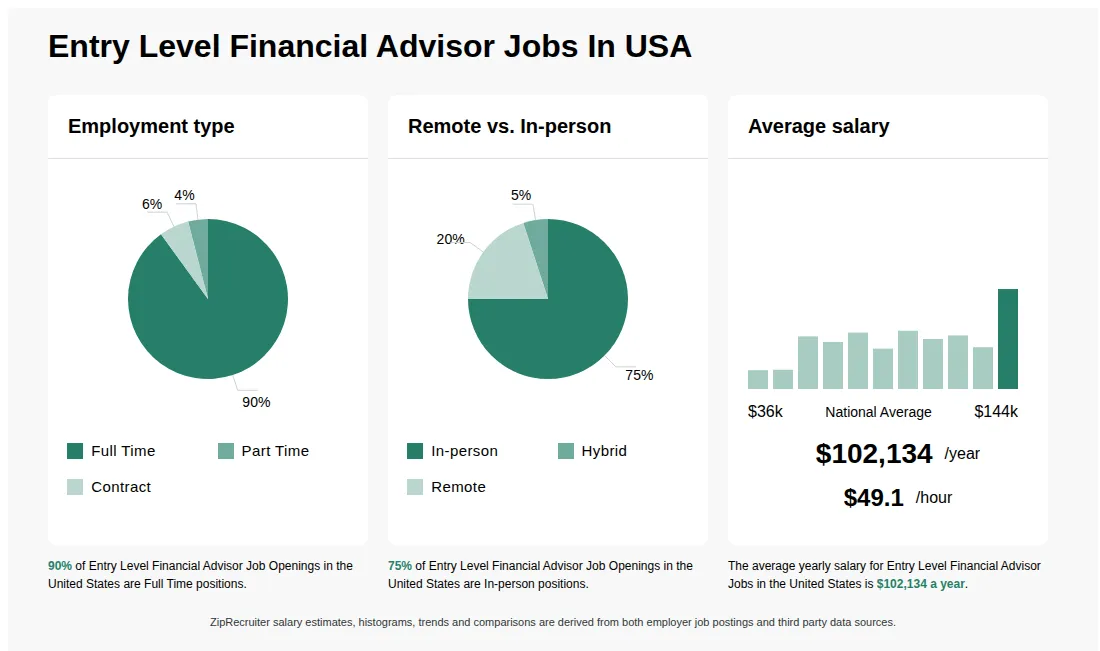
$36K

$102.1K

$144K

How much do entry level financial advisor jobs pay per year?

As of Jun 25, 2026, the average yearly pay for entry level financial advisor in the United States is $102,134.00, according to ZipRecruiter salary data. Most workers in this role earn between $75,000.00 and $131,000.00 per year, depending on experience, location, and employer.

Is 200,000 enough to work with a financial advisor?

As an entry-level financial advisor, having $200,000 can be sufficient to start working with clients and build a portfolio, especially if you are managing your own investments or advising clients with similar assets. Success in the role often depends on skills, certifications, and client relationships rather than initial capital alone.

Is 50,000 enough to work with a financial advisor?

For an entry-level financial advisor, a $50,000 income can be sufficient depending on location, living expenses, and career stage. Many advisors start with lower earnings and build their client base over time, often earning commissions or fees based on assets under management. Success in this role also depends on skills, certifications, and the ability to attract clients.

How do you become a financial advisor with no experience?

To become an entry-level financial advisor with no experience, individuals typically complete relevant education such as a bachelor's degree in finance, economics, or a related field, and obtain necessary licenses like the Series 7 and Series 66 exams. Gaining skills in financial planning, customer service, and sales, along with internships or entry-level positions, can help build experience and credibility in the field.

What are the key skills and qualifications needed to thrive as an Entry Level Financial Advisor, and why are they important?

To thrive as an Entry Level Financial Advisor, you need foundational knowledge in finance, economics, and investment strategies, usually supported by a bachelor’s degree in a related field. Familiarity with financial planning software, CRM systems, and obtaining certifications like Series 7 or 66 are often required. Strong interpersonal skills, active listening, and the ability to build trust with clients are essential soft skills. These competencies enable advisors to provide sound financial guidance, develop client relationships, and grow their practice effectively.

What are some common challenges faced by entry level financial advisors and how can they overcome them?

Entry level financial advisors often face challenges such as building a client base, gaining trust from clients, and staying updated with changing financial regulations. To overcome these, new advisors should focus on networking, seeking mentorship from experienced colleagues, and consistently educating themselves through industry certifications and training. Additionally, developing strong communication skills and being proactive about client outreach can help accelerate professional growth and establish credibility within the firm.

What does an Entry Level Financial Advisor do?

An Entry Level Financial Advisor helps clients understand their financial options and assists them in setting and achieving financial goals. Typical duties include assessing clients' financial situations, recommending investment strategies, and explaining products such as retirement plans, insurance, and savings accounts. They often work under the guidance of more experienced advisors while building their own client base. Entry level advisors also stay current on financial regulations and market trends to provide the best advice possible.

What do entry-level financial advisors do?

Entry-level financial advisors assist clients with financial planning, investment strategies, and retirement planning. They gather client information, analyze financial data, and recommend suitable financial products, often working under the supervision of experienced advisors and using financial planning software.

What is the difference between Entry Level Financial Advisor vs Financial Planner?

AspectEntry Level Financial AdvisorFinancial Planner
CertificationsTypically requires Series 7, Series 66, or 63; CFP certification may be preferredOften holds CFP, CFA, or ChFC certifications
Work EnvironmentFinancial firms, banks, or advisory firms; client-facing rolesIndependent or firm-based; comprehensive financial planning
Job FocusAssisting clients with investments, basic financial adviceHolistic financial planning, estate, retirement, and tax strategies

While Entry Level Financial Advisors focus on basic investment advice and client onboarding, Financial Planners provide comprehensive financial strategies. Both roles often require similar certifications initially, but Financial Planners typically have more advanced credentials and a broader scope of services.

More about Entry Level Financial Advisor jobs
What cities are hiring for Entry Level Financial Advisor jobs? Cities with the most Entry Level Financial Advisor job openings:
What are the most commonly searched types of Financial Advisor jobs? The most popular types of Financial Advisor jobs are:
What states have the most Entry Level Financial Advisor jobs? States with the most job openings for Entry Level Financial Advisor jobs include:
Entry-Level Financial Advisor

Entry-Level Financial Advisor

Principal

Indianapolis, IN

$76K/yr

Full-time

Posted 4 days ago


Principal Financial Group rating

8.5

Company rating: 8.5 out of 10

Based on 52 frontline employees who took The Breakroom Quiz

86th of 261 rated insurance


Job description

Are you ready to start building a financial practice—without needing prior experience?

Today’s technology—powered by AI—handles much of the research, prospecting, and administrative work that used to slow new advisors down. That means you can focus on what truly drives success from day one: building relationships, growing your confidence, and helping clients achieve meaningful financial outcomes.


At Principal, we specialize in developing new advisors and helping them succeed in the business market. You’ll gain access to innovative solutions for small and mid-sized businesses across retirement, benefits, and asset management—all while learning how to apply them in real-world situations. In this role, you’ll leverage Principal’s platform and AI‑enabled tools to prospect more effectively and uncover opportunities within the business community.


What You’ll Do:

  • Use AI‑powered prospecting tools to identify businesses that may benefit from your outreach—eliminating the guesswork of where to start
  • Begin building and growing your own client base within the small and mid-sized business market
  • Learn to use advanced technology to prepare for meetings, uncover insights, and confidently engage with clients
  • Accelerate your development through hands-on training, mentorship from experienced leaders, and AI‑driven coaching
Compensation:

$76,000 at plan earnings


Responsibilities:
  • Participate in training and development programs while building the skills needed to become a successful Financial Advisor
  • Learn how to identify and connect with prospective clients to begin building your network and client base
  • Gather and understand basic financial information to help support client conversations and planning
  • Assist in developing personalized financial strategies with guidance from experienced advisors and leadership
  • Provide thoughtful, client-focused support and recommendations as you grow into a trusted financial resource

Qualifications:
  • Requires a Bachelor’s degree in business administration, finance, or other work/sales related experience
  • Stellar communication and math skills complemented by a proven track record of building strong client relationships with existing and prospective customers
  • We will sponsor candidates for FINRA Series 7/66 required registrations

About Company

You’ll join a nationwide network of affiliated financial professionals partnering with Principal, with the autonomy to grow your practice your way. Principal is a recognized leader in solutions for small and mid-sized businesses, offering expertise in retirement, employee benefits, business protection, and asset management.

We understand every practice is unique. That’s why we offer flexible affiliation options, along with a variety of team structures and benefit choices—all backed by robust resources, technology, and support. Our model delivers the backing of an established firm with a payout structure that reflects an independent approach.

And just as we help businesses provide meaningful benefits, we do the same for you—offering more than traditional compensation, with support designed to help you grow and succeed long term.


What Principal Financial Group employees say

Pay

Benefits

Hours and flexibility

Workplace

Get the full story on Breakroom