2

Entry Level Financial Advisor Jobs (NOW HIRING)

... financial outcomes. At Principal, we specialize in developing new advisors and helping them succeed in the business market. You'll gain access to innovative solutions for small and mid-sized ...

Participate in training and development programs while building the skills needed to become a successful Financial Advisor * Learn how to identify and connect with prospective clients to begin ...

A New York Life Financial Advisors will entail: Comprehensive professional training with TAS (Training allowance Subsidy)Competitive benefits plus Residuals Trails and RenewalsPension Plan* (Only 2% ...

... financial outcomes. At Principal, we specialize in developing new advisors and helping them succeed in the business market. You'll gain access to innovative solutions for small and mid-sized ...

A New York Life Financial Advisors will entail: Comprehensive professional training with TAS (Training allowance Subsidy)Competitive benefits plus Residuals Trails and RenewalsPension Plan* (Only 2% ...

next page

Showing results 1-20

Entry Level Financial Advisor information

See salary details

$36K

$102.1K

$144K

How much do entry level financial advisor jobs pay per year?

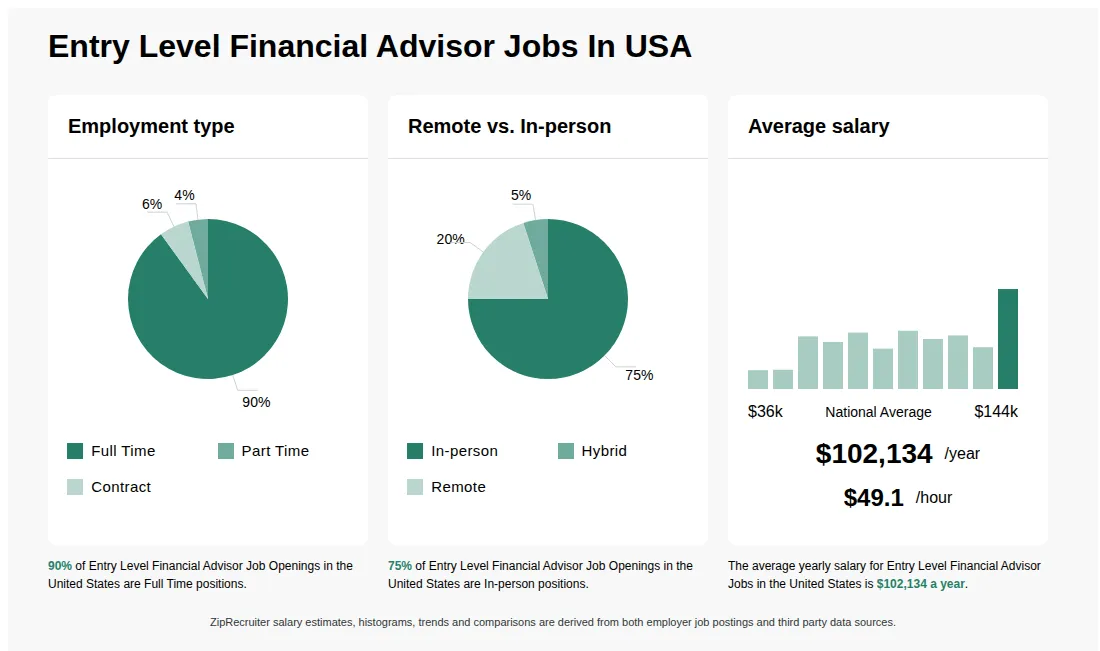
As of Jun 25, 2026, the average yearly pay for entry level financial advisor in the United States is $102,134.00, according to ZipRecruiter salary data. Most workers in this role earn between $75,000.00 and $131,000.00 per year, depending on experience, location, and employer.

Is 200,000 enough to work with a financial advisor?

As an entry-level financial advisor, having $200,000 can be sufficient to start working with clients and build a portfolio, especially if you are managing your own investments or advising clients with similar assets. Success in the role often depends on skills, certifications, and client relationships rather than initial capital alone.

Is 50,000 enough to work with a financial advisor?

For an entry-level financial advisor, a $50,000 income can be sufficient depending on location, living expenses, and career stage. Many advisors start with lower earnings and build their client base over time, often earning commissions or fees based on assets under management. Success in this role also depends on skills, certifications, and the ability to attract clients.

How do you become a financial advisor with no experience?

To become an entry-level financial advisor with no experience, individuals typically complete relevant education such as a bachelor's degree in finance, economics, or a related field, and obtain necessary licenses like the Series 7 and Series 66 exams. Gaining skills in financial planning, customer service, and sales, along with internships or entry-level positions, can help build experience and credibility in the field.

What are the key skills and qualifications needed to thrive as an Entry Level Financial Advisor, and why are they important?

To thrive as an Entry Level Financial Advisor, you need foundational knowledge in finance, economics, and investment strategies, usually supported by a bachelor’s degree in a related field. Familiarity with financial planning software, CRM systems, and obtaining certifications like Series 7 or 66 are often required. Strong interpersonal skills, active listening, and the ability to build trust with clients are essential soft skills. These competencies enable advisors to provide sound financial guidance, develop client relationships, and grow their practice effectively.

What are some common challenges faced by entry level financial advisors and how can they overcome them?

Entry level financial advisors often face challenges such as building a client base, gaining trust from clients, and staying updated with changing financial regulations. To overcome these, new advisors should focus on networking, seeking mentorship from experienced colleagues, and consistently educating themselves through industry certifications and training. Additionally, developing strong communication skills and being proactive about client outreach can help accelerate professional growth and establish credibility within the firm.

What does an Entry Level Financial Advisor do?

An Entry Level Financial Advisor helps clients understand their financial options and assists them in setting and achieving financial goals. Typical duties include assessing clients' financial situations, recommending investment strategies, and explaining products such as retirement plans, insurance, and savings accounts. They often work under the guidance of more experienced advisors while building their own client base. Entry level advisors also stay current on financial regulations and market trends to provide the best advice possible.

What do entry-level financial advisors do?

Entry-level financial advisors assist clients with financial planning, investment strategies, and retirement planning. They gather client information, analyze financial data, and recommend suitable financial products, often working under the supervision of experienced advisors and using financial planning software.

What is the difference between Entry Level Financial Advisor vs Financial Planner?

AspectEntry Level Financial AdvisorFinancial Planner
CertificationsTypically requires Series 7, Series 66, or 63; CFP certification may be preferredOften holds CFP, CFA, or ChFC certifications
Work EnvironmentFinancial firms, banks, or advisory firms; client-facing rolesIndependent or firm-based; comprehensive financial planning
Job FocusAssisting clients with investments, basic financial adviceHolistic financial planning, estate, retirement, and tax strategies

While Entry Level Financial Advisors focus on basic investment advice and client onboarding, Financial Planners provide comprehensive financial strategies. Both roles often require similar certifications initially, but Financial Planners typically have more advanced credentials and a broader scope of services.

More about Entry Level Financial Advisor jobs
What cities are hiring for Entry Level Financial Advisor jobs? Cities with the most Entry Level Financial Advisor job openings:
What are the most commonly searched types of Financial Advisor jobs? The most popular types of Financial Advisor jobs are:
What states have the most Entry Level Financial Advisor jobs? States with the most job openings for Entry Level Financial Advisor jobs include:

Full-time, Part-time

Posted 26 days ago


Job description

Description
Remote | Part-Time or Full-Time
We are expanding our team of Financial Advisors in a fully remote environment. This entry-level opportunity is available on both a part-time and full-time basis.
Through a structured training program, you will develop the skills to assess the financial needs of individuals and families, guide conversations around their goals, and contribute to building personalized financial strategies. These strategies may include areas such as debt management, budgeting, retirement planning, wealth accumulation, college planning, and other financial solutions.
This role is well-suited for individuals seeking flexibility, professional development, and long-term growth within the financial services industry.
Preferred Skills and Attributes
  • Self-motivated with a strong sense of accountability
  • Coachable and receptive to feedback
  • Goal-oriented with a results-driven mindset
  • Demonstrates integrity and professionalism
  • Strong organizational and time-management skills
  • Comfortable working independently and collaboratively
  • Interest in financial education and helping others

Work Schedule & Training
This position offers flexible scheduling, allowing you to align your hours with your availability. A general commitment of approximately 10-15 hours per week supports consistent progress and development.
Weekly training sessions are available at the following times:
  • Tuesdays: 8:00 PM EST / 5:00 PM PST
  • Saturdays: 12:00 PM EST / 9:00 AM PST

Participation in training sessions supports ongoing development and skill-building.
Additional Information
This opportunity is designed with flexibility in mind and can complement existing professional commitments. Individuals may engage on a part-time or full-time basis depending on their goals and availability.
If you are interested in developing a career in financial services while contributing to improving financial awareness and outcomes for others, we welcome your application.
Responsibilities
• Participate in structured training and ongoing professional development
• Observe and support client meetings, financial reviews, and presentations
• Analyze client financial information to help identify needs and goals
• Educate clients on financial concepts, strategies, and available options
• Assist in developing financial solutions aligned with client objectives
• Maintain professional, ethical, and compliance-focused standards
• Build and manage long-term client relationships
Qualifications
• At least 18 years of age
• Lawful resident of the United States (NO H1-B status permitted)
• Valid government-issued identification (Driver's License or State ID)
• Open to background screening, where permitted by law
• Interest in obtaining a Life & Health insurance license
• Strong communication and interpersonal skills
• Customer service or client-facing experience is beneficial