2

Entry Level Computer Science Internships Jobs (NOW HIRING)

$13 - $17.50/hr

Over the course of this internship, you will work directly with our dynamic team of applied ... Engineering, Physics, Computer Science or a related field, within 1 year of completion.

Device Refresh Tech

Orange, CA · On-site

$16.90 - $17/hr

Open to entry level computer science graduates * 0-1-year experience with IT setup, desktop setups * Adept with computer installations, operating systems, Windows 10, hardware support and maintenance

CPU Design Verification Engineer

Austin, TX

$134K - $164K/yr

... or Computer Science Internships or other academic project experience in hardware verification and/or design Academic experience in digital logic design, chip architecture, and microarchitecture ...

Data Science Internship - Fall 2026 Faire leverages machine learning and data insights to transform ... in Computer Science, Operations Research, Statistics, Econometrics, or a related technical ...

CPU Design Verification Engineer

Austin, TX

$134K - $164K/yr

... or Computer Science Internships or other academic project experience in hardware verification and/or design Academic experience in digital logic design, chip architecture, and microarchitecture ...

next page

Showing results 1-20

Entry Level Computer Science Internships information

See salary details

$22K

$45K

$65K

How much do entry level computer science internships jobs pay per year?

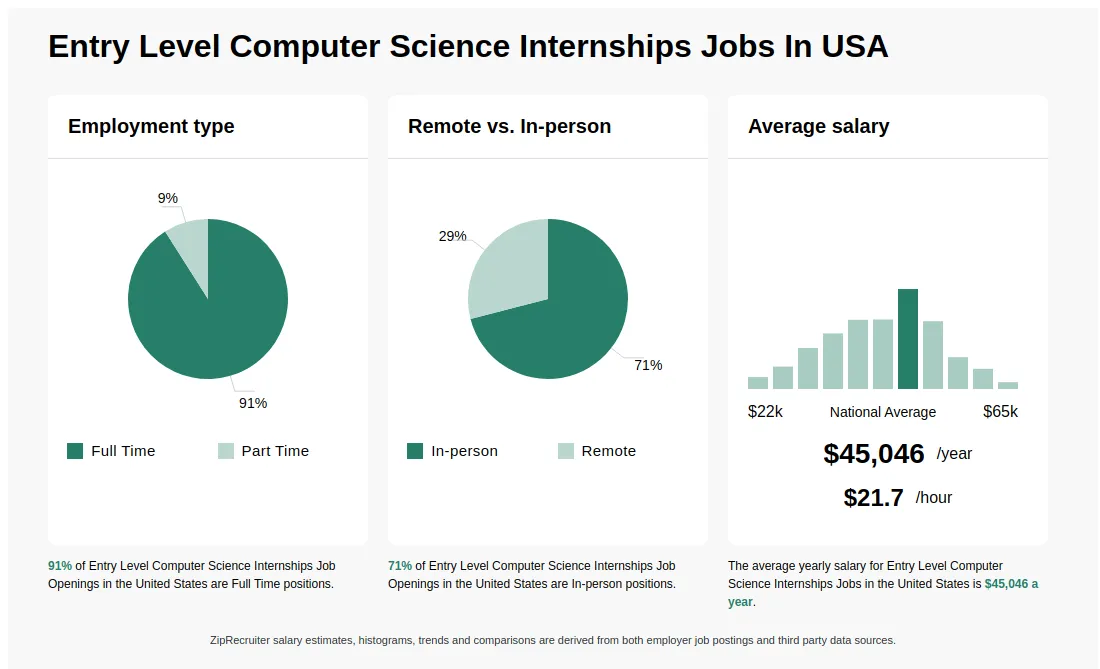
As of Jun 21, 2026, the average yearly pay for entry level computer science internships in the United States is $45,046.00, according to ZipRecruiter salary data. Most workers in this role earn between $37,000.00 and $50,000.00 per year, depending on experience, location, and employer.

What types of projects or tasks can I expect to work on during an entry-level computer science internship?

As an entry-level computer science intern, you can expect to work on a variety of tasks such as assisting with software development, debugging code, writing documentation, and performing quality assurance testing. Interns often collaborate with full-time engineers on real-world projects, gaining exposure to the software development lifecycle and agile methodologies. You'll likely participate in team meetings, code reviews, and may have the opportunity to contribute to new features or improvements under the guidance of a mentor. This hands-on experience is valuable for building skills and expanding your professional network.

What is the difference between Entry Level Computer Science Internships vs Software Developer Internships?

AspectEntry Level Computer Science InternshipsSoftware Developer Internships
Required CredentialsTypically pursuing or recently completed a computer science degreeSame as above, often with some coding coursework
Work EnvironmentAcademic, corporate, or startup settings; focus on learning and supportDevelopment teams; hands-on coding and project work
Employer & Industry UsageUniversities, tech companies, startups, government agenciesTech companies, software firms, startups

Entry Level Computer Science Internships and Software Developer Internships both target students or recent graduates with a background in computer science. The main difference lies in the focus: internships labeled as "Computer Science" often emphasize foundational knowledge and learning, while "Software Developer" internships are more focused on hands-on coding and project development. Both roles serve as valuable stepping stones into tech careers, with similar educational requirements and work environments.


What are entry level computer science internships?

Entry level computer science internships are short-term positions designed for students or recent graduates who are looking to gain practical experience in the field of computer science. These internships typically involve working on software development, data analysis, IT support, or other technical projects under the supervision of experienced professionals. They provide hands-on learning opportunities, exposure to real-world problems, and a chance to build professional networks, making them an important step toward a career in technology.

What are the key skills and qualifications needed to thrive as an Entry Level Computer Science Intern, and why are they important?

To thrive as an Entry Level Computer Science Intern, you generally need a foundational knowledge of programming languages (such as Python, Java, or C++), problem-solving abilities, and current enrollment in or completion of a relevant degree program. Familiarity with version control systems like Git, basic software development tools, and sometimes experience with databases or cloud platforms is typically expected. Strong communication, eagerness to learn, and teamwork skills help interns integrate smoothly and contribute effectively to projects. These skills and qualities are crucial for adapting quickly, collaborating with colleagues, and making the most of hands-on learning opportunities in a professional environment.
More about Entry Level Computer Science Internships jobs
What cities are hiring for Entry Level Computer Science Internships jobs? Cities with the most Entry Level Computer Science Internships job openings:
What are the most commonly searched types of Computer Science Internships jobs? The most popular types of Computer Science Internships jobs are:
What states have the most Entry Level Computer Science Internships jobs? States with the most job openings for Entry Level Computer Science Internships jobs include:
Infographic showing various Entry Level Computer Science Internships job openings in the United States as of June 2026, with employment types broken down into 78% Full Time, 19% Part Time, 1% Temporary, 1% Contract, and 1% Nights. Highlights an 97% Physical, 1% Hybrid, and 2% Remote job distribution, with an average salary of $45,046 per year, or $21.7 per hour.

Computer Systems Analyst I

4pconsultinginc

Birmingham, AL • On-site

Contractor

Posted 24 days ago


Job description

Position: Computer Systems Analyst I

Location- Birmingham, AL

Client- Alabama Power

Contract- 1 Year

We are seeking a motivated Entry-Level Computer Systems Analyst I to support business and operational systems in a utility services / vegetation management environment. This role will assist with data processing, system monitoring, reporting, automated workflow support, and process documentation.

The ideal candidate will have strong analytical skills, attention to detail, and a basic understanding of data management, systems, and business processes. This is a great opportunity for someone looking to build experience in systems analysis, reporting, automation, GIS/data support, or operational technology.

Responsibilities

  • Monitor and process system-generated requests and records.
  • Extract, compile, and maintain recurring operational reports.
  • Support automated workflows, system alerts, and notifications.
  • Execute and validate scripts or system processes.
  • Assist with data preparation, validation, and reporting.
  • Organize large datasets for business and technical use.
  • Identify workflow inefficiencies and support process improvements.
  • Create and maintain clear process documentation and standard operating procedures.
  • Collaborate with operations, business, and technical teams.

Qualifications

  • Bachelor’s degree or degree in progress in Computer Science, Information Systems, GIS, Data Analytics, or a related field.
  • Basic knowledge of data management, systems, and business processes.
  • Proficiency in Microsoft Excel or similar data tools.
  • Strong analytical, organizational, and problem-solving skills.
  • High attention to detail and ability to meet deadlines.
  • Strong written and verbal communication skills.

Preferred Skills

  • Exposure to SQL, Python, PowerShell, or automation tools.
  • Familiarity with GIS, mapping, or geospatial data.
  • Experience with reporting tools, system integrations, or enterprise applications.
  • Process documentation or workflow improvement experience.

Key Skills

Data analysis, reporting, system monitoring, Excel, process improvement, documentation, troubleshooting, organization, and communication.