2

Entry Level Cfd Engineer Jobs (NOW HIRING)

This is an entry-level design role built to grow an engineer into an independent contributor on ... Analysis and Documentation * Assist with analytical and CFD studies and help reduce results into ...

This is a temporary, full-time entry-level position working in our nuclear power simulation group ... dynamics (CFD) to develop, analyze, and maintain software models of fluid systems using CORYS ...

This is a temporary, full-time entry-level position working in our nuclear power simulation group ... CFD) to develop, analyze, and maintain software models of fluid systems using CORYS proprietary ...

Propulsion Engineer I

Madison, WI · On-site

$70K - $96K/yr

This entry-level position provides an opportunity to gain valuable experience under the guidance of ... Basic proficiency in using engineering design software and tools such as CAD, FEA, or CFD. * Basic ...

Propulsion Engineer I

Madison, WI · On-site

$70K - $96K/yr

This entry-level position provides an opportunity to gain valuable experience under the guidance of ... Basic proficiency in using engineering design software and tools such as CAD, FEA, or CFD. * Basic ...

next page

Showing results 1-20

Entry Level Cfd Engineer information

See salary details

$40.5K

$73.5K

$121K

How much do entry level cfd engineer jobs pay per year?

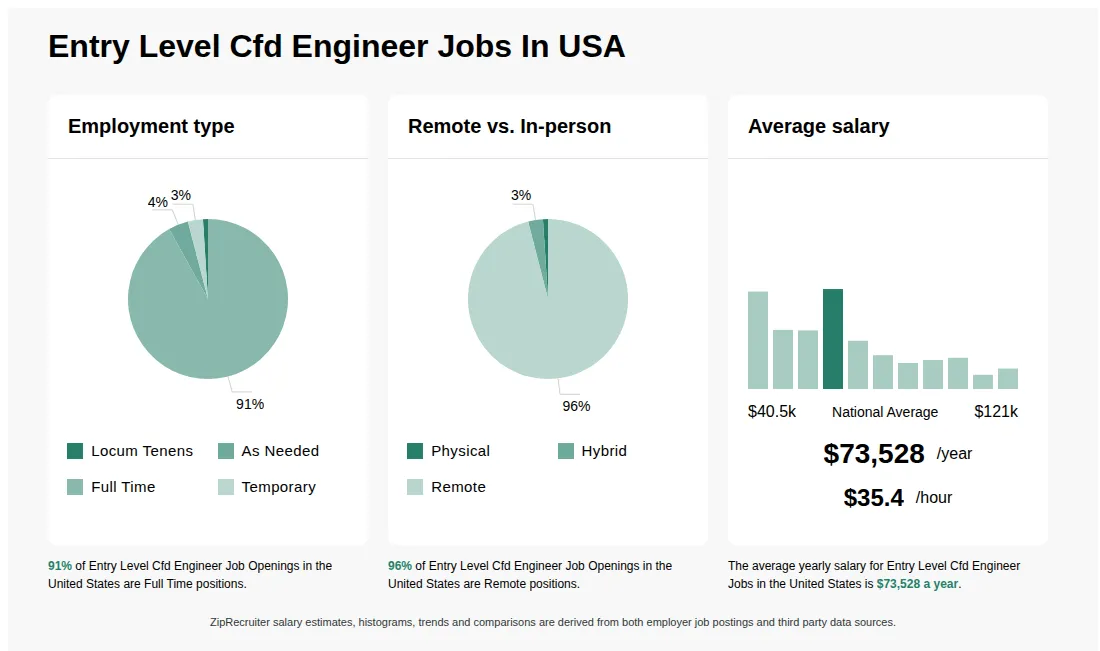
As of Aug 4, 2026, the average yearly pay for entry level cfd engineer in the United States is $73,528.00, according to ZipRecruiter salary data. Most workers in this role earn between $52,000.00 and $88,500.00 per year, depending on experience, location, and employer.

What are the typical projects or tasks an entry level CFD engineer can expect during their first year?

As an Entry Level CFD Engineer, you can expect to work on projects involving simulation setup, meshing, running analyses, and post-processing of results for various engineering applications such as aerodynamics, HVAC systems, or thermal management. You may assist senior engineers in validating simulation data, preparing technical reports, and presenting findings to clients or team members. Daily tasks often include refining models, troubleshooting computational issues, and collaborating with CAD designers or testing teams. This hands-on experience helps you build technical expertise and develop a strong foundation for more advanced CFD projects over time.

What is an entry level CFD engineer?

An Entry Level CFD (Computational Fluid Dynamics) Engineer is responsible for using simulation tools to analyze and predict fluid flow, heat transfer, and other related physical phenomena. They typically assist in designing and optimizing products or systems in industries like aerospace, automotive, and energy. Their role involves setting up simulations, processing computational models, and interpreting results to improve designs. Strong analytical skills, proficiency in CFD software (such as ANSYS Fluent or OpenFOAM), and a solid understanding of fluid mechanics are essential for this role.

What are the key skills and qualifications needed to thrive in the entry level CFD engineer position, and why are they important?

To thrive as an Entry Level CFD Engineer, you need a solid background in fluid dynamics, heat transfer, applied mathematics, and an engineering degree such as Mechanical or Aerospace Engineering. Familiarity with computational tools like ANSYS Fluent, OpenFOAM, or STAR-CCM+, and proficiency in programming languages like Python or MATLAB are typically required. Strong analytical thinking, problem-solving skills, and effective communication help you interpret results and collaborate with multidisciplinary teams. These skills ensure accurate simulations, clear reporting, and successful integration of CFD analyses into real-world engineering projects.

Are entry level CFD engineers in demand?

Entry level CFD engineers are in demand in industries such as aerospace, automotive, and energy, where computational fluid dynamics skills are valued for product design and analysis. Employers seek candidates with proficiency in CFD software like ANSYS or OpenFOAM and a strong foundation in fluid mechanics, making entry-level positions available for those with relevant technical skills and internships.
More about Entry Level Cfd Engineer jobs
What cities are hiring for Entry Level Cfd Engineer jobs? Cities with the most Entry Level Cfd Engineer job openings:
What are the most commonly searched types of Cfd Engineer jobs? The most popular types of Cfd Engineer jobs are:
What states have the most Entry Level Cfd Engineer jobs? States with the most job openings for Entry Level Cfd Engineer jobs include:
What job categories do people searching Entry Level Cfd Engineer jobs look for? The top searched job categories for Entry Level Cfd Engineer jobs are:
Infographic showing various Entry Level Cfd Engineer job openings in the United States as of July 2026, with employment types broken down into 92% Full Time, and 8% Temporary. Highlights an 100% In-person job distribution, with an average salary of $73,528 per year, or $35.4 per hour.

Junior Propulsion Component Engineer

Amca

El Segundo, CA

Other

Posted 18 days ago


Job description

Overview

The Junior Propulsion Component Engineer supports the design and development of Amca's propulsion control hardware under the direction of senior engineers. You will contribute to the design of valves, regulators, actuators, and manifolds, run analysis, and produce drawings and models. This is an entry-level design role built to grow an engineer into an independent contributor on propulsion component programs.

Responsibilities

Design Support

  • Support the design of propulsion components and assemblies under the guidance of senior engineers.
  • Build CAD models and detailed drawings, applying GD&T under review.
  • Perform hand calculations and basic analysis for flow, pressure drop, and sizing.

Analysis and Documentation

  • Assist with analytical and CFD studies and help reduce results into usable design guidance.
  • Draft portions of requirements documents, interface control documents, and technical data packages.
  • Maintain design files and support configuration management.

Collaboration and Development

  • Work with test and manufacturing teams to understand build and qualification feedback.
  • Support troubleshooting and data collection on design and field issues.
  • Build propulsion component design fundamentals through mentorship and design reviews.

Basic Qualifications

  • Bachelor's degree in mechanical engineering, aerospace engineering, or a related technical discipline.
  • 0 to 2 years of engineering experience, including internships or co-ops.
  • Working knowledge of fluid dynamics, hydraulics, or pneumatics fundamentals.
  • Proficiency in 3D CAD (Creo, SolidWorks, or NX) and a working understanding of GD&T.
  • Strong analytical skills and a willingness to learn on complex hardware.

Preferred Qualifications

  • Coursework or project experience in fluid mechanics, thermodynamics, or fluid power.
  • Exposure to CFD tools such as ANSYS Fluent.
  • Internship or project experience in aerospace, defense, or high-reliability hardware.
  • Familiarity with engineering drawings and technical data packages.