1

Engineering Technician Jobs in Raleigh, NC (NOW HIRING)

Job Title: Engineering Technician The Engineering Technician performs electrical testing and validation of switchgear assemblies in a manufacturing environment to ensure safety, quality ...

Job Posting Information Posting Number PG194634SP Internal Recruitment No Working Title Engineering Technician Anticipated Hiring Range $48,000 - $58,000 Work Schedule Monday - Friday, 8 am - 5 pm ...

... with engineers, project managers, and other technicians to support project delivery Ensure work is completed within project schedules and budgets Apply company CADD standards and contribute to ...

... engineers, project managers, and other technicians to support project delivery • Ensure work is completed within project schedules and budgets • Apply company CADD standards and contribute to ...

... engineers, project managers, and other technicians to support project delivery • Ensure work is completed within project schedules and budgets • Apply company CADD standards and contribute to ...

Communicate with project manager, engineering technicians, client representative, contractor's representative and others as applicable regarding the construction site, project requirements, and ...

next page

Showing results 1-20

Engineering Technician information

See Raleigh, NC salary details

$31.6K

$61.2K

$92.8K

How much do engineering technician jobs pay per year?

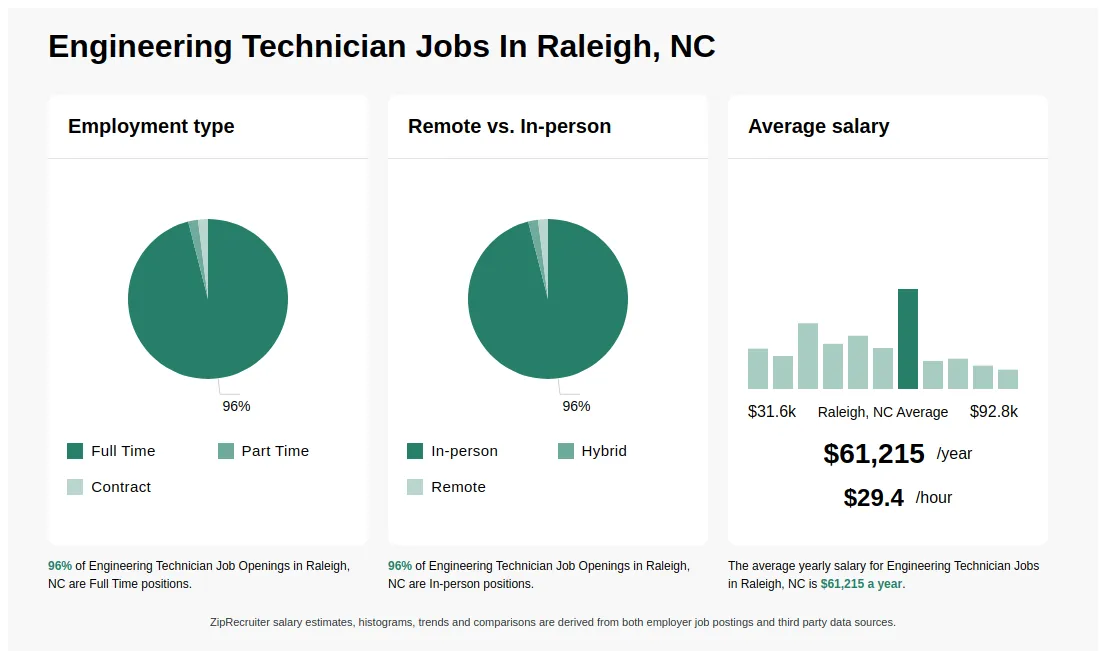
As of Jul 18, 2026, the average yearly pay for engineering technician in Raleigh, NC is $61,219.00, according to ZipRecruiter salary data. Most workers in this role earn between $45,700.00 and $70,000.00 per year, depending on experience, location, and employer.

What are the key skills and qualifications needed to thrive as an Engineering Technician, and why are they important?

To thrive as an Engineering Technician, you need a solid background in engineering principles, mathematics, and technical drafting, usually obtained through an associate degree or technical certification. Familiarity with CAD software, electronic testing equipment, and industry-specific tools is commonly required. Attention to detail, problem-solving abilities, and strong teamwork skills help you excel in this role. These capabilities ensure precise execution of engineering projects, efficient troubleshooting, and effective collaboration with engineers and other team members.

What is the difference between Engineering Technician vs Mechanical Technician?

AspectEngineering TechnicianMechanical Technician
Required CredentialsAssociate degree or technical diploma in engineering technologyAssociate degree or diploma in mechanical technology or related field
Work EnvironmentDesign labs, engineering firms, manufacturing plantsManufacturing facilities, maintenance departments, repair shops
Employer & Industry UsageEngineering firms, construction, aerospace, electronicsManufacturing, maintenance, industrial sectors
Common Search & Comparison IntentYesYes

Engineering Technicians and Mechanical Technicians often share similar educational backgrounds and work environments, but Engineering Technicians typically focus on supporting engineering design, testing, and development, while Mechanical Technicians concentrate on maintaining, repairing, and operating mechanical systems. Both roles are essential in manufacturing and engineering industries, with overlapping skills but different primary responsibilities.

Is EngTech worth it?

Engineering Technician (EngTech) is a recognized professional certification that can enhance job prospects and credibility in engineering fields. It often requires relevant technical skills, certifications, and experience, and can lead to higher earning potential and career advancement opportunities.

How much do engineering technicians earn?

Engineering technicians typically earn a median annual salary of around $55,000 to $65,000, depending on experience, location, and industry. Salaries can increase with specialized skills, certifications, and advanced technical knowledge, especially in fields like manufacturing, aerospace, or civil engineering.

What Does an Engineering Technician Do?

As an engineering technician, your job is to perform the labor requested by senior engineers. To do this, you may help with the construction of various devices, provide input on mechanical design, and ensure that the labs have the necessary supplies. Depending on the needs of the project, you may also develop how-to guides for getting the job done, perform quality control measures, and test your results to ensure everything meets the intended standards. Most engineering technicians specialize in a particular field, such as chemical, biomedical, or civil engineering. Expect to frequently use computer-aided design software, perform mathematical calculations, and write reports that summarize your collected data.

What can an engineering technician do?

An engineering technician assists engineers by preparing technical drawings, conducting tests, collecting data, and maintaining equipment. They often work in laboratories, manufacturing, or construction environments and may use tools like CAD software or measurement instruments. Certification or technical training is typically required for this role.

What are some common challenges Engineering Technicians face when supporting multiple projects simultaneously?

Engineering Technicians often juggle several projects at once, which can present challenges like managing shifting priorities, coordinating with various teams, and ensuring accuracy under tight deadlines. Effective communication and strong organizational skills are crucial to staying on top of multiple tasks and meeting project milestones. Many technicians find success by using project management tools and regularly checking in with engineers and supervisors to clarify expectations and address potential roadblocks early. This dynamic environment offers a chance to develop multitasking abilities and grow professionally.

What engineers make $200,000 a year?

Senior engineering roles such as petroleum engineers, aerospace engineers, and certain software engineers with extensive experience and specialized skills can earn $200,000 or more annually. These positions often require advanced certifications, a strong technical background, and work in high-demand industries or leadership positions.

What are engineering technicians?

Engineering technicians are professionals who assist engineers in designing, developing, testing, and maintaining a variety of products, equipment, and systems. They often work in fields such as civil, mechanical, electrical, or industrial engineering, performing technical tasks like running tests, collecting data, and troubleshooting equipment. Engineering technicians typically use specialized tools and software, and may work in laboratories, offices, or on job sites. Their work helps ensure that engineering projects are completed efficiently and meet quality standards.
What are the most commonly searched types of Engineering Technician jobs in Raleigh, NC? The most popular types of Engineering Technician jobs in Raleigh, NC are:
What job categories do people searching Engineering Technician jobs in Raleigh, NC look for? The top searched job categories for Engineering Technician jobs in Raleigh, NC are:
What cities near Raleigh, NC are hiring for Engineering Technician jobs? Cities near Raleigh, NC with the most Engineering Technician job openings:
Infographic showing various Engineering Technician job openings in Raleigh, NC as of July 2026, with employment types broken down into 83% Full Time, 4% Temporary, and 13% Contract. Highlights an 100% In-person job distribution, with an average salary of $61,219 per year, or $29.4 per hour.
Engineering Technician CMT

Other

Re-posted 10 days ago


Job description

Description

Geo-Hydro Engineers provides site development engineering and environmental consulting services for major developers. Our employees enjoy competitive pay, excellent benefits, growth opportunities, gain valuable hands-on experience and certifications, participate in innovative solutions and robust training and have the opportunity to make Geo-Hydro a part of their long-term career!


We are seeking motivated and dependable Engineering Technicians to join our team, providing essential support for civil engineering consulting and testing services. This hands-on role involves field and laboratory testing of construction materials-including soil, concrete, and masonry-in accordance with ASTM standards. Technicians are responsible for observing construction activities for compliance with project specifications and documenting field results accurately and clearly. The position requires physical stamina, attention to safety protocols, reliable transportation, and the ability to obtain industry certifications such as ACI, ICC, and OSHA. Successful candidates will demonstrate a commitment to quality, safety, and professionalism while working in dynamic construction environments.

Requirements

Education: Engineering technicians must have a high school diploma or the GED high school equivalency credential.

  • Certification: Engineering technicians will obtain and maintain relevant ACI, ICC, and OSHA certifications, as well as other certifications as deemed appropriate by their supervisor.


Pre-employment Requirements:

  • Drug Testing: All job applicants will undergo testing for the presence of illegal drugs as a condition of employment. All employees will follow Geo-Hydro Engineers' Drug Free Workplace Substance Abuse Policy.
  • Driving Record: Engineering technicians will have a valid driver's license with no violations that prevent them from being insured through the company's insurance carrier. The ability to be insured is at the discretion of the company's insurance carrier. The insurance carrier routinely reviews employee's driving records and may determine at any time than any employee will no longer be permitted to operate any company vehicle.


Job Responsibilities and Requirements:

  • Observation: Engineering technicians must be able to observe construction work for compliance with applicable project drawings and specifications, and for general accordance with International Building Code requirements.
  • Testing: Engineering technicians must be able to perform field and laboratory testing of soil, stone, concrete, grout, masonry, and other construction materials in accordance with ASTM standards. Applicable ASTM standards include but are not limited to the following: D-698, D-1557, D-1556, D-2937, D-2216, D-6938, C-31, C-143, C-173, C-231, and ASTM STP 399.
  • Documentation: Engineering technicians document field observations and test results by writing legibly in English with proper grammar. Basic mathematics (addition, subtraction, multiplication, and division) is an integral part of all testing and reporting.
  • Safety: Engineering Technicians must wear appropriate personal protection equipment (PPE), attend safety training sessions, and follow the requirements within the Geo-Hydro Safety and Health Manual.


Physical Requirements Lifting:

  • Must be able to lift, load and unload soil, sand, asphalt, CMU, and concrete samples weighing up to 100 pounds.
  • Concrete Sampling and Testing: Must be able to maneuver a 6-cubic foot wheelbarrow loaded with 150-200 pounds of fresh concrete for up to 50 yards over uneven ground.
  • Unit weight testing requires lifting a 50-pound container of concrete. Six-inch compressive strength test cylinders weigh 30 pounds each.
  • Volumetric air content testing requires repeated swinging of the 30-pound concrete-filled test device from knee-level to head-level.
  • Soil Density Testing: The technician must be able to repeatedly drop a 25-pound drop slide hammer to drive sampling tubes into the ground and then manually excavate the sampling tubes back out of the ground with mattock and shovel.
  • Must be able to load and unload a 90-pound case containing a nuclear density gauge and carry the 50-pound nuclear density gauge by hand for up to 50 yards over uneven ground.
  • Hand Auger and Penetrometer: Must be able to manually hand auger down to 10 feet into soil to obtain samples and perform portable dynamic cone penetrometer testing. The hand auger may require up to 50 pounds of pull to remove it from wet soil conditions. The total weight of the dynamic cone penetrometer ranges from 20 to 40 pounds. Operation of the penetrometer requires repeated raising and dropping of the 15 pound slide weight.