1

Electronic & Telecommunication Engineering Jobs (NOW HIRING)

next page

Showing results 1-20

Electronic Telecommunication Engineering information

See salary details

$29.5K

$60.8K

$95.5K

How much do electronic & telecommunication engineering jobs pay per year?

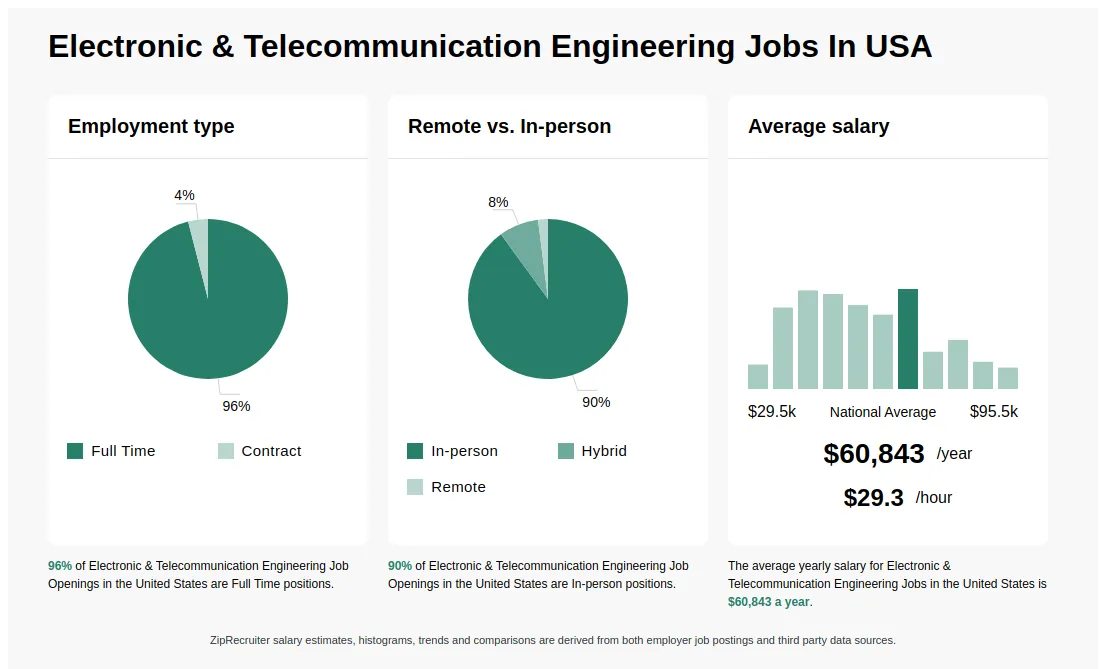
As of Jun 8, 2026, the average yearly pay for electronic & telecommunication engineering in the United States is $60,843.00, according to ZipRecruiter salary data. Most workers in this role earn between $46,000.00 and $70,000.00 per year, depending on experience, location, and employer.

What are the key skills and qualifications needed to thrive as an Electronic & Telecommunication Engineer, and why are they important?

To thrive as an Electronic & Telecommunication Engineer, you need a solid understanding of electronics, signal processing, and communication networks, typically supported by a bachelor's degree in electrical, electronics, or telecommunication engineering. Familiarity with design and simulation tools such as MATLAB, CAD software, and network analyzers, as well as relevant certifications like CCNA or IEEE credentials, is often required. Strong problem-solving skills, attention to detail, and effective teamwork and communication abilities set standout professionals apart. These skills and qualifications are crucial to designing, implementing, and maintaining complex communication systems in a rapidly evolving technological landscape.

What is Electronic & Telecommunication Engineering?

Electronic & Telecommunication Engineering is a branch of engineering that focuses on the design, development, and maintenance of electronic devices, systems, and communication networks. Professionals in this field work on technologies such as mobile phones, satellites, radar, fiber optics, and wireless communication. The discipline blends electronic engineering principles with communication technologies to enable the transfer and processing of information over distances. Graduates can pursue careers in telecommunications companies, electronics manufacturing, broadcasting, and IT industries.

What are some common challenges faced by Electronic & Telecommunication Engineers when working on multidisciplinary teams?

Electronic & Telecommunication Engineers often collaborate with professionals from software, mechanical, and civil engineering backgrounds on large projects. One common challenge is ensuring clear communication across disciplines, as each field may use different technical jargon and methodologies. Balancing project requirements, such as integrating hardware with software or managing signal interference in complex environments, also requires adaptability and strong problem-solving skills. Proactively engaging in regular team meetings and fostering open communication can help address these challenges and ensure project success.

What is the difference between Electronic & Telecommunication Engineering vs Electrical Engineering?

AspectElectronic & Telecommunication EngineeringElectrical Engineering
CredentialsBachelor's or Master's in Electronic & Telecommunication EngineeringBachelor's or Master's in Electrical Engineering
Work EnvironmentTelecom companies, electronics manufacturing, network providersPower plants, manufacturing, electrical systems design
Industry UsageTelecommunications, electronics, signal processingPower systems, electrical machinery, control systems

Electronic & Telecommunication Engineering focuses on communication systems, signal processing, and electronics, while Electrical Engineering covers power systems, electrical machinery, and broader electrical infrastructure. Both fields share foundational knowledge but serve different industry needs and applications.


More about Electronic Telecommunication Engineering jobs
What states have the most Electronic & Telecommunication Engineering jobs? States with the most job openings for Electronic & Telecommunication Engineering jobs include:
What job categories do people searching Electronic & Telecommunication Engineering jobs look for? The top searched job categories for Electronic & Telecommunication Engineering jobs are:
Infographic showing various Electronic & Telecommunication Engineering job openings in the United States as of May 2026, with employment types broken down into 4% Locum Tenens, 9% As Needed, 10% Full Time, 50% Part Time, and 27% Contract. Highlights an 93% Physical, 3% Hybrid, and 4% Remote job distribution, with an average salary of $60,843 per year, or $29.3 per hour.
Telecommunications Engineer 2 - Atlanta, GA

Telecommunications Engineer 2 - Atlanta, GA

M.C. Dean, Inc

Atlanta, GA • On-site

Full-time

Posted 24 days ago


M.C. Dean rating

7.5

Company rating: 7.5 out of 10

Based on 42 frontline employees who took The Breakroom Quiz

221st of 352 rated engineering


Job description

Overview
About M.C. Dean
M.C. Dean is Building Intelligence. We design, build, operate, and maintain cyber-physical solutions for the nation's most mission-critical facilities, secure environments, complex infrastructure, and global enterprises. With over 7,000 employees, our capabilities span electrical, electronic security, telecommunications, life safety, automation and controls, audiovisual, and IT systems. Headquarters in Tysons, Virginia, M.C. Dean delivers resilient, secure, and innovative power and technology solutions through engineering expertise and smart systems integration.
Why Join Us?
Our people are passionate about engineering innovation that improves lives and drives impactful change. Guided by our core values-agility, expertise, and trust-we foster a collaborative and forward-thinking work environment. At M.C. Dean, we are committed to building the next generation of technical leaders in electrical, engineering, and cybersecurity industries.
The Mission Critical Telecommunications Engineer 2 position involves the design, coordination, and implementation of telecommunication structured cabling systems for high density Artificial Intelligence (AI) driven data centers.
The engineer shall be responsible for researching, understanding, developing, and coordinating the engineering solution of the telecommunication cabling, equipment, pathways, spaces, and grounding and bonding for inside and outside plant infrastructure. They will interface with the customers, project leadership, field leadership, other trades, manufacturers, and other telecommunications engineers.
The engineer shall be responsible for producing constructible engineering deliverables that illustrate telecommunications device locations on floor/ceiling plans, telecommunications space layout on enlarged plans and elevations, mounting and assembly instructions on detail drawings, point to point cable connections on riser diagrams, telecommunications administration plans, acceptance test plans, acceptance test reports, quality control plans, studies and calculations, list of materials, cabling schedules, operations manuals, and warranties to support the design, installation, and closeout of their projects.
The engineer will oversee the technical requirements of the project throughout the entire project lifecycle, assisting with solution development, troubleshooting construction discrepancies, contribute to the overall schedule and budget planning.
Responsibilities
  • Developing, Identifying, Coordinating, and Tracking project requirements
  • Coordinating communication connectivity requirements to include backbone and interrack cabling, work area outlet types, cabling media and connector types, system topology, and device locations with the Data and Wireless Networking, Audio Visual, Security, Mechanical, Electrical, and other stakeholders.
  • Coordinating detailed telecommunications space plans with consideration for Architecture, MEP, and Electronic Systems.
  • Coordinating detailed telecommunications pathway designs to support inside and outside plant cabling infrastructure to include fill calculations, BIM, etc.
  • Identifying, writing and responding to Requests for Information (RFI)
  • Producing coordinated detailed design and construction drawings in AutoCAD or REVIT based on project requirements and specifications.
  • Producing coordinated detailed telecommunications construction specifications based on project criteria.
  • Creating and managing cable run lists/system labeling
  • Creating and managing cable acceptance test plans based on specification requirements.
  • Identifying products, creating Bill of Materials, and developing
  • Product Data deliverables that meet the project and system requirements
  • Understanding and implementing the M.C. Dean Quality Control process to ensure all engineering deliverables comply with the project requirements, provide clear and constructible information, and meet M.C. Dean's engineering standards.
  • Perform site surveys, produce reports, identify/propose/develop solutions based on observations made on the site.
  • Produce Pre-fabrication designs and test procedures for Pre-Installation and Check Out (PITCO) activities.
  • Learn the operation of and lead in the design of active systems to include nurse call systems, public address systems, distributed antenna systems, and emergency phones.
  • Develop an in-depth knowledge of and utilize relevant sections of NFPA codes, TIA Standards, BICSI publications, or other relevant criteria.

Qualifications
  • Minimum 2+ year's experience in the telecommunications structured cabling industry to include inside and outside plant pathways, cabling, components, testing, and design and a Bachelor's Degree in an applicable Engineering field.
  • Detailed, motivated, self-starter; must be able to work independently and in a team environment.
  • Must be willing to expand knowledge base to new systems and technologies as project demand dictates.
  • Must poses and demonstrate basic understanding of TIA standards and NFPA Codes.
  • Must be able to successfully pass an extensive background check.
  • Up to 10% of travel may be required.

Desired Training:
  • CompTIA Network+ Engineer-in-Training (EIT/FE) or Professional Engineer (PE) Leadership in Energy & Environmental Design (LEED)
  • Certified Associate in Project Management (CAPM)
  • Design Build Institute of America (DBIA)
  • BICSI RCDD Other Experience working with Computer Aided Drafting (CAD) or Building Information Management (BIM) systems such as REVIT.
  • Working knowledge of active communication systems such as Public Address, Nurse Call, Distributed Antenna Systems, WLAN, Emergency Phones.
  • Manufacturer certifications a plus.
  • Prior field installation and testing experience a plus.

Abilities:
  • Exposure to computer screens for an extended period of time.
  • Sitting for extended periods of time.
  • Reach by extending hands or arms in any direction.
  • Have finger dexterity in order to manipulate objects with fingers rather than whole hands or arms, for example, using a keyboard.
  • Listen to and understand information and ideas presented through spoken words and sentences.
  • Communicate information and ideas in speaking so others will understand.
  • Read and understand information and ideas presented in writing.
  • Apply general rules to specific problems to produce answers that make sense.
  • Identify and understand the speech of another person.

What M.C. Dean employees say

Pay

Benefits

Hours and flexibility

Workplace

Get the full story on Breakroom


M.C. Dean logo

About M.C. Dean

Sourced by ZipRecruiter

M.C. Dean is Building Intelligence®. We design, build, operate, and maintain cyber-physical solutions for the nation's most recognizable mission-critical facilities, secure environments, complex infrastructure, and global enterprises. The company's capabilities include electrical, electronic security, telecommunications, life-safety, instrumentation and control, and command and control systems. M.C. Dean is headquartered in Tysons, Virginia, and employs more than 5,100 professionals who engineer and deploy automated, secure, and resilient power and technology systems; and deliver the management platforms essential for long-term system sustainability.

Industry

Engineering professional services

Company size

10,000+ Employees

Headquarters location

Tysons, VA, US

Year founded

1949

Social media