1

Electrochemistry Jobs (NOW HIRING)

Showing results 41-60

Electrochemistry information

See salary details

$31.5K

$95.2K

$136K

How much do electrochemistry jobs pay per year?

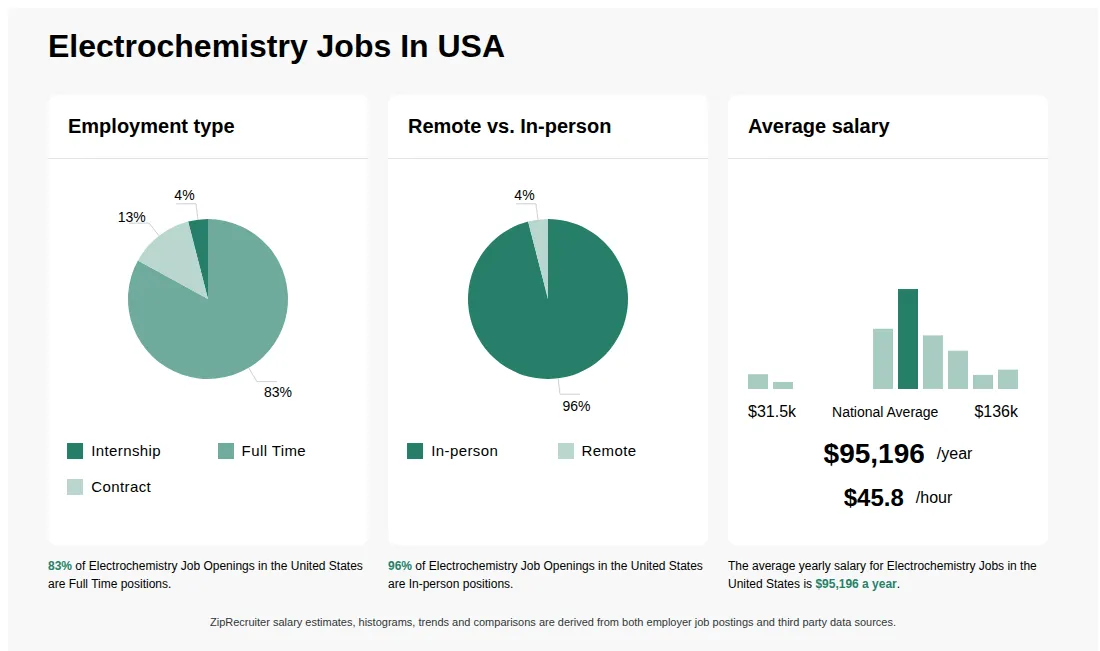
As of Aug 12, 2026, the average yearly pay for electrochemistry in the United States is $95,196.00, according to ZipRecruiter salary data. Most workers in this role earn between $87,500.00 and $106,500.00 per year, depending on experience, location, and employer.

What careers use electrochemistry?

Electrochemistry is used in careers such as battery development, fuel cell engineering, corrosion analysis, and electrochemical sensor design. Professionals in these fields often work in laboratories, manufacturing, or research settings, utilizing skills in chemistry, materials science, and instrumentation.

What is an electrochemist?

Electrochemists are scientists who study the chemical processes that involve the movement of electrons, particularly the interactions between electricity and chemical reactions. They work on topics such as batteries, fuel cells, corrosion, and electroplating. Electrochemists may conduct research, develop new materials or devices, and apply their findings in industries like energy storage, environmental monitoring, and electronics. Their work is crucial for advancing technologies such as rechargeable batteries and sustainable energy solutions.

Is electrochemistry a good field?

Electrochemistry is a specialized field within chemistry that involves studying chemical processes involving electric currents, often requiring skills in laboratory techniques and understanding of electrical systems. It offers career opportunities in research, energy storage, and materials development, with roles in academia, industry, and government agencies. The field can be rewarding for those interested in scientific innovation and problem-solving.

What are the key skills and qualifications needed to thrive as an electrochemist, and why are they important?

To thrive as an Electrochemist, you need a solid background in chemistry, physics, and mathematics, often supported by a degree in chemistry or chemical engineering and relevant laboratory experience. Familiarity with analytical instruments such as potentiostats, electrochemical impedance spectroscopy, and software for data analysis is typically required. Critical thinking, attention to detail, and strong problem-solving abilities are essential soft skills for interpreting experimental results and troubleshooting complex issues. These skills ensure accurate research outcomes, innovation in electrochemical applications, and the advancement of technologies in areas like energy storage and corrosion prevention.

What are the typical challenges faced by professionals working in electrochemistry, and how can they be addressed?

Professionals in electrochemistry often encounter challenges such as managing complex instrumentation, maintaining precise control over experimental conditions, and interpreting nuanced electrochemical data. Collaboration with multidisciplinary teams, including chemists, engineers, and material scientists, is essential to troubleshoot technical issues and develop innovative solutions. Staying updated with the latest advancements in analytical techniques and regularly attending workshops or conferences can also help address these challenges and foster career growth.

What is electrochemistry?

Electrochemistry is the scientific study of chemical processes that move electrons, and particularly how and when that movement creates electricity. Most electrochemistry focuses on understanding and improving chemically-caused electrical reactions. For example, electrochemists may study the impact of energy storage in different chemicals or look for ways to generate more electricity from the same substance. Electrochemistry also evaluates corrosion caused by the movement of electricity. Electrochemistry is a branch of physical chemistry, which deals with the larger question of how the laws of physics apply to atoms and chemical reactions. It should not be confused with the similarly-named chemical physics, which focuses more on physics than on chemistry.


Is electrochemistry in demand?

Electrochemistry is a specialized field within chemistry with steady demand in industries such as energy storage, batteries, corrosion prevention, and sensor development. Professionals with expertise in electrochemical analysis, materials, and instrumentation are sought after in research, manufacturing, and environmental sectors.

What is the difference between Electrochemistry vs Chemical Engineer?

AspectElectrochemistryChemical Engineer
Required CredentialsBachelor's in Chemistry, Chemical Engineering, or related; certifications in electrochemical analysisBachelor's or higher in Chemical Engineering; professional engineering license often preferred
Work EnvironmentLaboratories, research facilities, industrial plants involving electrochemical processesFactories, chemical plants, design offices, research labs
Industry UsageElectrochemical research, battery development, corrosion studiesProcess design, plant operation, product development across various industries

Electrochemistry focuses specifically on electrochemical processes and research, often within labs or specialized industries. Chemical engineers have a broader scope, working on chemical process design and manufacturing. While both roles require chemistry knowledge, electrochemistry is more specialized in electrochemical systems, whereas chemical engineering covers a wider range of chemical processes.

What cities are hiring for Electrochemistry jobs? Cities with the most Electrochemistry job openings:
What are the most commonly searched types of Electrochemistry jobs? The most popular types of Electrochemistry jobs are:
What states have the most Electrochemistry jobs? States with the most job openings for Electrochemistry jobs include:
Infographic showing various Electrochemistry job openings in the United States as of August 2026, with employment types broken down into 1% Internship, 19% Full Time, 79% Part Time, and 1% Contract. Highlights an 20% Physical, 1% Hybrid, and 79% Remote job distribution, with an average salary of $95,196 per year, or $45.8 per hour.

Mechanical Design Engineer - Advanced Electrochemical Systems

Approach Venture LLC

Los Angeles, CA โ€ข On-site

$130K - $180K/yr

Full-time

Medical, Dental, Vision, Retirement, PTO

Posted 27 days ago


Job description

Mechanical Design Engineer - Develop Advanced Electrochemical Systems for Space
Los Angeles, CA | On-site
Opportunity Summary
Join a seed-stage space technology startup developing advanced spacecraft propulsion and energy systems that enable the next generation of in-space mobility. As a Mechanical Design Engineer, you will lead the design, development, and integration of advanced electrochemical hardware that serves as a critical component of the company's propulsion architecture. This is a highly hands-on engineering role with ownership from concept through flight-qualified hardware. You will apply mechanical design, fluid systems, thermal analysis, and electrochemical fundamentals to develop high-performance hardware while collaborating across propulsion, systems, manufacturing, and test engineering teams. The role combines analytical engineering with rapid hardware iteration in a fast-moving development environment.
About Us
We are an early-stage aerospace company building advanced spacecraft and propulsion technologies for commercial and government space missions. Our multidisciplinary engineering team is developing integrated propulsion, power, and fluid systems that enable more capable spacecraft while solving complex engineering challenges through rapid design, testing, and iteration. Engineers have broad ownership and play a direct role in shaping both the technology and the company's future.
Job Duties
  • Lead the mechanical design and development of advanced electrochemical hardware supporting spacecraft propulsion systems.
  • Design, analyze, prototype, and test electrochemical stacks and associated mechanical assemblies.
  • Develop innovative hardware architectures that improve performance, reliability, manufacturability, and system efficiency.
  • Perform mechanical, thermal, and fluid analyses to support component sizing, optimization, and validation.
  • Utilize analytical calculations and engineering simulation tools to evaluate sealing performance, structural integrity, and thermal behavior.
  • Investigate prototype and test failures through structured root cause analysis and implement design improvements.
  • Support the development of related propulsion, fluid, thermal management, and energy conversion subsystems.
  • Create engineering drawings, interface definitions, assembly documentation, test procedures, and manufacturing documentation.
  • Support laboratory testing of electrochemical, propulsion, and fluid systems.
  • Participate in system safety assessments, hazard analysis, and safe operation of high-pressure test systems.
  • Collaborate closely with multidisciplinary engineering teams throughout the product development lifecycle.

Qualifications
  • BS in Mechanical Engineering, Chemical Engineering, or a related engineering discipline.
  • 2+ years of experience designing, analyzing, building, or testing complex mechanical, electrochemical, thermal, or fluid systems.
  • Hands-on experience with electrochemical stacks, battery systems, fuel cells, heat exchangers, or comparable engineered hardware.
  • Strong understanding of fluid mechanics, thermodynamics, heat transfer, compressible flow, and mechanical design fundamentals.
  • Experience performing engineering analysis using hand calculations, CAD, FEA, CFD, Python, MATLAB, or similar engineering tools.
  • Strong mechanical design skills including GD&T, material selection, manufacturability, assembly, and testing.
  • Familiarity with high-pressure fluid systems and safe laboratory testing practices.
  • Ability to solve complex engineering problems using first-principles thinking.
  • Comfortable working in a fast-paced startup environment with significant technical ownership.

Preferred Experience
  • Experience developing electrochemical systems such as electrolyzers, fuel cells, batteries, or similar energy conversion hardware.
  • Background designing pressure vessels, sealed assemblies, or high-performance fluid systems.
  • Experience with hydrogen, oxygen, or other specialty fluid systems.
  • Knowledge of leak testing, cleanliness requirements, and hazardous fluid handling.
  • Experience supporting hardware through prototype development, qualification, and production.
  • Startup or early-stage aerospace product development experience.

Why Join Us
  • Competitive salary based on experience and qualifications.
  • Equity participation through stock options.
  • Medical, dental, and vision coverage.
  • 401(k) program.
  • Paid time off.
  • Opportunity to develop critical spacecraft hardware from concept through flight.
  • Significant technical ownership with direct collaboration alongside experienced aerospace engineers.
  • Career growth within a rapidly expanding seed-stage space company.

Compensation Details
$130,000 - $180,000