1

Electrical Lineman Jobs (NOW HIRING)

Completion of Lineman Career Development Program Level II preferred. Thorough knowledge of the practices, methods, equipment, materials, and tools used in the erection and maintenance of electrical ...

Interpret electrical schematics, GIS maps, and construction drawings. * Ensure compliance with ... Mentor and train Apprentice and B-level Linemen. * Complete daily work reports, material usage logs ...

Powerline Lineman

Odessa, TX ยท On-site

$30 - $55/hr

Description The Powerline Lineman is responsible for constructing, repairing, and maintaining overhead and underground Electrical Distribution Systems (EDS). The Lineman regularly works on poles and ...

Lineman

Pecos, TX ยท On-site

Company Description Blackfield Industries is a leading provider of instrumentation and electrical ... The Lineman will perform day-to-day tasks such as constructing, installing, maintaining, and ...

Use volt-amp meters, ground meggers, continuity testers and other electrical test equipment ... Lineman C Education requirements are listed below: * High School Diploma or equivalent Work ...

Lineman I

Clute, TX ยท On-site

As a Lineman I, you will be responsible for the installation, maintenance, and repair of electrical power lines and equipment. You will work outdoors in all weather conditions, often at great heights ...

Showing results 41-60

Electrical Lineman information

See salary details

$34

$57

$59

How much do electrical lineman jobs pay per hour?

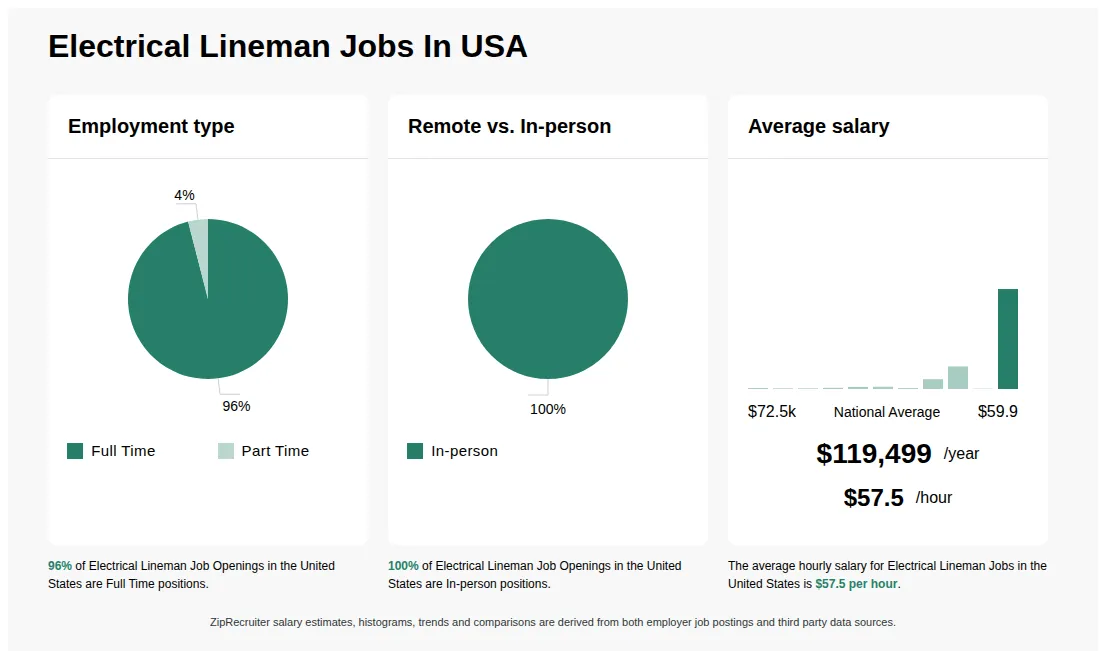
As of Sep 5, 2026, the average hourly pay for electrical lineman in the United States is $57.45, according to ZipRecruiter salary data. Most workers in this role earn between $59.62 and $59.62 per hour, depending on experience, location, and employer.

What is an electrical lineman?

An electrical lineman, or electrical line worker, installs and maintains power lines. Their duties include putting up or maintaining new power lines, as well as repairing broken lines or transformers. Linemen make sure electrical lines are functioning and make repairs quickly and accurately to restore electrical service to customers. Line workers work at multiple outdoor sites and at tall heights.

What are the key skills and qualifications needed to thrive as an electrical lineman?

To thrive as an Electrical Lineman, you need a solid understanding of electrical systems, physical stamina, and a high school diploma or equivalent, often supplemented by an apprenticeship or technical training. Familiarity with climbing gear, bucket trucks, electrical testing equipment, and safety certifications such as OSHA are typically required. Strong problem-solving skills, attention to detail, and effective teamwork are critical soft skills for this role. These competencies ensure the safe and efficient installation, maintenance, and repair of power lines, minimizing risks and service interruptions.

What are some common challenges faced by electrical linemen in the field, and how are they managed?

Electrical linemen often work in challenging environments, including adverse weather conditions and at significant heights, which requires strict adherence to safety protocols. Managing fatigue during long shifts, especially during emergency repairs or outages, is another common challenge. Team coordination and communication are crucial, as linemen regularly collaborate with crew members and other utility professionals to ensure the efficient restoration and maintenance of electrical systems. Regular training and the use of specialized equipment help mitigate these challenges and maintain a safe work environment.

What is the difference between Electrical Lineman vs Power Line Technician?

AspectElectrical LinemanPower Line Technician
CredentialsHigh school diploma, lineman training, CDL often requiredHigh school diploma, lineman training, CDL often required
Work EnvironmentOutdoor, on utility poles and power linesOutdoor, on utility poles and power lines
Industry UsageElectric utilities, constructionElectric utilities, construction
Job FocusInstalling, maintaining, repairing power linesInstalling, maintaining, repairing power lines

Electrical Linemen and Power Line Technicians perform similar roles, focusing on installing and repairing power lines in outdoor environments. Both require comparable certifications and work in utility industries. The terms are often used interchangeably, but 'Electrical Lineman' is the more common title in the industry.

Is electrical lineman a good career?

Electrical linemen install, maintain, and repair power lines and electrical systems, often working outdoors in various weather conditions. The job typically requires physical strength, technical skills, and safety certifications, and it offers competitive wages and opportunities for advancement. However, it can be physically demanding and involves working at heights and with high-voltage equipment.

Is electrical lineman hard to get into?

Becoming an electrical lineman typically requires completing an apprenticeship program, which involves technical training, physical fitness, and safety certifications. Entry can be competitive due to the specialized skills and experience needed, but with proper training and qualifications, it is achievable.

What cities are hiring for Electrical Lineman jobs?

Cities with the most Electrical Lineman job openings:

What are the most commonly searched types of Electrical Lineman jobs?

The most popular types of Electrical Lineman jobs are:

Who are the top companies hiring for Electrical Lineman jobs?

The top employers for Electrical Lineman jobs are:

What states have the most Electrical Lineman jobs?

States with the most job openings for Electrical Lineman jobs include:

What are popular job titles related to Electrical Lineman jobs?

For Electrical Lineman jobs, the most frequently searched job titles are:

Infographic showing various Electrical Lineman job openings in the United States as of August 2026, with employment types broken down into 92% Full Time, 5% Part Time, 2% Contract, and 1% Nights. Highlights an 96% Physical, 1% Hybrid, and 3% Remote job distribution, with an average salary of $119,499 per year, or $57.5 per hour.

Electric Distribution Tech III

City of Shelby, NC

Shelby, NC โ€ข On-site

$29.89/hr

Full-time

Medical, Dental, Vision, Life, Retirement

Re-posted 28 days ago


Job description

Salary: $29.89 Hourly
Location : Shelby, NC
Job Type: Full-Time
Department: Energy Services
Division: Electric
Opening Date: 02/04/2026
FLSA: Non-Exempt
General Description
Performs difficult skilled trades work overseeing and participating in the construction, maintenance, and operation of an electric distribution system, installing, maintaining, and repairing overhead and underground power lines and related facilities, operating equipment, and related work as apparent or assigned. Work is performed under moderate supervision of the Electric Service Supervisor. Limited supervision is exercised over assigned crew members.
Essential Functions
  • Performs the duties of Electric Distribution Technician II.
  • Climbs poles, operates bucket and line trucks, and various pieces of equipment as required.
  • Frames poles, installs hardware, fuses, transformers, and pulls wires.
  • Ties in conductors and changes insulators; performs electrical hot line work as required.
  • Operates hotline equipment and tools; uses standard hand and power tools.
  • Takes clearances and occasionally performs switching at unattended substations and line sectionalizing disconnect switches.
  • Installs single phase and multi-phase underground and overhead services.
  • Maintains and assists in repairs of various substation equipment as required.
  • Installs and removes cross arms, cutouts, lighting arresters, primary and secondary lines, span guys, breaker bars, etc.
  • Carries out requisite ground work in preparation for and at the conclusion of a job.
  • Maintains and repairs street and rental lights as required.
  • Maintains necessary paperwork and transformer card data as needed.
  • Initiates and disconnects services at the pole; checks voltage and rotation.
  • Installs voltage and current transformers; wires transformer rated meters.
  • Diagnoses problems in the field, responds with sound judgment to unusual and hazardous circumstances and determines action and restores service.
  • Maintains and installs underground services; operates all underground equipment.
  • Verifies the condition of all vehicles, equipment, and tools provided for use in the performance of work.
  • Participates in job briefings; conducts and attends safety meetings.
  • May be required to work outside of normal working hours in stand-by, on-call, or emergency situations.

Typical Qualifications
High school diploma or GED and considerable experience in electric line construction and maintenance, or equivalent combination of education and experience. Possession of CPR and First Aid certifications upon hire. Completion of Advanced Lineman, Underground, and Meter courses, Competent Person, and Confined Space training upon hire. Complete Advanced Underground School, Advanced Lineman School, and Advance Meter School within 24 months of hire. Successfully complete Pole Top Rescue and Bucket Rescue upon hire and each year thereafter. Completion of the following Electricities schools: Intermediate Lineman School, Trouble Shooting School, and Transformer School. Valid commercial driver's license in the State of North Carolina. Completion of Lineman Career Development Program Level II preferred.
Thorough knowledge of the practices, methods, equipment, materials, and tools used in the erection and maintenance of electrical lines; thorough knowledge of the standard practices applicable in making electric service connections; thorough knowledge of the location of the distribution system and of the areas serviced; thorough knowledge of the design and principles of various types of relays and other instruments used in electric substations; thorough knowledge of the occupational hazards and the safety precautions of the work; thorough knowledge of the basic operation of computers and computer programs; thorough knowledge of basic math skills and mathematical calculations; thorough knowledge of the practices, methods, tools, and equipment used in the maintenance, repair, and testing of instruments and controls; skill in the use and care of tools and equipment to which assigned; ability to understand and carry out complex oral and written instructions; ability to read and understand schematic diagrams; ability to make proper service connections with speed and accuracy; ability to train and supervise staff; ability to establish and maintain effective working relationships with associates and the general public.
Physical Demands
To perform this job successfully, an individual must be able to perform each essential function satisfactorily. The requirements listed below are representative of the knowledge, skill, and/or ability required. Reasonable accommodations may be made to enable an individual with disabilities to perform the essential functions.
This work requires the regular exertion of up to 25 pounds of force, frequent exertion of up to 50 pounds of force and occasion exertion of up to 100 pounds of force; work regularly requires standing, walking, speaking or hearing, using hands to finger, handle or feel, climbing or balancing, reaching with hands and arms, pushing or pulling, lifting and repetitive motions, frequently requires stooping, kneeling, crouching or crawling and occasionally requires sitting and tasting or smelling; work requires close vision, distance vision, ability to adjust focus, depth perception, color perception, night vision and peripheral vision; vocal communication is required for expressing or exchanging ideas by means of the spoken word and conveying detailed or important instructions to others accurately, loudly or quickly; hearing is required to perceive information at normal spoken word levels and to receive detailed information through oral communications and/or to make fine distinctions in sound; work requires preparing and analyzing written or computer data, visual inspection involving small defects and/or small parts, using of measuring devices, assembly or fabrication of parts within arm's length, operating machines, operating motor vehicles or equipment and observing general surroundings and activities; work regularly requires working near moving mechanical parts, working in high, precarious places, exposure to outdoor weather conditions, exposure to the risk of electrical shock and exposure to vibration and frequently requires exposure to wet, humid conditions (non-weather), exposure to fumes or airborne particles, exposure to toxic or caustic chemicals, exposure to extreme heat (non-weather), working with explosives and exposure to blood borne pathogens and may be required to wear specialized personal protective equipment; work is generally in a loud noise location (e.g. grounds maintenance, heavy traffic).
This full-time position qualifies for benefits, which include; Health, Dental, Vision, Disability, Life Insurance, 401k and NC Retirement. Please visit the link below for details.